
KINGSTON, Jamaica — For fast-rising Jamaican entertainer Arribazon, who has built a massive global fanbase through his viral “Musical A.I” persona on TikTok, creativity has long been intertwined with life experience. Now, he is turning one of the darkest chapters of his personal journey into a force for collective encouragement with his deeply moving new inspirational single, *I’ll Rise Up*.
标签: Jamaica
牙买加
-
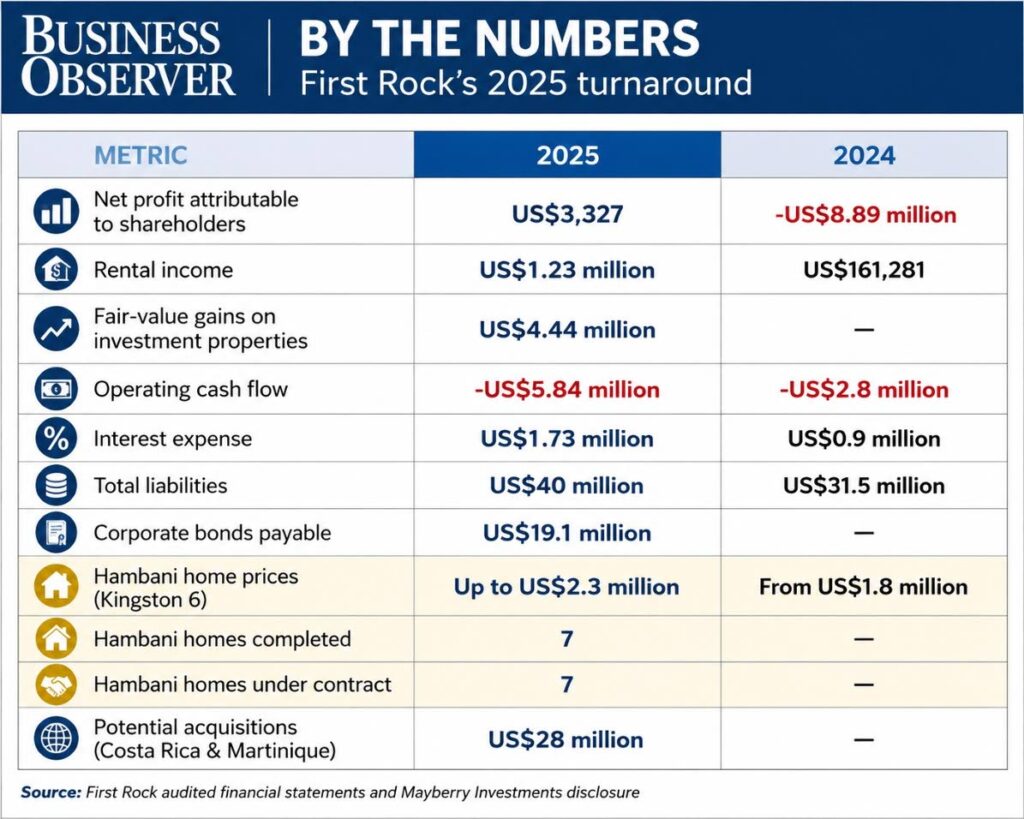
First Rock returns to profit but cash strain persists
Jamaica-based property developer First Rock Real Estate Investments has pulled off a notable return to profitability in 2025, driven by skyrocketing rental revenue and upward property value revaluations, but the firm still faces significant headwinds including negative operating cash flow, ongoing debt restructuring and heavy reliance on luxury residential sales to maintain adequate liquidity.
According to newly released financial results, the company logged a net profit of US$3,327 attributable to shareholders for the 2025 calendar year. This result marks a sharp reversal from the US$8.89 million net loss the firm posted in the prior year. The profit turnaround was fueled by two key factors: a 663% year-over-year surge in rental income, which reached US$1.23 million, and a US$4.44 million gain from upward revaluation of the company’s investment property portfolio. Without the non-cash revaluation boost, however, First Rock would still face material earnings pressure, company filings show.
The dramatic jump in recurring rental revenue aligns with First Rock’s publicly stated strategic pivot toward stabilizing commercial and income-producing real estate assets, a move designed to cut the firm’s historical reliance on one-off development project sales. Even with this top-line improvement, audited financial statements reveal ongoing strain on the company’s cash position. Operating cash flow registered a negative US$5.84 million for the year, while annual interest expenses nearly doubled to hit US$1.73 million amid a broader high interest rate environment that has pushed up financing costs across the global and local real estate sectors. First Rock remains in active negotiations with creditors to refinance maturing short-term debt and secure additional working capital to fund its ongoing operations.
At the center of the firm’s near-term cash generation strategy is the near-completed Hambani luxury residential development located in Kingston 6. In a disclosure dated April 30, transaction advisor Mayberry Investments confirmed that seven luxury villas at the development have received practical completion certificates, and all seven are already under contract to buyers. Completed units are priced between US$1.8 million and US$2.3 million, and Mayberry noted that proceeds from sales to date are enough to cover all remaining development costs and leave a surplus of cash to support other corporate obligations.
First Rock Chief Executive Officer Ryan Reid explained that the company’s current capital structure was intentionally structured to tie debt repayment timelines to development completion and unit sales. “Unit sales are indeed a key part of our repayment strategy, and that’s really by design, which reflects the direct alignment between our development pipeline and our capital structure,” Reid told the Jamaica Observer in written comments.
A review of the company’s balance sheet shows 15% year-over-year expansion in total assets, which grew to US$65.8 million at the end of 2025. Total liabilities also climbed, rising from US$31.5 million in the prior year to US$40 million in 2025. Outstanding corporate bonds jumped sharply to US$19.1 million, while combined current and non-current long-term loans remained elevated at roughly US$16 million. Audit notes reveal that some of First Rock’s newest financing arrangements carry interest rates as high as 18%, underscoring the steep cost of capital facing heavily leveraged property developers operating in Jamaica’s current high interest rate landscape.
Reid emphasized that growing recurring rental revenue will be the core driver of improved operating cash flow going forward. “The revaluation gains reflect genuine value creation in our portfolio, but we absolutely understand that cash generation is important, hence the massive movement in our rental income year on year,” Reid told Business Observer. “We expect operating cash flow to further improve meaningfully.”
Even as the company works through ongoing debt refinancing discussions, First Rock is advancing plans for two regional acquisitions in Costa Rica and Martinique, with a combined transaction value of US$28 million. Reid stressed that the planned purchases are not aggressive expansion into speculative development, but rather a targeted move to accelerate growth in recurring cash flow. “The acquisitions we’re pursuing are not about expansion for its own sake, they are highly selective opportunities that we believe will generate returns faster than greenfield developments would. These are fully tenanted rental income opportunities,” Reid said. “In each case, the entry price, existing entitlements, and near-term development potential mean these assets contribute to cash generation rather than stretching it further.”
Auditors from Ernst & Young, the firm that signed off on First Rock’s 2025 financial statements, identified investment property valuation as a key audit matter. They noted that investment properties and properties held for sale collectively account for roughly 50% of the company’s total assets as of year end. After years of debt-fueled expansion, First Rock now faces growing pressure to prove that its evolving rental-focused business model can generate sustained, stable cash flow, reducing the firm’s current heavy reliance on non-cash property revaluations and irregular development sales to deliver positive bottom-line results.
-

GraceKennedy Foundation’s 36th annual lecture to highlight progress in restoring Kingston Harbour
KINGSTON, Jamaica — Ahead of World Environment Day 2026, the GraceKennedy Foundation has unveiled plans for its 36th Annual Public Lecture, an event centered on celebrating and unpacking the landmark progress of the Kingston Harbour Cleanup Project (KHCP), Jamaica’s pioneering large-scale effort to reverse solid waste pollution in one of the Caribbean’s most ecologically and economically vital coastal ecosystems.
Scheduled for Friday, June 5, 2026, the lecture — branded *Kingston Harbour Cleanup Project: From Vision to Reality* — will dive into how cross-sector strategic alliances, cutting-edge waste interception technology, and evidence-based scientific guidance have turned a long-held conservation ambition into tangible, impactful action. Kingston Harbour stands as a foundational natural and economic asset for the entire Caribbean region, supporting commercial shipping, local fishing livelihoods, and marine biodiversity that sustains coastal communities across the island.
The KHCP is led by the GraceKennedy Foundation in partnership with local environmental group Clean Harbours Jamaica, with core funding provided by The Ocean Cleanup, the globally recognized non-profit specializing in large-scale interception of plastic waste in rivers and oceans. In its first five years of operation, the initiative has already delivered extraordinary results, blocking almost 13 million pounds of plastic and other solid waste from entering the harbour’s waters.
Caroline Mahfood, CEO of the GraceKennedy Foundation, emphasized that the project offers a replicable blueprint for global conservation action. “This initiative proves what is possible when science, private sector leadership, and local community commitment align behind a shared environmental goal,” Mahfood explained. “Our collaboration with The Ocean Cleanup and Clean Harbours Jamaica has demonstrated that measurable, meaningful progress to reverse environmental damage is well within reach. Through this annual lecture, we aim to share not just what the project has delivered for Kingston Harbour, but also a broader, hopeful message: restoring degraded natural resources is absolutely achievable through sustained collaboration and intentional long-term commitment.”
The GraceKennedy Foundation’s annual public lecture series, launched in 1989, has grown into one of the Caribbean’s most respected public platforms for examining pressing regional challenges, from climate change to environmental degradation. The 2026 event marks a full-circle moment for the foundation’s work on Kingston Harbour: it revisits a conversation first opened by the organization’s 2019 lecture, *Clean Kingston Harbour: Pipe Dream or Pot of Gold?*, which was instrumental in raising national awareness of the harbour’s unfolding pollution crisis and building public support for large-scale cleanup action.
The 2026 lecture will be presented by a trio of key stakeholders: GraceKennedy Foundation CEO Caroline Mahfood; Michael McCarthy, Managing Director of Clean Harbours Jamaica Limited; and Professor Mona Webber, holder of the GKF James S. Moss-Solomon Senior Chair in Environment at The University of the West Indies, Mona. A special pre-recorded video message will also be shared by Boyan Slat, founder and CEO of The Ocean Cleanup, offering a global perspective on the project’s significance for international ocean conservation efforts.
Leading the discussion as moderator will be Professor Michael Taylor, noted climate scientist and Dean of the Faculty of Science and Technology at The University of the West Indies, Mona. In a push to make the event accessible to audiences across Jamaica and around the world, the foundation is opening free virtual attendance via livestream on GraceKennedy’s official YouTube channel. Interested participants can register for access to the livestream at gkflecture2026.eventbrite.com, and additional information about the ongoing work of the Kingston Harbour Cleanup Project is available at www.cleankingstonharbour.org.
-

Seprod sells International Biscuits for $1.71 billion
Jamaican manufacturing and distribution conglomerate Seprod Limited has reported a near 100% jump in first-quarter net profit, a surge driven almost entirely by a one-time gain from the strategic divestment of its subsidiary International Biscuits Limited (IBL), even as slowing consumer demand across Jamaica and Trinidad & Tobago dragged down core operating results for multiple group businesses.
Completed on February 28, the IBL sale forms a core part of Seprod’s long-term strategy to cut group-level debt and streamline its asset portfolio to align with future growth priorities. According to the firm’s first-quarter cash flow disclosures, the disposal generated a net cash inflow of $1.71 billion for the company.
In its official Q1 report, Seprod framed the divestment as a deliberate strategic move, noting that offloading IBL allowed the group to refocus its resources on core priorities aligned with long-term value creation. Accounting records show the firm logged a $20.62 million loss from discontinued IBL operations for the quarter, paired with a $921.86 million gain on the disposal of the subsidiary. Based on IBL’s reported net assets of $913.96 million as of December 2024, the purchase price from the buyer worked out to roughly $784.20 million above IBL’s net asset valuation.
For the three-month period ending March 31, Seprod posted a consolidated net profit of $1.65 billion, marking a 95% increase from the $849.92 million recorded in the same period last year. However, the impressive headline growth masks underlying weakness in core operations: excluding the $921.86 million one-time disposal gain, consolidated net profit would have come in at just $730.83 million, down from the prior year’s baseline.
Overall group revenue slipped 3% year-over-year to $36.42 billion, a decline that Seprod attributes in large part to ongoing disruption to the HORECA (hotels, restaurants, cafés, and catering) channel in the wake of Hurricane Melissa. The downturn is even more pronounced at AS Bryden & Sons Holdings Limited (ASBH), Seprod’s 80% controlled subsidiary, which saw a 6% drop in consolidated revenue to US$141.19 million (equal to $22.13 billion). ASBH’s net profit plummeted from US$3.23 million in the prior-year quarter to just US$67,000 in the latest period.
Much of ASBH’s profitability decline stems from performance issues at Caribbean Producers (Jamaica) Limited (CPJ), its 79.99% owned subsidiary. CPJ’s revenue fell 28% to US$33.13 million in the quarter, swinging from a prior-year net profit of US$1.81 million to a net loss of US$1.17 million this quarter.
In its own Q1 report, ASBH outlined a mix of external and internal headwinds driving the weak results: higher alcohol duties in Trinidad & Tobago, softening consumer demand across key product categories, persistent disruptions to Jamaica’s hospitality and tourism sectors following Hurricane Melissa, and elevated overhead costs tied to the group’s ongoing regional expansion and integration projects. The soft operating performance across multiple business units comes as Seprod continues its push to streamline its portfolio, cut debt, and boost efficiency against a backdrop of broadly slowing consumer demand across the Caribbean region.
Despite the widespread operating headwinds, Seprod’s leadership struck an optimistic tone about the firm’s long-term trajectory, noting that cost containment efforts have so far kept expense growth in check. The group’s gross profit margin dipped only marginally, from 26.73% to 26.64%, even in the face of higher input costs and lower top-line revenue. Overall operating expenses rose just 1% ($90 million) in the quarter, a figure Seprod says reflects active management efforts to control unnecessary spending. Net profit attributable to Seprod shareholders jumped from $548.40 million in the prior-year quarter to $1.67 billion in the latest period.
Signed by Chairman Paul B Scott and Chief Executive Officer Richard Pandohie, the Q1 report reaffirmed the group’s core strategic priorities: “We remain focused on margin resilience, cash generation, cost optimisation, disciplined growth, and improving return on equity (ROE). These initiatives are foundational to building a more efficient, integrated, and performance-driven organisation.”
Over the quarter, Seprod’s total consolidated asset base contracted 5% to $137.44 billion, with current assets totaling $75.15 billion. The firm purchased 5.29 million ASBH 6.00 preference shares for US$5.29 million ($812.81 million) during the period, after existing shareholders Ambergate Limited and Fairchild Limited cut their positions in the subsidiary.
Total group liabilities fell 9% to $86.78 billion, driven by reductions in accounts payable and the current portion of long-term debt, with total consolidated equity coming in at $50.66 billion, $39.94 billion of which is attributable to shareholders. Seprod’s full audited 2025 financial statements are currently delayed, as ASBH has not yet completed its own audited disclosures; ASBH has indicated it expects to submit its completed financials by May 31.
As of Monday’s market close, Seprod’s share price stood at $82.43, leaving the stock down 2% year-to-date in 2026 with a total market capitalisation of $75.09 billion. The firm has also declared a $0.605 per share dividend, totaling $551.12 million, which will be paid out on June 5 to shareholders recorded on the company’s books as of May 15. While the per-share dividend matches the 2025 payout, the total payment is larger than last year’s $443.80 million, a change driven by a July 2025 share swap that increased Seprod’s stake in ASBH to 80% after the firm issued 177,398,683 new ordinary shares.
-

‘You do not have my permission to take a picture of me!’
Surveillance cameras positioned across residential neighborhoods, commercial properties, traffic infrastructure, and other public spaces document the daily movements of millions of people globally. Beyond formal security recording, ordinary people often end up as unintended background subjects in personal photos or selfies. In other scenarios, individuals may intentionally capture images of strangers—for casual entertainment, or in more harmful cases, to record awkward or compromising moments that are later spread across social media. This widespread reality leads to a critical, often misunderstood legal question: does entering a public space automatically mean an individual surrenders their right to control their own image? The answer, under Jamaican law, is firmly no.
Jamaica’s judicial system has a long-standing precedent for protecting individuals against unauthorised use of their personal image. Two landmark Supreme Court cases laid early groundwork for these protections: the 1994 dispute between the Robert Marley Foundation and Dino Michelle Limited, centered on the unapproved use of Bob Marley’s likeness on mass-produced apparel, and the 2004 case Georgia Messam v Morris and Williams, which addressed the unauthorised inclusion of Messam’s image in a commercially distributed publication. In both rulings, the court formally recognised the tort of misappropriation of personality, a legal claim that applies when a person’s image or identity is exploited for commercial gain without their explicit permission, alongside the related tort of passing off. Importantly, Jamaican law also recognises that privacy violations related to unapproved image use can occur even when no commercial motive is involved.
These protections are rooted in Jamaica’s foundational law: the Charter of Fundamental Rights and Freedoms, enshrined in the national constitution, explicitly guarantees every person the right to respect and protection of their private and family life. The 2019 case Julian Robinson v The Attorney General of Jamaica [2019] JMFC Full 04 reinforced this right, citing reasoning from a prominent Indian privacy ruling that established every individual holds the right to control how their own image and personal identity are presented to the world, including how those elements are used for commercial purposes. Control over the distribution and publication of one’s own image is a core component of the broader right to privacy, and this right is enforceable not only against the state but also between private citizens. Even with this clear foundation, conflicts between competing rights do arise: every person holds both a right to privacy and a right to freedom of expression. When one individual’s exercise of free expression violates another person’s privacy, Jamaican legal framework requires courts to assess whether the violation is clearly justifiable in a free and democratic society, with particular weight given to the principle of proportionality.
To further clarify the application of privacy rights in image use, courts often reference persuasive precedent from other common law jurisdictions, particularly the United Kingdom. A defining UK ruling, Campbell v MGN [2004] UKHL 22, established a foundational objective test for determining if a reasonable expectation of privacy exists: the standard asks whether a reasonable person in the same circumstances, facing the same level of public exposure, would expect their image and activity to remain private. The ruling clarified that all people, whether public figures or ordinary private citizens, must accept that they may be observed and photographed without consent when they are out in public, just as they accept being seen by other members of the public. Disliking an unapproved photograph taken in a public space does not automatically require the photographer to delete the image under law. Even so, the ruling warned that anyone capturing images of others must exercise caution—especially when the image captures a humiliating moment, when the subject explicitly withholds consent, or when the subject requests the image be deleted.
In the Campbell case itself, the majority of the Law Lords ruled in favor of the claimant, a prominent international fashion model who had been photographed on a public street leaving a Narcotics Anonymous meeting. The publication of the photograph contradicted the model’s previous public statements that she did not use drugs, outing her private struggle with addiction. The court found that she did hold a reasonable expectation of privacy in this scenario, and that this privacy right outweighed the publisher’s claim to freedom of expression. The ruling also drew a critical, often overlooked distinction between simply taking a photograph or video recording, and publishing that material to a wider audience. For example, when a CCTV camera captured a man in an embarrassing moment and that footage was repeatedly broadcast on television, UK courts ruled that the level of exposure far exceeded anything the man could reasonably have anticipated when he was in public. A CCTV camera that incidentally captures passersby for security purposes may be entirely acceptable, but that does not grant the camera owner the right to publish any and all recordings it captures.
When assessing whether an individual has a reasonable expectation of privacy, courts consider all relevant circumstances of a given case, including eight core factors: the personal characteristics of the claimant bringing the case; the nature of the activity the claimant was engaged in when the image was captured; the location where the recording or photography took place, including whether the location is a private space open to the public with its own photography rules; the nature and purpose of the intrusion into the individual’s privacy; whether consent was not given, and whether the person capturing the image knew consent was withheld or could have reasonably inferred it; the specific harm or impact the image use caused the claimant; whether the image relates to a matter of legitimate public interest; and the circumstances and purpose that led the publisher to obtain the image.
In the digital age, capturing and sharing images and videos has never been easier, but this accessibility comes with legal responsibility. To avoid potential legal liability for privacy violations, anyone capturing or sharing images of other people without their explicit consent must exercise careful judgment. Acting in good faith and with basic respect for others’ rights is the most reliable step to avoid violating privacy laws.
This analysis is written by Kimberley Brown, an associate in the commercial department at the law firm Myers, Fletcher and Gordon. The article is intended for general educational purposes only and does not constitute formal legal advice.
-

Vanessa Bling gets personal on True Story
Well-known dancehall performer Vanessa Bling is gearing up to launch one of the most intimate musical projects of her decades-long career, with her deeply personal new single *True Story* set to hit all major digital streaming platforms worldwide on May 20. Far from a standard dancehall release, this track is crafted from raw, unfiltered emotion, framed around themes of self-reflection and perseverance, and sees the artist opening up for the first time about some of the most traumatic and transformative periods of her private and public life.
For Bling, the creation of *True Story* served as a pathway to reclaim her agency, voice and personal power after years of hardship. In a recent discussion about the upcoming track, she emphasized that every line of the song is rooted in real lived experience, moments that shaped both the person and the performer she is today.
“Every challenge I walked through helped build the woman I am now,” Bling shared. “It made me tougher, wiser, and more sure of who I am. As an artist, it taught me to create from a place of radical honesty, to not shy away from putting pain, growth and resilience into my music. As a woman, it deepened my faith and my confidence in myself. I know my story can lift other people up—because even at my lowest, I never stopped believing in myself.”
Centered on core themes of endurance, unforgiving public scrutiny, deep emotional trauma and survival, *True Story* walks listeners through years of personal struggle, unfair judgment and private battles, before landing on a message of celebration for the resilience that pulled Bling through those dark days. The track opens with the simple, deliberate line “Yeah, yeah, true story,” immediately setting an intimate, vulnerable tone as Bling reflects on years lost to hardship, crippling isolation, and the constant pressure of forces working to break her spirit. One raw verse lays out that frustration plainly: “Years of my life that mi can’t get back / No want me free dem want fi take me way.”
Across the track’s runtime, Bling speaks openly about surviving intense pressure, personal betrayal, and public backlash, all while refusing to dim her identity or surrender hope. In one of the single’s most rousing, memorable moments, she declares, “They tried to break me down / They tried to take my crown / They could never take my pride.” The chorus, anchored by the repeated refrain “Freedom, freedom, I deserved my freedom,” elevates the track from a personal memoir to a universal anthem of encouragement for audience members facing their own unspoken struggles.
“*True Story* is me speaking straight from the most real part of my life,” Bling explained. “There were so many moments I felt misunderstood, judged, and pushed to my limit, but through all of it I held onto my faith and stayed standing. I wanted people to hear my truth directly from me, through the music that has always been my way of connecting.” She added that the core mission of the single is to give hope to people fighting battles that no one else sees.
“So many people carry their struggles in silence, so I hope this song reminds them that no matter what they’re up against, they can get through it and come out stronger on the other side,” she said. The emotionally charged track also doesn’t shy away from Bling’s vulnerability: she reflects on friends and loved ones who stepped away during her hardest days, while extending gratitude to the small circle that stayed by her side, offering prayer and unwavering support.
Bling has long built her reputation on blending unflinching emotional honesty with the high-energy rhythm that defines dancehall, and *True Story* continues her pattern of using music as a vehicle for empowerment and authentic storytelling. Following the single’s release, Bling is already booked for a high-profile performance: she will take the stage at the 2026 Best of the Best Music Fest on Sunday, May 24, held at Miami’s downtown Museum Park. She will share the lineup with some of the biggest leading names in reggae, dancehall, and soca music for the widely anticipated festival.
-

St James Municipal Corporation donates $20m to Montego Bay Sports Complex
ST JAMES, Jamaica — In a pivotal step toward reviving a key regional recreational hub, the St James Municipal Corporation has committed JA$20 million in funding to Montego Bay Multi Sports Development Limited, marking the official launch of the cleanup phase for the long-awaited Montego Bay Sports Complex rehabilitation project. The funding announcement was made Wednesday during a public ceremony hosted at the complex itself, where organizers also unveiled full master plans for the site’s extensive refurbishment and expansion. The venue suffered extensive structural and terrain damage last October when Hurricane Melissa swept across Jamaica, leaving critical facilities, including the main football pitch, submerged and ruined by floodwaters.
Montego Bay Mayor and Councillor Richard Vernon shared details of the municipal contribution during the ceremony, emphasizing the local government’s commitment to revitalizing public sports infrastructure for the St James community. Johann ‘Yoni’ Epstein, who leads both Montego Bay Multi Sports Development Limited and top-tier local football club Montego Bay United, confirmed that the flood-ravaged main football field is on track to be fully restored and ready to host matches in time for the 2026-27 national football season.
Beyond repairing existing damage, the project’s long-term vision transforms the underutilized site into a multi-purpose regional sports destination. The master plan includes adding multiple new full-size football pitches, a regulation Olympic-sized swimming pool, dedicated futsal courts, facilities for racquet sports such as tennis and squash, on-site athlete dormitories, and a fully equipped public gym. The redevelopment project has been years in the making: Montego Bay Multi Sports Development first submitted a 25-year lease bid for the complex valued at roughly JA$700 million in November 2024, and the partnership between the private development group and municipal government was formalized with a signed Memorandum of Understanding this past February. The new 25-year lease agreement paves the way for phased construction and upgrades to be rolled out over the coming years.
-

STILL ALIVE
The stage is set for a pair of do-or-die Jamaica Premier League (JPL) semi-final second legs at Kingston’s National Stadium on Wednesday, with four teams all harboring distinct ambitions of claiming a spot in the season’s title decider. Defending champions Cavalier FC enter their most high-stakes match of their title defense, staring down a 1-0 first-leg deficit against Montego Bay United (MBU), and need an outright victory to keep their streak of consecutive finals alive.
-

Malfunctioning mic at Gordon House forces temporary suspension of sitting
KINGSTON, Jamaica — What was scheduled to be a routine Wednesday sitting of Jamaica’s House of Representatives got off to a chaotic, delay-plagued start after an unexpected technical failure knocked out the building’s core microphone infrastructure inside Gordon House, the official seat of Jamaica’s parliamentary lower house.
The issue emerged within minutes of proceedings getting underway, when Deputy Speaker Heroy Clarke stepped up to open the session and attempted to activate his wired desk microphone. Instead of capturing his voice, the faulty device emitted a deafening burst of high-pitched audio feedback that completely drowned out Clarke’s remarks, leaving attendees and observers unable to hear a single word.
Parliamentary staff quickly intervened, passing Clarke a portable wireless microphone to allow him to continue his opening address while a team of on-site audio technicians raced to identify the root of the problem and conduct emergency repairs on the chamber’s integrated sound system.
Unfortunately, the backup wireless mic also suffered a failure just minutes into use, leaving parliamentary leaders with no option but to call a temporary suspension of the entire sitting while technical crews worked relentlessly to fully restore full audio functionality to the chamber.
Despite the extended early disruption to the day’s agenda, parliamentary authorities confirmed that the technical issue was eventually fully resolved, allowing the sitting to resume and proceed with its scheduled business as planned. As of Wednesday’s adjournment, official authorities had not yet released any immediate details on what caused the original audio system malfunction.
Reporting by Jerome Williams
-

Unblocking PATH
Jamaica’s government has announced sweeping, immediate reforms to the country’s flagship social assistance initiative, the Programme of Advancement Through Health and Education (PATH), after a systemic review identified crippling bureaucratic barriers that blocked eligible low-income Jamaicans from accessing critical support. Minister of Labour and Social Security Pearnel Charles Jr. outlined the changes Tuesday during his contribution to the 2026/27 Sectoral Debate in the House of Representatives, framing the overhaul as a major shift from inefficient bureaucracy to people-centered social protection.
Prior to the reforms, accessing PATH benefits followed a rigid three-step process. Prospective beneficiaries first complete a preliminary assessment through the Beneficiary Management Information System (BMIS) at a local PATH office. After preliminary approval, applicants waited while social workers conducted in-person field verification, then finished with a mandatory orientation and training session. Charles explained that the review found months-long delays were common for the second and third steps, leaving qualified Jamaicans in limbo even after they passed the initial screening. Data from the assessment shows more than 80 percent of applicants who pass the preliminary BMIS check ultimately go on to pass full verification, making the extended wait unnecessary for the vast majority of eligible people.
Under the new rules, which went into effect immediately after the announcement, all applicants who receive provisional approval through the BMIS preliminary assessment will automatically move to temporary payable status, eliminating unnecessary delays for vulnerable households while the full verification process is completed. The ministry will also modernize and strengthen the full verification and orientation process going forward, implementing clear mandatory timelines, upgraded operational standards, and more robust verification mechanisms. Charles emphasized that the reforms do not weaken accountability; instead, they remove unnecessary barriers to efficiency while strengthening oversight systems to ensure support reaches those who need it most.
A second core set of reforms addresses longstanding problems with PATH’s mandatory recertification process, which requires the ministry to reassess a household’s eligibility every four years to reflect changes in household size, income, or dependent status. The review found that the old system failed to update legitimate changes to beneficiary status in a timely manner, leaving thousands of households stuck in the recertification pipeline with delayed or interrupted benefits. Common unprocessed updates included children transitioning from primary to secondary school — a change that alters benefit levels — and new children added to a household through birth.
To resolve the backlog, the ministry will immediately begin progressively regularizing all beneficiaries who were stalled due to unresolved status updates, accelerating the process of reconciling and updating all affected cases. Moving forward, the recertification framework will be strengthened to process household changes faster, ensuring eligible families receive the full level of support they qualify for without unnecessary delays. Charles noted that recertification should serve as a pathway to fair, accurate support, not a barrier to assistance. The ministry will also continue targeted efforts to remove ineligible or no longer eligible recipients from the program to preserve resources for vulnerable groups.
In his address, Charles shared that PATH delivered more than J$9.1 billion in direct cash assistance to over 240,000 beneficiaries across Jamaica in the 2025/26 financial year, making it the country’s largest social safety net program. The reforms are designed to ensure this critical investment reaches Jamaicans in need when they need it most, aligning the program with the core purpose of social protection: to adapt to the changing realities of the communities it serves.