标签: Haiti

海地

  • Justice : The fight against corruption, faced the regime of impunity

    Justice : The fight against corruption, faced the regime of impunity

    At a solemn gathering marking International Anti-Corruption Day, Haiti’s transitional leadership delivered a stark assessment of the nation’s justice system while reaffirming commitment to governance reforms. Interim President Laurent Saint-Cyr addressed dignitaries at Port-au-Prince’s Karibe Hotel on December 9, emphasizing transparency as the cornerstone of public trust during ceremonies organized by the Anti-Corruption Unit (ULCC).

    The high-profile event assembled key stakeholders including Canadian Ambassador André François Giroux, United Nations representatives, finance ministry officials, and diplomatic corps members alongside student delegations and youth activists. Saint-Cyr particularly highlighted the vital role of younger generations as both participants and beneficiaries in the anti-corruption movement, identifying education as the fundamental mechanism for fostering integrity and societal resistance to corruption.

    The transitional leader outlined institutional priorities, stressing the necessity of unimpeded oversight operations and inter-agency cooperation to prevent misuse of public resources and strengthen constitutional order. He formally recognized ULCC personnel as ‘Guardians of Transparency, Integrity, and Good Governance’ while referencing the April 2025 decree establishing specialized judicial hubs for processing complex financial crimes.

    Despite these declarations, official statistics reveal a disheartening enforcement gap. Historical data indicates that since ULCC’s establishment in 2004, the agency has submitted 94 investigative reports to judicial authorities resulting in merely two convictions—one in 2015 and another in 2024. Under current director Hans-Jacques Ludwig Joseph, 68 cases have been referred for prosecution with minimal judicial action, exposing systemic deficiencies in Haiti’s legal apparatus.
    This disparity between investigative efforts and judicial outcomes underscores what analysts describe as an entrenched regime of impunity, particularly regarding corruption cases involving powerful interests. The transitional administration now faces dual challenges of implementing structural reforms while overcoming institutional inertia within the justice sector.

  • Religion : Christmas Message 2025 from the Catholic Bishops of Haiti

    Religion : Christmas Message 2025 from the Catholic Bishops of Haiti

    In a profound Christmas message addressing Haiti’s deepening crisis, the nation’s Catholic bishops have delivered a stark yet hopeful assessment of the country’s turmoil while calling for constitutional adherence and renewed leadership.

    The Episcopal Conference of Haiti (CEH) released its traditional holiday communique on December 8, 2025, drawing powerful parallels between the biblical narrative of Christ’s birth in impoverished circumstances and Haiti’s current reality of suffering and institutional collapse.

    Describing the Haitian people as ‘journeying through the dark night of uncertainty and pain,’ the bishops rejected both naive optimism and despair, instead advocating for ‘responsible action grounded in faith.’ They characterized hope not as passive waiting but as active participation in creating ‘a better tomorrow,’ invoking their designation as ‘Pilgrims of Hope.’

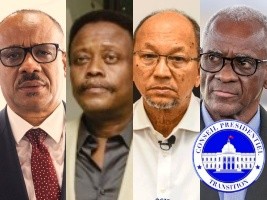
    The religious leaders made specific reference to the upcoming political transition, urgently calling for adherence to the 1987 Constitution as the Presidential Transitional Council’s mandate approaches its expiration on February 7, 2026. They emphasized that democratic elections would remain impossible without first establishing nationwide security, calling upon both national and international actors to accelerate efforts toward creating stable conditions.

    In a notable passage, the bishops pointed to the recent success of Haiti’s national football team as evidence of the nation’s ‘remarkable capacity for resilience when they choose unity and solidarity.’ This achievement, they noted, demonstrates that ‘no darkness is invincible.’

    The message condemned structural violence and institutional limitations while appealing to political leaders to prioritize peace and human dignity over partisan interests. The bishops called for a new leadership model based on ‘integrity, service, and selflessness,’ describing true civic engagement as potentially requiring a form of ‘martyrdom’ through relinquishing privileges and resisting corruption.

    Concluding with a solemn entrustment of Haiti to ‘Christ Jesus, Prince of Peace,’ the bishops invoked the Virgin Mary’s protection for the nation and those working toward reconciliation. The message was signed by all members of the Episcopal Conference, including Archbishop Max Léroys Mestidor of Port-au-Prince and Cardinal Chibly Langlois of Les Cayes.

  • FLASH : International Conference of GSF Contributing Countries

    FLASH : International Conference of GSF Contributing Countries

    Haitian Prime Minister Alix Didier Fils-Aimé embarked on a crucial diplomatic mission to New York on December 8, 2025, to spearhead international efforts addressing Haiti’s severe security crisis. The centerpiece of his visit is the International Conference of GSF Contributing Countries, convened on December 9 to finalize preparations for the imminent deployment of the multinational Gang Suppression Force (GSF).

    The strategic gathering represents a watershed moment in Haiti’s ongoing battle against rampant gang violence that has paralyzed the nation. Prime Minister Fils-Aimé’s personal participation underscores the Haitian government’s determination to mobilize global support and demonstrates high-level commitment to restoring security and stability.

    The conference brings together key international stakeholders, including Canada’s Permanent UN Representative David Lametti, U.S. Deputy Secretary of State Chris Landau, U.S. Ambassador Wooster, and representatives from Kenya and Guatemala. These nations form the core coalition supporting the GSF initiative, which is projected to reach full strength of 5,500 police and military personnel.

    Ambassador Wooster emphasized the United States’ commitment via social media, stating: ‘Rallying the international community, especially regional partners, in support of Haiti remains a top priority. We must work together to combat criminal gangs terrorizing Haitians and destroying the country.’

    The Prime Minister is scheduled to address the plenary session regarding contribution announcements before returning to Haiti on December 10, marking a critical step in operationalizing the security force intended to combat Haiti’s escalating gang violence.

  • FLASH : Kenyan reinforcements have arrived in Port-au-Prince (video)

    FLASH : Kenyan reinforcements have arrived in Port-au-Prince (video)

    PORT-AU-PRINCE, Haiti – In a significant reinforcement of international security efforts, Haiti welcomed 230 specialized Kenyan police officers on December 8, 2025. The arrival marks the fifth contingent deployed from Kenya to support the Caribbean nation’s ongoing battle against armed gangs.

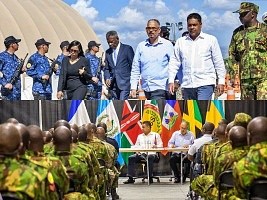
    Laurent Saint-Cyr, President pro tempore and Coordinator of Haiti’s Transition Council, personally received the officers at Toussaint Louverture International Airport. The specialized unit joins the multinational Gang Repression Force (FRG) operating within the country’s security framework.

    The Kenyan delegation, led by Deputy National Security Advisor Joseph Boinett and Principal Deputy Inspector General James Kamau, received high-level welcomes from Haitian defense leadership. The reception committee included Commander Godfrey Otunge of the GSF, Lieutenant General Derby Guerrier of the Haitian Armed Forces, and Acting Police Director Vladimir Paraison. Diplomatic representatives from Canada, France, and Kenya’s Consul General in Haiti were also present.

    Concurrently, a rotation of 100 Kenyan officers concluded their mission and departed for home. Transition Council Coordinator Saint-Cyr acknowledged their service while assuring remaining troops of continued harmonious collaboration between Haitian authorities and international forces.

    GSF Commander General Otunge emphasized operational improvements based on lessons from previous multinational missions in Haiti. ‘We have learned from the experience of the Multinational Mission in Haiti to make this new Force more effective,’ Otunge stated, committing to work in Haiti’s best interests.

    Joseph Boinett conveyed President William Ruto’s personal message: ‘Kenya will stand with the Haitian people to guarantee peace and stability during this transitional phase.’ The declaration reinforces Kenya’s commitment to the international stabilization effort.

    The new arrivals join existing contingents from Guatemala, El Salvador, the Bahamas, and Jamaica. Commander Otunge noted their deployment coincides with critical expansion of the GSF’s mandate, positioning them to ‘play a vital role in strengthening, consolidating, and accelerating the progress already achieved.’

  • Great South : PAHO/WHO fights against maternal mortality

    Great South : PAHO/WHO fights against maternal mortality

    A significant multinational health initiative is underway in Haiti’s southern regions to combat the nation’s persistently high maternal mortality rates. The Pan American Health Organization/World Health Organization (PAHO/WHO), backed by the European Union’s Universal Health Coverage Partnership, is collaborating with Haiti’s Ministry of Public Health through its Family Health Directorate (DSF) to implement critical interventions across four southern departments.

    The comprehensive program has equipped 55 healthcare professionals with specialized training in Maternal Death Surveillance and Response (MDSR) systems, while simultaneously establishing seven dedicated committees within institutions providing emergency obstetric and neonatal care. This dual approach has enabled medical staff to better understand the root causes of maternal fatalities and implement evidence-based practices to enhance care quality.

    Parallel to these training efforts, medical teams have conducted detailed mortality reviews throughout the Grand Sud region, identifying specific risk factors and developing targeted corrective measures. The initiative has also revitalized departmental MDSR committees to improve monitoring of implemented recommendations and optimize coordination across different tiers of Haiti’s healthcare system.

    Notably in Grand’Anse department, the United Nations Population Fund (UNFPA) has provided co-financing for training activities, demonstrating crucial inter-agency cooperation in addressing Haiti’s maternal health challenges. This collaborative model aims to strengthen early detection of maternal risks and refine patient referral systems.

    The integrated strategy seeks to consolidate MDSR protocols at local levels, improve prenatal and obstetric care quality, and ultimately achieve sustainable reduction of Haiti’s maternal mortality ratio through coordinated action across all healthcare system levels.

  • Justice : Message by Martine Moïse on the assassination of President Jovenel Moïse

    Justice : Message by Martine Moïse on the assassination of President Jovenel Moïse

    In a powerful address to the Haitian nation and diaspora, former First Lady Martine Moïse has delivered a scathing indictment of Haiti’s judicial system, condemning its role in the political persecution and ultimate assassination of President Jovenel Moïse. The emotional statement marks 53 months since the controversial events that culminated in the president’s killing on July 7, 2021.

    Mrs. Moïse characterized Haiti’s justice system as a weaponized tool manipulated by a powerful minority to maintain control over the population. She asserted that the judiciary operates with complete impunity, serving oligarchs and corrupt politicians rather than the Haitian people. The system, she claimed, actively participated in destroying President Moïse’s character during his lifetime and continues to disrespect his legacy after his death.

    The former First Lady referenced specific events, including the February 7, 2021 judicial plot to overthrow the democratically elected president using fabricated court rulings and illegal warrants. She directly connected these judicial maneuvers to the eventual assassination, asking how the same system that participated in the crime could possibly deliver justice.

    Mrs. Moïse described an environment of extreme violence across multiple regions including Arcahaie, Montrouis, Saint-Marc, and Martissant, where citizens face brutal attacks without accountability. She invoked Haiti’s revolutionary heroes—Padrejean, Makandal, Boukman, Toussaint, and Dessalines—and their rallying cry of ‘Liberty or death!’ as inspiration for contemporary resistance.

    Despite the bleak assessment, the former First Lady maintained hope that justice would ultimately prevail, warning that ‘karma exists’ and there’s ‘a price to pay for every action.’ She concluded with a declaration that the Haitian people have reached their breaking point and that the current oppressive system must collapse.

  • Graduation : 100 young people with disabilities graduate in massage therapy and functional rehabilitation

    Graduation : 100 young people with disabilities graduate in massage therapy and functional rehabilitation

    Port-au-Prince witnessed a profoundly moving ceremony on International Day of Persons with Disabilities as 100 young Haitians with diverse disabilities—including visual impairments, mobility limitations, and other physical challenges—received professional diplomas in massage therapy and functional rehabilitation. These graduates successfully completed an intensive three-month vocational program designed to equip them with specialized healthcare skills.

    The Office of the Secretary of State for the Integration of Persons with Disabilities (BSEIPH) orchestrated this landmark event, which transcended conventional graduation ceremonies to represent a strategic advancement in Haiti’s national inclusion agenda. The occasion served as a powerful testament to human resilience, demonstrating how determination can overcome physical limitations and societal barriers. High-level government officials and international representatives attended, underscoring the ceremony’s significance within national development priorities.

    Secretary of State Génard Joseph articulated a transformative vision during his address, positioning persons with disabilities as active contributors to Haiti’s development trajectory. He emphasized that genuine inclusion requires moving beyond theoretical discourse to implement concrete measures including vocational education, psychological support services, employment accessibility, and facilitated civic engagement. The Secretary championed the concept of disabled individuals as valuable societal assets possessing professional expertise that benefits the broader community.

    The BSEIPH, in collaboration with its partner organizations, has committed to expanding these vocational training initiatives, creating additional pathways for young Haitians with disabilities to achieve professional certification, economic self-sufficiency, and meaningful social participation.

  • Education : Investment Scenarios for Haitian Preschools

    Education : Investment Scenarios for Haitian Preschools

    Port-au-Prince, Haiti – Haitian education officials and international partners have concluded a landmark three-day workshop establishing comprehensive investment strategies to revolutionize early childhood education nationwide. The gathering marked a pivotal moment in Haiti’s educational development, focusing on implementing findings from the groundbreaking National Preschool Education Survey.

    Minister of National Education Augustin Antoine articulated a powerful vision for educational equity, emphasizing that “whether a child comes from wealthy or impoverished circumstances, they must receive identical educational opportunities. We are committed to standardizing the preschool sector and eliminating disparities between urban and rural regions.”

    The comprehensive survey data provides unprecedented insights into Haiti’s preschool infrastructure, detailing operational mechanisms, service diversity, cost structures, and systemic challenges. Minister Antoine highlighted the transformative potential of this information, noting it will “drive strategic planning and ground-level interventions to meet population expectations while bringing coherence to educational initiatives.”

    UNICEF Representative in Haiti Geetajanli Narayan characterized the collected data as “an invaluable foundation for guiding future policy and strategic decisions.” She emphasized the workshop’s role in evaluating “the most effective public policy options to ensure equitable expansion of public preschools while enhancing quality and sustainability of non-public services.”

    Professor Alain Mingat facilitated critical sessions exploring investment scenarios aligned with forthcoming National Preschool Policy priorities. The discussions culminated in a unified call for international cooperation agencies to bolster the Haitian government’s financial commitments to preschool education.

    The high-level participation underscored global support for Haiti’s educational transformation, featuring representatives from multiple international agencies including the French Development Agency, Inter-American Development Bank, UNESCO, World Food Programme, and diplomatic corps from France, Taiwan, Mexico, and Spain.

  • Colombia : Specialized training concludes for 23 Haitian police officers

    Colombia : Specialized training concludes for 23 Haitian police officers

    In a significant bilateral cooperation effort, Colombia has successfully completed an intensive training program for 23 officers of the Haitian National Police (PNH). The closing ceremony, held on December 4th, 2025 at the Colombian International Police Training Center in San Luis, Tolima, was attended by Ambassador Rafael Orozco, Director for the Americas at Colombia’s Ministry of Foreign Affairs.

    This specialized training initiative represents a concrete implementation of the Colombia-Haiti Work Plan, stemming from commitments made during President Gustavo Petro’s official visits to Haiti in January and July 2025. The program was developed through collaborative efforts between Colombia’s Ministry of Foreign Affairs, Ministry of National Defense, National Police, and the Presidential Agency for International Cooperation (APC Colombia).

    Colombian police instructors delivered comprehensive training across five critical security domains essential for strengthening Haiti’s law enforcement capabilities. The curriculum focused on citizen security protocols, advanced criminal investigation techniques, tactical operations in both urban and rural environments, intelligence gathering methodologies, and strategies for combating smuggling operations.

    This capacity-building program underscores Colombia’s strategic commitment to supporting institutional strengthening and security stabilization in Haiti. The training approach emphasized knowledge transfer through practical, scenario-based learning designed to enhance the operational readiness and strategic decision-making capabilities of Haitian law enforcement personnel.

    The initiative reflects Colombia’s broader foreign policy objective of promoting regional security cooperation through technical assistance programs that respect national sovereignty while addressing shared security challenges. This cooperation model demonstrates how South-South collaboration can effectively contribute to peacebuilding and institutional development efforts in partner nations.

  • FLASH WC 2026 : The Grenadiers will play their 3 matches in the USA (Official schedule)

    FLASH WC 2026 : The Grenadiers will play their 3 matches in the USA (Official schedule)

    The official match schedule for Haiti’s national football team, the Grenadiers, in the 2026 FIFA World Cup has been finalized, positioning all three of their Group C matches within the United States. This announcement follows Friday’s draw ceremony that revealed Haiti would compete against Brazil, Morocco, and Scotland in the tournament’s initial stage.

    According to the published timetable, the Grenadiers will commence their campaign against Scotland on June 13, 2026, at Boston’s Gillette Stadium. Their second encounter pits them against five-time world champions Brazil on June 19 at Philadelphia’s Lincoln Financial Field. The final group stage match will see Haiti facing Morocco, the current African football powerhouse, on June 24 at Atlanta’s Mercedes-Benz Stadium.

    French coach Sébastien Migné provided strategic insights regarding the challenging group composition. “We face the legendary Brazilian team and Morocco, the sensational semi-finalists from the last World Cup,” Migné acknowledged. “This represents fantastic exposure for Haitian football and a tremendous reward for our players, but we must elevate our performance accordingly.”

    Migné emphasized the critical importance of their opening match against Scotland, noting that “nothing is impossible” in tournament football. He referenced his previous experience defeating Brazil with Cameroon as evidence that underdog victories remain achievable at the highest level.

    However, a significant concern overshadows the team’s preparation: the ongoing travel restrictions preventing most Haitian supporters from attending matches. The U.S. State Department confirmed to Politico that no special exceptions would be made for Haitian fans despite the World Cup hosting, maintaining visa eligibility restrictions established during the previous administration.

    Coach Migné expressed hope that political circumstances might evolve, stating: “We know there’s a large Haitian diaspora in the United States. We’re counting on them, and we hope that politically, now that Donald Trump has received the FIFA Peace Prize, he’ll continue in this direction and be more inclusive, because this should be a fantastic celebration for football and for Haitian citizens.”