标签: Cuba

古巴

  • Mexican President says people can limit Trump

    Mexican President says people can limit Trump

    Mexican President Claudia Sheinbaum has firmly dismissed the possibility of U.S. military intervention in Mexico, emphasizing national sovereignty and a comprehensive domestic approach to tackling organized crime. Her statements came during a routine press conference at the National Palace, where she addressed concerns about former U.S. President Donald Trump’s repeated proposals to deploy American troops into Mexican territory under the pretext of combating drug cartels.

    President Sheinbaum argued that external military involvement would not resolve Mexico’s security challenges, noting that such interventions undermine constitutional principles and national autonomy. Instead, her administration is implementing a four-pillar strategy focused on addressing socioeconomic root causes, ensuring judicial accountability, strengthening institutions, and promoting regional development.

    She also criticized domestic opposition groups that she accused of seeking foreign support to gain political advantage, warning that such approaches ultimately fail to resonate with the Mexican public. The president reaffirmed that unity and a clear vision grounded in Mexico’s legal framework are essential to navigating complex bilateral relations with the United States.

    Sheinbaum expressed confidence that Mexico possesses the capacity and resources to manage its security situation without external interference, highlighting collaboration with international partners on terms that respect Mexican law and self-determination.

  • Cuban Embassy in the US honors fallen combatants in Venezuela

    Cuban Embassy in the US honors fallen combatants in Venezuela

    In a solemn display of diplomatic solidarity, Cuban mission staff assembled Monday morning under the leadership of Head of Mission Lianys Torres to commemorate personnel lost in the line of duty. The gathering transformed into a powerful political demonstration against what officials characterized as imperial aggression targeting Venezuela’s constitutional order.

    Oscar Larralde, addressing colleagues as their representative, condemned Saturday’s offensive against Venezuela and the abduction of its constitutional president as a fundamental assault on national sovereignty. ‘In the face of this aggression,’ Larralde declared, ‘we reaffirm our unwavering solidarity with the Venezuelan people and their legitimate government.’ The diplomat revealed that thirty-two Cuban citizens had perished on Venezuelan soil, their blood serving as testament to the profound solidarity binding the two nations.

    The ceremony evolved into a historical rallying cry, with Larralde invoking the legacy of Major General Antonio Maceo, Cuba’s legendary Bronze Titan from the independence wars. He reiterated Maceo’s uncompromising principle that Cuban independence remains non-negotiable—a warning directed at contemporary ‘imperialist gentlemen’ and ‘circling hawks.’ The official channeled the warrior’s defiant proclamation that any attempt to seize Cuba would yield only ‘blood-soaked dust’ unless aggressors perished in the struggle.

    The emotionally charged event culminated with diplomatic personnel singing Cuba’s National Anthem with fervent patriotism, followed by vocal acclamations celebrating Cuba, its revolutionary tradition, and current leadership. The gathering simultaneously functioned as a memorial for fallen heroes and a strategic political statement reinforcing Cuba’s alliance with Venezuela’s government amid escalating regional tensions.

  • China underscores willingness to deepen ties with Venezuela

    China underscores willingness to deepen ties with Venezuela

    In a firm diplomatic stance, China has denounced recent U.S. military operations in Venezuela while reaffirming its strategic partnership with the South American nation. Foreign Ministry Spokesperson Lin Jian declared that China’s legitimate interests in Venezuela would be legally protected, emphasizing Beijing’s commitment to international law and sovereign equality.

    The Chinese government expressed strong condemnation of what it termed the ‘abduction’ of Venezuelan President Nicolas Maduro and First Lady Cilia Flores following U.S. military airstrikes. Spokesperson Lin reiterated China’s position of respecting Venezuela’s sovereignty and independence, expressing confidence that Caracas would manage its internal affairs in accordance with its constitutional framework.

    Foreign Minister Wang Yi articulated Beijing’s rejection of unilateralism in international relations, explicitly criticizing the concept of any nation assuming the role of ‘world policeman’ or acting as a global judiciary. This statement reflects China’s broader foreign policy approach that prioritizes multilateralism and non-interference in sovereign states’ domestic affairs.

    The bilateral relationship between China and Venezuela was characterized as an ‘unwavering strategic partnership’ with comprehensive cooperation across multiple sectors including energy, infrastructure, and finance. This longstanding alliance has involved significant Chinese investment in Venezuela’s oil industry and development projects.

    Beijing has formally called upon the United States to immediately release President Maduro and his wife while ceasing what China describes as attempts to destabilize Venezuela’s constitutional order. The statement represents one of the most direct confrontations between Beijing and Washington regarding Western Hemisphere affairs in recent years.

  • AU prepares for Assembly of Heads of State and Government

    AU prepares for Assembly of Heads of State and Government

    The African Union (AU) has officially disclosed the comprehensive timeline for its forthcoming leadership summit, with high-level assemblies scheduled to culminate in February 2026. The detailed agenda was formally announced through the continental body’s official social media channels.

    The preparatory phase will commence with the 51st Ordinary Session of the Permanent Representatives’ Committee, convening from January 12 to 30. This crucial preliminary meeting will assemble ambassadors from member states alongside senior AU officials. Their primary mandate involves conducting thorough analyses of draft reports and meticulously formulating the agenda for the subsequent Executive Council session.

    Following this diplomatic groundwork, the 48th Ordinary Session of the Executive Council is slated for February 11-12. This ministerial-level gathering will bring together foreign ministers and other designated high-ranking officials from across the continent. The Council’s agenda focuses on substantive discussions regarding issues forwarded from the preparatory committee, alongside critical evaluations of policy implementation measures previously ordained by the Assembly. Participants will also dedicate significant effort to crafting detailed session agendas and drafting formal decisions for higher-level consideration.

    The entire process will reach its apex with the 39th Ordinary Session of the Assembly of Heads of State and Government on February 14-15, 2026. This premier gathering of African leaders represents the highest decision-making organ within the AU structure, where heads of state will convene to deliberate on and ultimately ratify decisions shaping the continent’s strategic direction.

  • Sri Lanka condemns US kidnapping of Maduro as piracy

    Sri Lanka condemns US kidnapping of Maduro as piracy

    The Communist Party of Sri Lanka (CPSL) has issued a strong condemnation of military actions targeting Venezuela, drawing explicit parallels to historical interventions by the United States. In a formal statement, the party characterized recent operations involving the deliberate bombing of civilian infrastructure as severe violations of international law that meet the criteria for war crimes.

    The CPSL analysis highlighted that these operations primarily targeted facilities essential to the daily lives and well-being of Venezuelan citizens, resulting in civilian casualties and creating severe humanitarian hardship. The party’s statement noted a ‘disturbing resemblance’ between these tactics and the systematic destruction of civilian infrastructure carried out in Iraq prior to the 2003 invasion.

    Contextualizing current events within broader historical patterns, the Sri Lankan political party referenced previous acts including the 2004 kidnapping of Haitian President Jean-Bertrand Aristide and the 1961 assassination of Patrice Lumumba, Prime Minister of the Democratic Republic of Congo. The CPSL framed these actions as part of a consistent pattern of imperialist objectives historically pursued by the United States to seize natural resources and wealth from sovereign nations.

    The party reiterated its firm rejection of these interventions and expressed unwavering solidarity with the Venezuelan people, praising their continued resistance against foreign interference and their defense of national sovereignty. The statement concluded by emphasizing the need for international accountability for actions that violate established international legal standards.

  • Tribute paid in Italy to Cuban combatants killed in Venezuela

    Tribute paid in Italy to Cuban combatants killed in Venezuela

    The Cuban embassy hosted a solemn commemorative ceremony this morning to honor combatants who perished during internationalist missions. Interim Chargé d’Affaires Damian Delgado presided over the event, which featured the singing of the national anthem and a moment of silent tribute for those “who sacrificed their lives while fulfilling the sacred duty of solidarity and internationalism inherent to Cuban revolutionaries.”

    Delgado eulogized the fallen as embodiments of “the nation’s most cherished values and the courageous fighting spirit of our people.” The ceremony transformed into a platform of political defiance, with attendees reaffirming their unwavering commitment to protect the Cuban Revolution against what was described as “threats from the US imperialist government.”

    The diplomat’s address culminated in a powerful declaration: “The decision is simple: Homeland or Death. We will prevail!” This statement captured the intensely patriotic atmosphere of the event, which memorialized martyrs said to have fought “to their last breath on Venezuelan soil.”

    In response to these casualties, the Cuban government has officially proclaimed a 30-hour period of national mourning commencing at 6:00 a.m. on January 5th, 2026, and concluding at 12:00 p.m. on January 6th. This gesture pays respect to those who “honorably fulfilled their duty and fell after demonstrating fierce resistance, either in direct combat against attackers or as casualties of facility bombings.”

    According to an official government statement, the deceased were deployed as representatives of Cuba’s Revolutionary Armed Forces and Ministry of the Interior, conducting missions at the request of Venezuelan counterparts. Their heroic actions, the statement concludes, “have exalted the solidarity of millions of compatriots.”

  • Cuban authorities congratulate the National Revolutionary Police

    Cuban authorities congratulate the National Revolutionary Police

    Cuban President Miguel Diaz-Canel marked the 65th anniversary of the National Revolutionary Police (PNR) with a social media tribute, emphasizing the institution’s transformative role in the nation’s history. “January 5, 1959, witnessed the end of abusive practices by the dictatorship’s police forces,” Diaz-Canel stated, “ushering in a new law enforcement body dedicated to serving the people and their Revolutionary ideals.

    The commemorations continued with National Assembly President Esteban Lazo honoring PNR members as “true Heroes in Blue” who perform daily feats in safeguarding public security and tranquility. Roberto Morales, Organization Secretary of the Communist Party Central Committee, echoed these sentiments, acknowledging the “commendable work” of the police force in a widely shared congratulatory message.

    Prime Minister Manuel Marrero provided historical context, noting the PNR’s origins in the Rebel Army under the initiative of then-Commander Raúl Castro. “The PNR remains an impregnable bastion defending public order and tranquility,” Marrero affirmed.

    The establishment of the PNR in 1959 represented a conscious effort to create an exemplary institution that would erase the legacy of repression, abuse, and corruption associated with Fulgencio Batista’s dictatorship (1952-1958). Today, the force maintains its fundamental mission of preserving public order, ensuring citizen safety, and regulating road security throughout Cuba.”

  • Cuba wakes up in National Mourning after Presidential Decree 1147

    Cuba wakes up in National Mourning after Presidential Decree 1147

    Cuba has entered an official state of national mourning following the deaths of 32 Cuban military personnel during what the government characterizes as a US-led offensive against Venezuela. The solemn period commenced at 6:00 a.m. local time today and will continue through midnight on Tuesday, January 6, 2026.

    In a nationally televised address, President Miguel Diaz-Canel announced that all public events and activities across the island nation are suspended indefinitely. The Cuban flag will fly at half-staff on all government buildings and military installations as a symbol of collective grief.

    The casualties occurred during early morning operations on January 3, when Cuban personnel stationed in Venezuela came under direct attack. According to President Diaz-Canel, the deceased were serving in official capacities as part of cooperative missions between Cuba’s Revolutionary Armed Forces, Ministry of the Interior, and their Venezuelan counterparts.

    ‘With profound sorrow, our people have learned that during the criminal attack perpetrated by the United States government against the sister Bolivarian Republic of Venezuela, 32 Cubans lost their lives in combat,’ the President stated in his formal declaration.

    Diaz-Canel elaborated that the fallen personnel ‘honorably fulfilled their duty and fell, after fierce resistance, in direct combat against the attackers or as a result of the bombing of facilities.’ He further emphasized that through their ‘heroic actions, they upheld the solidarity of millions of our fellow citizens,’ framing their sacrifice within Cuba’s longstanding internationalist traditions.

    The incident marks one of the most significant losses of Cuban military personnel abroad in recent decades and substantially escalates tensions between Havana and Washington.

  • These are not times for half measures, these are times for defining our positions and taking a stand against fascism and imperial barbarism!

    These are not times for half measures, these are times for defining our positions and taking a stand against fascism and imperial barbarism!

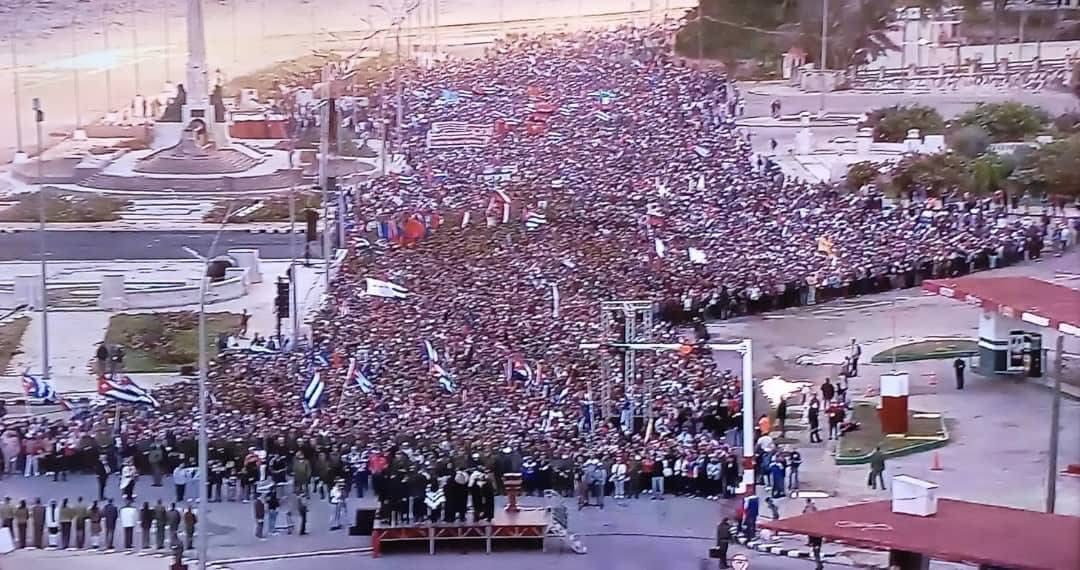
    In a fiery address delivered at Havana’s José Martí Anti-Imperialist Tribune, Cuban President Miguel Díaz-Canel delivered a scathing condemnation of what he termed “U.S. military aggression” against Venezuela and the alleged kidnapping of President Nicolás Maduro. The January 3rd speech framed the operation as an act of “state terrorism” that violates international law and threatens regional stability.

    Díaz-Canel characterized the predawn military action as a “cowardly, criminal, and treacherous” attack motivated by imperialist desires for Venezuela’s oil reserves and natural resources. He explicitly rejected the Monroe Doctrine and what he called the “fallacious narrative of narco-terrorism” that U.S. officials had allegedly propagated to justify intervention.

    The Cuban leader drew historical parallels, invoking Fidel Castro’s warnings about U.S. imperialism from two decades prior and comparing current U.S. leadership to Nazi propagandists employing Goebbels’ principle of repeating lies until they become accepted as truth. He further equated the Venezuela operation to “crimes against humanity committed by Israeli Zionism in the Gaza Strip.”

    Díaz-Canel called for international mobilization against what he described as an illegal regime change operation, emphasizing that the threat extended beyond Venezuela to all of humanity. He demanded proof of life for Maduro and his partner Cilia Flores, while asserting that the United States bears responsibility for their physical safety.

    The speech concluded with revolutionary slogans and declarations of solidarity between Cuba and Venezuela, with Díaz-Canel vowing that both nations would defend Venezuelan sovereignty at “a very high price” if necessary.

  • Information from the Revolutionary Government on combatants who fell in the line of duty in Venezuela

    Information from the Revolutionary Government on combatants who fell in the line of duty in Venezuela

    Cuba has confirmed the deaths of 32 military personnel in what it describes as a “criminal act of aggression and state terrorism” by the United States government against Venezuelan territory. The incident occurred during early hours of January 3, 2026, when Cuban combatants were reportedly conducting security operations at the request of Venezuelan authorities.

    According to official statements from the Cuban government, the deceased personnel were serving with the Revolutionary Armed Forces and Ministry of the Interior on cooperative defense missions in the Bolivarian Republic of Venezuela. The casualties resulted from both direct combat engagements with American forces and aerial bombardment of military facilities where Cuban troops were stationed.

    The Cuban government emphasized that its personnel demonstrated “dignity and heroism” during what it characterized as fierce resistance against the attackers. Following verification procedures, all affected families have been notified and have received personal condolences from Cuban leadership, including Army General Raúl Castro Ruz and President Miguel Díaz-Canel Bermúdez.

    The Revolutionary Government has announced plans to organize appropriate memorial actions to honor the fallen combatants, whom they describe as having embodied the solidarity principles valued by millions of Cubans. This incident represents a significant escalation in the ongoing geopolitical tensions between Cuba, Venezuela, and the United States.