
标签: Belize

伯利兹

  • Major Jones Says BDF Soldiers Are Being Shortchanged

    Major Jones Says BDF Soldiers Are Being Shortchanged

    In a blunt rebuke of the Belize Defence Force’s institutional management, retired Major Lloyd Jones has raised serious alarms about unfair treatment of active-duty soldiers, pointing to problematic military ration provision as evidence of deeper systemic rot within the country’s defense establishment. Speaking to local outlet News Five in comments published July 9, 2026, Jones argued that active service members are being sidelined as an afterthought in budget and resource priorities, with a stark discrepancy between public funds allocated for soldier rations and the actual food that ends up being served to troops. According to Jones, this gap points to unaccounted “leakages” that siphon resources away at every step of the supply chain.

    “What happens is that it starts at the top as we are seeing now, which is the troubling part for me,” Jones explained. “But all along the supply chain, starting with the ministry and for every door it enters, the ration gets smaller and smaller.” The retired major emphasized that the chasm between total spending on rations and the final portion served to soldiers exposes fundamental flaws in how the defense system is run. While Jones stopped short of formally accusing any individual of explicit corruption or illegal wrongdoing, he warned that problematic practices at the most senior levels of leadership create a cultural ripple effect that distorts behavior across the entire supply chain.

    “If people see people at the top ‘feeding’, then when it reach their level they also feel like I should get a little too,” Jones said. “And then it finally reaches the plate of the soldiers and he is wondering, what happened here.” Beyond the ration controversy, Jones also slammed what he frames as a widespread lack of respect and appreciation for the work of BDF members, noting that dozens of skilled, capable service members have resigned from the force in recent years out of mounting frustration over poor working conditions and unaddressed grievances. Most provocatively, Jones openly questioned whether two senior cabinet officials — Florencio Marin Jr. and Oscar Mira, the heads of the relevant defense-linked ministries — still retain the public confidence necessary to effectively lead their portfolios.

    Marin and Mira have already been placed on administrative leave from their posts as of the time of Jones’ comments, though no official explanation for their leave has been released in the correspondence covered by the reporting. In an official response to Jones’ allegations, Francis Usher, Chief Executive Officer of the Ministry of Defence, pushed back on the retired major’s grim assessment while acknowledging his long professional history with the force. “I think that Major Jones is a very experienced individual. I think he is more than capable of drawing his own conclusions,” Usher stated. “I would not go as far as saying that, but I do understand his position, and he is free to make his opinion.” The exchange has reignited public debate over transparency, resource management, and leadership accountability within Belize’s national defense institutions, with calls emerging for an independent audit of military ration spending to resolve the conflicting claims.

  • Fifty-Four Invoices, One Supplier, and a $435,000 Question

    Fifty-Four Invoices, One Supplier, and a $435,000 Question

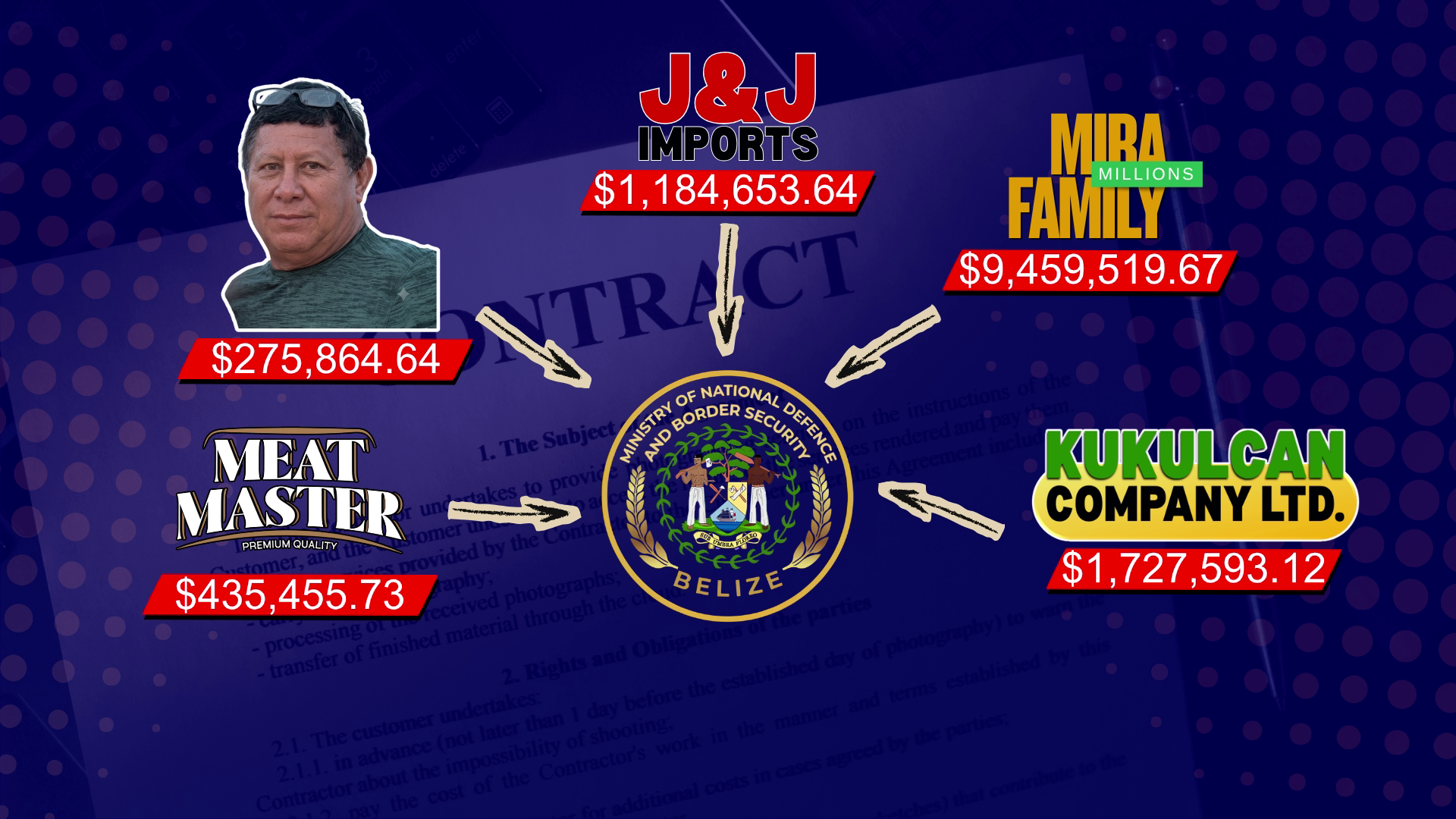
    A new controversy has erupted over government procurement practices at Belize’s Ministry of Defense, as a politically connected meat supplier has been revealed to receive more than $435,000 in public funds via a highly unusual structure of 54 split invoices, each falling just below a key spending threshold designed to trigger higher-level oversight. The case, first reported by journalist Paul Lopez for News Five on July 8, 2026, centers on Orange Walk-based meat supplier Meat Master, a company owned by the wife’s cousin of Ministry of Defense Chief Executive Officer Francis Usher. Over just two months—April and May 2026—the company accumulated $435,455.73 in payments from the ministry, with every single invoice submitted for amounts under $10,000. The most alarming detail to emerge is a single day of payouts on May 11, 2026, when the ministry disbursed more than $300,000 to Meat Master split across 35 separate invoices, all kept just below the $10,000 limit that would require additional authorization from the national treasury and ministry of finance. This is not an isolated incident: the supplier is the latest in a growing list of defense contractors linked to close relatives and associates of high-ranking Belizean government officials, including Ministers Oscar Mira, Florencio Marin Junior, and Ramon “Monchi” Cervantes, all of whom have been named in previous reporting on questionable procurement deals. In an on-the-record interview with Lopez, Usher acknowledged the family connection but defended the ministry’s actions, insisting that all procurement processes were followed strictly in line with the law. The CEO argued that vendors themselves choose to split larger orders into smaller invoices to speed up government payment processing, noting that smaller transactions below the $10,000 threshold are processed more quickly by the ministry’s internal accounting department. When challenged on the $300,000 single-day payout, which would normally require formal approval from national financial authorities above the defense ministry’s own accounting department, Usher maintained that all delivered goods were verified and all required procedural steps were completed. “Invoices would not have been paid if the necessary requirements were not met,” Usher stated, adding that he sees nothing questionable about the transaction because the process included full accountability and transparency. He further explained that Meat Master remains an active ministry supplier because standard government vendor contracts are active for 12 months once awarded. Critics of the arrangement, however, argue that the structure of the invoices can only be interpreted as a deliberate effort to sidestep official procurement safeguards designed to prevent corruption and mismanagement of public funds. The case has reignited broader calls for independent audits of defense ministry contracting, as questions mount over whether the pattern of politically connected suppliers and threshold-avoiding invoice practices indicates systemic gaps in accountability rather than isolated coincidence. This report is a transcribed adaptation of an evening television broadcast from News Five.

  • $9,425 Here, $9,750 There: What’s Behind the Pattern?

    $9,425 Here, $9,750 There: What’s Behind the Pattern?

    On July 8, 2026, public scrutiny has emerged around a controversial payment pattern at Belize’s Ministry of Finance, where a single vendor received more than $300,000 in government funds via 35 separate invoices processed in a single business day. An independent review of the payment records uncovered recurring identical amounts across multiple invoices, most notably $9,425 and $9,750, leading to widespread speculation that the large total contract was intentionally split into thousands of smaller sub-payments to evade public transparency and financial accountability requirements.

    In an official response to media inquiries, Francis Usher, Chief Executive Officer of the Ministry of Finance, has pushed back against claims of improper activity, outlining the administrative practice that led to the clustered payment structure. According to Usher, the multiple same-value invoices did not represent an attempt to split a large contract. Instead, he explained, vendors routinely consolidate delivery documentation for batch submission to the ministry’s accounting department, rather than filing separate payment requests after every individual delivery.

    The payments in question, Usher confirmed, correspond to supplies delivered to the Belize Defence Force (BDF) and the Belizean Coast Guard by local vendor Meat Master, covering completed orders spanning a full two-month period. The standard procurement process requires every delivery to follow strict verification protocols: suppliers start with a formal quotation, receive an official purchase order, complete delivery, then have the order jointly certified as matching the purchase order by both the vendor and the receiving agency (the BDF or Coast Guard) via a signed waybill. Instead of submitting payment requests for each small delivery immediately, vendors accumulate all completed order paperwork to submit in a single bi-monthly or monthly batch, leading to dozens of invoices being processed for payment on the same day when the batch is cleared.

    Despite Usher’s denials of intentional wrongdoing, widespread public concern over the perception of a lack of transparency has pushed the Ministry of Defense to implement immediate changes to its payment processing policies. The longstanding practice of processing repeated individual payments of less than $10,000 will be discontinued immediately. Going forward, the ministry’s accounting team will consolidate all outstanding invoices from a single vendor into one single combined payment, a reform that many public accountability advocates argue should have been in place from the beginning.

    Usher acknowledged that the public has interpreted the small, repeated payment pattern as an attempt to avoid disclosure and oversight, but he reaffirmed that no such intent existed. He explained that vendors had developed the practice of requesting small individual payments because they received cleared funds faster, which helped small businesses maintain the working capital they need for ongoing operations. Now, even when individual invoices still come in below $10,000 per delivery, the ministry will aggregate all invoices per vendor before issuing a single combined payment to strengthen clarity and eliminate any perception of improper activity.

    “If anything we welcome the scrutiny and accountability and we want to demonstrate that it is a transparent process,” Usher said.

    As of July 8, an official audit into the payment practices remains ongoing, and Usher confirmed that the Ministry of Defense continues to cooperate fully with auditors conducting the review.

    This report is adapted from a transcribed evening television newscast, with original Kriol language remarks standardized to English for publication.

  • Did “Human Error” Leave Belize’s Defenders Behind?

    Did “Human Error” Leave Belize’s Defenders Behind?

    In the small Central American nation of Belize, a $13 million financial controversy tied to the ruling People’s United Party (P.U.P.) administration has thrown the government’s credibility into crisis, with opposition voices and even long-time party supporters questioning the official explanation of simple human error for improper payments funneled to political allies and relatives of elected officials. The scandal first came to public light following a series of Smart Stream data leaks, and it has already led to the controversial overnight arrest of prominent opposition figure Alberto August, former deputy chairman of the United Democratic Party (UDP).

    Over the weekend of July 8, 2026, Prime Minister John Briceño addressed growing public anger during the P.U.P.’s National Party Council meeting, leaning on a familiar framing for the misallocated funds that passed through the Ministry of Defense. “I will be the first to admit that we’re not perfect, we make mistakes. And that’s natural, that’s human nature,” Briceño told party supporters. His line of reasoning was echoed by embattled Belmopan Area Representative Oscar Mira, who faced questioning over his complaint against August. “I think we can always reflect on what has happened in the past. We are humans and we can always look back and see how it could have been done better,” Mira stated in comments from July 1.

    But for many Belizeans, a sum as large as $13 million cannot be written off as an accidental clerical error. The scandal has eroded public trust in the P.U.P., which campaigned on a promise of cleaner governance than its predecessors. Even loyal party allies have raised alarm: Major Lloyd Jones, a retired Belize Defence Force (BDF) officer and former P.U.P. candidate for Belize Rural North, said the scandal breaks the core promises the party made to voters. “We promised that we were going to be different. We promised we were going to do better and hopefully this is the extent of it and it does not go to other ministries. But, it is troubling for me as a supporter of the party,” Jones explained.

    Top financial officials have also cast doubt on the “human error” narrative. Financial Secretary Joseph Waight described the irregular payments as suspicious in comments from June 23, noting, “Certainly it does not look good. In my view somebody dropped a ball, fell asleep or they moved together on it.”

    August, the opposition figure who was arrested amid the unfolding scandal, argued that the exposure of the payments is a rare turning point for Belize’s public accountability. “This is by Belizeans, as somewhat of a blessing in disguise, all of this was happening unknown to the Belizean people, unknown to the taxpayers of this country who are being saddled with increasing cost of living, increasing prices of fuel, and here we have these people engaging in this kind of activity,” August said.

    Beyond the political fallout, the greatest harm of the misallocated funds may fall on the BDF personnel tasked with protecting Belize’s borders and territorial waters. Jones, drawing on his decades of experience with the force, explained that the millions earmarked for defense supplies have not reached the frontline troops. “If you speak with soldiers they will tell you what they are seeing on the news in terms of the quantum, the millions they spent, that is not being translated on their plates. So somewhere along the line we are losing value. And if you don’t feed your soldiers well, you lose morale. You undermine the morale of a soldier who is away from his family, I want to remind you that these are our children, your brother, your sister, your friend. Parents send their children to the BDF with the hope that those who are in command will look after them.”

    As the controversy continues to dominate national public discourse, the core question lingers: if the misallocation was nothing more than innocent human error as the prime minister claims, why are ordinary service members, taxpayers, and the cause of good governance paying the price for the mistake? This report is a transcript of an evening television broadcast from News Five, reported by Paul Lopez.

  • Espat on Cabinet Turmoil After Mira and Marin Jr. Step Aside

    Espat on Cabinet Turmoil After Mira and Marin Jr. Step Aside

    In a significant political shakeup rocking Belize’s ruling administration dated July 8, 2026, two senior cabinet members—National Defense Minister Florencio Marin Jr. and Home Affairs head Oscar Mira—have stepped aside amid escalating fallout from a leaked internal document scandal originating from the Ministry of Defense. Following the departures, incumbent Infrastructure Development and Housing Minister Julius Espat has been appointed to hold the additional Home Affairs portfolio, expanding his responsibilities within the cabinet.

    The controversy, triggered by the unauthorized release of internal defense ministry files, has thrown the government into turmoil, forcing the reshuffle just weeks after the first allegations came to light. In an exclusive interview with journalist Shane Williams, Espat opened up about the mood among cabinet members following the two high-profile departures.

    When asked about the collective reaction to the latest resignation, Espat described the prevailing sentiment across the cabinet as one of sadness. “Sad. You would wish that nothing like this ever happens,” he stated, noting that the unfolding situation is now a matter for Prime Minister John Briceño to resolve, as he gathers full information and verifies the facts surrounding the leak.

    As a longstanding advocate for anti-corruption reforms within the current administration, Espat acknowledged that temptation for misconduct is a universal human challenge, and it falls to the government to put safeguards in place to minimize such risks. He expressed full confidence in the prime minister’s ability to reach a conclusion that will align with the expectations of all Belizean citizens. “We are all concerned. At the end of the day all of us are human beings and temptation exists. So it is the responsibility of the government to make sure that it is minimized. And that’s why we have a Prime Minister. That’s why we have a Cabinet and the people of Belize. And I know he will make a good decision. I believe in that,” Espat said.

    When pressed for details on his expectations for the ongoing official audit into the defense ministry’s activities, Espat declined to comment, stating that any formal updates should come directly from the prime minister. Prime Minister Briceño has previously confirmed that the independent audit will examine ministry records covering a full decade, from 2015 through 2025, to get to the bottom of the controversy.

    This report is a transcribed excerpt from an evening television newscast, with all Kriol-language remarks rendered using a standardized orthography system for accuracy.

  • Major Jones Says B.D.F. Soldiers Are Treated Like an Afterthought

    Major Jones Says B.D.F. Soldiers Are Treated Like an Afterthought

    In comments dated July 8, 2026, retired Belize Defence Force (BDF) Major Lloyd Jones has launched sharp criticism of institutional mismanagement within the country’s defense apparatus, arguing that frontline service members are systematically undervalued amid growing allegations of ration supply chain corruption.

    Jones, a veteran former officer with decades of service in the BDF, did not limit his critique to reports of ongoing food shortages for active-duty soldiers. He raised serious claims that systemic leakages are occurring at multiple levels of the supply chain, starting from the highest echelons of the defense ministry. According to Jones, portions of allocated rations are siphoned off at every step of the distribution process, leaving barely enough for the service members who need the provisions most. “It starts at the top, which is the troubling part for me,” Jones explained. “By the time rations go through the ministry and every point along the chain, each step shrinks the amount that gets through. There’s a massive gap between what’s budgeted for soldier rations and what actually ends up on their plates.”

    Jones suggested that this pattern of diversion is normalized by unethical behavior at senior levels: if top officials are seen benefiting from misallocated supplies, lower-ranking actors along the chain feel entitled to take a share as well. What remains after this widespread diversion is too little for frontline troops, he added.

    Beyond the immediate ration scandal, Jones argued that the situation reflects a long-standing failure to properly recognize the value of the BDF as an institution. He noted that many skilled recruits have left the force out of sheer frustration, cutting short careers that would have benefited Belize’s national security. “We have never really appreciated the BDF the way we should,” Jones emphasized. “There is no real appreciation for what this kind of institution should do for Belize.”

    The ongoing scandal, Jones contends, has done irreparable damage to the credibility of the nation’s top defense leaders: Florencio Marin Jr. and Oscar Mira. The scandal has not only tarnished the government’s public image, he said, it has also destroyed the confidence of the rank-and-file service members that the two men are tasked with leading. For that reason, Jones argued, both officials are no longer fit to hold their leadership positions, and should step down. Both Marin and Mira are currently on administrative leave from their respective ministry posts amid the investigation.

    News Five reached out to Francis Usher, Chief Executive Officer of the Ministry of Defense, to ask whether he shared Jones’ view that Marin and Mira should resign. Usher, who credited Jones with providing critical guidance early in his own career during his transition to lead the BDF airwing (a unit that grew out of the maritime wing Jones once commanded), declined to go as far as calling for the pair’s departure. “Major Jones is a very experienced individual, he is more than capable of drawing his own conclusions,” Usher said. “I would not go as far as saying that, but I do understand his position, and he is free to make his opinion.”

    This report is adapted from a televised evening newscast transcript, with all speaker remarks retained and formatted for online publication.

  • High Prices Persist as CARICOM Pushes Regional Market Agenda

    High Prices Persist as CARICOM Pushes Regional Market Agenda

    The 51st Regular Meeting of CARICOM Heads of Government concluded its four-day negotiating session in St. Lucia on July 8, 2026, with the long-proposed Caribbean Single Market and Economy (CSME) remaining the top priority for regional integration efforts. However, the gap between policy progress and tangible relief for ordinary Caribbean households remains wide, as sky-high consumer prices and persistent import-driven inflation continue to squeeze household budgets across the bloc’s small island developing states.

    For decades, CARICOM has advanced the vision of a unified regional market to reduce economic vulnerability, boost cross-border trade, and lower costs for local consumers. While incremental progress has been made on harmonizing regional rules, the initiative has not yet delivered on its core promise: cutting the region’s heavy reliance on imported goods and insulating consumers from global inflationary pressures.

    Belize, a key member of CARICOM, sent Oscar Arnold, Chief Executive Officer of the nation’s Ministry of Foreign Affairs, to represent its interests at the gathering. In an interview on the sidelines of the meeting, Arnold outlined the core challenges standing in the way of a functional, cost-lowering single market, pointing to fragmented regulatory frameworks and inefficient logistics as major cost drivers.

    “CSME was discussed at length, with delegates debating actionable next steps and how to harmonize regulations across all CARICOM member states,” Arnold explained. “We have to work around existing national laws in different territories that impact everything from consumer protection to cross-border goods trade, and even the adoption of artificial intelligence and digital trade protocols. One of the most productive conversations centered on goods movement and logistics infrastructure.”

    Arnold highlighted the fundamental inefficiency of the region’s current supply chain that ultimately passes extra costs down to end consumers: at present, nearly all cargo moving between Caribbean nations must first be shipped north to major North American ports before being routed back south to regional destinations. This roundabout shipping process inflates logistics and transportation costs dramatically, adding to the final price tag for nearly all goods sold across the region.

    Delegates also centered the urgent need to curb imported inflation, a challenge that hits small Caribbean states disproportionately hard. Most member nations import the vast majority of consumer and industrial goods, meaning global price volatility for fuel and commodities translates directly to higher costs for households, Arnold noted. The pinch of elevated fuel costs, in particular, has been felt across every corner of the bloc, amplifying existing affordability struggles for low- and middle-income families.

    The 51st meeting was chaired by St. Lucia Prime Minister Phillip J Pierre, with delegates set to advance working group discussions on regulatory harmonization and regional logistics investment ahead of next year’s gathering. This report is a transcript of an evening television broadcast, edited for clarity, with all statements from speakers preserved in their original context.

  • No Gunfire, But No Full Answers in Kevaughn Gabriel Case

    No Gunfire, But No Full Answers in Kevaughn Gabriel Case

    On July 8, 2026, new developments in the death of 25-year-old Kevaughn Gabriel have resolved one critical question but left the broader case far from closed. A formal post-mortem examination has confirmed that Gabriel did not die from gunfire, contradicting earlier public speculation. Instead, his cause of death has been pinned on internal bleeding matching the injury profile of a blunt force traffic accident. According to official statements from Belize’s law enforcement agency, the incident unfolded when Gabriel and three responding police officers were struck by an unattended vehicle that rolled backward down a steep slope located at the junction of Fidel Castro Street and Intelco Hill. The officers had been on site responding to a routine domestic violence call when the unforeseen event occurred, with police already labeling it an unforeseen tragedy. Still, critical pieces of public information remain outstanding. The local news organization investigating the case has yet to receive the full official incident report, the public identification of the three officers involved in the response, or a clear, minute-by-minute timeline laying out exactly how events unfolded on the day of Gabriel’s death. Julius Espat, the country’s Minister of Home Affairs, called the incident “deeply unfortunate” during public comments on the case, confirming that a full formal investigation remains ongoing. “I’ve received a brief initial overview of the incident that took the life of this young man,” Espat told reporters. “I have not yet dug into the full details of what happened, but my understanding is that the investigation is moving forward. If any individual is found to be at fault for this outcome, we will ensure that accountability is properly carried out. No matter how you frame it, this is a devastating situation.” When pressed by reporter Shane Williams on whether the government is preparing for potential civil litigation over Gabriel’s death, Espat offered a straightforward response: “If a lawsuit comes, it comes.” Members of the press have attempted to secure comment from Kevaughn Gabriel’s family multiple times as new details emerge. Most recently, Gabriel’s mother stated that the family intends to keep all discussions of the case private as they process their loss. This report is a transcript of a televised evening newscast; any comments originally delivered in Kriol have been transcribed using a standardized spelling system for accessibility.

  • Woman Charged for Knocking Down Jehovah’s Witness

    Woman Charged for Knocking Down Jehovah’s Witness

    Nearly three days after a 55-year-old community volunteer was left with severe head injuries in a Belize hit-and-run collision, law enforcement officials have formally filed criminal charges against the driver accused of fleeing the scene. The case, which has drawn local attention over claims of preferential treatment for the defendant, moves forward as the victim’s family pushes for full accountability.

    The victim, Cheryl August, is a dedicated Jehovah’s Witness who has long been a familiar figure in the Hillview neighborhood of Santa Elena. Neighbors and congregants know her for her daily bicycle trips, which she uses to travel to worship services, check in on fellow members of her congregation, and care for elderly community members in need. On the evening of the incident, August took all appropriate safety precautions: she wore a high-visibility reflective vest, and her bicycle was fitted with additional reflective gear to make her visible to oncoming traffic. Despite these measures, she was struck by a passing vehicle on Friday night, and the driver, identified as Stephanie Young, left the scene immediately after the collision. August suffered life-altering serious head injuries in the crash.

    In the wake of the incident, August’s family has spoken out to raise concerns about how the case has been processed. Young was released on police bail just two days after the collision, on Sunday, and the family says the quick release has left them convinced Young is receiving favorable treatment that would not be extended to other defendants. As of the latest update, law enforcement has not yet released a full public incident report detailing the circumstances of the crash, including whether speed, alcohol, or distracted driving were contributing factors. Despite the lack of a public police report, Young has already been arraigned at the San Ignacio Magistrates Court, where she faces multiple criminal charges connected to the hit-and-run. For August’s family, the filing of formal charges marks a small but important step toward achieving justice for the injured community activist, though questions about the case’s processing remain unanswered.

    This report is adapted from a transcript of a televised evening news broadcast, with Kriol language portions transcribed using a standardized spelling system for accessibility.

  • McDonald Cyberbullying Case Heads to High Court

    McDonald Cyberbullying Case Heads to High Court

    In a significant development in a high-profile legal matter out of Belize, the cyberbullying case brought by Nichole McDonald against former Commissioner of Police Chester Williams has been officially transferred to the country’s High Court for further proceedings. As of July 8, 2026, the 38-year-old home care nurse and mother of five remains in custody at Belize Central Prison, after her bail was revoked last month.

    During a hearing held on Monday at the Belize City Magistrate’s Court, prosecutors confirmed that the Director of Public Prosecutions (DPP) has issued a directive that the case proceed by way of indictment, moving it out of the lower court’s summary trial jurisdiction. McDonald, who is currently representing herself after being unable to secure legal counsel, was provided with 30 pages of evidentiary disclosure from the prosecution, and the court scheduled two upcoming court dates: a preliminary inquiry set for July 27, with a subsequent hearing scheduled for August 3.

    Court observers noted that McDonald appeared visibly confused when the magistrate explained the procedural shift, which means her case will no longer be adjudicated in the lower magistrate’s court. Her placement in remand follows a bail revocation ruling last month, after new criminal allegations were filed involving a neighbor, multiple police officers, a doctor, and a nurse. Belizean courts had previously granted McDonald bail, with a condition that she avoid any additional arrests or criminal charges while released; the new allegations violated that condition, leading Supreme Court justices to revoke bail and order her to remain behind bars pending further proceedings.

    McDonald has formally entered a plea of not guilty to the earlier charges lodged against her. Addressing the court during the recent hearing, she stated that she feels targeted and victimized by the legal process. She also voiced deep concern for her five minor children, who are currently being cared for by her two oldest adult daughters in her absence.

    This report is adapted from a televised evening newscast originally published online, with transcription completed in line with the outlet’s editorial standards.