博客

  • BNTU Demands Immediate Changes to TVET Bill

    BNTU Demands Immediate Changes to TVET Bill

    In a sharply worded announcement made public on August 19, 2026, the Belize National Teachers Union (BNTU) has issued a critical warning that the country’s proposed Technical and Vocational Education and Training (TVET) Bill risks continuing decades of unfair treatment for vocational educators, calling for immediate legislative amendments to address deep-seated inequities.

    BNTU President Nadia Caliz highlighted that the draft legislation fails to resolve long-standing gaps in support, pay progression, and professional development for TVET (locally referred to as VoTech) teachers, leaving thousands of educators in a precarious transitional limbo. Caliz explained that the current framework creates an inconsistent two-tier system: educators who move from classroom roles to positions under the new TVET authority receive higher salaries, while their peers who remain teaching under the existing Education Act are stuck on outdated pay scales with limited pathways for advancement.

    A key point of contention is the lack of accessible higher education pathways for in-service vocational teachers. Caliz pointed out that teachers holding associate degrees in specialized TVET fields currently have no clear route to earn bachelor’s degrees within Belize, a systemic gap that has suppressed salary growth and professional recognition for years. She emphasized that the BNTU will no longer accept the status quo that has left many senior VoTech teachers stagnating at pay scale 8, point 4 for more than two decades, a grievance the union has negotiated with the Ministry of Education (MOE) for years without meaningful resolution.

    Caliz framed TVET teachers as the unsung backbone of Belize’s skills development ecosystem, responsible for training the workforce that drives key sectors of the national economy, yet they have been systematically undervalued for generations. While the union has granted the Ministry of Education a 90-day window to address a broader set of educator welfare concerns, Caliz stressed that revisions to the flawed TVET Bill cannot wait for this extended timeline, requiring immediate action to correct the inequities baked into the draft legislation.

    This report is a transcribed excerpt from an evening television newscast focused on Belizean education policy.

  • Preparing Belizean Students for an Automated World

    Preparing Belizean Students for an Automated World

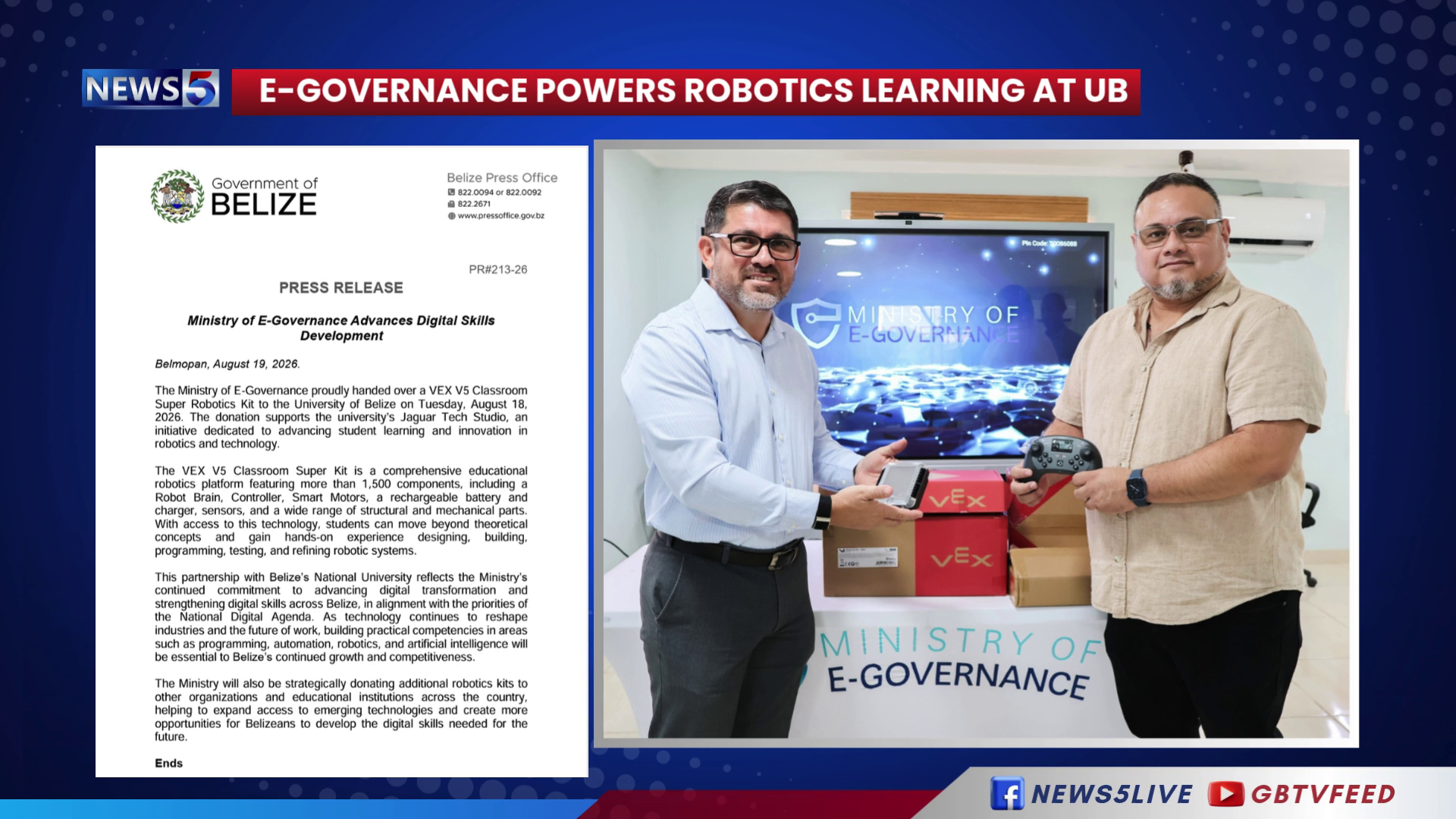
    For many residents of Belize, advanced robotics remains a far-off concept tied to science fiction, but a new initiative from the government is bringing this cutting-edge technology directly into university lecture halls to prepare the next generation for an increasingly automated global workforce.

    On August 19, 2026, Belize’s Ministry of E-Governance officially delivered a VEX V5 Classroom Super Robotics Kit to the Jaguar Tech Studio at the University of Belize (UB), marking a key milestone in the country’s National Digital Agenda strategy. Unlike generic educational equipment, this comprehensive kit includes over 1,500 individual components ranging from a central processing “robot brain” and wireless controller to precision smart motors, environmental sensors, rechargeable power systems, and modular mechanical parts. With these resources, students can move beyond abstract textbook learning to design, construct, code, test, and refine fully functional robotic systems from their own concepts.

    Government officials emphasize that this donation is far more than a one-off gift of high-tech hardware. It is a core component of a broader national effort to expand accessible digital and technical skills across Belize’s education sector, as the world sees rapid shifts in labor markets driven by automation, artificial intelligence, and advanced manufacturing. The hands-on learning opportunity is designed to bridge the long-standing gap between theoretical computer science education and practical innovation, empowering students to develop the problem-solving abilities that employers across tech and advanced industries increasingly demand.

    While the University of Belize is the first beneficiary of this national rollout, the Ministry of E-Governance confirmed that additional robotics kits will be distributed to other educational institutions and youth-focused organizations across the country in the coming months. The initiative reflects a growing recognition among Belizean policymakers that early investment in technical STEM (science, technology, engineering, and mathematics) education is critical to ensuring the country’s young people can compete and thrive in the evolving global economy, rather than being left behind by rapid technological change.

  • Miss Universe Franchise Responds to Backlash

    Miss Universe Franchise Responds to Backlash

    Days of public outrage over the 2026 Miss Universe Belize pageant have pushed the global pageant’s national franchise to break its silence, issuing a formal public statement that confirms Caleigh-Rose West’s win was valid while owning up to the string of missteps that sparked widespread confusion during the live finale broadcast.

    The statement, released on August 19, acknowledges multiple missteps that marred the event, ranging from mistakes in calculating contestant scores to failures in production logistics and disruptions to the live airing. Organizers emphasized that a thorough, independent review of all judges’ scoring confirmed West secured the highest cumulative marks, making her the rightful holder of the national crown.

    One of the most heavily criticized missteps was the broadcast’s use of stock images of Guatemala’s iconic Tikal archaeological site during the nationally televised event, a gaffe that angered Belizean viewers who expected the broadcast to highlight Belize’s own rich cultural and historical heritage. The organization labeled the incident as an unforgivable serious production error, extending a formal apology to the entire Belizean public. It also clarified that all graphic assets for the broadcast were produced in-house by a local Belizean production team, which has already issued its own separate apology for the mistake.

    To rebuild public trust following the controversy, the Miss Universe Belize franchise has outlined a series of sweeping reforms for future competitions. These changes include introducing real-time public score tabulation to eliminate scoring confusion, implementing independently certified judging procedures to ensure fairness, and making future pageant broadcasts available to the public for free, increasing accessibility and transparency.

    As West prepares to travel to Puerto Rico to represent Belize at the global Miss Universe 2026 competition, pageant officials are calling on the Belizean public to set aside divisions from the controversy, rally around the newly crowned queen, and stand together as she represents the country on the international stage.

  • Faith Meets Fierce Competition on KTV Gospel Night

    Faith Meets Fierce Competition on KTV Gospel Night

    As the countdown to the grand final of a popular KTV singing competition gets underway, competitors delivered a memorable night of faith-infused performances at the iconic Bliss Center in Belize District on August 19, 2026. With only four contestants remaining in the running for the $10,000 grand prize, every participant pushed their creative and vocal boundaries by stepping far outside their usual performance comfort zones.

    Unlike previous rounds that featured mainstream popular music, this special edition of the competition centered on gospel selections, original self-penned compositions, and custom jingles created for SMART, a key event partner. The theme twist brought a unique blend of spiritual conviction and artistic originality to the stage, as every singer sought to connect deeply with both the judging panel and the voting public that will ultimately decide the winner.

    Local entertainment correspondent Britney Gordon has prepared a full highlight package of the night’s standout moments, with raw video clip set to be added to the online broadcast following the original evening television airing. This online publication is presented as a verbatim transcript of the televised newscast. Per the outlet’s long-standing editorial policy, any commentary delivered in Kriol, Belize’s widely spoken creole language, has been transcribed using a standardized spelling system to preserve the original tone and content of the remarks. Readers can access the full uncut televised broadcast via a linked embed on the news organization’s website.

  • Circus at Belle posed public health risk – expert

    Circus at Belle posed public health risk – expert

    A leading Caribbean environmental expert has backed the government’s decision to relocate the Suarez Brothers Circus from a protected groundwater site in Barbados, while suggesting circus operators may have received incomplete guidance on the strict permitting requirements for the sensitive location.

    Dr. Adrian Cashman, former director of the University of the West Indies’ Centre for Resource Management and Environmental Studies (CERMES), clarified that public health risks stemmed not just from the site’s location, but from the circus’s day-to-day operations near one of the country’s most important drinking water sources. Speaking after government officials outlined the rationale for the move at a recent press briefing, Cashman emphasized the site sits within Zone A, the highest classification of water protection area designed to shield the country’s primary Belle aquifer from contamination.

    “It’s not so much the physical location; it’s the activities that would go on in that location, as the minister was pointing out. You not only have hundreds of members of the public visiting each day, but you also have the performers who would be living on-site, and that all takes place in a Zone A water protection zone,” Cashman explained. He added that recent heavy rainfall across Barbados drastically speeds up the movement of pollutants into the groundwater, cutting short the 90-day buffer period that Zone A designation is designed to provide. “If you have activities generating wastewater or leaving pollutants on the ground, these recent intense downpours would wash those contaminants into the aquifer far faster than the 90-day protection window the zone is supposed to provide. This is an unambiguous public health risk,” he said.

    When asked how the circus was initially permitted to set up at the International Botanical Gardens at the Belle, Cashman suggested the multi-step permitting process across multiple government agencies may have left operators without clear guidance on all required approvals. “Different activities require different levels of clearance from different bodies. It seems to me that they were ill advised. Maybe it wasn’t made clear to the Suarez Brothers team when they were applying just how broad the set of permissions they needed to obtain actually was,” he noted.

    The relocation incident has already sparked internal government reflection on inter-agency coordination. Deputy Prime Minister and Minister of Environment Santia Bradshaw referenced the controversy during closing remarks for the 2026 Environmental Summer Internship Programme on Monday, stressing that natural resource protection depends on breaking down silos between government departments. “We have seen what a circus can be made of when we do not communicate effectively,” Bradshaw told interns, adding that collaboration across agencies and disciplines is non-negotiable for protecting Barbados’ limited natural resources.

    Cashman also addressed public concerns surrounding two other developments sited in the same Zone A protection area: a new geriatric hospital and a reported incinerator. He noted that the hospital, which is not connected to the Bridgetown or South Coast sewage systems, would have undergone rigorous statutory consultation with the Barbados Water Authority during the planning process, requiring strict on-site wastewater collection and treatment protocols that keep contamination risk extremely low.

    “Any planning permission for a major development like this is legally required to include consultation with the Barbados Water Authority. Any concerns would have been raised and incorporated into the permit’s conditions. I would be extremely surprised if all of the relevant matters had not been taken into consideration, resulting in an extremely low contamination risk,” Cashman explained. He declined to comment on the proposed incinerator, noting that it falls outside his area of expertise.

    Cashman praised the Barbados Water Authority and other involved government agencies for their consistent commitment to protecting public water supplies, noting that their high level of professionalism often flies under the public radar. “I’ve worked with the Barbados Water Authority and some other government agencies over many years now, and I think it is underrecognised the degree of professionalism that they exercise in these cases,” he said, adding that agencies should be more proactive about sharing their work with the general public: “I would say, blow their own trumpet a little bit more.”

    The circus relocation controversy unfolded over roughly two weeks: On July 25, Suarez Brothers Circus announced its return to Barbados, with performances set to begin August 7 at the Belle’s International Botanical Gardens. The circus opened as planned on August 7, but just one day later, authorities notified management of contamination risks linked to the Zone A location and the lack of approved hygienic water access. The circus was granted limited permission to sell pre-packaged food on August 9, with all on-site food preparation banned, before the site was shut down entirely that same day, cancelling the scheduled 5 pm performance. By August 10, crews began dismantling the circus grounds while management met with officials to review five potential alternative locations. On August 16, Garrison Savannah was selected as the new site, and equipment relocation began immediately. In an August 17 interview with Barbados TODAY, circus manager Ivan Suarez said the company had already completed and paid for permitting through multiple government agencies for the original Belle site, and was now forced to repeat the entire process for the new Garrison Savannah location. During an August 18 press conference, Minister Marsha Caddle confirmed that while the circus had obtained permission from the Ministry of Environment to operate at the Belle, it failed to secure all required clearances from other relevant authorities, including water access approval from the Barbados Water Authority and approved on-site accommodation for performing staff.

  • Education advocates urge transparency, deeper scrutiny following CXC results

    Education advocates urge transparency, deeper scrutiny following CXC results

    The release of 2026 preliminary results from the Caribbean Examinations Council (CXC) has sparked renewed calls from two prominent regional education advocates for sweeping changes to exam reporting, systemic transparency, and national investigations into student well-being across the Caribbean. While thousands of candidates across the bloc have marked academic achievements across four major CXC qualification frameworks – the Caribbean Advanced Proficiency Examination (CAPE), Caribbean Secondary Education Certificate (CSEC), Caribbean Vocational Qualification (CVQ), and Caribbean Regional Certificate of Secondary Competence (CCSLC) – advocates argue that the official published aggregate statistics hide deep, long-running systemic flaws that demand immediate, targeted scrutiny.

    Official published metrics put the 2026 regional pass rate for CSEC at 72.18%, with CAPE posting an even higher 93.5% pass rate, under CXC’s current grading system that designates Grades 1 through 5 as passing outcomes. But Paula-Anne Moore, a parent advocate who serves as spokesperson for both Barbados’ Group of Concerned Parents and the regional Caribbean Coalition for Exam Redress, has raised urgent questions about the real-world utility of these broad, aggregated passing bands, especially for students seeking employment or admission to competitive higher education institutions.

    Moore pointed out that while CXC classes Grades 1 to 5 as acceptable passing outcomes for CAPE, few competitive employers or reputable tertiary institutions would consider a Grade 4 or 5 acceptable in today’s crowded academic and job markets. Even a Grade 3, she noted, falls short of entry requirements for many leading universities. To bring regional exam reporting into line with global best practices – such as the United Kingdom’s Cambridge A-Level system, which publishes granular breakdowns of top A and A* grades – Moore has called on CXC and all Caribbean national education ministries to publish disaggregated data on the share of candidates attaining Grade 1, the highest performance level, for both CAPE and CSEC. She also highlighted the complete absence of public data on another critical matriculation benchmark: the share of students passing five CSEC subjects, including core Mathematics and English A, a requirement for entry to most post-secondary programs across the region. While Moore acknowledged that CSEC Mathematics pass rates have risen to 42% this cycle, she warned that aggregated statistical reporting is often used to frame incremental gains as major successes, rather than encouraging full transparency that would reveal ongoing gaps in performance.

    Dr Zhanè Bridgeman-Maxwell, a science educator and the second advocate involved in the call for reform, offered context for the stark performance gap between CAPE and CSEC pass rates, noting that the structure of post-secondary study shapes student outcomes intrinsically. Unlike CSEC, which is a compulsory secondary-leaving qualification for most students, CAPE is undertaken by students who have already chosen to pursue sixth-form study in specialized, career-focused academic disciplines. “When you are intrinsically motivated, and you’re choosing something that you like, students tend to be more engaged,” she explained, noting that high CAPE pass rates do reflect that students who reach this stage of study are generally thriving. The gap, she argued, lies in the large share of regional students who never progress past CSEC before seeking post-secondary opportunities. While some leading regional institutions, such as the University of the West Indies, offer preliminary bridging programs to help these students close preparation gaps, the achievement gap remains a major barrier to upward mobility for thousands of young Caribbean people each year.

    Beyond academic performance outcomes, both advocates raised alarms about two underreported trends revealed in the 2026 results data: candidate absenteeism and widespread examination irregularities. CXC’s official data records more than 35,000 candidate no-shows for the 2026 exams, alongside 128 confirmed cases of exam malpractice, most linked to unauthorized use of smart devices, candidate collusion, and the emerging threat of generative AI-facilitated cheating. Dr Bridgeman-Maxwell framed both absenteeism and cheating as interconnected coping mechanisms for students navigating a high-stakes testing system that places extreme pressure on young people. “At the end of the day, any source of irregularity in an exam and absenteeism are two sides of the same coin. What is common between the two is that candidates are finding a way of coping with facing a high-stakes test, whether that means not showing up or attempting unauthorised means to sit the exam,” she observed. She called on regional governments, tertiary institutions, and social service providers to conduct localized, in-depth studies to address rising academic anxiety, widespread student disengagement, and a growing gender gap that has seen increasing rates of male attrition from secondary education across the region. She also warned that unregulated generative AI use poses a growing threat to the development of critical thinking skills among students, and that cheating enabled by AI is likely to rise significantly without targeted, structured classroom interventions to help students use AI ethically.

    Moore went further, sharply criticizing CXC for its pattern of shifting blame for systemic exam challenges onto students and teachers, while refusing to acknowledge its own institutional missteps. She pointed to the January 2026 hybrid e-testing pilot for English A and Mathematics, which saw widespread disruption across Barbados and Trinidad and Tobago, with widespread technical failures, multi-hour delays, and inadequate paper backup plans that left thousands of students in severe distress. “Thousands of students were traumatised by these exams. They were inadequately piloted, no mock exams or basic preparation was provided, and exams were delayed by three to seven hours in a morass of confusion,” Moore said. “Yet CXC claimed no student was disadvantaged and delays were minimal. This callous, dismissive communication destroys trust and confidence in the system year after year.” She added that long-running unaddressed issues, including repeated exam paper errors, duplicated multiple-choice questions, and the failure to implement key recommendations from the 2020 Independent Review Team of CXC, continue to erode the credibility of regional qualifications among employers and universities globally.

    The conversation also touched on CXC’s newly piloted Caribbean Technical and Vocational Education Certification (CTEC), a modular assessment framework designed to reduce student cognitive stress by splitting cumulative exams into smaller, sequential units. CXC has hailed the pilot’s early results, reporting an 80 to 90% pass rate for CTEC Mathematics Module 1 and framing the outcome as proof that modular assessment improves student knowledge retention and reduces exam-related anxiety. While Dr Bridgeman-Maxwell welcomed the exploration of alternative assessment pathways as a positive step, she cautioned against premature celebration of the pilot based solely on entry-level module results. “Module 1 covers foundational entry level concepts. High pass rates there do not necessarily map onto students performing well in higher-order mathematical mastery required in module 2 and module 3,” she noted, raising a core policy question: “does modularisation build genuine competence in students, or does it simply certify basic skills for better reporting metrics of CXC?”

    Both advocates agreed that while new structural initiatives like CTEC hold potential for improving student experiences, modular assessment tools cannot replace the core foundations of strong classroom learning, robust diagnostic teaching, and full institutional accountability across the entire Caribbean Community (CARICOM) education ecosystem. Until CXC addresses long-standing transparency gaps, institutional failures, and unaddressed systemic barriers to student success, they argue, regional qualifications will continue to fall short of meeting the needs of Caribbean young people.

  • Stone Thrown at MBS Office as Public-Sector Buildings Face Fresh Damage

    Stone Thrown at MBS Office as Public-Sector Buildings Face Fresh Damage

    A wave of targeted vandalism against public infrastructure in Antigua’s capital St. John’s took a new turn Wednesday afternoon, when an unidentified object believed to be a stone was thrown through a window of the Medical Benefits Scheme’s Human Resources division. The incident unfolded just after 1:00 p.m. at the office, which occupies an upper floor above the MBS Pharmacy on the busy Nevis Street corridor. The sudden act of vandalism left office staff shaken by the unexpected, dangerous event. In response to the incident, management authorized all employees to clock out early and leave the premises for the rest of the workday. Wednesday’s attack comes on the heels of overnight vandalism that left three separate government agencies on Independence Drive with damaged property. Between Tuesday evening and the early hours of Wednesday morning, unknown perpetrators damaged glass entryways at three major public institutions: the Antigua Public Utilities Authority, the national Treasury Department, and the Antigua and Barbuda Social Security Board. Law enforcement officials have already launched formal investigations into the three earlier overnight incidents. As of the latest update, investigators have not confirmed any formal link between the earlier vandalism spree and Wednesday afternoon’s stone-throwing attack at the Medical Benefits Scheme office, leaving open multiple lines of inquiry into the recent string of destruction targeting public-sector buildings.

  • Chinese humanoïde robot Unitree breekt records op de beurs

    Chinese humanoïde robot Unitree breekt records op de beurs

    On a watershed Wednesday for the global humanoid robotics industry, leading Chinese commercial humanoid robot developer Unitree Robotics made a blockbuster debut on Shanghai’s STAR Market, with its share price surging more than 620% from its initial offering price. The spectacular opening rally sent the Hangzhou-based firm’s market capitalization soaring to a peak of 445 billion yuan, equivalent to roughly $66 billion — a seven-fold jump from its pre-IPO valuation of around 61 billion yuan ($9 billion), which was set at an initial offering price of 50.8 yuan per share.

    Founded in 2016 by engineer Wang Xingxing, Unitree Robotics has emerged as one of China’s most high-profile and commercially successful humanoid robotics manufacturers. The company first gained global attention through viral demonstrations of its humanoid robots performing dynamic dances and martial arts routines, showcasing the firm’s advanced motion control technology. Last year alone, Unitree delivered more than 5,500 humanoid robots to customers across the world, cementing its status as a leading player in the early commercialization of this cutting-edge technology. Most recently, the company unveiled its latest flagship model, dubbed the ‘Superman’, which the firm says is capable of jumping up to two meters in height and reaching a top speed of 12.66 meters per second.

    Industry analysts note that the overwhelming investor enthusiasm for Unitree’s IPO reflects the company’s unique strong position in a nascent market with few established, scalable competitors. “Unitree is one of the only humanoid robotics companies in the world that actually generates real revenue, is profitable, and operates large-scale production,” explained Rinat Mirzaitov, founder of industry research firm Humanoid Analytics. Even so, Mirzaitov cautioned that Unitree does not yet hold a dominant position across the full humanoid robotics market, and faces the key challenge of translating its current hardware innovation lead into widespread, practical commercial applications across different sectors.

    The rapid growth of China’s humanoid robotics sector comes as the industry has become a key focal point of technological competition between the United States and China. Last month, the U.S. administration under President Donald Trump issued an import ban on Chinese-manufactured humanoid robots, citing vague national security concerns. According to financial services firm JPMorgan, China already controls roughly three-quarters of the global market for humanoid robots and autonomous vehicles. Industry projections forecast explosive growth for the sector over the coming decade: global annual humanoid robot sales are expected to skyrocket from $2 billion in 2025 to as much as $300 billion by 2035.

    Unitree’s blockbuster debut underscores both China’s expanding leading role in this high-growth advanced technology sector and the extremely high expectations that global investors hold for the future commercial development of humanoid robotics.

  • Five Bajans earn CWI camp call-up

    Five Bajans earn CWI camp call-up

    Cricket West Indies (CWI) has named 22 of the most promising young female cricketers from across the Caribbean to attend a two-week elite High-Performance camp in Antigua, with preparations for the 2027 ICC Under-19 Women’s T20 World Cup now ramping up. Five players from Barbados earned selections, marking the second-largest national contingent at the camp – trailing only tournament winners Trinidad and Tobago, who secured seven spots. Among the Barbadian group is Eboni Brathwaite, the top run-scorer of the recently concluded CWI Rising Stars Under-19 Women’s Championship, where Barbados claimed the runner-up position behind Trinidad and Tobago.

    Regional representation is rounded out by four selections from the Leeward Islands, two picks apiece for the Windward Islands, Jamaica and Guyana, reflecting a broad scouting of talent across Caribbean territories. The high-intensity camp kicked off on Monday and will run through August 29, bringing emerging players straight from the regional championship grounds to the elite training environment in a deliberately structured timeline.

    Dwain Gill, CWI’s High-Performance Manager, explained the strategic logic behind the immediate transition from competitive tournament to specialized training. “The Rising Stars Championship gave us a valuable opportunity to see these players compete, respond to pressure and demonstrate their potential in a regional environment,” Gill noted. “We did not want that assessment process to end with the tournament. Bringing the selected players directly into camp allows us to build on what we have seen, work more closely with them and begin addressing the areas that will be critical to their progression.”

    Selections for the camp were not based solely on raw tournament stats; CWI’s selection panel weighed multiple factors including on-field performance results, in-depth technical evaluations, age eligibility requirements, tactical game awareness, on-pitch temperament, competitive drive and overall physical fitness. Once at the camp, athletes will undergo a holistic development program targeting four core domains: technical skill refinement, tactical game understanding, physical conditioning, and mental resilience for high-stakes competition.

    Leading the on-field training schedule is Ryan Austin, assistant coach of the senior West Indies women’s national team, who will be joined by two seasoned cricket figures: former West Indies wicketkeeper Shane Dowrich and Ramesh Subasinghe, head coach of the West Indies Academy. Beyond Brathwaite, the full 22-player roster includes Davehjah Brown, Zaniyah Bruce, CQuinya Dasent, Jessica Davis, Kaela George, Brianna Harricharan, Sabriel Headley, Allia Henry, Theanny Herbert-Mayers, Jadaeya Holder, Shriya Jairam, Danielle Manns, Jannah Mohammed, Brianna Plummer, Sian Ramnarine, Samara Ramnath, Zara Skerritt, Amrita Ramtahal, Jaeda Tyrell, Leanga Warner and Aaliyah Weekes. The camp marks a key milestone in CWI’s long-term pathway to develop a competitive squad for the 2027 global tournament, identifying and nurturing the next generation of West Indies female cricket stars.

  • NHC reports progress on housing handovers, tenant ownership

    NHC reports progress on housing handovers, tenant ownership

    Decades of uncertainty over property ownership for thousands of long-term public housing tenants in Barbados have moved closer to resolution, following new legislation passed by national lawmakers that clears the way for full legal transfer of occupied National Housing Corporation (NHC) units, though residents continue to voice frustration over lingering delays.\n\nThe long-running push to grant ownership to eligible long-term tenants gained formal legislative backing in May this year, when Parliament approved the State (Acquisition and Vesting of Property) Act. The legislation, designed to cut through years of crippling administrative backlogs, paves the way for 3,892 long-term NHC tenants to become official homeowners, with upper house senators hailing the law as a long-overdue reform expected to deliver sweeping social benefits. The measure covers nine major housing estates across the country: Deacons Farm, Grazettes, Fernihurst, Wildey, Bonnetts, Golden Acre, Silver Hill, Gall Hill and Wotton.\n\nIn an update on the programme’s rollout, NHC General Manager Ian Gill confirmed that progress is already visible in the initial distribution phases. To date, nearly 500 households across the first two allocation batches have successfully taken full ownership of their properties through the initiative.\n\nThe government’s scheme builds on the existing Twenty-Year Programme, a policy that grants full legal ownership to NHC tenants who have continuously rented their units for 20 years or more and met all eligibility criteria. For many qualifying residents, however, the promise of ownership has remained unfulfilled for more than a decade, leaving them grappling with serious practical and financial barriers.\n\nWithout official title deeds, many households cannot leverage their property as collateral for loans, unlock equity for home improvements or development, or formalize inheritance arrangements after the death of a property occupant. One long-term Deacons Farm resident, who has waited more than 10 years for her title, shared her experience following her mother’s death: despite having lived in the home her entire life, she was still required to produce formal legal proof of ownership to secure rights to the property. “When my mother got the keys for this house, she put them in my hand. I was the first one to open this door, and to this day I am still waiting for papers,” she said, adding that without formal documentation, she cannot even access basic banking services that rely on property proof.\n\nOther residents have pointed to a pattern of broken political promises around the title transfer process. Multiple residents reported that electoral candidates routinely pledge fast-tracked title deeds during campaign periods to win votes, only for the process to stall immediately after elections conclude. “When election time comes, they bring a piece of paper telling you that they will give it to you after the election in a couple of weeks or months, but it never happens. It is empty promises, and that has been going on for four or five elections now,” one long-term tenant explained, adding that every change in NHC leadership requires residents to restart the entire application process from scratch.\n\nGill acknowledged the frustration among waiting residents but sought to reassure them that the administrative process is moving forward, stressing that legal property transfers require thorough, deliberate oversight to avoid errors. “Everybody across Barbados who has been approved under the twenty-year programme will eventually receive their houses,” he said. “Whatever the legislation states, they will receive their houses. It is only a matter of time. Everything takes time, especially where legal work is concerned.”\n\nWhen asked to address separate resident concerns about the Grotto housing complex, Gill declined to comment on the record but invited local outlet Barbados TODAY to tour the site to observe ongoing work. During the outlet’s visit, two construction cranes were on site carrying out tree removal, and residents reported that the work is part of a broader estate beautification project that will include power-washing and repainting building exteriors, as well as cleaning up common green spaces and grounds.