博客

  • 72 Children, One Reality: Cancer in Belize

    72 Children, One Reality: Cancer in Belize

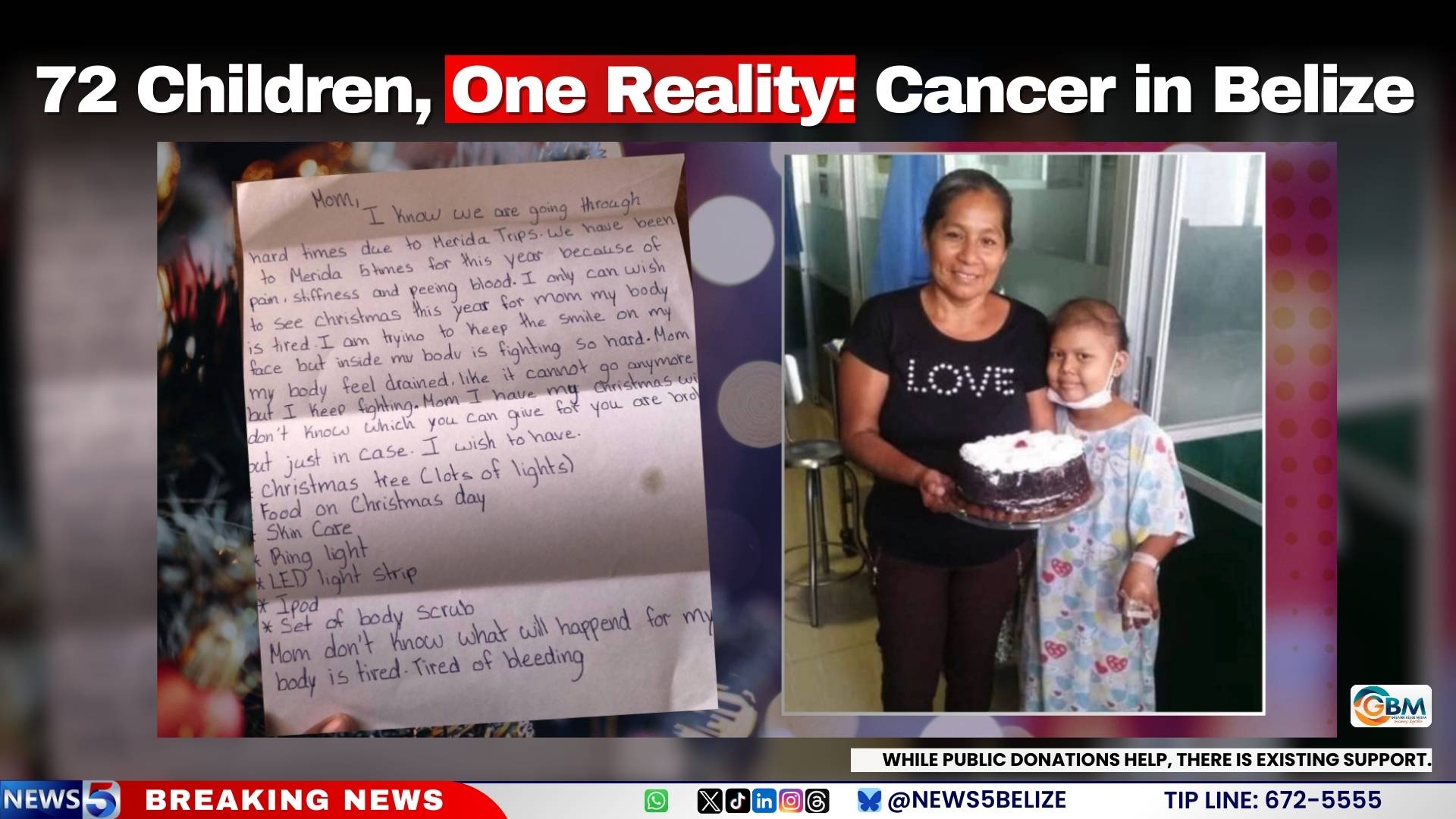
    BELIZE CITY – A deeply personal story of one child’s cancer battle has catalyzed national awareness around pediatric oncology in Belize, where official health data reveals 72 children have received cancer diagnoses over the past five years. These diagnoses create profound emotional distress and impose severe financial burdens on affected families, exposing systemic healthcare challenges in the Central American nation.

    Amidst this crisis, structured support mechanisms are emerging. The Belize Cancer Society has positioned itself as a critical intervention agency, providing comprehensive assistance with medical logistics, international travel coordination, and financial aid. “The moment a child receives a cancer diagnosis, families experience complete overwhelm. Our mission at the cancer center is to immediately step into that chaos with structured support,” explained Kim Simplis Barrow, President of the Belize Cancer Society.

    The organization facilitates navigation through complex healthcare systems and ensures timely access to treatment. “We deliver essential information and guide families through every step—from Belize to overseas care centers. Our response is typically immediate, without unnecessary delays,” Barrow emphasized.

    On the governmental front, Dr. Natalia Largaespada Beer, Technical Advisor at the Ministry of Health and Wellness, confirmed that chemotherapy treatments are fully funded at the Karl Heusner Memorial Hospital, with the government having eliminated the General Sales Tax on cancer medications to reduce financial barriers.

    Significant treatment advancements have emerged from pandemic-driven innovations. A coalition of healthcare providers now delivers specialized chemotherapy within Belize—a development initially necessitated by international border closures but now becoming a permanent enhancement to domestic care capabilities.

    Despite these improvements, critical limitations persist. Complex diagnostics and long-term treatment protocols still require international referrals, creating additional strain on families. Addressing this gap, a transformative project is underway: construction of a new pediatric cancer wing, supported by St. Jude Children’s Research Hospital, scheduled for completion in 2027. This facility promises to localize comprehensive childhood cancer care, fundamentally transforming treatment accessibility in Belize.

    “This initiative represents a monumental shift—it’s about bringing complete childhood cancer care home to Belize,” Barrow stated, highlighting the project’s potential to revolutionize pediatric oncology in the nation.

  • Ombudsman Swazo Reacts to Exit

    Ombudsman Swazo Reacts to Exit

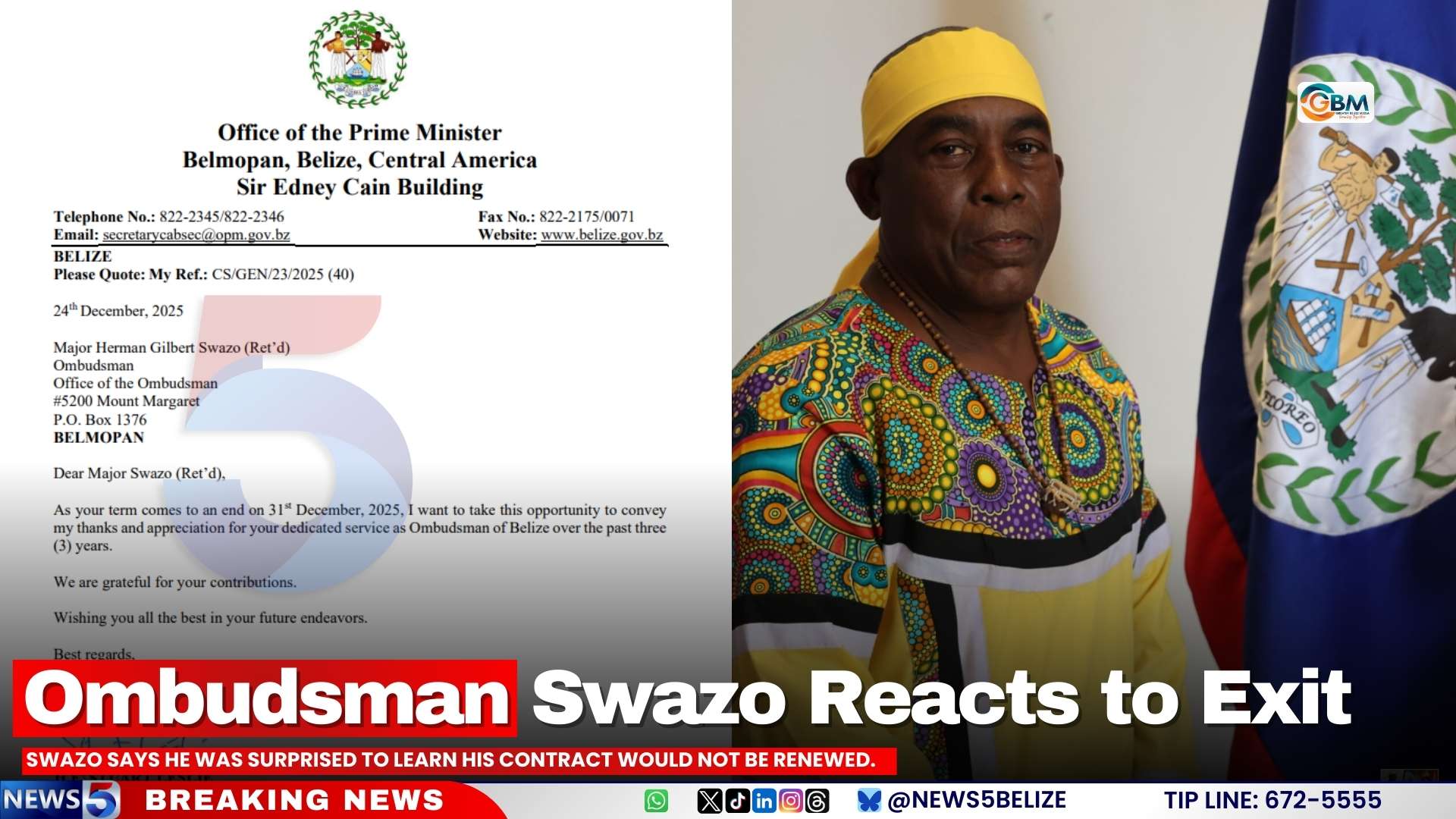
    In a development that has raised questions about governmental transparency, Belize’s outgoing Ombudsman Major Herman Gilbert Swazo (Ret’d) has expressed surprise at the non-renewal of his contract, which concludes on December 31, 2025. The seasoned official learned of the decision through an email delivered on December 24 from Cabinet Secretary Stuart Leslie, who conveyed the government’s appreciation for Swazo’s three years of dedicated service without addressing contract renewal prospects.

    Swazo revealed to News 5 that the correspondence made no mention of reengagement possibilities despite his prior requests for continuation. “The letter did not in any way or form, in my view, address reengagement,” Swazo stated. “To me, that implies then that I am not going to be reengaged.” The timing and delivery method of the notification added to the unexpected nature of the communication.

    During his tenure, Swazo maintained several public positions on governance matters, including freedom of information requests. When questioned whether these actions might have influenced the non-renewal decision, Swazo emphasized his strict adherence to legal parameters. “I took a solemn oath to abide by the Constitution and to do right in all manner of people,” he affirmed. “I operated within the confines of the law, and that is what I did.”

    Contradicting Swazo’s interpretation, Cabinet Secretary Stuart Leslie provided clarification to News Five, characterizing the letter as standard procedural communication marking the conclusion of an existing agreement. Leslie indicated that no definitive decision regarding Swazo’s potential contract renewal has been finalized by the National Assembly, suggesting the situation remains fluid rather than conclusively terminated.

    Despite the uncertainty surrounding his professional future, Swazo maintains no regrets about his tenure, asserting that his commitment to constitutional principles and rule of law guided every action during his service as Belize’s Ombudsman.

  • ATTORNEYS’ CALL: Employers told to re-examine disciplinary practices after CCJ ruling

    ATTORNEYS’ CALL: Employers told to re-examine disciplinary practices after CCJ ruling

    A landmark Caribbean Court of Justice (CCJ) decision has triggered urgent calls for Barbados employers to overhaul workplace disciplinary practices, with legal experts warning that procedural fairness and contractual compliance are no longer optional. The ruling in Massy Stores (Barbados) Limited v Forde [2025] has established stringent new standards for employee discipline that could expose companies to significant legal liability if ignored.

    Legal attorneys Katriel Pile and Maya L. Kellman, who conducted a comprehensive analysis of the precedent-setting case, emphasize that the court’s decision fundamentally reshapes employer obligations regarding employee misconduct proceedings. The case originated from a dispute where Massy Stores bypassed its own disciplinary procedures to summarily dismiss an employee, prompting judicial scrutiny of whether such actions constituted lawful termination.

    The CCJ’s ruling clarified that while summary dismissal remains justified for repudiatory breaches of employment contracts, employers cannot automatically resort to immediate termination without considering contextual factors. The court established that mere misconduct warranting dismissal doesn’t necessarily justify bypassing progressive disciplinary measures when other considerations are present.

    Pile and Kellman identify several critical principles emerging from the ruling: contractual incorporation of disciplinary procedures creates binding obligations regardless of employee tenure; suspension without pay requires explicit contractual authorization; and employers must demonstrate proportionality in sanctions considering mitigating circumstances and historical practices.

    Perhaps most significantly, the attorneys note the ruling establishes that procedural fairness requirements apply to all employees beyond probationary periods, dismantling the common misconception that short-service employees lack protection against unfair dismissal claims. The decision also introduces what legal experts describe as a ‘humanizing patina’ approach, recognizing that not every rule violation justifies termination and employers must account for human fallibility in workplace contexts.

    The legal analysis concludes that effective discipline now requires balancing rule enforcement with lawful, proportionate implementation that acknowledges workplace realities. Failure to adopt these standards could expose employers to claims for lost wages, breach of contract allegations, and significant reputational damage.

  • New U.S remittance tax could impact Dominican families in 2026

    New U.S remittance tax could impact Dominican families in 2026

    Beginning January 1, 2026, a significant policy shift will affect thousands of Dominican families who depend on financial support from relatives working in the United States. The U.S. government will implement a 1% tax on specific categories of international money transfers, particularly those funded through cash, money orders, or cashier’s checks sent to foreign destinations.

    This fiscal measure applies universally, regardless of the sender’s immigration status—impacting U.S. citizens, permanent residents, and undocumented workers equally when utilizing these payment methods. For Dominica, where remittances constitute a vital economic lifeline, this development carries substantial implications. These funds are instrumental in supporting daily household expenses, post-hurricane reconstruction efforts, educational costs, and healthcare needs.

    Economic analysts emphasize that remittances represent more than individual financial support—they serve as a critical component of the nation’s economic ecosystem. The circulation of these funds through local communities sustains small businesses, supports service providers, and fuels rural development initiatives. Even marginal reductions in transfer volumes could trigger noticeable effects on local spending patterns and commercial vitality.

    Notably, the regulation contains a crucial exemption: electronic transfers initiated directly from bank accounts, debit/credit cards, or digital remittance applications remain exempt from the additional levy. Financial experts are actively encouraging Dominican households to advise their overseas relatives to transition toward these digital channels to preserve the full value of their transfers.

    With the United States serving as Dominica’s primary source of remittance income, and billions of dollars flowing annually throughout the Caribbean region, this policy change underscores how U.S. financial regulations can produce immediate socioeconomic repercussions across neighboring economies. As 2026 approaches, Dominican communities are preparing through increased awareness, technological adaptation, and strategic financial planning to ensure that essential overseas support reaches beneficiaries without unnecessary reduction.

  • Building bridges, uniting wills, and cultivating peace

    Building bridges, uniting wills, and cultivating peace

    The Cuban Institute of Friendship with the Peoples (ICAP) commemorated its 65th anniversary on December 30, 2025, with a formal ceremony attended by top government officials and international delegates. Established on December 30, 1960, through Law No. 901 published in Cuba’s Official Gazette, the organization was founded by revolutionary leader Fidel Castro during a period of heightened tensions with the United States government.

    The anniversary event was presided over by President Miguel Díaz-Canel Bermúdez, alongside high-ranking officials including Foreign Minister Bruno Rodríguez Parrilla and Organization Secretary Roberto Morales Ojeda. Also present were Cuban Heroes, ICAP President Fernando González Llort, and Gerardo Hernández Nordelo, National Coordinator of the Committees for the Defense of the Revolution.

    ICAP President González Llort addressed 240 international guests from 32 countries, emphasizing the institute’s enduring mission to “build bridges, unite wills, and cultivate peace” across global boundaries. He highlighted the organization’s critical role in developing Cuba’s international solidarity network, which now encompasses over 1,900 organizations across 151 countries worldwide.

    The ceremony included recognition of long-serving ICAP employees and presented commemorative stamps to approximately twenty organizations and personalities. Throughout its 65-year history, ICAP has facilitated the establishment of solidarity committees with Cuba across five continents and provided international support through initiatives like the renowned Henry Reeve Cuban Medical Brigade.

    The institute continues to function as a fundamental pillar in maintaining Cuba’s diplomatic relationships and people-to-people connections despite ongoing geopolitical challenges, serving as a testament to Cuba’s commitment to international cooperation and mutual understanding.

  • Three Antiguans Named in King’s New Year Honours

    Three Antiguans Named in King’s New Year Honours

    In a prestigious recognition of outstanding contributions to national development and Commonwealth service, three distinguished Antiguans have been named in King Charles III’s New Year Honours list. The announcement was formally made by Governor General Sir Rodney Williams, with Buckingham Palace confirming the awards that will be formally presented at upcoming investiture ceremonies.

    The honorees include Janey Howell, appointed Officer of the Order of the British Empire (OBE) for her extensive philanthropic work; Dr. Gabriella Poppy Valentine Howell, named Member of the Order of the British Empire (MBE) for her contributions to cultural preservation and education; and Assistant Commissioner of Police Desmond Dinard, recipient of the King’s Police Medal (KPM) for exemplary service in law enforcement.

    Sir Rodney Williams emphasized that these awards reflect the nation’s core values of “dedication to duty, generosity of spirit, and commitment to the welfare of others.” He noted that the achievements of these individuals not only bring national pride but also serve as inspiration for future generations.

    Janey Howell’s recognition comes after decades of voluntary service in heritage preservation, including significant contributions to the Heritage Trust of Antigua and Barbuda and instrumental support for the Government House museum project. Her humanitarian efforts during the COVID-19 pandemic further demonstrated her commitment to community welfare.

    Assistant Commissioner Dinard received honors for his remarkable four-decade career in policing, beginning with his joining the force in 1982. His contributions span crime prevention initiatives, professional training programs, and enhancing public safety through both frontline and leadership roles.

    Dr. Howell was acknowledged for her leadership in cultural heritage and education, particularly her work in restoring The Great House Antigua as a heritage tourism destination and her involvement in the Government House Museum redevelopment project. Her charitable endeavors extend to healthcare, education, and environmental conservation.

    The Governor General highlighted that these honors underscore the international respect earned by Antiguans and Barbudans through their dedicated service. Further details regarding the formal investiture ceremonies will be announced in due course.

  • Several Archeological Sites Across Belize Defaced

    Several Archeological Sites Across Belize Defaced

    Belize’s archaeological authorities have issued a forceful public warning following a series of vandalism incidents at protected historical sites, with the ancient Mayan complex of Xunantunich becoming the latest target of destructive graffiti tagging. The Institute of Archaeology emphasized that such acts inflict permanent damage on the nation’s cultural heritage and violate strict preservation laws.

    Dr. Melissa Badillo, Director of the Institute of Archaeology, expressed profound disappointment at the recurring vandalism despite ongoing educational initiatives. “It is deeply disheartening to witness visitors engaging in such destructive behavior,” Dr. Badillo stated. “We maintain continuous awareness programs with schools, tour operators, local communities, and researchers precisely to prevent these occurrences.”

    The Institute highlighted the severe legal consequences for damaging protected monuments, including fines reaching $75,000 Belize dollars or imprisonment for up to five years. Dr. Badillo acknowledged the challenges of monitoring visitor behavior, particularly in high-traffic tourist areas, while emphasizing the shared responsibility of both local and international visitors.

    “We’ve documented incidents involving both Belizean citizens and foreign tourists,” Dr. Badillo noted. “Our message is unequivocal: this destructive behavior is universally unacceptable and carries serious legal ramifications.”

    The Institute urges all visitors to respect site regulations, follow guidance from archaeological rangers and certified tour guides, and immediately report any suspicious activity to help preserve Belize’s irreplaceable archaeological treasures for future generations.

  • Dominican man in Antigua pleads for help amid life-threatening cancer battle

    Dominican man in Antigua pleads for help amid life-threatening cancer battle

    A 61-year-old Dominican native who has resided in Antigua and Barbuda for over two decades now confronts a severe health crisis in isolation. Zophar ‘Tupac’ Andrew, who originally migrated seeking improved economic prospects, received a prostate cancer diagnosis approximately twelve years ago and currently requires urgent surgical intervention estimated at EC$6,000—a sum he cannot possibly afford.

    Andrew’s situation is compounded by his complete lack of official documentation in Antigua. Without a passport, Social Security identification, or medical benefits coverage, he finds himself systematically excluded from formal assistance programs. His health deterioration has progressively diminished his capacity for self-sufficiency and employment.

    In a candid reflection, Andrew acknowledged his past lifestyle choices: ‘I initially achieved financial success but squandered resources on reckless pursuits. I once perceived myself as invincible, but my circumstances have dramatically reversed.’

    Despite approaching multiple religious institutions for support, he received only spiritual consolation rather than tangible aid. His familial connections remain in Dominica, but relatives lack the financial means to assist, while in Antigua, he faces complete isolation.

    Currently occupying a small unauthorized wooden shelter on agricultural property in Jennings, Andrew sustains himself through minimal subsistence farming. However, even this basic survival mechanism becomes increasingly challenging as his physical capabilities decline.

    Remarkably, Andrew maintains resilient determination, explicitly stating he seeks not sympathy but merely an opportunity to survive. Having contributed to Antiguan society through decades of labor, he now appeals to the community for support during his most critical struggle.

    Potential supporters may contact him directly at 1-268-723-3379. While he has received minor provisions of food and essentials, the substantial financial requirement for life-saving surgery remains unmet.

  • Family of Ten Left Homeless After Early Morning Fire

    Family of Ten Left Homeless After Early Morning Fire

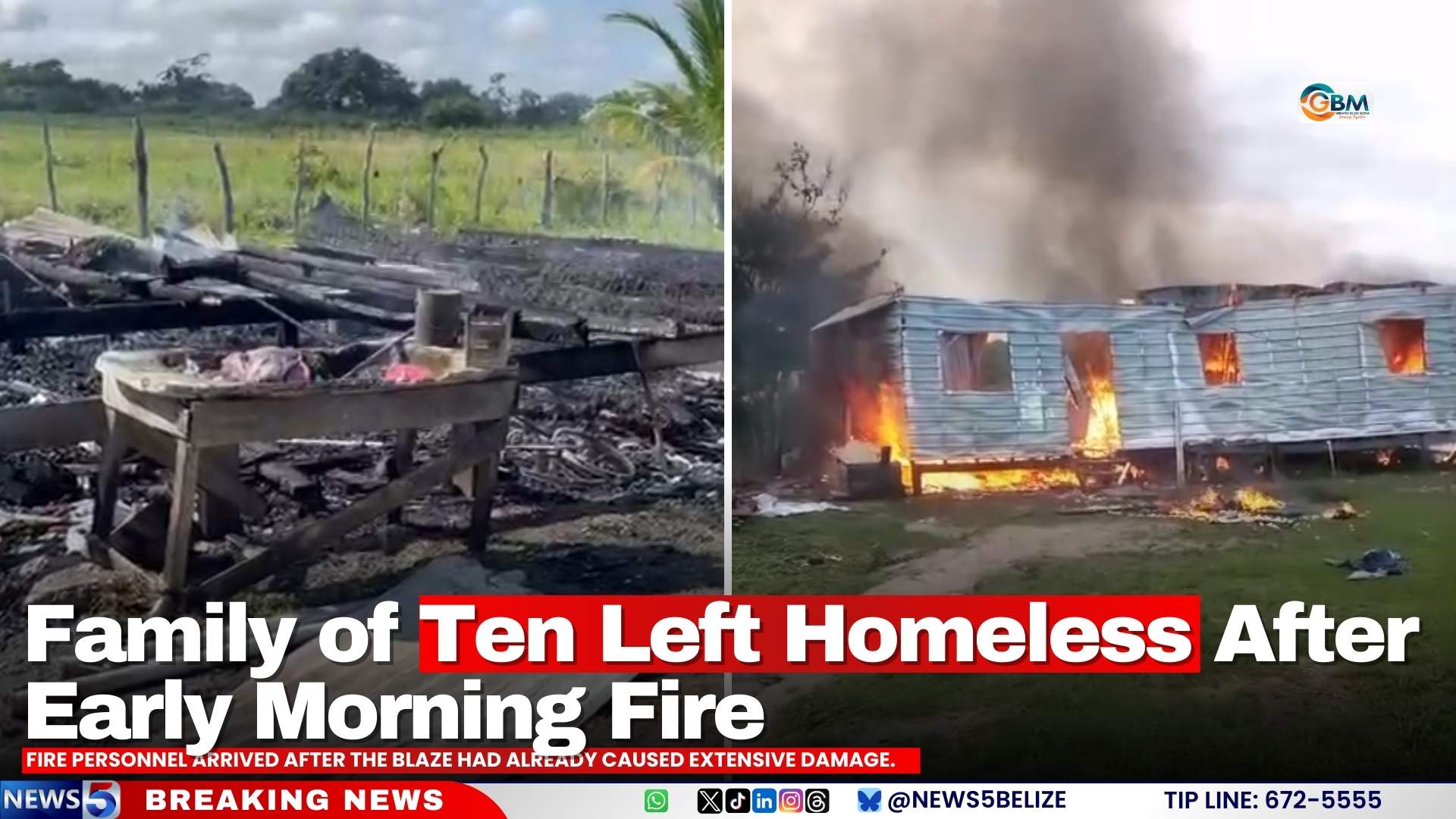
    A devastating early morning fire has left a ten-member family homeless in Guinea Grass Village, Orange Walk, destroying their residence and all personal possessions. The blaze erupted approximately at 6:00 AM on December 30, 2025, when resident Jose Mejia, 25, awoke to the smell of smoke and discovered flames emerging from an unoccupied bedroom.

    Mejia recounted the rapid escalation of the emergency in a telephone interview, describing his frantic efforts to evacuate nine other family members including multiple young children and a 45-year-old father-in-law. Despite the swift spread of the fire, all occupants managed to escape with only minor injuries reported, including a slight burn to Mejia’s foot sustained during the rescue operation.

    The family attributes the fire’s origin to an electrical malfunction involving an outlet on a structural post. Fire department personnel arrived after the structure had sustained extensive damage, preventing salvage of any belongings. Mejia described attempts to rescue clothing and other items that were ultimately consumed by the advancing flames.

    The household, comprising children ranging from four to fifteen years old alongside young adults, now faces complete destitution. With no possessions remaining, the family has issued a public appeal for assistance as they confront the overwhelming task of rebuilding their lives. Community members wishing to provide support may contact the family at +501 656-2143 or +501 606-0666.

  • Goddard Enterprises records profits following cocoa business turnaround

    Goddard Enterprises records profits following cocoa business turnaround

    Barbados-based conglomerate Goddard Enterprises Limited (GEL) has announced a substantial financial upswing for its fiscal year ending September 30, with net profits climbing to $76.8 million—marking a $24.3 million increase compared to the previous year. This impressive performance was largely driven by a dramatic reversal in its cocoa processing operations in Ecuador.

    The company’s earnings per share rose to 27.9 cents, and shareholders are set to receive a final dividend of three cents per share in late February. Chairman Charles Herbert and Managing Director Anthony Ali attributed the strong results primarily to improved manufacturing performance, particularly highlighting the remarkable recovery of their Ecuadorian subsidiary, Ecuakao.

    Ecuakao, which had suffered significant losses of $21.2 million the previous year, generated a robust profit of $16.7 million this fiscal period. Company leadership cited increased cocoa production volumes, expanded sales, and favorable pricing for raw cocoa beans as key factors behind this turnaround. The manufacturing division’s return to profitability was largely contingent on Ecuakao’s recovery.

    Despite these gains, the company incurred substantial costs associated with its financial strategy. GEL allocated $8.5 million for protective measures related to cocoa futures trading and provisioned $4.1 million for potentially irrecoverable customer debts.

    The conglomerate’s consumer products joint venture with Trinidad and Tobago’s Agostini Limited, Acado Limited, delivered another strong performance, with most markets showing positive results despite operational challenges in St. Lucia.

    Goddard Catering Group reported solid revenue growth but faced profitability pressures due to losses at associate companies in Costa Rica. The group recorded $10.8 million in expected credit loss provisions from two associates and wrote down $5.4 million in goodwill from its Panama catering business, which has been struggling with intensified competition at the country’s main international airport.

    The building supplies division achieved an 8.5% revenue increase while maintaining operating profits consistent with the previous year, though higher interest and tax expenses reduced net profits from this segment.

    Conversely, the automotive division experienced a challenging period with weak vehicle sales in Barbados and Jamaica, inventory reduction efforts, increased financing costs related to the GAC brand launch, and a $1.3 million property revaluation loss in Barbados.

    The smaller shipping and services division performed in line with management expectations, according to company officials.