博客

  • Regional Measles Spike Brings New Health Warning for Belizeans

    Regional Measles Spike Brings New Health Warning for Belizeans

    As of early April 2026, public health officials in Belize have issued a pressing warning to residents over a surging measles outbreak sweeping across the Americas, with transmission risks amplified by nearby cases in neighboring nations. Just three months into the year, the Pan-American region has already logged 75% of the total measles cases reported across all of 2025, and public health data confirms case counts continue to climb at an accelerating rate. Eleven confirmed deaths have already been linked to the current outbreak, nearly all concentrated in Belize’s bordering countries Guatemala and Mexico, a geographic proximity that has put cross-border spread at the top of local health authorities’ list of concerns.

    Contrary to a common misperception that measles is a trivial childhood illness, health leaders stress it is an extremely contagious viral infection that can trigger permanent, life-altering health complications. After exposure, symptoms typically develop within a window of 7 to 21 days. Initial signs include high fever, nasal congestion, and inflamed, watery eyes, which are followed several days later by a distinct rash that originates at the hairline before spreading across the entire body. A particularly insidious feature of the virus is its ability to spread before an infected person shows obvious symptoms: carriers can transmit the pathogen starting four days before the rash emerges, and for four days after it appears, meaning many people spread the illness without knowing they are infected.

    Despite the alarming spread of the outbreak, Belize’s Ministry of Health and Wellness emphasizes that measles is entirely preventable through vaccination. The widely used MMR (measles, mumps, and rubella) vaccine is documented as safe and extremely effective, with a two-dose series offering lifelong protection against the virus. Preliminary data from 2025 shows Belize achieved an 88% coverage rate for the first dose of the MMR vaccine, but gaps in immunization leave large swathes of the population vulnerable. Unvaccinated people face a 90% chance of contracting measles if exposed to the virus, making widespread vaccination not just a matter of individual health, but a critical defense for community-wide herd immunity.

    In response to the current threat, Belizean health authorities are calling on all unvaccinated residents of all ages to schedule an appointment at their nearest public health facility to get vaccinated as soon as possible. For residents planning cross-border travel to neighboring countries or other destinations in the Americas, the Ministry strongly advises that unvaccinated travelers complete their vaccine series at least two weeks before departing, to allow the body to build full immunity ahead of potential exposure.


  • Prescod urges Landship ‘rebirth’, slams ‘commercialisation’

    Prescod urges Landship ‘rebirth’, slams ‘commercialisation’

    One of Barbados’ most cherished, centuries-old community cultural institutions is facing an identity crisis as growing commercialization for tourism pulls it away from the working-class grassroots roots that gave it life, the island’s Minister for Pan-African Affairs and Heritage Trevor Prescod has warned.

    Prescod shared his concerns Wednesday during a cultural heritage workshop hosted by the Pinelands Creative Workshop (PCW), arguing that the core spiritual essence of the Barbados Landship can only survive when anchored in the rural village communities that spawned the movement more than 160 years ago.

    Originating in 1863 in Licorish Village, My Lord’s Hill, the Landship is a one-of-a-kind cultural tradition modeled after a seafaring vessel, featuring naval-style hierarchical ranks, community parades, and choreographed movement sequences designed to simulate a ship sailing across dry land. Beyond its performative elements, the movement was originally founded as a mutual aid society for working-class Barbadians: it provided members with collective fellowship, cooperative savings programs, and funeral support, while using immersive music, dance, and ceremonial practice to strengthen and preserve Afro-Barbadian cultural identity and local community bonds. The tuk band music that accompanies Landship performances even carries layered historical roots, adapted from the drum-and-fife marching traditions of the 19th century British military.

    Prescod, who represents Licorish Village as part of his St Michael East constituency, notes this small community remains one of the only places where the Landship still operates according to its original community-focused model. Today, by contrast, the tradition has shifted dramatically: from being woven seamlessly into the fabric of daily village life, it now exists primarily as a curated spectacle for national civic events and international tourists.

    “I still believe that the landship should go back to the village occasionally. That’s where the spirit and the dynamics of the life that formed the landship itself emerge,” Prescod said, reflecting on the rich, informal grassroots cultural life that once sustained local community bonds. He recalled a bygone era when neighborhoods were filled with spontaneous street performances, including the familiar sound of a penny whistle player busking early in the morning beneath residential windows — casual, community-rooted expression that shaped the Landship from its earliest days.

    In a subsequent interview with Barbados TODAY, Prescod expanded on his concerns, explaining that the Landship’s historic role as a self-sustaining community support network has eroded significantly amid the shift to commercial tourism-focused performance. The movement once operated as a formal economic and social safety net for working-class members: it ran collective savings schemes known locally as “susu” or “meeting turn” that helped members fund home construction, and offered practical and financial support to families grieving the loss of a loved one.

    “It has been commercialised and because it has been commercialised, it is losing its indigenous value,” he told the outlet.

    Despite these growing challenges, efforts to safeguard the tradition are already underway. The Barbados Landship Association is currently working to expand public engagement with the movement through school education programs and social development community projects. Just recently, the tradition earned international recognition when UNESCO added it to the 2003 Convention List of Intangible Cultural Heritage in Need of Urgent Safeguarding, a designation that draws global attention to at-risk cultural practices.

    Still, Prescod emphasized that international recognition alone is not enough to preserve the Landship’s core identity. He warned that modern commercial adaptation must not erase the tradition’s original purpose and cultural meaning, and called on the Pinelands Creative Workshop to support efforts to revive its grassroots roots. For the minister, the work ahead goes far beyond simple preservation of the status quo.

    “It’s not even a case of retaining it now,” he said. “We have to give it a rebirth.”

  • Davia Richardson Returns Home to Inspire Young Belizean Swimmers

    Davia Richardson Returns Home to Inspire Young Belizean Swimmers

    At 17 years old, Belize’s trailblazing swimming sensation Davia Richardson has traded the frigid pool decks of her training base in New York for the warm Caribbean waters of her home country, launching a multi-day outreach campaign designed to ignite a love of competitive swimming among Belize’s next generation of athletes. After making history as the first Belizean swimmer to earn a spot at the World Aquatics Championships in Singapore, bringing home multiple international gold medals and setting new national records, Richardson arrived in Belize on April 8, 2026 alongside her core support team: her mother, long-time personal coach, and sports psychologist, a testament to the foundational community that has fueled her rapid rise in global aquatics.

    Richardson’s first stop immediately after clearing the airport was the YWCA swimming pool in Belize City, where a group of young swimmers from the HUB Resource Center had already gathered to meet their sporting idol. Eager to show off their growing skills, the program’s senior age-group swimmers held an informal exhibition race for their visiting star, putting the techniques they have learned in training on full display. Speaking to reporters from local outlet News Five, Richardson expressed her joy at being back in her home country after months of training abroad.

    “It is good to be back. It is really cold in New York, so I love the weather here. I love seeing all the swimmers here and it makes me want to get in right now. So I am excited to be here for the next few days,” Richardson said.

    With 12 years of competitive swimming already under her belt, Richardson has used the sport to travel to corners of the world she never imagined she would see as a young girl growing up in Belize. Her core message to the young athletes she meets during this trip centers on the power of hard work, persistence, and a strong support network to turn even the biggest dreams into reality.

    “I have been swimming for twelve years and it has taken me all over the world. It brought me a lot of new memories. It had taken me to places I never thought I would be and just that you can get really far with a lot of hard work and determination and a really good support system which I have and I am really blessed to have them,” she added.

    The homecoming outreach trip is a collaborative effort between Richardson and the Belize Aquatics Federation, led by president Giovanni Alamilla. Alamilla explained that Richardson personally reached out to the federation to organize the initiative during her school break, saying she was eager to give back to the swimming community that launched her career. Over the first two days of her visit, Richardson and local coaches will host a specialized swimming camp for young aspiring swimmers. Richardson’s sports psychologist will also partner with the Belize Olympic Committee to hold mental skills workshops for athletes across multiple national sporting federations, covering everything from pre-competition preparation to managing life after major events.

    Beyond her work with young swimmers, the trip also holds deep personal meaning for Richardson. Five years after losing her father, she plans to visit his grave at Lord Ridge Cemetery during her stay, reflecting on how his memory and her love for her home country have carried her through hardship.

    “You can do a lot with the little you have. Hardship can be a lot. My dad passed away when I was twelve and he is buried so I am excited to go visit him. Knowing I am representing him and his country to the best of my ability helps me get through that hardship and challenge,” Richardson shared. “It is a small country but I am very appreciative with all the support I have been given and the continued support I will have and I hope you know I will do my very best to represent the country every time I step out on that block and I will continue to strive for greatness.”

    As she connects with emerging local talent and honors the roots that shaped her, Richardson remains committed to raising Belize’s profile in international aquatics and proving that world-class athletic dreams can start even in a small Central American nation. Reporting for News Five, Paul Lopez contributed to this report.

  • Spanish Chamber backs Abinader’s National Agreement amid global tensions

    Spanish Chamber backs Abinader’s National Agreement amid global tensions

    Santo Domingo — As geopolitical friction escalates across the Middle East between major global powers and regional actors, a leading Spanish business organization in the Dominican Republic has thrown its weight behind a new national initiative spearheaded by President Luis Abinader. The Spanish Chamber of Commerce in the Dominican Republic, widely known by its local acronym Camacoes, announced its formal support for Abinader’s call for a cross-sector National Agreement, designed to align all branches of government and private industry around a coordinated strategy to mitigate the economic fallout from intensifying international tensions involving the United States, Israel, and Iran.

    In a public briefing this week, Camacoes president Paco Pérez outlined the immediate risks that mounting instability in the Persian Gulf poses to the Dominican Republic’s open, trade- and tourism-reliant economy. Pérez emphasized that the volatility has already started to ripple through key national sectors, with tourism — one of the Dominican Republic’s largest sources of foreign revenue and employment — facing outsized pressure. The interconnected global energy market has pushed aviation fuel costs sharply higher in recent weeks, while growing uncertainty among international travelers has created a weaker outlook for bookings, a shift that could erode the Caribbean nation’s competitive edge in the global leisure travel market, Pérez explained.

    Beyond its statement of support, the chamber put forward a series of targeted policy recommendations to be included in the final National Agreement framework. Among the top priorities identified are concrete measures to counter extreme swings in global crude oil prices, speed up the country’s planned transition from fossil fuels to renewable energy sources, cut bureaucratic red tape to streamline cross-border customs procedures, and build up strategic stockpiles of critical essential goods. These steps, the organization argues, will help curb ongoing domestic inflation and shield household consumers from unexpected price shocks.

    Camacoes also reaffirmed the commitment of its member Spanish companies to stand alongside the Dominican government in addressing these challenges. Spanish firms operating in the country are ready to contribute cutting-edge technology and specialized professional expertise to advance progress on both energy transition and improved logistics management, the chamber confirmed.

  • Flooding in Guayacanes kills more than 11,000 chicks after heavy rains

    Flooding in Guayacanes kills more than 11,000 chicks after heavy rains

    On April 7, intense torrential downpours swept across the Dominican Republic, triggering widespread flash flooding that inflicted devastating damage across multiple sectors, with agriculture bearing the brunt of the destruction. One of the most stark losses unfolded at a commercial poultry farm in Guayacanes, a municipal district in the eastern province of San Pedro de Macoris, where rising floodwaters completely submerged the farm’s infrastructure. By the time emergency responses could be mobilized, more than 11,000 young chicks had perished in the inundation.

    Local reports confirm that floodwaters not only covered the farm’s entire breeding zones but also caused the structural collapse of multiple livestock pens. The rapid rise of water caught farm workers off guard, leaving them no time to evacuate the young birds or move them to higher, safer ground. For the farm’s owner, this incident amounts to a crippling financial blow, and it has also created an unexpected disruption to regional poultry supply chains that serve local communities across San Pedro de Macoris.

    The damage extends far beyond the single poultry operation. The heavy rainfall overwhelmed drainage systems in low-lying, high-risk communities across the country, leading to flood damage to hundreds of residential properties, critical rural road networks, and thousands of acres of productive cropland. As national emergency authorities continue their on-the-ground assessments to tally the full extent of flood-related damage nationwide, local agricultural producers have issued a urgent warning: extreme weather events like this intense flooding are growing more frequent, and they pose an escalating existential threat to small and medium agricultural operations across the nation. In response to the crisis, producers are calling on the national government to roll out targeted flood mitigation infrastructure projects and provide emergency financial support to help affected producers recover and build resilience for future extreme weather events.

  • Police Dismiss Kidnapping Claims in Dangriga Man’s Disappearance

    Police Dismiss Kidnapping Claims in Dangriga Man’s Disappearance

    A mysterious disappearance in Belize’s Dangriga District has taken an unexpected turn, after a close family member of missing local man Jericho Humes has refuted widespread kidnapping claims that circulated earlier this week. While the unsubstantiated abduction allegations have been dismissed by Humes’ own relative, the 35-year-old (as of local reporting context) man remains untraced, and law enforcement continues to treat the incident as an active missing person investigation.

    On Wednesday, Assistant Superintendent of Police Stacy Smith spoke to local media, confirming that investigators had interviewed Humes’ brother, who was one of the relatives initially linked to the kidnapping claims. According to Smith, the brother acknowledged that he had viewed an unverified video shared in connection to the disappearance, but stated clearly that the individual shown in the footage was not his missing sibling.

    “This case remains classified as a missing persons investigation, and all our investigative work is proceeding from that framework,” Smith told reporters. She added that law enforcement has not yet been able to trace how the relative received the unconfirmed video, noting that “whoever sent this material is a person of interest that our team is working to identify.”

    The latest official update comes just one day after a group of Humes’ relatives told police they had received a series of extortionate demands from anonymous callers. The relatives claimed the callers, who spoke Spanish and placed the calls from a number with a Mexican area code, demanded a $10,000 ransom for Humes’ safe release. The callers also sent a photograph purporting to show Humes with a knife held to his neck, and threatened that Humes would be killed if police were contacted to investigate the demand.

    To date, Belizean law enforcement has not been able to independently verify any of these extortion and kidnapping claims. Humes was last observed leaving his home to travel to work on a recent Wednesday morning. When he failed to return home and could not be reached, family members entered his property and discovered his home had been ransacked: a entry door had been forced open, and a pot of cooked food had been left out, left to spoil. No signs of Humes have been detected since that discovery.

  • GFA’s Referee Academy to elevate officiating standards

    GFA’s Referee Academy to elevate officiating standards

    In a landmark step for football development across the Caribbean island nation, the Grenada Football Association (GFA) formally launched its specialized Referee Academy during an official ceremony hosted April 8 at the VIP Conference Room of the Kirani James Athletics Stadium.

    The creation of this new institution marks a defining milestone in the GFA’s ongoing pledge to professionalize every tier of Grenada’s football ecosystem. For years, the local governing body has identified inconsistent officiating quality and a limited pool of certified match officials as key bottlenecks holding back the growth of both domestic leagues and national team competition. By establishing a dedicated training academy, the GFA aims to address these gaps directly, creating a clear, structured progression route for emerging referees looking to build careers in the sport. The initiative’s core objectives include boosting the overall standard of in-match officiating, supporting continuous professional development for new and existing officials, and expanding the pipeline of qualified referees eligible to oversee matches at both local and international levels.

    The launch ceremony opened with keynote remarks from GFA President Marlon Glean, who centered his address on the underrecognized critical role referees play in upholding the sport’s integrity and driving its forward progress. “This academy is far more than a new training program – it is a strategic investment in the future of Grenadian football,” Glean stated during the event. “Our core goal is to arm up-and-coming and current referees with all the technical knowledge, practical tools, and physical conditioning they need to thrive at the highest levels of the global game.”

    A highlight of the event was the attendance of Javier Santos, FIFA’s regional Referee Development Officer, whose participation highlighted the global governing body’s backing for Grenada’s efforts to bring its referee training framework in line with international best practices.

    Moving forward, the Referee Academy will deliver a holistic, multi-faceted training curriculum that combines in-depth theoretical classroom instruction with hands-on practical on-field training sessions. This blended approach is designed to ensure trainees master both the rules of the game and the on-pitch decision-making skills required at competitive levels. For the GFA, this initiative solidifies capacity building as a central pillar of the association’s long-term strategic vision to grow and elevate football across Grenada.

    Disclaimer: NOW Grenada does not take responsibility for opinions, statements, or third-party contributed media content published on its platform. Users may report content that violates platform guidelines through the official abuse reporting channel.

  • Annalisa Brown joins elite company with 800m Silver

    Annalisa Brown joins elite company with 800m Silver

    At the 2026 CARIFTA Games, young Grenadian middle-distance runner Annalisa Brown delivered a career-defining performance that etched her name into her country’s regional athletics record books, claiming silver in the Under-17 Girls 800 metres to secure a historic milestone. With this result, Brown became the first Under-17 female athlete from Grenada to earn medals in both the 800m and 1,500m events at a single edition of the Caribbean’s premier youth track and field competition, a feat not achieved by a Grenadian competitor of the same age group since Daniella Abraham’s 1999 performance in Fort-de-France, Martinique.

    Brown crossed the finish line at the 800m event with a time of 2:14.40, marking a new personal best for the rising star. This clocking also stands as the second-fastest 800m time recorded by any female Grenadian athlete in the 2026 competitive season, demonstrating the significant progress Brown has made since her last appearance at the games. Her silver medal marks an upgrade from the bronze medal she claimed in the same division at the 2024 CARIFTA Games, which were hosted on her home track in Grenada. Gold in the 2026 Under-17 800m went to Guyana’s Olivia Solomon.

    With this latest podium finish, Brown’s total CARIFTA medal count over her Under-17 career has risen to three, a tally that underscores her consistent competitiveness across multiple distances and multiple years of regional youth competition. A student at Boca Secondary School, Brown trains with the local Finishline Sports Club under the guidance of head coach Ronald Charles. In a post-race reflection, Charles opened up about the grueling multi-event schedule his young athlete navigated throughout the 2026 championships.

    “I’m very pleased with Anna,” Charles said. “It’s not the time we were hoping to get, but she participated in the 4×100m, the 1500m, and the rounds of the 800m. When we assessed her, she did mention slight discomfort, so the legs were a bit tired.” Even with the accumulated fatigue and physical strain of a packed competition schedule, Charles emphasized that Brown’s ability to hit a new personal best and secure an individual silver medal was a remarkable outcome.

    “Against that backdrop, achieving a new personal best and winning an individual medal on the track is a good look for us,” he added. Looking ahead, Brown is already scheduled to make her next competitive appearance at the 2026 Classic Lighting Communal Invitational, which will run from 25 to 26 April at Grenada’s Kirani James Athletic Stadium, where she will look to build on her historic CARIFTA Games success.

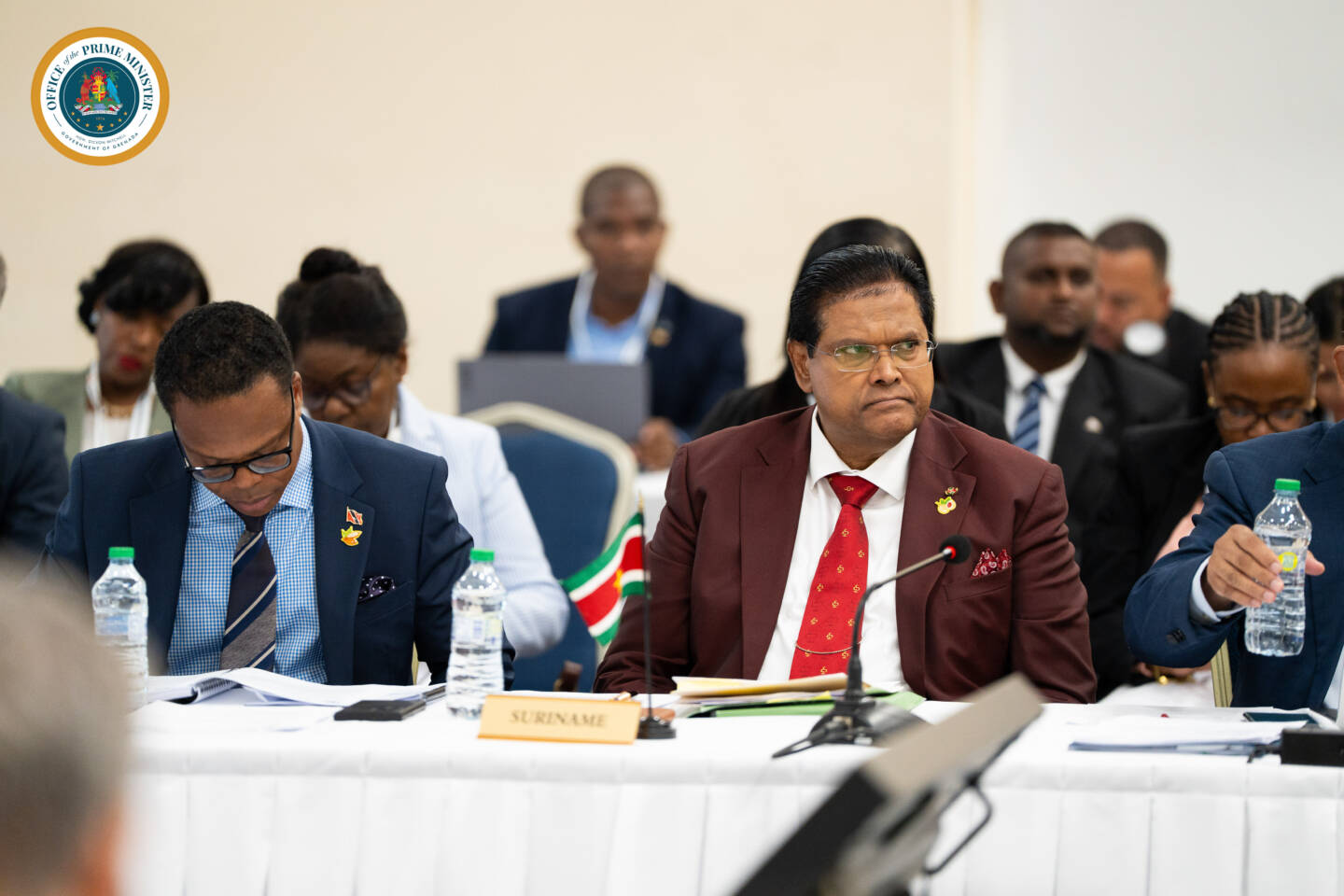
  • Condolences on the passing of H E Chandrikapersad Santokhi

    Condolences on the passing of H E Chandrikapersad Santokhi

    The Office of the Prime Minister of Grenada has issued an official statement of deep condolence to the government and people of the Republic of Suriname following the passing of former Surinamese President Chandrikapersad Santokhi.

    Widely remembered across the region as a committed public servant and a principled leader, Santokhi built his decades-long public career around a core belief in collaborative progress and collective action across the Caribbean. Throughout his tenure in public office, his work was defined by unwavering integrity, a dedication to public service, and a persistent commitment to strengthening democratic governance and expanding cross-regional partnerships.

    Santokhi served as Chairman of the Caribbean Community (Caricom) from July through December 2022, a period marked by widespread global volatility and uncertainty. During his time in this leadership role, he delivered steady, goal-oriented direction for the bloc, consistently advocating for Caribbean unity, prioritizing investments in regional resilience, and pushing for coordinated collective responses to shared transnational challenges. These challenges included the accelerating impacts of climate change, growing gaps in food and nutrition security, advancing sustainable development goals, and driving inclusive economic recovery in the wake of global shocks. His leadership centered on the enduring vision that the Caribbean region gains its greatest strength when all member states advance forward together.

    A core tenet of Santokhi’s approach to regional governance was the repeated emphasis that progress cannot be achieved in isolation. Instead, he argued that lasting advancement grows from intentional cross-border partnership and shared responsibility. This collaborative approach deepened constructive dialogue between Caricom member states and strengthened the foundational frameworks that support ongoing regional integration efforts.

    On behalf of the government and people of Grenada, the Prime Minister extended sincere sympathies to Santokhi’s immediate family, close friends, professional colleagues, and all communities in Suriname and across the broader Caribbean who are mourning his passing. The statement closed with a note of hope that Santokhi’s legacy of principled leadership, selfless public service, and unwavering commitment to Caribbean unity will continue to inspire current and future generations of regional leaders.

    The statement ends with a prayer for the eternal rest of Santokhi’s soul.

    *Editor’s note: NOW Grenada notes it is not responsible for the opinions, statements or third-party media content shared by contributors to its platform. Users may click to report any content that violates platform community guidelines.*

  • Possessory Titles (Amendment) Bill, 2026 to strengthen land ownership processes and transparency

    Possessory Titles (Amendment) Bill, 2026 to strengthen land ownership processes and transparency

    The Ministry of Legal Affairs, Labour and Consumer Affairs of Grenada has tabled a landmark piece of legislation, the Possessory Titles (Amendment) Bill 2026, designed to overhaul the nation’s existing framework for granting legal land titles through adverse possession. The proposed changes target longstanding gaps in the 2016 Possessory Titles Act, prioritizing three core goals: boosting procedural transparency, upholding fairness for all stakeholders, and speeding up the resolution of legitimate land claims.

    At the heart of the reform package are a series of targeted adjustments to eligibility and procedural rules that reshape how adverse possession claims are processed. First, the bill introduces stricter qualifying thresholds for claimants, including hard caps on the size of land that can be claimed via this process unless a compelling, documented justification for a larger claim is provided. It also raises the bar for required supporting documentation, making formal reports from licensed land surveyors a mandatory requirement for all applications, replacing the looser documentation standards of the original 2016 legislation.

    To address a longstanding criticism of the existing system—that affected parties are often left unaware of pending claims against their property—the amendments outline enhanced notification protocols. These rules require all relevant stakeholders, including former registered landowners and owners or occupiers of adjacent parcels, to receive formal, timely notice of any active claim, giving them a clear opportunity to contest the application if they wish.

    Additional oversight measures have also been built into the revised framework: the Attorney-General is now required to participate in every possessory title proceeding, creating an extra layer of government accountability to prevent improper rulings. The bill also modernizes procedural practices by expanding the use of digital communication tools, including allowing required public notices to be published electronically alongside traditional print publication, improving accessibility and reducing processing delays. Notably, the legislation grants courts new flexibility to review and adjust prior rulings in exceptional, unforeseen circumstances, correcting a major inflexibility in the current law.

    To crack down on fraud and routine misuse of the system, the bill includes targeted anti-abuse provisions. These include restrictions on filing repeated unsuccessful claims within a set time frame, as well as a requirement for claimants to submit a financial deposit to cover the full cost of administrative processing for their application. This deposit structure discourages frivolous claims that clog up the court system and create unnecessary costs for the public.

    According to the ministry, the overarching objective of these changes is to strike a careful, balanced compromise between two competing priorities: on one hand, ensuring that legitimate claimants who have occupied and maintained land for the required period can still access formal legal title, and on the other, protecting the established property rights of registered landowners. The reforms are also intended to rebuild public trust in the land titling legal process by making its rules and outcomes more predictable and fair.

    The amendments will also align Grenada’s possessory title system with contemporary regional legal standards, specifically bringing the local rules into compliance with the Eastern Caribbean Supreme Court Civil Procedure Rules. This alignment is a key step toward building a more transparent, accountable national land administration system, which the government says will support broader national goals. As part of the administration’s wider agenda for sustainable development, attracting foreign and domestic investment, and maintaining social stability, strengthening land governance remains a top policy priority for the government.

    This report is based on an official release from the Ministry of Legal Affairs, Labour and Consumer Affairs of Grenada. NOW Grenada disclaims responsibility for content from external contributors, and provides a channel for reporting misuse of its publication platform.