博客

  • Nations must cooperate to fight terror financing — FATF chief

    Nations must cooperate to fight terror financing — FATF chief

    PARIS, France – Amid widening geopolitical rifts that have strained cross-border multilateral cooperation, the head of the global anti-money laundering and counter-terrorism financing watchdog FATF has issued an urgent call for unified international action to block funding channels for terrorist groups, speaking exclusively to AFP on Tuesday.

    Elisa de Anda Madrazo, president of the Financial Action Task Force (FATF), made her remarks ahead of a high-level counter-terrorism financing gathering convened on the sidelines of the G7 finance ministers’ meeting being held in the French capital. She stressed that transnational terrorist networks operate without regard for national boundaries or ethical limits, leaving countries no alternative but to coordinate their enforcement efforts.

    Headquartered in Paris, FATF is a leading international body tasked with evaluating anti-financial crime frameworks across more than 200 countries and jurisdictions globally. The organization maintains a widely cited “grey list” of jurisdictions flagged for enhanced global monitoring of their financial systems to curb illicit activity.

    De Anda Madrazo’s appeal comes at a moment when global multilateral collaboration has faced significant headwinds, driven by increasingly hardline geopolitical postures among major world powers including the United States, Russia and China. Despite these divisions, she argued that information sharing remains non-negotiable for effective counter-terrorism, pointing to the 2024 Paris Olympic Games as a concrete example of how coordinated financial intelligence delivers results.

    “Multiple planned terrorist attacks were disrupted and neutralized because of shared financial intelligence,” she noted. “This approach works, it deters attacks, and there is no room to walk back from cooperation. We must deepen our collaboration and work more closely than ever before.”

    The fifth iteration of the “No money for terror” conference, which is hosting dozens of national delegations in Paris, aims to advance collective progress: participants will focus on updating strategies to keep pace with rapid changes in the global financial system, adapting regulatory and enforcement tools, and sharing proven best practices, according to the French conference presidency.

    Intelligence communities across the globe have documented a sharp shift in the structure of terrorist threats in recent years. While core jihadist groups like Al-Qaeda and the Islamic State have weakened structurally, their regional offshoots have gained greater autonomy, and domestic threats from lone-actor extremists have grown in frequency and severity. This fragmentation has been matched by evolution in how terrorist groups raise, move, and store funds, alongside widespread adoption of new financial technologies.

    De Anda Madrazo emphasized that the current threat landscape bears little resemblance to the context when the “No money for terror” conference series launched in 2018. “Back then, terrorist financing networks were far more centralized,” she explained. “Today, we have unregulated virtual assets, widespread digitalization of finance, and a global economy with an entirely different architecture. The combination of long-standing illicit funding mechanisms and emerging digital technologies creates a complex new risk that global regulators must tackle together.”

  • PM defends large Cabinet size – Pintard says backbench silenced

    PM defends large Cabinet size – Pintard says backbench silenced

    Fresh off a landslide general election victory that solidified his party’s hold on national power, Bahamas Prime Minister Philip “Brave” Davis is standing firm against growing criticism over the unprecedented size of his new Cabinet, arguing that a large, talented ministerial team is critical to delivering on the ambitious campaign promises his Progressive Liberal Party (PLP) made to voters.

    The political clash erupted this week following the PLP’s resounding win in the May 12 general election, where the party secured 33 of the 41 available parliamentary seats — a decisive mandate that gave Davis near-total control of the national legislature. When the new administration unveiled its ministerial line-up, it immediately drew public and opposition scrutiny: at 29 members total, the Cabinet includes 21 full Cabinet ministers, seven junior ministers of state, and the prime minister, making it the largest ruling council in Bahamian history.

    This new Cabinet represents a notable expansion from the 22-member team Davis assembled when he first took office in 2021, and dwarfs the 16-member initial Cabinet of the previous Free National Movement (FNM) administration, which took power in 2017 with just 13 full ministers and three ministers of state. When measured against population, the scale becomes even more striking: with the Bahamas’ total population sitting just above 400,000, the country now has roughly one national minister for every 14,000 residents. For context, far more populous Caribbean nations including Jamaica and Trinidad and Tobago maintain ministerial teams of roughly the same size, despite having millions more citizens.

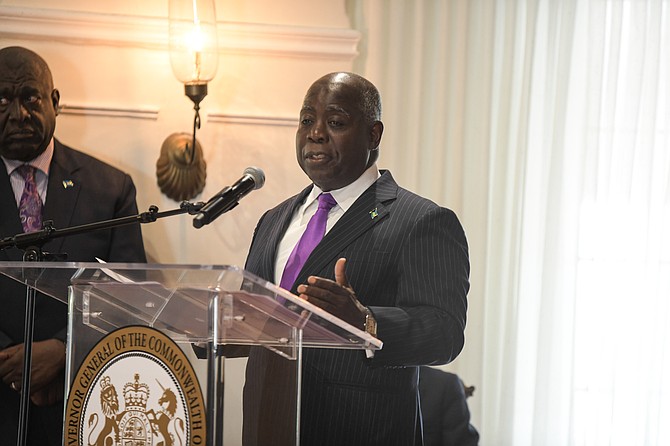
    Speaking during a ceremonial swearing-in event for nine newly appointed senators, Davis pushed back against critics, emphasizing that the government has a full slate of urgent near-term priorities and long-term transformative national goals that require the most capable leaders in key roles.

    “We need the best hands on deck,” Davis stated. “At the start of our last term, some already questioned our move to expand the size of the administration. But it was precisely that approach that allowed us to deliver the progress that earned us a renewed vote of confidence from the Bahamian people. Now, the task ahead is even larger, so we must bring every available talent to bear to deliver on our commitments.” This echoes Davis’s reasoning after the 2021 election, when he argued the scale of the country’s challenges demanded an “all hands on deck” governing strategy.

    But Opposition Leader Michael Pintard, who was recently sworn in to lead the FNM following the party’s election defeat, argues that the oversized Cabinet poses a direct threat to parliamentary accountability. The core of his criticism centers on the fact that the vast majority of the PLP’s elected parliamentary representatives now hold paid Cabinet positions, leaving only a tiny handful of ruling-party backbenchers — the elected MPs who do not hold government posts and are traditionally responsible for providing internal scrutiny of the administration from within the ruling party’s ranks.

    “One of the core reasons we must remain vigilant in holding this government to account is that the government has effectively silenced its own backbench,” Pintard said. “This arrangement leaves almost no room for independent scrutiny from ruling party elected members. It is inappropriate for the majority of an administration’s elected representatives to hold Cabinet posts, because what healthy governance requires is robust, open debate and space for disagreement. Backbenchers are supposed to hold the Cabinet accountable, but we already knew this administration has no interest in dissent — we have seen that repeatedly, so this move does not surprise us.”

    Beyond accountability concerns, Pintard also raised questions about the additional public financial burden that 29 senior government appointments will place on national coffers, urging the government to disclose the full cost of the expanded Cabinet. The opposition leader added that his party would carry out its constitutional oversight responsibilities by supporting government policies that benefit the Bahamian people and opposing measures that do not serve the public interest.

    Turning to the FNM’s own post-election reflection, Pintard acknowledged that both the ruling PLP and the opposition FNM failed to energize voters in the recent contest, contributing to low turnout and widespread public disillusionment with the political system. He added that rebuilding public trust in political institutions is a critical task for all national leaders, and the FNM is conducting a full, transparent review of every factor that led to its recent election defeat.

    “We are still assessing all contributing factors, from personnel choices at every level starting from the top leadership,” Pintard said. “We are committed to taking a sober, honest look at what worked and what did not, and making the necessary adjustments — nothing is off the table. I am deeply honored that the FNM executive council and our newly elected members have supported my return as leader, and I will repay that confidence with diligent work to rebuild our party and serve the Bahamian people.”

  • Arajet expands in Argentina with new Mendoza–Punta Cana route

    Arajet expands in Argentina with new Mendoza–Punta Cana route

    Low-cost Caribbean carrier Arajet has marked another milestone in its Latin American expansion strategy with the launch of a new nonstop air route connecting Mendoza, Argentina’s popular western wine and tourism hub, to Punta Cana, the Dominican Republic’s top Caribbean leisure destination. The new connection marks the third Argentine destination added to Arajet’s growing route network, following existing services to the capital Buenos Aires and central city Córdoba.

    Under the announced schedule, the new Mendoza-Punta Cana service will operate three flights per week, bringing transformative travel options to passengers in the region. For travelers originating in Mendoza, the route eliminates the need for time-consuming connecting layovers in other hubs, granting direct access to Punta Cana. From the Caribbean hub, passengers can also connect seamlessly to more than a dozen key destinations across North, Central and South America, including Mexico’s Cancún, major U.S. cities Miami, Orlando and Chicago, Peru’s capital Lima, Mexican powerhouse Mexico City, Jamaica’s capital Kingston, and Puerto Rico’s San Juan.

    The launch was celebrated with an official inaugural ceremony hosted at Mendoza’s El Plumerillo International Airport, where senior leaders from Arajet joined Argentine and Dominican tourism and aviation officials to mark the occasion. During the event, stakeholders emphasized the far-reaching benefits of the new connection, noting that it will unlock new opportunities for two-way tourism growth, expand bilateral trade links, and deepen people-to-people cultural exchange between Argentina and the Dominican Republic.

    For Arajet, the new route reinforces the airline’s aggressive expansion goals across the Western Hemisphere. Company representatives noted that the launch further cements Punta Cana’s status as a critical strategic transit hub for regional travel connecting South America to the Caribbean and North America, while also strengthening the carrier’s footprint in Argentina’s fast-growing aviation market.

  • WATCH: KSAMC conducts clean up activities on Heywood Street

    WATCH: KSAMC conducts clean up activities on Heywood Street

    KINGSTON, Jamaica — Local authorities in Jamaica’s capital have wrapped up a targeted sanitation drive on one of downtown Kingston’s busiest commercial corridors, marking the latest phase of a city-wide effort to improve public health and urban livability. On Sunday, teams from the Kingston and St Andrew Municipal Corporation (KSAMC) carried out a comprehensive clean-up operation along Heywood Street, where crews unclogged blocked drainage systems, hauled away accumulated roadside debris, and power-washed the public roadway. The intervention has earned broad approval from local vendors who rely on the area’s public spaces to earn their daily incomes.

    Kingston Mayor Andrew Swaby explained that Sunday’s work is an integral component of the Cleaner Kingston initiative, a long-term project dedicated to eliminating persistent waste buildup across the downtown district. Ahead of the operation, KSAMC issued a 30-day advance notification to all Heywood Street vendors to ensure they could prepare for the work, a collaborative step that municipal leaders prioritized to minimize disruption to local commerce. In addition to clearing the roadway, crews also removed discarded materials from the adjacent Queens Market, prioritizing drain clearing to address longstanding blockages that posed public health and flooding risks.

    “Sanitation is a top priority for KSAMC, and protecting the health of both vendors and the everyday patrons who shop in this area is our core goal,” Swaby noted in an interview following the operation.

    The Heywood Street clean-up follows a similar intervention completed on nearby Beckford Street in recent weeks. That earlier project included participation from representatives of two major local utilities — the National Water Commission (NWC) and Jamaica Public Service (JPS) — who joined to assess unaddressed sewage and streetlight infrastructure issues that have plagued the neighborhood. KSAMC has confirmed plans to move forward with repairs for those systems in the coming months.

    Moving forward, Swaby confirmed that the incremental street-by-street clean-up push will continue across downtown Kingston, with municipal teams focusing on one corridor at a time to deliver thorough, long-lasting improvements. The mayor emphasized that local vendors have reacted positively not just to the results of the clean-up, but to the transparent, consultative approach KSAMC has taken throughout the initiative.

    Toleen Edwards, a food vendor who has operated on Heywood Street for years, called the regular cleanings long overdue. “Before this, there were rats and cockroaches all along the road, and I sell food here — I don’t want pests running through my stall,” Edwards explained. “This should be done regularly, either every week or every month.”

    Beyond sanitation, Mayor Swaby also addressed a second persistent problem plaguing Heywood Street: unregulated taxi parking that creates chronic traffic congestion. The mayor announced he will soon convene a roundtable discussion with local police, independent taxi operators, and leadership of the national taxi association to collaborate on solutions. The talks will center on identifying actionable changes to ease traffic delays and create smoother, more reliable traffic flow for all road users and pedestrians in the area.

  • Clarendon NW residents protest over bad roads

    Clarendon NW residents protest over bad roads

    CLARENDON, Jamaica — For two straight days, residents of Sunbury district in the Spalding area of Clarendon have shut down key thoroughfares through their community, escalating a grassroots protest against the crumbling, unsafe road conditions that have long upended daily life for local people.

    The demonstration first unfolded on Monday, when local law enforcement was dispatched to the neighborhood to clear a makeshift barricade constructed from discarded derelict vehicles and fallen tree debris. Crews were able to reopen the route to northwestern Clarendon that day, but the respite was temporary: frustrated by a lack of commitment to repairs from elected officials, residents assembled a new roadblock on Tuesday, forcing police to return for a second consecutive day of clearance work.

    Photographs from the scene show a passenger bus, used by local residents to block a critical stretch of the roadway, as the centerpiece of the protest. The bus highlights how everyday residents are willing to disrupt ordinary movement to demand action from leaders who they say have ignored their community’s infrastructure needs for far too long.

    When reached for comment Tuesday, Richard Azan, the Member of Parliament for Clarendon North Western and opposition spokesperson on road infrastructure, acknowledged that the conditions described by residents are accurate and deeply problematic.

    “We just wrapped up parliamentary budget deliberations, and the only commitment the government has offered is a general patching program across the island,” Azan explained. “To date, I have not received any confirmation that funding has been allocated for repairs to this specific stretch of road in Sunbury.”

    Azan went on to note that Sunbury’s crisis is far from an isolated case, warning that the entire island is grappling with a widespread decline in road quality. “Northwestern Clarendon alone has dozens of roads in catastrophic condition, and this issue is not limited to our constituency,” he said. “Members of Parliament from both the ruling party and the opposition across every region of Jamaica are fielding constant complaints from constituents about failing, unsafe roads.”

    As of Tuesday evening, residents remain firm in their commitment to continuing protest action until they receive a concrete timeline and funding commitment for full road repairs, signaling that the standoff between the community and political leaders is far from over.

  • Dominican Republic’s population is aging rapidly, ONE Director says

    Dominican Republic’s population is aging rapidly, ONE Director says

    The Dominican Republic is currently navigating a defining demographic shift characterized by rapidly aging population and plummeting birth rates, new data from the country’s National Statistics Office (ONE) confirms. ONE Director Mildred Martínez has projected that the Caribbean nation’s total population will stabilize at approximately 12 million people in the coming years, capping decades of gradual population growth that is now slowing due to changing reproductive patterns.

    During an appearance on the digital current affairs program *La Esquina*, Martínez broke down key demographic shifts captured in recent census data. She highlighted that the share of Dominican residents aged 60 and older has jumped considerably over the past 12 years, rising from just 9% of the total population counted in the 2010 national census to 13% in the 2022 enumeration. This sharp four-point increase, Martínez emphasized, offers clear evidence that the country’s population aging trend is advancing faster than many observers previously anticipated. She traced the core driver of this shift to a nationwide trend of smaller family sizes, with Dominican women having far fewer children on average than generations before.

    Beyond the overall aging trend, the ONE director also drew attention to a persistent gender gap in life expectancy across the country. Data shows that Dominican women outlive men by an average of six years, with the average female life expectancy reaching 79 years, compared to 73 years for men. This puts the national average life expectancy across all genders at 76 years. Martínez explained that the six-year longevity gap stems from two key factors: a significantly higher rate of violent fatalities among working-age and young men, and a systemic pattern of lower utilization of preventive healthcare services by men across all age groups.

  • Dominican Republic to host Ibero-American road safety data summit

    Dominican Republic to host Ibero-American road safety data summit

    The Caribbean nation of the Dominican Republic is preparing to welcome delegates from 14 Ibero-American countries for the eighth iteration of the Ibero-American Meeting on Data and Road Safety, a landmark regional event organized by the country’s National Institute of Transit and Land Transportation (INTRANT). Scheduled to run from May 20 to 23 at the convention center of the Dominican Ministry of Foreign Affairs in the capital city of Santo Domingo, the gathering aims to strengthen cross-border data management practices and craft collaborative strategies to cut down on preventable traffic accidents across the region.

    Among the participating delegations are senior technical representatives from major Ibero-American states including Spain, Argentina, Chile, Colombia, Peru, and Uruguay. Over the four-day event, attendees will take part in a series of targeted technical sessions covering high-priority topics: enhancing the accuracy and completeness of road safety data, advancing robust statistical analysis methods, improving institutional interoperability across different national agencies, and supporting the development of road safety policies rooted in solid empirical evidence.

    INTRANT Executive Director Milton Morrison emphasized that access to consistent, reliable road safety data forms the non-negotiable foundation for designing policies that actually reduce road fatalities and keep vulnerable road users safe. Beyond knowledge sharing, organizers expect the meeting to deliver tangible outcomes: deepened long-term regional cooperation on road safety, the launch of new cross-national initiatives to upgrade national road safety information systems, and expanded coordinated support for safer, more sustainable mobility across every corner of Ibero-America.

  • Researchers say conch, lobster and grouper stocks overfished

    Researchers say conch, lobster and grouper stocks overfished

    A landmark 73-year analysis led by Sea Around Us researchers has delivered a stark warning for The Bahamas’ marine ecosystems: 11 out of 12 of the nation’s most culturally and commercially vital seafood species are now categorized as overfished, with most being harvested far faster than natural populations can replenish. Published in the peer-reviewed journal *Frontiers in Marine Science*, the findings validate long-held anecdotal concerns from local Bahamian fishers, who have reported declining catches of iconic species for decades.

    To build their dataset, researchers reconstructed total catch records stretching from 1950 through 2022, offering one of the most comprehensive long-term assessments of Caribbean fisheries ever conducted. The 12 species evaluated represent the backbone of The Bahamas’ seafood economy and cultural identity. Among the at-risk populations, Nassau grouper and yellowfin grouper were ranked as “grossly overfished”; queen conch, Caribbean spiny lobster, hogfish, black grouper, rock hind and wahoo fell into the “overfished” category; and lane snapper, mutton snapper and gray snapper were listed as “slightly overfished.” Only one species — dolphinfish, more commonly known as mahi mahi — was found to have a stable, healthy population.

    The results carry profound implications for The Bahamas, a nation where seafood is central to both domestic food security and a tourism-driven economy. Across the 73-year study period, researchers estimated that a total of 1.3 million tonnes of seafood were harvested from Bahamian waters, averaging 17,500 tonnes per year. Just two species — Caribbean spiny lobster and queen conch — made up more than half of that total catch: lobster accounted for 33% (around 425,000 tonnes) and conch for 21%. Both are now officially overfished, with lobster populations at just 61% of the biomass required to support long-term maximum sustainable yield, and queen conch at 59%. Maximum sustainable yield is the scientific benchmark for the largest catch that can be maintained indefinitely under stable environmental conditions.

    Reef-dwelling groupers and snappers showed the most alarming population declines of all species assessed. Yellowfin grouper, the most imperiled species in the study, was found to have only 40% of the biomass needed for sustainable harvesting. Nassau grouper, which has been listed as critically endangered by the International Union for Conservation of Nature since 2015, was measured at just 49% of the required sustainable biomass. Data shows Nassau grouper catches exceeded maximum sustainable yield for nearly 40 years before populations collapsed from their mid-1990s peak, and the species has yet to show any signs of recovery in the decades since.

    Breaking down catch contributions across the fishing sector, the study found that recreational fishing — including tourism-focused charter boats, sportfishing operations, and visiting angling groups — accounted for 46% of total historical catch, the largest share of any segment. Industrial fishing, centered primarily on export-focused spiny lobster operations, made up 26% of total catch, while small-scale artisanal fishing for local markets contributed 23%, and small-scale subsistence fishing accounted for the remaining 5%.

    The study’s clear findings intensify pressure on Bahamian fisheries regulators, who have long struggled to manage iconic seafood industries hampered by incomplete population data, inconsistent enforcement of fishing rules, and persistent high public demand for local catch. Dr. Krista Sherman, study co-author and researcher at the Perry Institute for Marine Science, emphasized that the overfished status of key species creates direct risks for domestic food access. “These species are the backbone of The Bahamas’ domestic seafood supply, supporting commercial and subsistence fishers across the islands and anchoring local food security,” Sherman explained. “Their overfished status means fewer fish in local markets and on local plates unless targeted management action is taken. These assessments not only improve our understanding of the status of key fisheries but also provide a critical foundation for the sustainable management of these valuable resources moving forward.”

  • Watson, Rahming and former NBA player Fox named to Senate

    Watson, Rahming and former NBA player Fox named to Senate

    Fresh off the Progressive Liberal Party’s commanding landslide win in last week’s general election, the Bahamas’ new parliamentary framework began to take shape on Wednesday, with a slate of Senate appointments that drew widespread public attention, including several high-profile figures from media, sports and public relations. The PLP secured a dominant majority in the May 12 poll, taking 32 of the 41 available House of Assembly seats and leaving the incumbent Free National Movement with just 8 seats, forcing the opposition to launch a new rebuilding effort following its second consecutive electoral defeat.

    The official swearing-in ceremony for government-aligned senators was held at Government House, where PLP Prime Minister Philip “Brave” Davis formally introduced his slate of appointees to the upper legislative chamber. Alongside returning former Senate President Lashelle Adderley, Davis’ picks included D’Asante Small, Deputy Director of Communications for the Public Hospitals Authority; former electoral candidates Robyn Lynes (Killarney) and Keno Wong (St Anne’s); PLP legal team representative Keenan Johnson; and sitting public sector leaders JaAnn Major and Kevin Simmons. Two appointees stood out for their particularly high public profiles: Clint Watson, General Manager of the state-owned ZNS broadcasting network, and Latrae Rahming, the PLP’s veteran communications director.

    Speaking after the ceremony, Prime Minister Davis emphasized his confidence in the new cohort of senators, noting that many of the appointees had already proven their capabilities through both public service and personal scrutiny. “Each of these individuals has been tested, either by my own experience working alongside them or in the unforgiving court of public opinion,” Davis said. “I am proud to welcome them to the Senate as we begin the work Bahamians elected us to do.”

    For Rahming, who previously led the PLP’s public relations response during the party’s last term in government, his move to the upper chamber carries a core mission: reigniting young people’s faith in the country’s democratic process and encouraging greater civic participation. Pointing to the lackluster voter turnout recorded in last week’s election, Rahming noted that many young Bahamians have grown disengaged from exercising their democratic rights, and he aims to change that narrative through his work in the Senate.

    Watson, a former journalist, brings a policy priority focused on reforming the Bahamas’ media landscape and advancing long-delayed transparency legislation. Citing his decades of experience in the news industry, Watson highlighted that public demand for a national Freedom of Information Act remains strong, and he will push to codify that law to build a more open, progressive modern Bahamas.

    On the opposition side, the Free National Movement also confirmed its own Senate appointees, led by one of the Bahamas’ most recognizable public figures: former NBA champion Rick Fox. Fox’s appointment comes as the FNM works to rebuild its public profile and regroup following its heavy electoral defeat, and the party also named three other senators: attorneys Elsworth Johnson and Arinthia Komolafe, and Dr Trevor Johnson.

    Outgoing Opposition Leader Michael Pintard acknowledged that the FNM had hoped for a far better electoral result, but the party accepted the mandate given to it by Bahamian voters and will fulfill its role as the official opposition in Parliament. “The people have spoken, and we respect their decision,” Pintard said. “Our job now is to hold the government accountable while we work to rebuild our party and earn the trust of voters moving forward.”

  • Japan donates equipment to help Dominican Republic combat sargassum

    Japan donates equipment to help Dominican Republic combat sargassum

    A new chapter of environmental cooperation between Japan and the Dominican Republic has officially begun, as Tokyo handed over a fleet of heavy machinery to help the Caribbean nation address the worsening sargassum crisis that has plagued its coastlines and critical tourism industry.

    The official handover ceremony took place at the Dominican Republic’s Ministry of Tourism, with top local government officials leading the event. Attendees included José Ignacio Paliza, Minister of the Presidency, and Carlos Peguero, Vice Minister of International Cooperation, who formally accepted the donation on behalf of the Dominican government.

    This support comes through Japan’s well-established Non-Reimbursable Financial Cooperation Program, an initiative that provides grant-based assistance to partner countries facing pressing social and environmental challenges. The donation package comprises 17 pieces of purpose-built heavy equipment: six heavy-duty dump trucks for transporting collected seaweed, five mechanical street sweepers to clear sargassum from coastal access areas and promenades, and five tractors to assist with large-scale containment and collection operations along the Dominican Republic’s extensive coastline.

    Dominican authorities have emphasized that the new equipment will fill critical gaps in the country’s current sargassum response capacity. For years, massive influxes of free-floating sargassum have washed up on Dominican beaches, decaying on shore and damaging fragile coastal habitats, driving away tourists, and cutting into revenue from the tourism sector – the single largest engine of economic growth and employment in the country.

    Tsuda Fumiyo, Japan’s Chargé d’Affaires in the Dominican Republic, used the occasion to underscore the strategic value of the collaboration. She noted that the partnership goes beyond just addressing an immediate environmental problem; it advances shared goals of long-term environmental sustainability and strengthens the institutional capacity of Dominican agencies tasked with coastal management. The handover marks another milestone in the deepening bilateral relationship between the two nations, centered on mutual support for sustainable development and economic resilience.