
KINGSTON, Jamaica — Nearly eight months after Hurricane Melissa swept across Jamaica causing widespread ecological damage, the island’s top natural resources oversight body has given preliminary approval to a tightly limited 2026 bird shooting season, balancing the needs of local shooting industry stakeholders against post-storm environmental recovery. The National Environment and Planning Agency (NEPA), which serves as the administrative body for the Natural Resources Conservation Authority (NRCA), announced the preliminary decision reached during the NRCA’s April 21, 2026 governing meeting. According to NEPA, the in-principle approval was crafted to address two competing priorities: enabling businesses in the bird shooting sector to complete critical early preparation work, while accounting for the lasting ecological disruption left by Hurricane Melissa, which made landfall on the island in October 2025. To align with ongoing ecosystem recovery efforts, the 2026 season will come with significant new constraints, including geographically restricted hunting zones and a lowered overall cap on permitted shooting activities, NEPA confirmed. The current advisory, agency officials emphasized, is intended exclusively to support forward planning for sector operators, such as securing necessary supplies and adjusting operational logistics well in advance of the planned opening. Final, formal details of the season’s structure, rules, and boundaries will be published at a later date once all regulatory and environmental assessments are completed. Per current projections, the 2026 bird shooting season is scheduled to launch between mid- and late-August 2026, and conclude by the end of September 2026.
博客
-

JC’s Michael-Andre Edwards breaks 10-year-old Penn Relays triple jump record
PHILADELPHIA – One of the most anticipated upsets at the historic 130th Penn Relays Carnival unfolded on Friday during the meet’s second day at Franklin Field, where Michael-Andre Edwards of Jamaica College delivered a career-defining performance to shatter a 10-year high school boys’ triple jump record that had stood since 2016.
Going into the competition, the 16.01m record set by former Jamaica College athlete O’Brien Wasome had long been flagged as vulnerable. Edwards proved that prediction correct in the third round of jumps, when he landed a 16.26m leap with a -0.1m/s wind to push past the old benchmark. Refusing to settle, the young jumper topped his own new mark in the very next round, clocking a personal best of 16.29m with a 0.8m/s tailwind that secured his place in the event’s history books.
In post-competition comments, Edwards acknowledged he had targeted the record long before stepping onto Franklin Field’s iconic track, driven in part by the connection of the previous record holder to his own school. His consistent dominance across the entire competition was remarkable: after setting the new record, Edwards delivered two additional jumps that cleared 16.12m, rounding out a standout series of performances that outpaced every other competitor in the field.
Edwards’ win also extended Jamaica’s unbroken streak of dominance in the event to five consecutive years. Even the second-place finisher, American Mile Nesmith of Memphis Central High School (Tennessee) – the holder of the U.S. high school indoor record – turned in an impressive performance that broke Wasome’s old record, landing a 16.18m jump with a 0.4m/s wind, but still fell short of Edwards’ historic mark.
The event saw multiple other Jamaican athletes place in top positions, reflecting the nation’s continued depth in track and field jumping events. Rekelme Hunter of Kingston College took third place with a 15.41m jump, Kabiki Thomas of Wolmers’ Boys School claimed fifth with 14.77m, Antonio Anderson of Calabar High took sixth with 14.75m, and Wolmers’ Boys School’s Roshane Francis followed close behind in seventh with 14.74m.
In other jumping events at the carnival, Santino Distin of St Elizabeth Technical notched a season-best 2.06m to earn third place in the high school boys’ high jump. The event was won by Ryan Buskey of Colonie Central High School in New York, who cleared 2.14m, while Darius Reid of Upper Perkiomen High School in Pennsylvania took second with a 2.09m clearance.
In the high school boys’ long jump, Jamaica also placed multiple athletes in the top ranks. Jaivar Cato of Jamaica College finished fourth with a 7.11m jump, Omarion Miller of Kingston College took fifth with 7.06m, and Talshawn Edwards of Calabar High secured sixth place with a 7.04m leap.
-

FID, RPD sign MoU to protect revenue and the financial system
KINGSTON, Jamaica — Two of Jamaica’s leading financial regulatory and law enforcement agencies have cemented a new strategic alliance to tackle pervasive illicit financial activity across the island. The Financial Investigations Division (FID) and the Revenue Protection Department (RPD) have officially signed a Memorandum of Understanding (MoU) that establishes a formal structure for deepened collaboration against a range of threats, including money laundering, terrorist financing, revenue fraud, and other systemic financial crimes.
Dennis Chung, Chief Technical Director of the FID, emphasized that the agreement builds on a already productive working relationship between the two agencies, while formalizing critical processes that will amplify their collective impact. Under the new framework, clear protocols for cross-agency information sharing, case referrals, and coordinated enforcement actions are now in place. These structured arrangements, Chung explained, will drastically boost both bodies’ capacity to identify, probe, and disrupt illegal financial activities that erode government revenue and undermine the stability and integrity of Jamaica’s entire financial system. He noted that this kind of targeted strategic partnership is a foundational requirement for effective national regulatory enforcement and crime mitigation.
Cranston Morgan, who serves as both Chief Technical Director of the RPD and Commissioner of Revenue Protection, echoed Chung’s optimism, highlighting that the alliance will strengthen both agencies’ ability to rapidly respond to financial misconduct and guard the broader public interest.
Morgan framed the MoU as another measurable milestone in the ongoing effort to tighten inter-agency cooperation. It creates a reliable foundation for timely information exchanges, more cohesive operational coordination, and more strategic utilization of each agency’s unique institutional expertise when addressing revenue offenses and linked financial crimes. He emphasized that the partnership delivers mutual benefits for both bodies, while also advancing the Jamaican government’s wider national goals: protecting public funds and bolstering domestic and international confidence in Jamaica’s financial regulatory ecosystem.
At its core, the MoU outlines a formal legal framework for consultation, collaborative action, and lawful information sharing that aligns with both agencies’ statutory mandates. Beyond information sharing, the agreement is designed to strengthen intelligence gathering, streamline cross-agency coordination, and enable more effective criminal and civil investigations as well as enforcement outcomes.
The agreement details clear reciprocal obligations for both agencies. The FID will supply the RPD with raw data and supporting materials required for intelligence development and ongoing investigations, alongside advance notification of any upcoming criminal probes that involve individuals or entities of interest to the RPD. It will also share requested statistical data to support RPD work.
In exchange, the RPD will provide the FID with its own relevant data and materials to aid the FID’s intelligence and investigation activities. This includes alerts of suspected revenue crimes and other financial offenses involving parties the FID is tracking, plus relevant statistical data, specialized technical assistance, and compliance data that can support the FID’s investigation and prosecution of financial crimes.
Additional provisions of the MoU cover expanded collaborative activities: case referrals between agencies, joint enforcement operations, parallel criminal investigations, cross-training for personnel from both bodies, and coordinated public outreach initiatives. These outreach efforts are designed to educate key stakeholders on the full range of risks linked to corruption, violations of revenue law, money laundering, and terrorist financing. The agreement also formalizes governance protocols to ensure all shared information is handled securely, protected from unauthorized access, and used only for appropriate, legally permitted purposes.
-

‘Natural’ birth control risks unwanted pregnancy, experts warn
Across Western Europe, a growing movement of women are stepping away from decades of reliance on hormonal contraception like the birth control pill, turning to so-called natural fertility tracking methods in search of a hormone-free approach to pregnancy prevention. But this growing trend, fueled in large part by social media influencer advocacy and the booming global wellness industry, carries significant underreported risks that have already led to devastating outcomes for some users, medical experts warn.
Elodie Monnier Legrand, a 30-year-old small business owner based in France, was one of the many women drawn to the idea of natural birth control after a decade of using the pill. She sought to let her body return to its natural, hormone-free state, investing in a monthly subscription for a popular fertility tracking app and a 200-euro smart temperature-monitoring ring to follow her cycle. Just months after making the switch, however, Legrand experienced two unplanned pregnancies that ended in abortion within six months. She later discovered her go-to app had miscalculated her fertile window by a small margin, a mistake that had life-altering consequences. “It’s not an exact science,” Legrand told AFP in an interview, adding that after the incidents, the app’s customer service offered only cold, impersonal responses. While she still considers the conversation around natural contraception interesting, she now questions whether the trend is little more than a new profitable market for the wellness industry.
Official data underscores just how quickly this trend is growing in France. According to France’s national health research institute INSERM, the share of women using natural contraceptive methods jumped from just 4.6% in 2016 to 7.5% in 2023. A similar decline in hormonal contraception use has been recorded across the English Channel: a 2023 study published in BMJ Sexual & Reproductive Health found that hormonal contraception use in England and Wales fell from 19% in 2018 to only 11% in 2023, mirroring the uptick in interest in natural fertility awareness methods.
Social media influencers are a core driver of this shift, often framing natural birth control as a form of liberation from the unwanted hormonal side effects of the pill and other hormonal contraceptives. For many women, these claims resonate. Louise, a 26-year-old French woman who asked to keep her surname private, told AFP that hormonal contraception caused severe health issues for her: at 18, her body rejected a hormonal IUD, and a subsequent contraceptive implant left her struggling with unmanageable weight gain, severe mood swings and clinical depression. For six years, she has relied on the calendar method, one of the most common natural approaches, which involves calculating the monthly 10-day fertile window and abstaining from intercourse during that time.
Other popular natural methods include the temperature method, which requires daily tracking of basal body temperature to detect the small increase that occurs during ovulation, the Billings method, which requires daily self-inspection of cervical mucus to identify fertile days, and the sympto-thermal method, which combines temperature and mucus tracking.
But medical experts say much of the popular rhetoric around hormonal contraception and natural methods relies on misinformation, and that fertility tracking requires extreme, consistent discipline to deliver even partial effectiveness. Geoffroy Robin, a gynecologist at Lille University Hospital in France, told AFP that the current surge in interest in natural methods stems from a widespread “climate of hormone-phobia” that overlooks the pill’s decades-long role as a foundational tool for women’s emancipation, giving women control over their reproductive plans that enabled educational and professional advancement.
Multiple independent studies confirm that natural contraceptive methods are far less effective than hormonal or barrier contraception. A 2022 INSERM review of roughly 100 popular fertility tracking apps found that fewer than 20% delivered accurate predictions of fertility cycles. The review also uncovered a major privacy risk: most apps shared users’ sensitive personal health data with third-party advertisers, often without explicit user consent. Robin added that natural methods are completely ineffective for the roughly one in five women who have irregular menstrual cycles, and many common everyday factors can skew tracking results: yeast infections and antihistamine medications can disrupt cervical mucus production, while paracetamol, antibiotics, or even a sudden shift in work schedule can alter basal body temperature, leading to incorrect fertile window calculations. The 2023 BMJ study also identified a correlation between the rise in natural contraception use and a recent increase in abortion rates across England and Wales.
INSERM experts emphasize that natural contraception should only be considered by women who are fully willing and able to accept the risk of an unplanned pregnancy. For those with irregular cycles or preexisting health conditions that can disrupt tracking, these methods are not a safe alternative to traditional contraception, doctors stress, urging any woman considering a switch from hormonal contraception to consult a licensed gynecologist before making a change.
French sociologist Cecile Thome points out that the trend is deeply tied to the growth of the global wellness industry, which markets natural contraception under the appealing banner of “taking control of one’s body”—a marketing message that has convinced millions of women to spend money on apps, wearables and other fertility tracking products. For Legrand, that promise of control ultimately ended in profound physical and psychological harm, leaving her to question whether the trend is as empowering as its advocates claim.
-

Edwin Allen reclaim high school girls’ 4x100m title at Penn Relays
The 130th running of the iconic Penn Relays Carnival, one of the most prestigious annual track and field events in North America, delivered another historic moment on its second competition day at Philadelphia’s Franklin Field, as Jamaica’s Edwin Allen High School defended its Championships of Americas girls’ 4x100m crown in dominant fashion, clocking the third-fastest time in the event’s history.
Competing against a stacked field of top high school relay squads from across the region, Edwin Allen faced an early test from Bullis School of Maryland, one of the top-ranked U.S. programs entering the final. But second-leg runner Alexxe Henry broke open the race early, seizing the lead from Bullis and extending a gap that Edwin Allen never relinquished through the final exchange. When the final sprinter crossed the finish line, the clock stopped at 44.13 seconds, a time that cements the team’s place in Penn Relays history.
This victory marks Edwin Allen’s 11th overall title in the event, and extends the program’s extraordinary decades-long run of dominance: this win is the Jamaican squad’s ninth in the last 11 editions of the Championships of Americas. The only two titles the program did not claim over that stretch went to Hydel High, another Jamaican powerhouse that has emerged as the school’s primary rival in recent years.
Only two 4x100m squads in Edwin Allen’s own decorated history have posted faster times at the Penn Relays: the 2019 team that set the current event meet record of 43.62 seconds, and the 2017 squad that ran 43.96 seconds, which was a meet record at the time.
In the final standings, Jamaica’s St Jago High took second place with a solid time of 45.08 seconds, while New Jersey’s Pennsauken rounded out the top three with a 45.30-second run. Excelsior High finished fourth in 45.6 seconds, followed by Mt Alvernia High, first-time finalists who clocked 45.94 seconds to take fifth.
In the accompanying International final, St Augustine’s from the Bahamas, the only non-Jamaican team in that competition field, claimed gold with a 45.90 finish. Alpha Academy took second in 46.42 seconds, followed by Holmwood Technical (46.74 seconds), St Mary High (46.77 seconds), William Knibb High (47.11 seconds), Vere Technical (47.33 seconds), Penwood High (47.45 seconds), Meadowbrook High (48.07 seconds) and Manchester High (48.19 seconds).
-

Jamaica College leads eight Jamaican teams into 4x100m COA finals
At the historic 130th Penn Relays Carnival held at Philadelphia’s Franklin Field, Jamaican high school track and field programs delivered a stunning display of sprinting dominance on Friday, claiming eight of the coveted spots in Saturday’s Championship of Americas boys’ final. Leading the charge was Jamaica College, whose four-person squad of Malique Dennis, Nathaniel Martin, Elijah Smeikle and Kai Kelly clocked a blistering preliminary time of 40.11 seconds — the fastest mark of any team across the entire qualifying round.
The only non-Jamaican team to secure a place in the final is St. James Academy from Virginia, which finished just 0.13 seconds behind Jamaica College with a time of 40.24 seconds. The remaining six spots in the eight-team final went to other elite Jamaican programs, who turned in consistently impressive performances throughout the preliminaries: Kingston College finished at 40.26 seconds, followed by Edwin Allen (40.37), Excelsior High (40.54), St Jago High (40.73), Petersfield High (41.19), St Mary High (41.21), and Wolmer’s Boys (41.24).
Wolmer’s Boys claimed the final spot in the Championship of Americas final via a photo finish, edging out fellow Jamaican squad William Knibb Memorial despite both teams posting an identical 41.24-second time. While William Knibb missed out on the top-tier final, the team’s strong performance landed it a spot in the meet’s international final, which will feature another six Jamaican squads alongside the local competitors. Additional Jamaican teams that secured qualification for the international final include St George’s College (41.56), Calabar High (41.58), Munro College (41.86), Cornwall College (41.91), and Herbert Morrison (42.21).
The overwhelming Jamaican presence in both the Championship of Americas final and the international final underscores the long-standing reputation of Caribbean high school programs for producing elite young sprint talent, setting the stage for a highly anticipated championship round on Saturday.
-

JC will be the lone Jamaican team in Penn Relays 4x800m final
At the 130th running of the iconic Penn Relays Carnival held in Philadelphia, Pennsylvania, Jamaica’s storied track program has produced one standout qualifier for the highly anticipated High School Boys’ 4x800m Championships of the Americas final, scheduled for Saturday. Three-time event champions Jamaica College emerged as the lone Jamaican squad to advance out of Friday’s qualifying heats, posting the fastest overall time to secure their spot in the title decider.
The quartet of Rasheed Pryce, Carlos Brison Caines, Sekani Brown, and Shemar Green delivered a dominant performance in their heat, crossing the finish line in 7 minutes 43.56 seconds to claim heat victory and lock in the top qualifying position. For the Jamaican powerhouse, Saturday’s final presents a chance to add another prestigious Penn Relays title to their trophy case: the program already claimed the 4x800m crown in 2024, making a 2025 win would mark their second title in three years.
A total of six other Jamaican high school squads took part in Friday’s qualifying rounds, but none managed to secure a spot among the finalists. Kingston College finished 14th overall with a cumulative time of 7:51.88, followed by Alphansus Davis in 22nd at 7:55.07 and St Elizabeth Technical in 24th at 7:55.43. Rounding out the competing Jamaican teams were Edwin Allen, which clocked 7:59.32, Calabar High with a time of 8:01.42, and Bellefield High, which finished with a time of 8:26.66. This report was contributed by Paul A Reid.
-

Jaii Frais and Jahvy Ambassador granted $1.5m bail
KINGSTON, Jamaica — Two prominent figures connected to Jamaica’s dancehall entertainment scene have been released on bail after their Friday court appearance at downtown Kingston’s Gun Court, capping off a high-profile case stemming from a violent carnival altercation earlier this year. Jhadee “Jaii Frais” Richards, a well-known podcaster, and Jahvel “Jahvy Ambassador” Morrison, manager and producer for popular dancehall artiste 450, each secured their release with bail set at $1.5 million.
Presiding Justice Natalie Hart Hines approved the bail requests, but attached a series of strict conditions designed to preserve the integrity of the ongoing judicial process. Both men are required to immediately surrender all valid travel documents to authorities, check in with local police stations three times each week, and adhere to a daily curfew that restricts their movement between 9:00 pm and 6:00 am. In an unusual stipulation that draws attention to the pair’s public profiles, the justice also explicitly warned both defendants against making any public comments about the case on any podcast or public media platform.
Richards, who is represented by defense attorneys Isat Buchanan and D’ondre Buchanan, faces a total of five serious criminal charges: shooting with intent, wounding with intent, possession of a prohibited weapon, unauthorized possession of ammunition, and use of a deadly weapon to commit a felony. Morrison, whose legal defense is being led by attorney Peter Champagnie, faces three separate charges: wounding with intent, assault occasioning bodily harm, and use of a firearm during the commission of a felony.
The legal proceedings trace back to a violent confrontation that broke out at the widely attended Big Wall carnival party. The altercation erupted between Richards and members of 450’s entourage — a group that includes Morrison in his role as the artiste’s manager. When the violence ended, two people were hit by gunfire: Richards himself and an uninvolved bystander who had traveled to the event from the United States.
Both men are scheduled to reappear at the court for their next hearing on July 8, as the judicial process moves forward to resolve the charges stemming from the high-profile incident that sent shockwaves through Jamaica’s entertainment community.
-

At 13, Christian Foster already rewriting history in Jamaican schoolboy football
Jamaican football is witnessing the rapid rise of an extraordinary young talent, 13-year-old Christian Foster of Hillel Academy, who has already carved out an unmatched reputation in the country’s schoolboy football landscape. What makes Foster’s trajectory extraordinary is that he made his breakthrough at 12, becoming one of the youngest players – and potentially the youngest ever – to earn a spot in the highly competitive Manning Cup, one of Jamaica’s most prestigious schoolboy football competitions. Barely a year into his teens, the versatile midfielder and forward has already cemented his status as one of the most promising young prospects in the entire nation.
This coming Sunday, April 26, Foster will add another chapter to his burgeoning story when he takes the pitch for the All-Star Jamaica Under-14 showcase, hosted at Jamaica College. The U-14 contest will kick off at 1:00 pm, preceding the U-16 all-star match scheduled for 3:00 pm. This selection marks not just another honor for the young star, but his third overall all-star nod: he previously earned a spot at the Under-12 level, and this selection marks his second consecutive invitation to the U-14 showcase.
For the eighth-grade student, every new opportunity is a chance to grow, and he brings a grounded enthusiasm to every match. “It’s a very great feeling to be able to be performing for my school and also to be excited for the All-Star,” Foster shared. “I’m hoping that I’ll be able to play well again in the upcoming season and also to play well in the All-Star.”
What sets Foster apart from his peers is not just natural talent, but a level of discipline, consistency, and on-pitch maturity that defies his young age. The statistics alone tell a compelling story of his dominance at his age group: he notched 13 goals this season for Hillel Academy’s Under-14 side in the ISSA U-14 competition, and currently sits as the top goalscorer in the Kingston and St Andrew Football Association Under-13 league, where he represents Cavalier Football Club with 14 goals to his name. His rising profile has also caught the attention of the national governing body, earning an invitation to train with the Jamaica Football Federation’s Under-14 program, a clear marker of his growing standing within the local football community.
Even as he balances the demands of academic work and competitive football, Foster says that the extra effort he puts in outside of organized team training is what has allowed him to outpace many players of his age. “Just by training for your team alone, it’s not enough to carry you to that extra, extra level,” he explained. That is why he puts in additional daily work with personal coaches Devon Anderson and Crooks, targeting specific areas of his game that need refinement. These extra sessions, which typically run around two hours per day, focus on core fundamentals: speed, shooting accuracy, passing technique, and the foundational skills that underpin elite performance.
Another major catalyst for Foster’s rapid development has been his early exposure to Manning Cup football, where he has been forced to compete against players who are years older, physically stronger, and faster than he is. The young prospect calls the experience invaluable. “It was a very great experience playing Manning Cup at such a young age. It gave me a feel of what playing with an older age group feels like. It’s definitely harder and the pace of the game is way faster than at the U-14 level,” he said. Despite the steep step up in competition, Foster adapted quickly to the new demands, noting that the faster pace required sharper technical decision-making and quicker movement off the ball. “From a technical standpoint, you have to move way faster. You have to be thinking more because you won’t have as much time on the ball because the players are bigger and faster,” he added.
Foster’s maturity extends beyond his on-pitch performance to his approach to leadership, as well. Already serving as captain of Hillel Academy’s Under-14 team, he believes that effective leadership starts with personal accountability and setting a strong example for his teammates. “I can’t be doing the wrong thing and tell my teammates to do the right thing. So I just have to do the right things and play well,” he said, while also crediting his teammates for being instrumental to his individual success.
Those who have followed Foster’s development from his early prep school days are quick to sing his praises. Leighton Davis, organizer of All-Star Jamaica, has tracked the prospect’s progression through the youth ranks, and highlighted what makes Foster stand out. “One thing I love about the competition is you get to see players like Christian who are coming from preparatory school and going into high school and still doing exceptionally well. We love to watch their journey, and of course, we think he’s a great player. We have seen that because he has also played up in Manning Cup, scored goals, so he is a leader and one to watch for the future,” Davis said.
Though still years away from reaching full adulthood, Foster already has clear, ambitious long-term goals for his career. A devoted fan of English Premier League side Arsenal, he dreams of eventually turning professional, playing either in Europe or in North America’s Major League Soccer. “I watch the Premier League the most, so that’s where I want to play in Europe,” he stated.
For the immediate future, however, the young prodigy remains focused on incremental growth: continuing to refine his game, guiding Hillel Academy to deeper runs in upcoming competitions, and leading his North team to a win in Sunday’s all-star clash, after the North fell to the South in the two previous editions of the showcase.
-
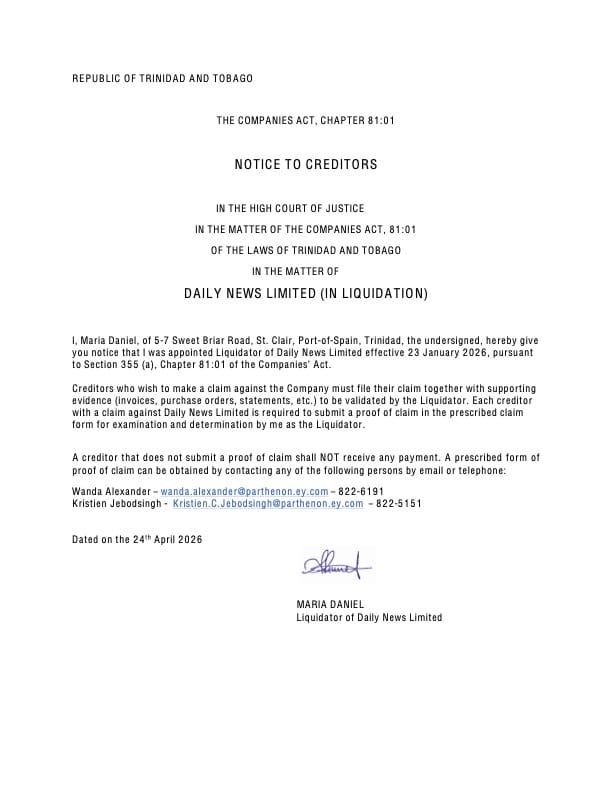
Daily News Limited – Newsday – Notice to Creditors 2026
The submitted content for news processing only includes metadata such as the posting attribution to a webmaster, a timestamp indicating the content was shared 12 hours ago, and a link to an associated image. No actual substantive news text, core event details, background context or related reporting information is included in the submission. Without the full text of the original news story, it is not possible to carry out a complete rewriting, in-depth analysis or contextual expansion of the reported event.