分类: weather

  • WEATHER (12:00 PM, May 30): Tropical wave to bring cloudiness, and scattered showers

    WEATHER (12:00 PM, May 30): Tropical wave to bring cloudiness, and scattered showers

    Meteorological forecasts point to an approaching tropical wave that will bring targeted weather shifts to the Lesser Antilles archipelago over the coming 12 to 24 hours, with the most pronounced impacts expected to hit island territories located south of the island chain. For the island of Dominica specifically, forecasters project a noticeable uptick in cloud cover beginning this afternoon and continuing through overnight hours, paired with scattered, unevenly distributed shower activity. Consistent breezy conditions will remain a constant feature of the local weather throughout this period, forecasters add.

    Beyond the tropical wave’s impacts, a persistent plume of Saharan dust already hanging over the region will not dissipate any time soon. Current projections indicate that dust concentrations will climb even higher starting Sunday, creating elevated air quality risks for vulnerable populations. Health officials are urging people with pre-existing respiratory sensitivities and conditions to remain vigilant and proactively take precautions to prevent potentially dangerous respiratory complications.

    For marine interests across the region, forecasts call for slight to moderate sea conditions over the next 24 hours. Wave height projections put swells along the western coast at roughly 3 feet, while eastern coastlines can expect higher swells reaching up to 5 feet. Due to haze associated with the incoming Saharan dust that can cut down on visibility, operators of small craft are warned to exercise extra caution when navigating local waters to avoid safety incidents.

  • Saharan dust and an anticyclonic system will keep the weather hot this Sunday

    Saharan dust and an anticyclonic system will keep the weather hot this Sunday

    The Dominican Institute of Meteorology (Indomet) has issued a detailed multi-day weather forecast confirming that two major atmospheric forces — vast plumes of Saharan dust and a stable high-pressure anticyclonic circulation system — will shape conditions across most of the Dominican Republic through the start of this week, with the Atlantic hurricane season set to officially launch on Monday, June 1.

    For Sunday, the national weather service forecasts predominantly sunny but hazy conditions across the island, with the haze driven directly by the incoming Saharan dust particles carried across the Atlantic. Only a small handful of inland and eastern provinces — including La Altagracia, El Seibo, Hato Mayor, La Vega, Monseñor Nouel, and Santiago Rodríguez — are expected to see isolated brief showers, triggered by wind shifts and daytime heating that fuels limited convective activity.

    Despite the persistent haze and above-warm temperatures, Indomet notes that overall conditions will remain suitable for most outdoor recreational and daily activities. That said, the agency has issued public health guidance to help residents cope with the hot, dusty conditions: it recommends that all people stay hydrated by drinking plenty of water throughout the day, opt for loose, light-colored lightweight clothing that reflects sunlight, limit prolonged direct exposure to midday and afternoon sun, and seek out cool, well-ventilated spaces when possible. The agency also specifically urged residents who have pre-existing respiratory sensitivities to dust to take extra precautions and follow established public health guidance for poor air quality.

    Temperature ranges will stay consistent across the country over the weekend, with overnight lows settling between 22°C and 24°C, and daytime highs reaching a balmy 30°C to 32°C.

    As the calendar turns to June, the official start of hurricane season for the entire Atlantic basin, including the Caribbean Sea and Gulf of Mexico, arrives on Monday. In its forecast for the opening day of the season, Indomet says a tropical wave currently tracking south of Dominican territory through Caribbean waters, combined with the influence of a low-pressure trough, will bring scattered local downpours and isolated thunderstorms to coastal and southern provinces including Santo Domingo, San Cristóbal, Peravia, and Barahona during Monday morning hours. By the afternoon, those rain systems are projected to shift northward into the Cibao region, impacting La Vega, Santiago Rodríguez, Valverde, Santiago, and Dajabón. For all remaining regions of the country, the stable anticyclonic system and lingering Saharan dust will maintain sunny, partly hazy conditions.

    Moving into Tuesday, the forecast calls for largely calm and stable weather across the Dominican Republic. The anticyclonic circulation will remain in place, and concentrations of Saharan dust in the atmosphere are expected to increase, keeping rainfall extremely rare across most of the country. Skies will be primarily sunny with occasional scattered cloud cover, holding to the pattern of warm conditions that dominated the weekend.

  • NOAA predicts below-normal 2026 Atlantic hurricane season

    NOAA predicts below-normal 2026 Atlantic hurricane season

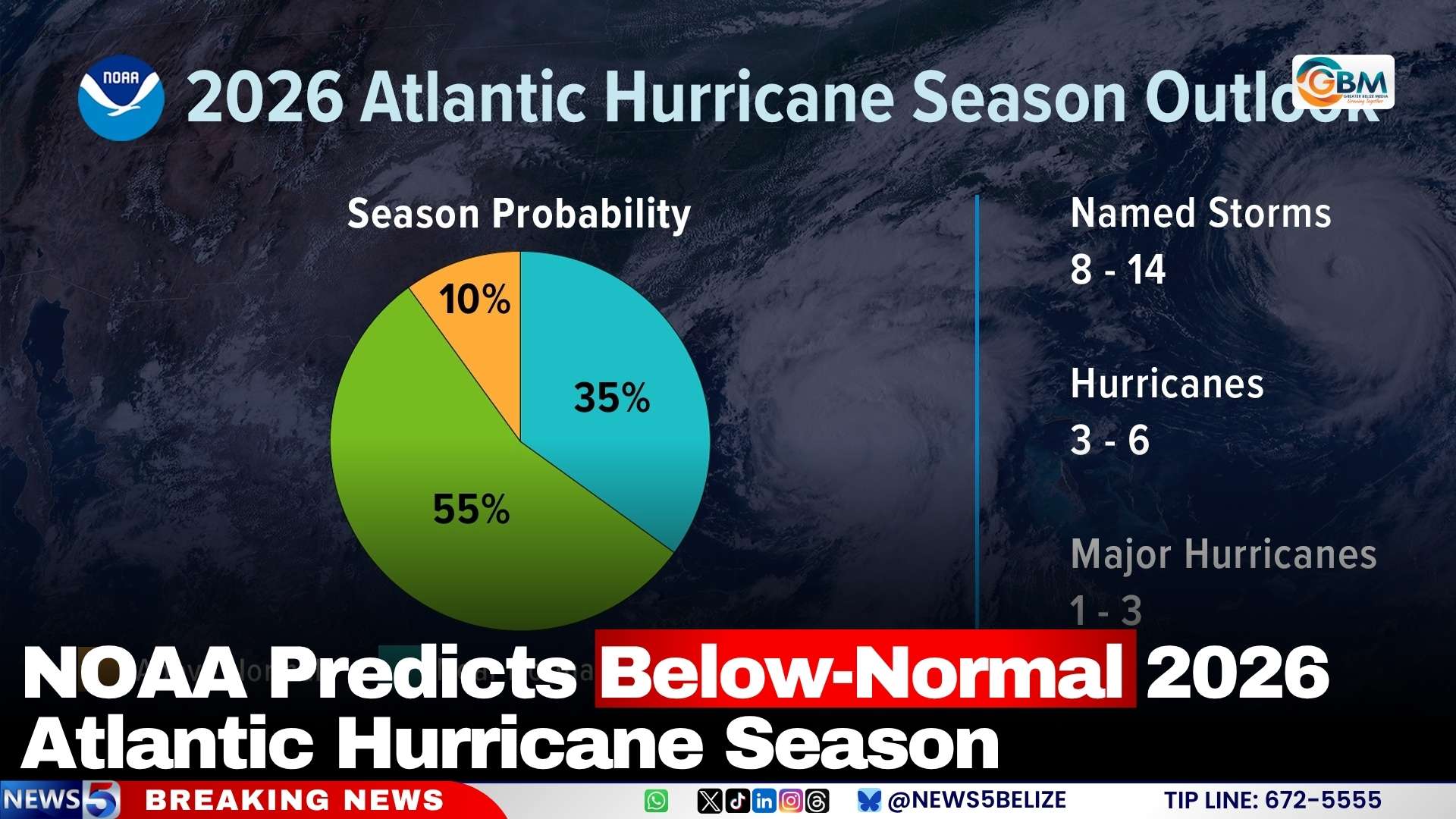
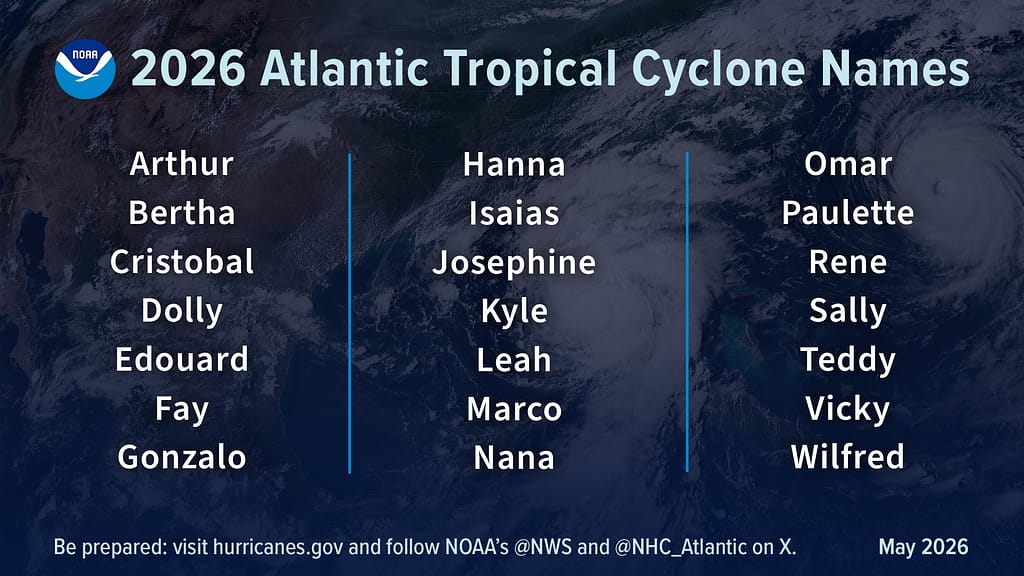
    The U.S. National Oceanic and Atmospheric Administration (NOAA) has released its official seasonal outlook for the 2026 Atlantic hurricane season, forecasting that overall storm activity will likely fall below the long-term average for the basin running from June 1 through November 30. According to NOAA’s National Weather Service forecasting team, the probability of a below-normal season stands at 55%, while near-normal activity carries a 35% chance and an above-normal season only a 10% likelihood. The agency projects the season will see between 8 and 14 named storms — systems producing sustained winds of 39 mph or higher. Of those named storms, 3 to 6 are expected to strengthen into hurricanes (winds of 74 mph or greater), with 1 to 3 growing into major hurricanes ranked Category 3, 4, or 5, which carry winds of 111 mph or higher. NOAA says it has 70% confidence in this projected range, which is noticeably lower than the historical average: a typical Atlantic season counts 14 named storms, seven hurricanes, and three major hurricanes. Commerce Secretary Howard Lutnick emphasized that NOAA and the National Weather Service have leveraged cutting-edge modeling and storm tracking infrastructure to stand ready to deliver real-time forecasts and emergency warnings as storms develop. “Our experts are integrating cutting-edge tools to ensure communities in the path of storms receive the earliest, most accurate information possible,” Lutnick said. NOAA Administrator Neil Jacobs, Ph.D., added that the agency’s rapid adoption of next-generation technologies — including artificial intelligence-powered weather models, reconnaissance drones, and new satellite data streams — allows forecasters to turn raw climate data into actionable guidance that protects American lives and livelihoods. “These new capabilities, combined with the unmatched expertise of our National Weather Service forecasters, will produce the most accurate forecasts possible to protect communities in harm’s way,” Jacobs noted. Multiple competing climate factors are shaping this year’s below-normal forecast. The primary driver is the expected development and intensification of El Niño conditions over the course of the hurricane season, a climate pattern that historically suppresses tropical cyclone formation in the Atlantic. Countering this effect, however, are slightly warmer-than-average Atlantic sea surface temperatures and weaker-than-average trade winds — two conditions that typically fuel more active hurricane seasons. Even with the forecast for reduced overall activity, NOAA’s National Weather Service Director Ken Graham stressed that uncertainty remains inherent in every seasonal outlook, and preparedness cannot be skipped. “Although El Niño’s impact in the Atlantic Basin can often suppress hurricane development, there is still uncertainty in how each season will unfold,” Graham said. “That is why it’s essential to review your hurricane preparedness plan now. It only takes one storm to make for a very bad season.” It is important to note that NOAA’s seasonal outlook only assesses overall basin-wide activity, rooted in large-scale climate and weather patterns. The outlook does not predict where or when individual storms will make landfall, as those outcomes depend on highly variable short-term weather patterns. No forecast of seasonal activity eliminates the risk of a destructive storm hitting coastal or inland communities. Graham urged at-risk communities to complete preparedness steps well ahead of any storm threat, directing residents to official resources including weather.gov/safety and Ready.gov for updated, evidence-based preparedness guidance. NOAA plans to release an updated 2026 seasonal outlook in early August, ahead of the historical peak of Atlantic hurricane activity, which typically runs from mid-September through October.

  • NOAA Predicts Below-Normal 2026 Atlantic Hurricane Season

    NOAA Predicts Below-Normal 2026 Atlantic Hurricane Season

    As the 2026 Atlantic hurricane season approaches, the U.S. National Oceanic and Atmospheric Administration (NOAA) has released its official seasonal outlook, projecting a lower-than-average number of storm systems for the coming six-month period. Even with this milder projection, however, federal weather officials are emphasizing that coastal and at-risk communities cannot afford to lower their guard, stressing that a single powerful hurricane can still cause catastrophic damage to life and infrastructure.

    The Atlantic hurricane season follows a fixed official timeline, running from June 1 through November 30 each year. NOAA’s climate analysis puts the probability of a below-normal season at 55%, with a 35% chance of activity matching long-term average levels, and just a 10% chance of an above-normal season that brings more frequent or intense storms than usual.

    Breaking down the projected storm counts, NOAA forecasts that between 8 and 14 named storms will develop across the Atlantic basin in 2026. Of these organized systems, 3 to 6 are expected to strengthen into full hurricanes, and 1 to 3 will intensify into major hurricanes — classified as systems with sustained wind speeds exceeding 111 miles per hour.

    To improve the reliability of storm tracking and public alerts, NOAA and its partner agency the National Weather Service have upgraded their forecasting infrastructure for this season. The agencies are integrating cutting-edge tools including artificial intelligence-powered weather modeling, specialized observation drones, and data from next-generation weather satellites, all designed to deliver faster, more accurate warnings that give communities more time to prepare and protect lives and property.

    Meteorologists point to the anticipated development of El Niño climate patterns as the primary driver behind the projected slowdown in hurricane activity. El Niño, characterized by elevated ocean surface temperatures in the central and eastern Pacific, typically generates increased wind shear across the Atlantic basin that disrupts the formation and strengthening of tropical cyclones. Even so, forecasters note that two key factors — slightly warmer-than-average Atlantic sea surface temperatures and weaker than usual trade winds — still create favorable conditions for some storm development this season.

    A critical note from NOAA: the seasonal outlook only provides a broad prediction of overall activity across the entire Atlantic basin, and cannot forecast how many storms will make landfall in specific regions. Details on individual storm tracks and landfall risks depend on short-term weather conditions that emerge over the course of the season, underscoring the need for all at-risk communities to have emergency plans in place regardless of the seasonal outlook.

  • Rough Seas Prompt Small Craft Advisory Through Tuesday

    Rough Seas Prompt Small Craft Advisory Through Tuesday

    On Sunday morning, 17 May 2026, the Antigua and Barbuda Meteorological Services issued an urgent Small Craft Advisory, alerting mariners to dangerous sea conditions expected to impact the Atlantic-facing waters of the twin-island nation over the coming days. The warning went into effect at 11:30 am local time, with hazardous conditions set to kick off tonight and persist through Tuesday afternoon, covering all open Atlantic waters extending 20 nautical miles off the islands’ coasts.

    Meteorologists attribute the unsafe conditions to a system of moderate to fresh eastward winds that are generating a dangerous combination of wind waves and swells across the affected area. Current forecasts peg sustained wind speeds between 28 and 39 km/h (equivalent to 15 to 21 knots, or 17 to 24 mph), with strong gusts capable of reaching up to 61 km/h (33 knots, 38 mph). These winds have pushed significant wave heights to between 1.8 and 2.4 meters (6 to 8 feet), with occasional local swells reaching nearly 3.1 meters (10 feet). Dominant wind-wave periods are expected to range from 6 to 9 seconds, conditions that meet the official threshold for a Small Craft Advisory, which is triggered when wind speeds reach 17 to 21 knots or wave heights hit 7 feet or greater.

    Officials have assessed the current threat level as moderate, though the advisory notes that significant impacts to life, property, and marine infrastructure are possible. The list of potential hazards includes loss of life at sea, serious injury to mariners, vessel capsizing, damage or total loss of small watercraft and marine equipment, and unexpected financial losses for businesses operating in the sector. Disruptions to local fisheries are also expected, which could lead to temporary scarcity of fish products in local markets, alongside widespread delays and disruptions to regional marine transportation.

    In its official cautionary note, the Meteorological Services stressed that inexperienced mariners, particularly those operating small recreational or commercial vessels, should avoid all travel through the affected waters for the duration of the advisory. The public and marine stakeholders are urged to continue closely monitoring evolving conditions, as the hazardous sea state poses ongoing risks to life and safety. Additional updates will be released directly by the Meteorological Office as new data becomes available. The advisory was issued by lead forecaster Letitia Humphreys.

  • Double Cold Front to Chill Belize This Weekend

    Double Cold Front to Chill Belize This Weekend

    Meteorological authorities in Belize have issued a weather advisory warning citizens to prepare for significantly cooler conditions as two consecutive cold fronts approach the nation. The first frontal system is projected to arrive by Saturday afternoon, with a secondary, more potent front following closely behind.

    The most pronounced temperature drop is anticipated from Sunday evening through Monday morning, creating unusually cold conditions for the region. Coastal areas should expect temperatures descending into the low 60s Fahrenheit, while interior regions may experience mid-50s readings. The elevated mountain districts could see temperatures approaching the upper 40s Fahrenheit—exceptionally cold by Belizean standards.

    Chief Meteorologist Ronald Gordon provided historical context, noting that while these temperatures represent a substantial cool snap, they are not expected to break historical records. “These are quite low for Belize in the Belizean context, but they are not record lows,” Gordon stated after reviewing archival data.

    Historical records indicate that the lowest temperature recorded for February 2nd was 59°F (15°C) at Central Farm, with the absolute monthly minimum being 46°F (7.8°C) at the same location. For Philip Goldson International Airport, the historical minimum for February 2nd stands at 56°F (13.3°C), with the monthly record being 52°F (11.1°C) from February 22, 1978.

    Gordon characterized the event as “a very cold snap, an arctic blast as some people might say” while emphasizing that temperatures may approach but not exceed historical extremes. Residents are advised to take appropriate precautions, including wearing warmer clothing and using additional bedding, as the Belizean population is generally unaccustomed to such cool conditions.

  • Cold Front Bringing Chilly Weekend Temperatures

    Cold Front Bringing Chilly Weekend Temperatures

    Meteorological authorities in Belize have issued advisories for significantly colder than average conditions expected throughout the weekend and into early next week. Chief Meteorologist Ronald Gordon confirmed that a sequence of two distinct cold fronts will traverse the nation, bringing notably low temperatures particularly unusual for the region.

    Gordon indicated that the most severe cold spell will manifest from Sunday night through Monday morning. Coastal regions should anticipate temperatures plunging into the lower 60s Fahrenheit, while inland population centers including San Ignacio and Belmopan will experience more pronounced cold in the lower to mid-50s. The elevated terrain of Pine Ridge and similar mountain areas face the most extreme conditions, with forecasts suggesting temperatures could drop into the upper 40s.

    The meteorological phenomenon driving these temperatures involves radiational cooling, a process where heat escapes rapidly into the atmosphere under clear nighttime skies. Gordon emphasized that despite the unusual cold, these temperatures do not represent record-breaking lows for Belize. Historical records indicate significantly colder episodes, including a February 1978 event when inland areas recorded 46°F and the international airport registered 52°F.

    Precipitation associated with these frontal systems will be minimal, with predominantly clear conditions expected throughout the cooling period. Meteorological models project a gradual temperature recovery beginning midweek as the frontal influence weakens and typical weather patterns reestablish.

  • Torrential Rains Soak Belize: More Downpours on the Way

    Torrential Rains Soak Belize: More Downpours on the Way

    A sustained period of intense rainfall has inundated Belize, with meteorological authorities forecasting continued precipitation throughout the weekend. A stationary frontal boundary interacting with moist northeasterly winds has created optimal conditions for persistent thunderstorms, particularly across central and southern districts.

    Precipitation measurements reveal significant regional variations, with Belize City recording 1-3 inches of rainfall while Hattieville experienced substantially heavier accumulation of 5-6 inches. The precipitation commenced overnight and continued through morning hours, resulting in slick road conditions and elevated flood risks in low-lying areas.

    Chief Meteorologist Ronald Gordon of the National Meteorological Service provided detailed analysis of the developing situation: ‘We’re observing a frontal boundary approaching our region that’s expected to become stationary, creating extended precipitation conditions. Unlike typical cold fronts that bring dry air, this system will function primarily as a rain front, maintaining substantial moisture content across our atmospheric column.’

    Gordon further elaborated on the meteorological mechanics: ‘The combination of surface-level frontal boundary stalling and supportive upper-level conditions is enhancing thunderstorm development. This convergence of factors explains the pronounced thunderstorm activity witnessed this morning in urban and Hattieville regions.’

    The precipitation pattern is expected to initially concentrate across northern and central territories before gradually extending nationwide. Meteorological models indicate probable continuation of rainfall through Saturday and Sunday, with improvements anticipated by Monday as the frontal system eventually dissipates or moves eastward.

    Residents are advised to exercise caution in flood-prone areas and monitor official weather updates. The National Meteorological Service maintains active monitoring of the system and will issue further advisories as conditions evolve.

  • Wet Weather to Linger Over Belize Through Friday

    Wet Weather to Linger Over Belize Through Friday

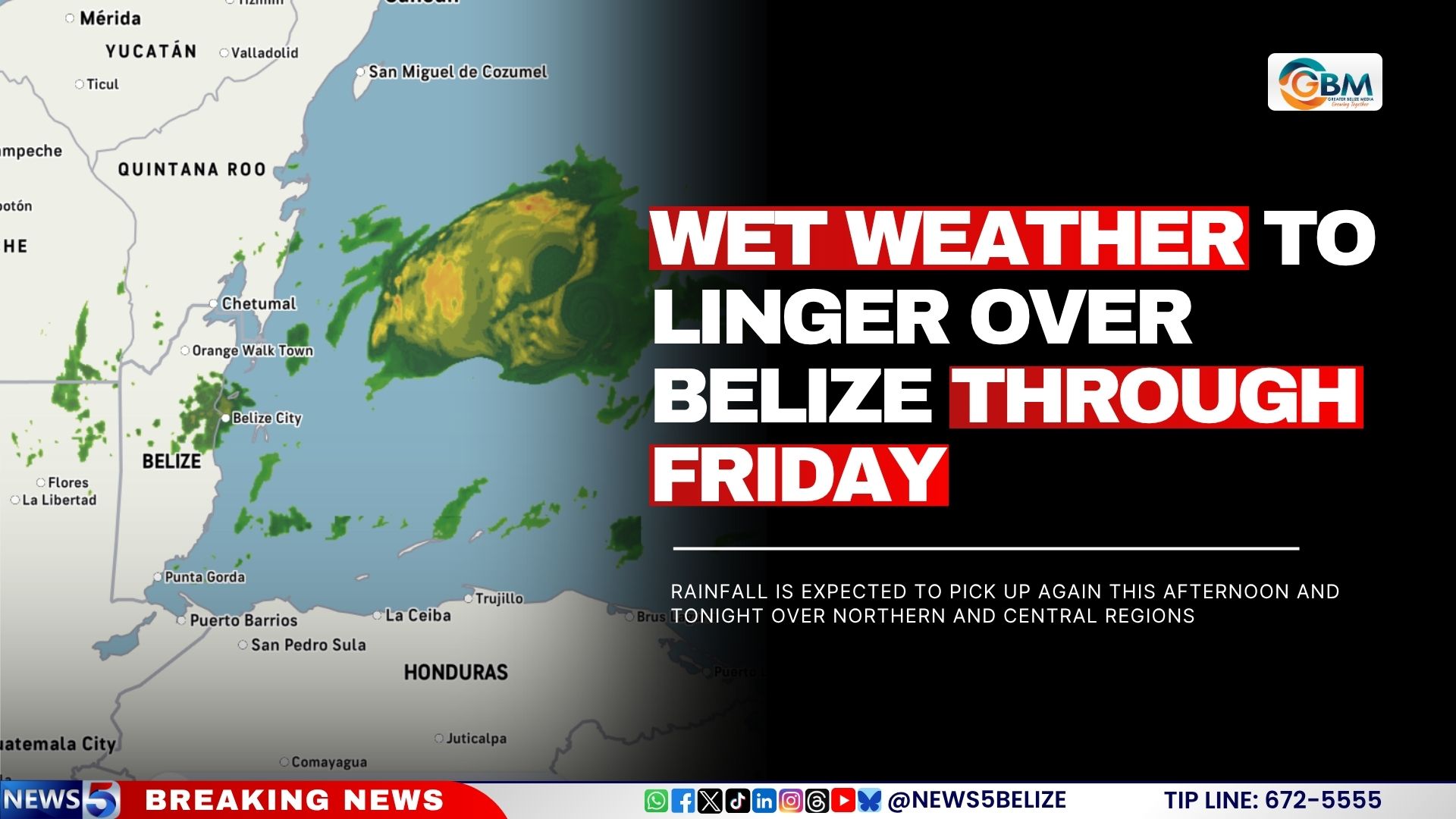
    Belize is set to experience continued wet and unstable weather conditions through Friday, with the National Meteorological Service predicting widespread rain and isolated thunderstorms. Over the next two days, the country will see mostly cloudy to overcast skies, with light to moderate rainfall intensifying into heavy showers, particularly in northern regions during the morning hours. By the afternoon and evening, rainfall is expected to increase again, with isolated thunderstorms likely in northern and central areas. Friday will maintain similar patterns, with scattered showers and thunderstorms concentrated in the north and central zones. Despite the persistent rain, the tropical outlook remains calm, with no tropical cyclones forecasted in the North Atlantic that could threaten Belize or its coastal waters in the coming days.

  • Moist and Unstable Weather Conditions Persist Across Belize

    Moist and Unstable Weather Conditions Persist Across Belize

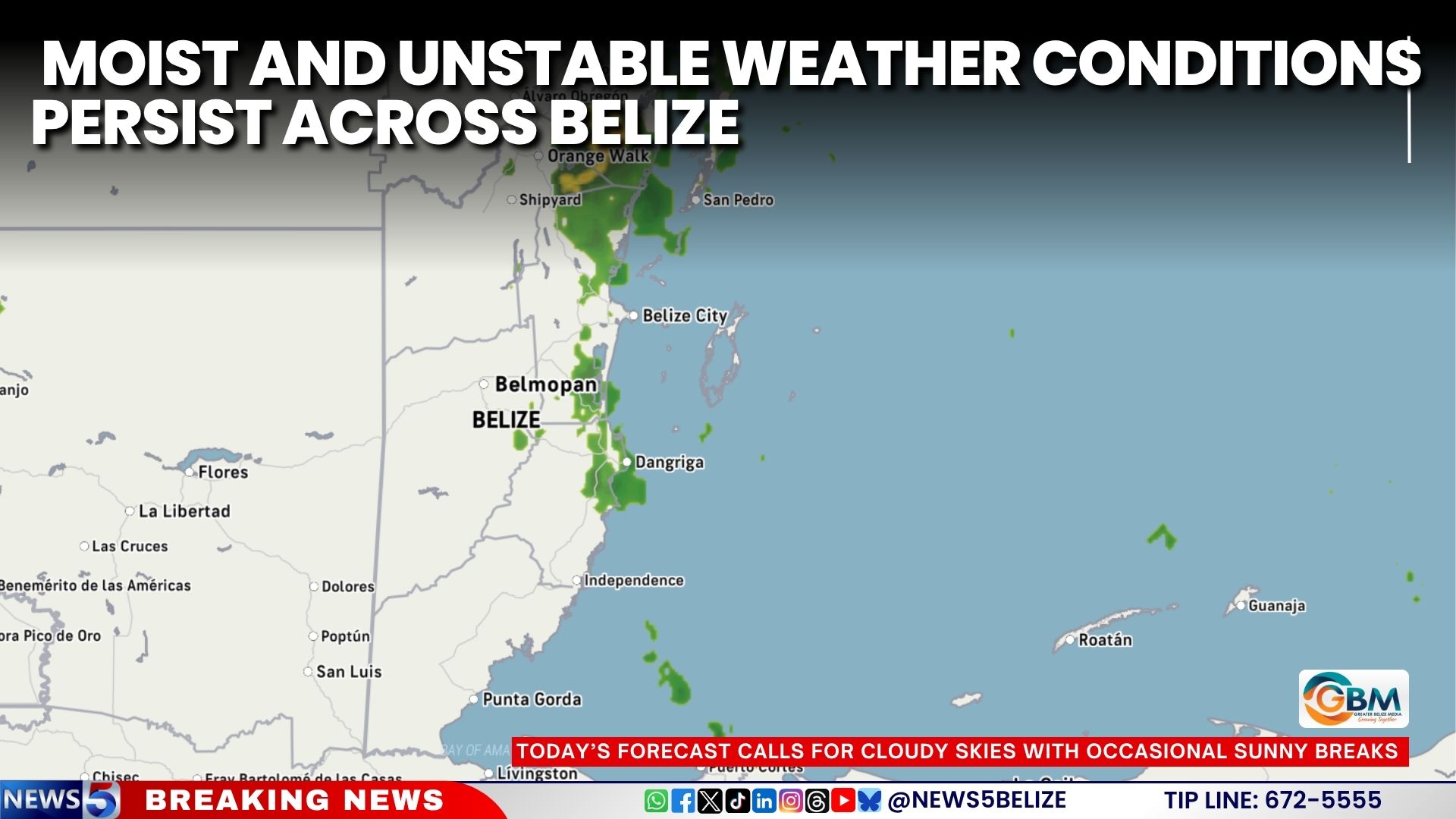
    Belize remains under the influence of moist and unstable weather conditions, as reported by the National Meteorological Service. Scattered showers and thunderstorms are prevalent across much of the country, with cloudy skies interspersed with brief sunny intervals. Coastal, central, and northern regions are particularly affected, experiencing persistent rainfall and thunderstorms. While shower activity is expected to diminish by evening, it is likely to redevelop later tonight, primarily in southern and coastal areas. Meanwhile, a tropical wave in the eastern Caribbean Sea is generating intense showers and thunderstorms. Although this system does not currently pose a direct threat to Belize, forecasters indicate that environmental conditions could become more conducive to the formation of a tropical depression or storm in the coming days. Authorities are vigilantly monitoring the situation. Similar weather patterns are anticipated to persist through Tuesday and into the night.