
In a groundbreaking move to position Guyana as a leader in digital innovation, the Government of the Co-operative Republic of Guyana and U.S.-based Cerebras Systems have signed a Memorandum of Understanding (MOU) to construct a state-of-the-art artificial intelligence (AI) data center in Wales, Guyana. The facility, with a capacity of up to 100MW, will be powered by Cerebras’ advanced CS-3 AI supercomputers and infrastructure, catering to international demand while fostering local economic growth and technological advancement. This initiative is a cornerstone of Guyana’s ambition to become an AI-first nation and a regional hub for digital transformation. The project will also include training programs, research initiatives, and partnerships with international universities to upskill Guyanese talent and ensure widespread community benefits. The data center, strategically located near the Gas-to-Energy plant, will anchor a broader vision for digital prosperity, including education hubs, startup incubators, and advanced research centers. The partnership has already attracted interest from global players in AI, cloud computing, and infrastructure, with additional collaborations under discussion. Guyana’s President Dr. Mohamed Irfaan Ali emphasized that this project is a declaration of the nation’s ambition to lead in frontier technologies and empower its citizens to drive global innovation. Cerebras CEO Andrew Feldman highlighted that this collaboration is a key part of the company’s Cerebras for Nations initiative, aimed at helping governments accelerate their sovereign AI capabilities. EY Global Partner Jay Persaud, a member of the Guyanese diaspora, expressed excitement about the transformative potential of this partnership, which promises to inspire the next generation and catalyze economic diversification.
分类: technology
-

Belize Government Lotteries App Removed from Google Play Store
In a surprising turn of events, the Belize Government Lotteries Limited (BGLL) app has been removed from the Google Play Store just one month after its launch. The app, which allowed users to purchase Boledo, Jackpot, and Ordinary Lottery tickets, was initially approved but later flagged for violating Google’s stringent gambling policies. Google prohibits apps that facilitate real-money lottery purchases, leading to the app’s removal. While existing users can still access the app, no future updates will be available. In response, BGLL has launched a web portal offering the same features and security as the app. Interestingly, the app remains accessible on the Apple App Store, as Apple permits licensed gambling apps in Belize. BGLL has assured users of its commitment to providing a seamless experience across platforms, urging Android users to transition to the web portal while iOS users can continue using the app as usual.
-

Google Pulls Belize Lottery App
In a surprising turn of events, Google has removed the ‘Fi We Boledo App’ developed by Belize Government Lotteries Limited (BGLL) from the Google Play Store. The app, which facilitates the purchase of real-money lottery tickets, was flagged during a review for violating Google’s stringent gambling policies, particularly in countries like Belize. While the app was initially approved, this subsequent action has left Android users in a precarious position. Although they can continue using the existing app, future updates will no longer be available, raising concerns about security and functionality. In response, BGLL has launched a web portal to ensure uninterrupted access for its users. This portal mirrors the app’s features, allowing users to log in with their existing accounts and retain all past purchases and winnings. Notably, iOS users remain unaffected, as Apple continues to permit licensed gambling apps in Belize.
-

Team SVG Robotics excels at first global challenge in Panama
Team SVG Robotics, representing St. Vincent and the Grenadines, made a remarkable impact at the 2025 FIRST Global Challenge held in Panama City from October 29 to November 1. Comprising Kai Francis, Alexys Liverpool, Amara Adams, Kuba Francis, and Malik Maragh, and guided by mentors Brodlon Daniel and Ozni Daniel, the team secured impressive regional rankings, placing 2nd among OECS countries and 3rd in the Caribbean, trailing only The Bahamas and the British Virgin Islands.
-
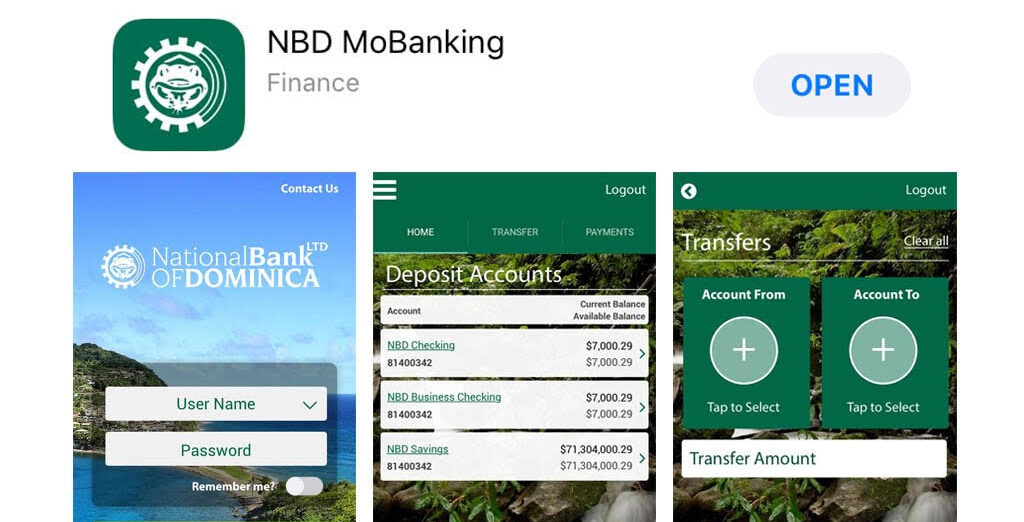
Open letter to National Bank of Dominica: Recommendations on ways to improve the MoBanking experience
In a recent social media post on June 8th, 2024, Grayson J. Stedman Jr., a Business Technology Solutions Consultant at Eclypse Technologies, shared a series of recommendations aimed at improving the MoBanking experience offered by the National Bank of Dominica Ltd (NBD). The post garnered significant attention, receiving over 200 reactions, 100 comments, and 70 shares, though NBD has yet to respond. Stedman’s suggestions focus on streamlining user interactions and expanding the app’s functionality, particularly for businesses and individual users. Key recommendations include enabling QR code generation and scanning for peer and merchant additions, eliminating redundant Mobile ID entries during peer transactions, and enhancing transaction details to include sender account numbers and names. Additionally, Stedman proposed integrating real-time notifications for account activities and developing a Point-of-Sale (POS) feature to facilitate faster and more secure transactions. He emphasized the potential for NBD to collaborate with local IT experts or existing POS providers to implement these features, leveraging the bank’s technical expertise while addressing its resource constraints. These improvements, if adopted, could significantly enhance MoBanking’s usability and appeal, particularly for small businesses and self-employed individuals who rely on the platform for financial transactions.
-

Raise game on cyber breach transparency, says data chief
Organizations across both public and private sectors remain alarmingly unprepared to effectively communicate data breaches to the public, heightening the risk of reputational damage and eroding consumer trust, warned Data Protection Commissioner Lisa Greaves on Tuesday. Speaking at a workshop titled ‘Human-Driven AI: Powering Communication Excellence,’ hosted by the International Association of Business Communicators (IABC) Barbados Chapter, Greaves emphasized the critical need for transparency and proactive measures in handling cybersecurity incidents. Despite the increasing frequency of data breaches, response strategies remain inconsistent and inadequate, she noted. Greaves highlighted the lack of transparency in Barbados, particularly in informing customers and clients about breaches and managing communication effectively. She cited the 2012 Target retail chain breach in the U.S., where a third-party vendor compromise led to significant reputational fallout due to poor communication. Greaves warned that government agencies are equally vulnerable to such risks, with several recent cyber incidents underscoring the importance of reputational management. She stressed the necessity of employee training, learning from past failures, and having pre-planned communication strategies in place. Under the Data Protection Act, breaches must be reported within 72 hours of discovery. Greaves urged organizations to involve communication specialists in their plans to dispel rumors and reassure the public. She also emphasized the immense value of data and the need for robust security investments, stating, ‘Data makes people billions of dollars a day. That’s the kind of security that has to be around data, because data is that powerful.’
-

OPINION: Why is AI so freaking smart?
Artificial Intelligence (AI) has emerged as one of the most transformative technologies of the modern era, captivating the world with its seemingly boundless capabilities. But what makes AI so remarkably intelligent? At its core, AI’s prowess stems from its ability to process vast amounts of data at unprecedented speeds, leveraging advanced algorithms and machine learning techniques to identify patterns, make predictions, and solve complex problems. Unlike human intelligence, which is constrained by biological limitations, AI thrives on computational power and scalability. It learns iteratively, improving its performance with each cycle of data analysis. Furthermore, AI systems are designed to mimic cognitive functions such as reasoning, decision-making, and even creativity, albeit in a structured and data-driven manner. The integration of neural networks, deep learning, and natural language processing has further amplified AI’s capabilities, enabling it to excel in diverse fields, from healthcare and finance to art and entertainment. However, the rapid advancement of AI also raises ethical and societal concerns, including issues of bias, privacy, and the potential displacement of human labor. As AI continues to evolve, it is crucial to strike a balance between harnessing its potential and addressing its challenges, ensuring that this powerful technology benefits humanity as a whole.
-

New CORS stations strengthen Dominican Republic’s geographic infrastructure
The Dominican Republic has taken a significant leap in geographic precision with the installation and activation of two new Continuously Operated Reference Stations (CORS) in Moca and Puerto Plata. These stations, integrated into the National Geodetic Network by the José Joaquín Hungría Morell National Geographic Institute (IGN-JJHM), are set to revolutionize real-time positioning accuracy across the country.
-

Technology : 71 IT Analysts Graduate
On November 9, 2025, Port-au-Prince witnessed a landmark event as 71 IT analysts graduated from an intensive six-month training program. This initiative, spearheaded by Akademi in collaboration with Quisqueya University, was financially supported by Haiti’s Ministry of Economy and Finance and the Bank of the Republic of Haiti (BRH). The program, known as Akademi’s Capstone Haiti 2025 Expo, underscores Haiti’s growing potential in the technology sector. The cohort began with 100 students, of which 71 successfully completed the rigorous curriculum. Participants were guided by industry experts and guest speakers, focusing on advanced technical skills in data science, artificial intelligence, software engineering, and cybersecurity. The Capstone phase required students to develop original projects, source datasets, and create software and machine learning solutions, culminating in professional-level presentations. Designed to align with international best practices while addressing local needs, the program aims to equip graduates with the skills necessary to drive Haiti’s digital transformation. This initiative highlights the country’s commitment to fostering talent in emerging fields critical to its digital economy.
-

The data courier problem
In a recent anecdote shared by Jonathan Reid, Barbados’ Minister of Industry, Innovation, Science, and Technology, the inefficiencies of the nation’s public services were starkly highlighted. While accompanying a loved one at the Queen Elizabeth Hospital, Reid found himself repeatedly explaining the patient’s condition to different healthcare providers. This scenario, all too familiar to many Barbadians, underscores a systemic issue: the failure of government agencies to share data effectively. Despite the Data Protection Act 2019 allowing internal data use, the lack of interoperable systems means citizens must redundantly provide the same information across various departments. This inefficiency permeates the public sector, from renewing driver’s licenses to applying for business permits. A recent case involving a vehicle registration mix-up further illustrates the problem. After renewing her motor insurance, a citizen discovered her number plate had been reassigned due to a data disconnect between the Barbados Revenue Authority and the Licensing Authority. Despite her insurer’s confirmation of payment and notifications to the BRA, the information failed to reach the Licensing Authority, leaving her to navigate a bureaucratic maze to reclaim her registration. This incident highlights the broader issue of data silos within government systems. While ministries have made strides in digitizing internal operations, these efforts often lack integration with other agencies. For instance, a tax compliance platform by the BRA could streamline business licensing or procurement processes if designed with inter-agency access in mind. However, without a national data governance framework, such potential remains untapped. The root of the problem lies not just in fragmented systems but also in a fragmented mindset. Barbados’ educational institutions focus on producing programmers and network administrators but lack emphasis on systems integration and enterprise design. This gap is mirrored in the private sector, where few businesses utilize APIs or shared platforms for secure data exchange. To move forward, Barbados must adopt a national data governance framework, supported by systems-integration experts and clear data standards. By fostering interoperability and stewardship, the government can ensure that information entered once serves multiple lawful purposes. This approach will not only enhance efficiency but also rebuild public trust. In the end, digital maturity is not about the volume of data a government holds but how effectively it uses that data to serve its citizens.