分类: society

  • Children and parents treated at A.B.L.E. event

    Children and parents treated at A.B.L.E. event

    The Kensington Oval in Barbados transformed into a vibrant hub of inclusivity as hundreds of citizens gathered for the annual ‘Everyone is A.B.L.E.’ event. This community initiative, orchestrated by the Kiwanis Club of Pride of Barbados, was specifically designed to create an environment of unity, support, and enjoyment for children with diverse abilities and their families.

    The event’s programming featured an array of activities carefully crafted to encourage interaction and mutual understanding among participants. Pediatric physiotherapist Dr. Rhea Clarke emphasized the significance of creating a barrier-free space where children could engage without limitations. ‘Our participants represent a broad spectrum of conditions including Down syndrome, autism spectrum disorders, cerebral palsy, visual impairments, and hearing challenges,’ Dr. Clarke noted. ‘The fundamental objective is to facilitate meaningful connections between children of all abilities, fostering a society that learns to coexist harmoniously.’

    Recognizing the substantial demands placed on caregivers, organizers implemented a comprehensive wellness component specifically for parents. Nicola Yarde, representing the Kiwanis Club, detailed the introduction of relaxation services including therapeutic massages and additional surprises designed to provide respite for families. ‘While we’ve hosted this event previously, this year we incorporated specialized support for parents who navigate considerable challenges daily,’ Yarde explained. ‘We established dedicated wellness stations where caregivers could experience moments of rejuvenation and unwind from their responsibilities.’

    The initiative has demonstrated remarkable growth and community engagement, with participation increasing substantially each year. Yarde reported overwhelming response from families who actively anticipate the annual event. ‘The enthusiasm continues to build with expanding attendance figures. Families consistently inquire about event dates well in advance, demonstrating the profound value this gathering provides,’ she observed. The palpable excitement among both children and parents underscores the event’s positive impact on the Barbadian community’s approach to disability inclusion and support systems.


  • Inspiring through culture: Barry George’s journey of passion, purpose and cultural leadership

    Inspiring through culture: Barry George’s journey of passion, purpose and cultural leadership

    After decades of transformative work in Saint Lucia’s cultural landscape, activist Barry George is being recognized with the prestigious Les Piton Gold Medal for his enduring contributions to the creative industries. George’s remarkable journey, which began in modest circumstances during his secondary school years, has evolved into a lifelong mission to cultivate artistic excellence and preserve cultural heritage.

    Founded thirty years ago, George’s Silver Shadow Performing Arts Academy stands as a testament to his commitment. What originated as a school-based initiative has matured into a comprehensive after-school program dedicated to providing structured pathways for young artists. The academy emphasizes theatrical expression, cultural education, and African-rooted traditions including traditional drumming and dance, ensuring participants maintain strong connections to their heritage.

    George’s impact on Saint Lucia’s carnival scene proves particularly significant. When junior carnival participation dwindled to merely two bands, he established Just4Kids—a pioneering junior carnival band that generated unprecedented youth engagement. The program achieved extraordinary success with eight consecutive victories between 2011 and 2018 before temporarily pausing during the pandemic. For senior carnival, George launched the Expression Carnival Band to address declining local participation, insisting on complete local production and design while prioritizing affordability and inclusivity.

    Beyond carnival, George has profoundly influenced pageantry culture, having mentored approximately 500 young women for regional competitions. He views leadership as the art of creating new leaders, emphasizing adaptability, humility, and trust. Despite his accomplishments, George expresses concern about structural deficiencies within Saint Lucia’s creative sector, noting inadequate support systems in music production, performance, and carnival design that force artists to navigate multiple roles independently.

    George remains dedicated to collaboration and mentorship as essential growth strategies, encouraging emerging creatives to seek guidance from established professionals. While acknowledging his own challenging path, he focuses on creating smoother trajectories for future generations and expresses unwavering confidence that those he has trained will surpass his achievements. The official award ceremony recognizing his lifetime of service is scheduled for this Sunday.

  • Sharpes burglar records 8th conviction in 10 years

    Sharpes burglar records 8th conviction in 10 years

    In a Kingstown Magistrate’s Court ruling on Monday, a 40-year-old electrician from Redemption Sharpes received a 13-month prison term for residential burglary, marking his eighth criminal conviction within the past decade. Gideon Quow appeared before Senior Magistrate Tamika McKenzie, where he admitted to unlawfully entering the dwelling of Don Phillips between February 22 and March 1.

    The court heard that Quow, who had been previously employed by the victim for construction work, stole building materials totaling EC$267.23 from Phillips’ residence. The stolen items included a white tarpaulin (EC$80), a Rubis gas cylinder (EC$40), multipurpose cement (EC$60), a kitchen faucet (EC$89.09), and a bathroom shower head (EC$40).

    Prosecutor Akeem Solelyn presented evidence indicating that Phillips discovered the burglary upon returning home on March 1 at approximately 5:30 PM, noting an open window and missing construction materials. Following a police report, PC 151 Defreitas conducted an investigation that led to Quow’s residence. Although initial searches revealed nothing, Quow subsequently directed officers to the home of Keron James, where the tarpaulin and gas bottle were recovered.

    The defendant provided a written confession to the offense, resulting in his arrest and formal burglary charges. During mitigation, Quow appealed for leniency, citing his parental responsibilities for two children and expressing remorse, stating he ‘could not sleep at night’ and requested forgiveness from the victim.

    The prosecution emphasized Quow’s extensive criminal history, which includes convictions for theft, attempted burglary, and assault occasioning bodily harm. Notably, this offense occurred less than two years after his previous sentencing for similar crimes. Magistrate McKenzie imposed the 13-month custodial sentence alongside an order for EC$150 in immediate compensation, with a three-month imprisonment alternative should payment not be forthcoming.

  • Woman, 74, killed as van overturns in Overland

    Woman, 74, killed as van overturns in Overland

    A devastating minivan accident in Overland on Thursday afternoon resulted in one fatality and left multiple individuals hospitalized, including students from local communities. The incident occurred approximately at 5:20 p.m. near the Bailey bridge approach toward Sandy Bay, where a white Toyota Hiace van (registration H8860) veered off the roadway and descended an embankment.

    Authorities confirmed the deceased as 74-year-old Mary Bracken, a domestic worker from Sandy Bay. Initial police reports inaccurately indicated two fatalities, which was subsequently corrected to a single death following further investigation.

    The vehicle, which typically transports students from Fancy and Owia to Georgetown Secondary School, was carrying 18 passengers in addition to the driver and conductor at the time of the accident. Notably, investigative sources indicate that the van’s regular student transport driver was not operating the vehicle during the tragic incident.

    Emergency services responded promptly to the scene, transporting injured individuals to medical facilities where two remain hospitalized. The Royal Saint Vincent and the Grenadines Police Force has launched a comprehensive investigation to determine the exact circumstances and contributing factors behind the accident, including road conditions, vehicle mechanical integrity, and driver credentials.

  • War over $21m land deal

    War over $21m land deal

    A contentious $21 million real estate transaction has been identified as the primary motive behind the assassination of prominent Trinidadian businessman Danny Guerra, who was fatally shot outside his DG Homes office in Sangre Grande on March 13. According to multiple investigative sources, the dispute centered on a strategically located parcel of land near Paharry Junction along Toco Main Road, originally intended for mixed commercial and residential development.

    Law enforcement officials confirm the killing exhibits all characteristics of a professionally executed contract murder, with the price tag believed to be approximately $600,000. The conflict emerged when Guerra allegedly seized complete control of the land acquisition from his business associate who initially brokered the deal. “He handled everything behind the man’s back and cut him out completely,” revealed an anonymous source close to the investigation. “From that point, it was war.”

    Investigators are focusing on the disgruntled business associate who possessed detailed knowledge of Guerra’s daily routines and movements. This individual is suspected of providing critical intelligence to the assassins, who reportedly tracked Guerra for several days prior to the shooting. On the day of his murder, Guerra had visited the US Embassy in Port of Spain, possibly to obtain travel documents, indicating he was aware of potential threats to his safety.

    The investigation has uncovered potential gang connections, with authorities suspecting the involvement of the Valencia-based Anybody Gets It (ABG) gang. Intelligence sources suggest the killing may have served dual purposes: settling the personal business dispute while simultaneously weakening the rival Resistance Gang, which Guerra was believed to financially support through his quarrying operations.

    While police initially considered alternative motives including previous equipment disputes and potential prison-orchestrated plots, these avenues have yielded minimal evidence. The land dispute remains the most substantiated theory, overshadowing speculation about political motivations or previous criminal associations.

    Guerra’s business empire, built through dominant control of the Eastern Division’s quarrying industry, had previously drawn law enforcement scrutiny. In November 2025, he was detained under a Preventative Detention Order for alleged connections to organized crime, including illegal quarrying, arms trafficking, and money laundering. Though released in January after legal challenges, investigators were reportedly preparing a new detention order based on intercepted communications discussing planned attacks at the time of his death.

    The aftermath continues to unfold with retaliatory violence already emerging, including the recent killing of quarry supervisor Rondell Adolphus. Intelligence sources warn additional targets connected to Guerra’s network have been identified, indicating the initial assassination may trigger further violence in the region.

  • Too broken for a hearse

    Too broken for a hearse

    The Ravine Sable community in Longdenville, Central Trinidad, faces an infrastructure crisis of such severity that it has fundamentally disrupted both life and death. The community’s main access road has deteriorated into an impassable hazard, recently forcing a funeral home to refuse hearse service. This left grieving residents unable to bring a deceased neighbor home for a final farewell, compelling them to hold services in a distant town center instead.

    This incident epitomizes a decades-long neglect. Senior citizen Madho Siew, a 30-year resident, confirmed the road was last properly paved in 1995. The situation has been severely exacerbated by over 50 daily ten-wheeler trucks accessing a local sandpit, traffic for which the road was never engineered. These heavy vehicles systematically destroy the pavement and generate suffocating dust clouds.

    The consequences are multifaceted and severe. Resident Sukdai Jogie, 72, suffers from chronic dust-induced coughing, a diagnosed medical condition directly attributed to her proximity to the road. The financial burden on residents is crushing; one newcomer reported spending nearly $30,000 on six separate vehicle repairs in just over a year. Local mechanic Darrion’s Automotive Mechanical Services confirms 75% of community vehicles require frequent suspension repairs, costing between $8,000-$15,000, leaving many cars abandoned as unaffordable fixtures.

    Public transport offers little relief. Taxis frequently refuse the route, and those that do charge exorbitant fares up to $50 for a single trip after dark. In the absence of government action for nearly a decade, community contractor Donny Parasram Sookdeo has become an unlikely guardian. He has personally absorbed thousands in costs to conduct patchwork repairs and clear overgrown vegetation, calling it his way of “giving back.”

    Residents now pin their hopes on a new government and their active MP, Dr. Rishad Seecheran, pleading for a permanent solution that will restore not just their road, but their dignity, health, and financial stability.

  • Expect patient delays at NCRHA facilities

    Expect patient delays at NCRHA facilities

    A severe nursing service disruption brought healthcare facilities under the North Central Regional Health Authority (NCRHA) to the brink of shutdown during the Easter weekend, prompting urgent patient diversions to neighboring regional health authorities. The Trinidad and Tobago National Nursing Association (TTNNA) issued a formal advisory urging the public to avoid NCRHA-operated hospitals and emergency facilities, recommending alternative care at institutions managed by the NWRA, ERHA, and SWRHA instead.

    TTNNA President Idi Stuart described the situation as “highly emotional and fluid,” identifying NCRHA Chairman Dr. Tim Gopeesingh’s removal as the critical requirement for restoring normal operations. The crisis most severely impacted major medical centers including the Eric Williams Medical Sciences Complex, Mount Hope Women’s Hospital, and Caura Hospital, with significant staff shortages also reported at Chaguanas and Arima District Health Facilities.

    The association outlined four primary grievances: unpaid February wages, reduction of overtime compensation from $75 to $60, demands for standardized overtime pay equivalent to other staff, and restricted extra duty opportunities despite persistent staffing shortages. Stuart attributed these directives directly to Chairman Gopeesingh, noting they have forced procedure cancellations, patient rerouting, and created life-threatening delays in medical care.

    Stuart escalated the matter to national leadership, calling directly on Prime Minister Kamla Persad-Bissessar to remove Gopeesingh from his position, characterizing him as a “loose cannon” whose actions are creating dangerous ripple effects throughout the healthcare system. The chairman had previously labeled Stuart a “lying coward” in public statements, though the nursing representative declined to engage in what he termed “gutter politics.”

    On-site observations at the EWMSC Emergency Department revealed dozens of patients experiencing extended wait times, with one individual reporting having navigated multiple facilities since 10 p.m. the previous evening. Another patient expressed frustration after waiting five hours without prior knowledge of the nursing action, while acknowledging understanding the nurses’ professional plight.

  • From The Bleachers: Ideas to improve school sports

    From The Bleachers: Ideas to improve school sports

    As another school sports season concludes in Saint Lucia, critical evaluation reveals both celebratory achievements and substantial areas requiring systemic improvement in track and field development. The current landscape demonstrates pressing needs for enhanced resources, strategic planning, and modernization to elevate athletic standards nationwide.

    Resource allocation emerges as a fundamental concern, with urgent requirements for additional qualified coaches, improved facilities, and proper equipment implementation. The installation of specialized infrastructure—including shot put circles, long jump pits, and high jump mats—across all 24 secondary schools represents an essential foundation for development. Athletic diversification beyond traditional flat sprints presents another crucial opportunity, particularly through investment in sprint hurdling and quarter-miling to develop more versatile competitors capable of international success.

    The scheduling coordination between school meets and club competitions demands immediate attention. This season’s congested calendar—featuring Island Champs, National Juniors, and subsequent events within tight succession—demonstrated the unsustainable pressure placed on multi-event athletes. Collaborative efforts between government entities, educational institutions, and the national athletics federation must establish complementary schedules that prioritize athlete development over organizational convenience.

    A paradigm shift toward national talent identification appears overdue, with proposals suggesting promising athletes should become national projects rather than individual school responsibilities. The documented success of Julien Alfred—who received coordinated support from the Athletics Association, Ministry of Sports, and Olympic Committee—provides a proven model for replication. Establishing a dedicated sports scholarship desk with transparent objectives and funding mechanisms would further address the gap between talent recognition and opportunity realization.

    Technical modernization through digital record-keeping represents another critical advancement area. While secondary schools currently access the athletic.net platform used throughout the Caribbean and United States, utilization remains limited to Island Champs registration. Mandating comprehensive use of the platform’s live results functionality would create valuable performance archives while enabling international benchmarking. The exemplary practices of District 2’s sports committee and select schools demonstrate the feasibility of implementing shareable, editable result formats.

    The controversial practice of cash incentives at school competitions requires reevaluation, particularly given the existing resource disparities between institutions. Redirecting focus toward equitable development across all schools rather than financial rewards would better serve long-term athletic development objectives. Strategic partnerships with alumni associations and community businesses could help less-resourced schools compete effectively despite smaller populations and limited coaching access.

    Addressing these structural gaps necessitates collaborative understanding between the Ministry of Education, Youth Development and Sports, individual schools, and the national governing body. Delivering world-class athletic programming demands commitment to modern thinking and sustained effort rather than seeking temporary solutions. The path forward requires acknowledging that meaningful progress emerges from coordinated long-term strategy rather than fragmented short-term interventions.

  • Fuel, in Haiti Beginning of panic among consumers

    Fuel, in Haiti Beginning of panic among consumers

    Port-au-Prince, Haiti – March 28, 2026: A wave of consumer anxiety has swept across Haiti, manifesting in lengthy queues at service stations and a resurgence in the use of jerrycans amid intensifying rumors of imminent fuel shortages and price surges. In a decisive response, the Ministry of Commerce and Industry has moved to quell the panic and enforce distribution laws.

    Minister James Monazard issued an official statement categorically denying the existence of a national fuel crisis. ‘No fuel shortage has been observed on the national market,’ the Minister asserted, confirming that petroleum products remain available at official pumps with distribution secured through formally authorized channels.

    The Ministry has enacted a strict prohibition on the sale of fuel outside these legal channels, specifically targeting unauthorized containers like jerrycans. The decree warns that any individuals or entities engaged in such illegal sales will face immediate enforcement actions, including product seizure, closure of offending outlets, and legal prosecution under Haitian law. Relevant authorities, including inspection services and law enforcement agencies, have been instructed to apply a zero-tolerance policy.

    To substantiate its claims and directly counter public rumors, the Ministry conducted a series of inspections on Saturday, March 28th. Teams visited multiple service stations in key areas including Delmas, Tabarre, Pétion-Ville, and the second district of Port-au-Prince. These operations verified the actual presence of fuel, contradicting widespread allegations of a shortage.

    A parallel inspection mission was executed in the Northeast Department, covering the communes of Ouanaminthe, Fort-Liberté, and Trou-du-Nord. Under the supervision of Departmental Director Lesly Théogène and Inspector Egains Joseph, eleven stations were assessed. The survey revealed that the vast majority were adequately stocked; only a single station in Ouanaminthe was found to be out of gasoline. The Ministry acknowledges that while availability is overall acceptable, the situation remains fragile.

    The government is urging public cooperation, encouraging citizens to report any illegal fuel practices to the authorities to help stabilize the market and prevent unnecessary panic.

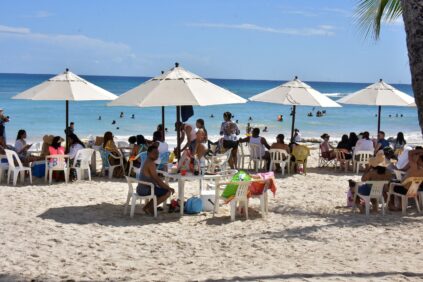
  • Mass parties at beaches and resorts are prohibited during Holy Week

    Mass parties at beaches and resorts are prohibited during Holy Week

    As one of the most widely observed religious and recreational periods in the region approaches, the Dominican Ministry of the Interior and Police (MIP) has rolled out a comprehensive suite of security regulations designed to protect public safety across high-traffic tourist and leisure hubs during Holy Week 2026.

    Through official Resolution MIP-RR-0001-2026, the MIP has enacted targeted restrictions on large-scale gatherings and high-risk activities that are common during the week-long holiday. The regulatory framework covers a range of crowd-focused activities, setting clear rules for sound amplification equipment use, temporary public structure installation, and group alcohol consumption in public spaces.

    The most notable restriction imposed by the resolution is a full ban on all mass gatherings for parties, whether publicly organized or private, across coastal beaches, rivers, streams, and surrounding resort areas. The temporary structure ban also applies to these same zones, and both restrictions will remain in effect from March 29 through April 5, 2026, covering the full span of Holy Week celebrations.

    Additional rules include a complete prohibition on the sale of alcoholic beverages across the country on Good Friday, a key solemn day of reflection for observant believers. To guarantee full compliance with the new resolution, MIP has formally directed two specialized state bodies—the Dominican National Police and the Directorate for the Control of Alcohol Sales (COBA)—to carry out regular patrols and enforcement actions throughout the holiday period.

    In an official statement justifying the new measures, MIP emphasized that unregulated large parties held in open public spaces often create avoidable risks to community safety. These events, which typically feature loud music, large crowds, and widespread alcohol consumption, frequently disrupt public order, impede local transportation and mobility, and erode peaceful citizen coexistence in popular recreational areas. The new regulatory package is crafted to mitigate these risks, balancing the public’s desire for holiday leisure with the need to maintain safety and order for residents and visitors alike.