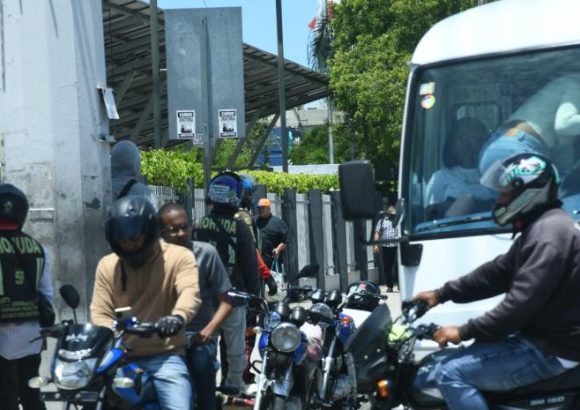
A recent minor traffic collision outside Santo Domingo’s Centro de los Héroes Metro station has pulled back the curtain on a growing, months-long mobility crisis plaguing the Dominican capital, exposing deep institutional gridlock over the regulation of informal motorcycle taxi (locally known as motoconcho) stands.
The incident unfolded when a motorcycle taxi driver traveling against the flow of traffic scraped a passing truck, sending the rider falling onto hot pavement. Within seconds, dozens of fellow drivers surrounded the vehicle, blocking the main thoroughfare in front of the busy transit hub and snarling traffic for passing commuters. While the collision caused no severe injuries or harm to the truck driver, it amplified longstanding questions from frequent station users: why is an unpermitted motorcycle taxi stand operating directly adjacent to an official “No Passengers” sign here?
Local residents confirm the informal stand’s appearance dates back to the inauguration of the city’s new Independence Corridor project. When existing public transport service disappeared from the corridor following the project’s completion, more than 10 drivers affiliated with local motoconcho associations MOHUDA and UNIMODIN gradually occupied a long stretch of curb space in front of the Metro station. To date, no local authority has intervened to remove the stand, which disrupts both pedestrian and vehicle movement on a daily basis. This unregulated encroachment is not an isolated incident: recent data from the Dominican Republic’s General Directorate of Internal Taxes (DGII) shows motorcycles have come to dominate the capital’s vehicle fleet. As of February 2026, the National District hosts roughly 841,647 registered motorcycles, with the national total hitting 3,954,053 by April 2026. Shockingly, 2025 data from the National Institute of Transit and Land Transportation (INTRANT) reveals only just over 11,000 of these motorcycle operators hold valid legal driving licenses.
To uncover who authorized this informal stand – and hundreds like it across the capital – reporters submitted three freedom of information requests to the Mayor’s Office of the National District and INTRANT, asking for public records of all permitted and registered motorcycle taxi stands in the capital. Under Dominican Law 63-17 on Mobility, Land Transport, Transit and Road Safety, the two institutions share formal responsibility for regulating motorcycle transport: Article 75 of the law states that motorcycle services are to be overseen by INTRANT in coordination with local municipalities, requiring joint authorization and an operating license for all motoconcho stands, plus a municipal registry of all permitted sites.
What followed was a clear case of bureaucratic buck-passing. A senior source within the National District Mayor’s Office confirmed no such registry exists, after the agency’s Public Information Access Office refused to fulfill the request and redirected all responsibility to INTRANT. After a 14-working-day delay, INTRANT responded with just four lines of text, asserting that under current law, registration of motorcycle taxi stands falls exclusively to local municipalities. This directly contradicts a 2025 response INTRANT gave to an identical request for records of motoconcho stands in Greater Santo Domingo. At that time, the agency claimed the information was still in internal review and data collection, rather than shifting full responsibility to the city government.
Even more striking, INTRANT’s own 2025 annual public report contradicts both agencies’ claims of having no active records. The report explicitly details the work of INTRANT’s Motorcycle Operating License Department, noting that the agency processed hundreds of applications to register new motorcycle taxi stands, update existing stands’ rosters, and conducted a full census of more than 200 motoconcho operating zones across multiple provinces including the National District in 2025. The report also mentions that INTRANT provided compensation and safety training to motoconcho operators displaced by new Metro and Cable Car construction in Los Alcarrizos.
While the current system is mired in chaos, policy experts and existing planning documents outline a clear path forward to formalize the service. A past national motorcycle registration initiative launched in 2021 and discontinued in 2022 offers a tested framework for identifying and registering the country’s massive unregulated motorcycle fleet. The official Sustainable Urban Mobility Plan for Greater Santo Domingo also proposes a practical solution that does not require eliminating the popular informal service: instead of eradicating motoconchos, urban mobility specialists recommend integrating them into the formal public transit network as last-mile feeder services. Under this plan, designated, clearly marked intermodal transfer zones would be established near mass transit stations like Centro de los Héroes, physically delimiting operating space to prevent spontaneous encroachment on sidewalks and traffic lanes, reduce congestion, and protect pedestrian safety.
This model has already proven successful across Latin America. Technical road safety reports endorsed by the Spanish Road Association highlight Brazil’s regulatory framework for motorcycle taxi services, which combines clear administrative requirements and direct institutional oversight to deliver smoother, safer traffic flow. The crisis of unregulated motoconcho stands in Santo Domingo ultimately presents an opportunity to turn systemic chaos into a efficient, integrated mobility model – but progress will first require an end to institutional buck-passing and a commitment to fulfilling the shared regulatory mandates set out in national law.