分类: society

  • New School of Agriculture in Glanvilles to Open Next Month

    New School of Agriculture in Glanvilles to Open Next Month

    The Antigua and Barbuda College of Advanced Studies (ABCAS) has announced the imminent launch of a pioneering agricultural education institution at the former Glanvilles Secondary School campus, with operations scheduled to commence as early as next month. This transformative educational initiative represents a strategic repurposing of educational infrastructure to address national priorities.

    Under the leadership of ABCAS President Dr. E. Jonah Greene, the institution is developing a specialized curriculum through collaborative efforts with both local and regional agricultural experts. The inaugural academic offering will feature two intensive short courses focused on crop production and poultry farming, scheduled for deployment between January and February.

    This educational repurposing follows the Cabinet-approved consolidation of Glanvilles and Pares Secondary Schools, a measure implemented to optimize resources amid declining enrollment figures. At the time of merger, Glanvilles recorded 163 students while Pares had 178 enrolled. The transition involved transferring current Glanvilles students to Pares Secondary School, with teaching staff either reassigned to other institutions or retained within the Ministry of Education’s administrative framework.

    The newly designated agricultural campus will leverage Glanvilles’ existing infrastructure, including a fully-equipped science laboratory, home economics department, hydroponic cultivation unit, animal pens, and multiple farm plots. This comprehensive facility repurposing aligns with the government’s heightened emphasis on achieving national food security objectives and advancing specialized agricultural education to strengthen the country’s resilience and self-sufficiency in food production.

  • PM Mottley urges families to join One Family drive to rebuild social fabric

    PM Mottley urges families to join One Family drive to rebuild social fabric

    In a significant national address, Barbados Prime Minister Mia Mottley has issued a powerful appeal for citizens to actively participate in restoring the nation’s social cohesion. Speaking at Wednesday’s inauguration of the first Social Empowerment Agency (SEA) client center in Six Roads, St Philip, Mottley positioned the new integrated social services model as a cornerstone of broader societal transformation.

    The Prime Minister articulated a compelling vision where poverty reduction and community strengthening require collective action beyond government intervention. “The battle to lift families from dependence to independence to nurture interdependence must happen not because government alone is integrating services,” Mottley emphasized, “but through combined efforts of public sector, private enterprise, and community engagement.”

    Mottley framed participation as both moral imperative and practical necessity, particularly urging economically stable citizens to join the One Family Programme. She challenged conventional notions of support, stating: “You can always give money, but money isn’t the only currency that helps to empower. The currency that helps to empower most is a listening ear and a helping hand, a warm heart, and voices that literally encourage others.”

    The Prime Minister illustrated this philosophy with a recent case where a business owner opted for restorative justice over prosecution for several youths in trouble. Through mediation involving parents, officials, and religious leaders, agreements were established to reward positive behavior—including academic improvement—with tangible support such as sporting equipment and transportation to recreational activities.

    Mottley connected this approach to Barbados’ cultural and religious values, reminding citizens: “If we don’t be the country that gives people a second chance, what is the basis of the religious faith of Christianity, if it is not about redemption and opportunities, and forgiveness?” Her address positioned social empowerment as both practical governance and national ethical commitment.

  • Senator Michael Freeland Pays Tribute to Teacher Gen’s Life and Legacy

    Senator Michael Freeland Pays Tribute to Teacher Gen’s Life and Legacy

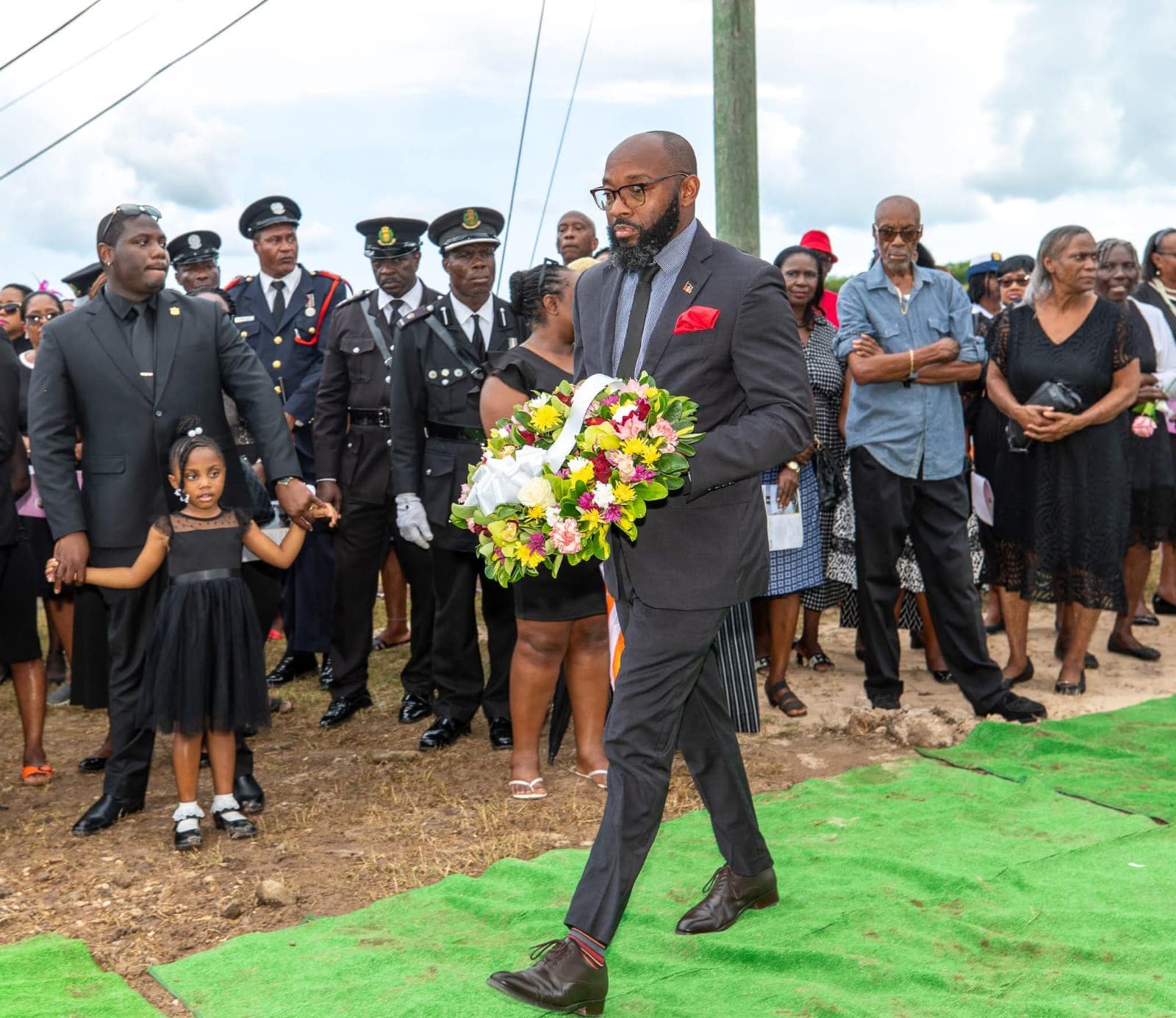
    ANTIGUA AND BARBUDA – The nation came together this week to honor the extraordinary legacy of the revered educator known affectionately as ‘Teacher Gen,’ whose funeral service became a powerful testament to a life lived in service of others. The ceremony, attended by citizens from across the dual-island nation, served as a profound reflection on her enduring contributions to education and community development.

    Prominent political figures joined family members in paying heartfelt tributes. Senator Michael Freeland delivered a poignant eulogy, characterizing the departed as a foundational pillar of society. ‘We gather today to celebrate a true matriarch,’ Senator Freeland stated, ‘whose wisdom, compassion, and unwavering commitment to our children and community will never be forgotten.’

    Her daughter, The Reverend Denise Smith-Lewis, offered a personal perspective on her mother’s lifelong mission. She shared that Teacher Gen ‘stood firmly for family and community, and clearly understood her life’s assignment,’ framing her work as a divine calling rather than merely a profession.

    Further illuminating her profound personal impact, Hon. Anthony Smith Jr. eulogized his grandmother as ‘a remarkable life, a beacon of love, faith, and inspiration to all.’ He provided intimate details of her home, which he described as having long served as ‘a sanctuary for the abandoned… a place where unconditional love, structure, and discipline transformed lives.’

    The widespread attendance and unified outpouring of respect highlighted the deep and lasting imprint of Teacher Gen’s decades of dedication, cementing her status as a national figure whose influence transcended the classroom and shaped the very fabric of Antiguan and Barbudan society.

  • Two Men Sentenced for Unlawful Possession of Cannabis

    Two Men Sentenced for Unlawful Possession of Cannabis

    In a decisive move underscoring the nation’s drug enforcement stance, the Antiguan judicial system has handed down significant financial penalties to two individuals convicted on cannabis possession charges. The rulings were delivered on Wednesday at the All Saints Magistrate’s Court, presided over by Magistrate Ngaio Emanuel.

    The first case involved Terrance Roberts, a 48-year-old resident of Federation Road. Roberts, who had previously entered a guilty plea, was found in possession of 267.8 grams of cannabis. The court imposed a substantial fine of $5,000 Eastern Caribbean Dollars, mandating full payment within a one-year period. Failure to comply with this financial penalty will result in a one-year custodial sentence at His Majesty’s Prison.

    In a separate and concurrent hearing, 32-year-old Roshawn Elliott from Potters Village faced sentencing after similarly pleading guilty. Elliott’s charges stemmed from the possession of a larger quantity—1.1 pounds (approximately 499 grams) of cannabis. Reflecting the greater amount seized, the court levied a more severe fine of $15,000 EC Dollars, also payable within a twelve-month timeframe. Defaulting on this payment will lead to an eighteen-month incarceration period.

    These consecutive sentencing procedures highlight the ongoing enforcement of cannabis legislation within Antigua and Barbuda, demonstrating the judiciary’s consistent application of penalties proportionate to the severity of the offense. The outcomes serve as a contemporary benchmark for drug-related convictions in the nation’s legal landscape.

  • OPINION: Caribbean Faces Rising Unemployment and Economic Uncertainty Amid Calls for Reform

    OPINION: Caribbean Faces Rising Unemployment and Economic Uncertainty Amid Calls for Reform

    The abolition of Caribbean slavery inaugurated a persistent struggle with employment, a complex issue often reduced to simplistic minimum wage debates and sterile statistics that obscure profound human suffering. The transition from plantation economies through post-colonial patriarchy to inadequate worker protection frameworks has left a fundamental question unresolved: what future awaits the region’s workforce?

    Global experiments offer little clarity. Finland’s Universal Basic Income trial provided unconditional payments to unemployed participants with inconclusive results, while India’s longstanding minimum hours protection for agricultural workers faces potential reform. The Cayman Islands recently implemented a hybrid approach emphasizing financial oversight and bureaucratic self-deception, even as the territory’s reputation suffers from yacht seizures and Ponzi scheme associations. Their entire financial sector now faces existential threat from proposed global corporate tax reforms targeting offshore havens.

    The heart of the unemployment crisis lies with disenfranchised youth who statistically drive regional criminal activity. Compounding this, efficiency gains, artificial intelligence, fiscal policies, and social spending demands are eliminating traditional lifetime employment for older workers—though not yet approaching Argentina’s pension crisis severity.

    Caribbean economies remain dangerously dependent on tourism, limited mineral resources, tax haven status, and remittances—a precarious foundation prompting some islands to explore military assistance economies akin to the Philippines. More alarmingly, formerly independent nations are increasingly functioning as U.S. detention facilities, trading sovereignty for economic survival.

    Remittance-dependent economies face additional pressure from American tax policies, while outsourcing sectors confront U.S. government opposition. Regional leadership promises 2026 solutions through economic diversification and sovereign wealth funds, but without substantive action, the future holds only intensified hardship and empty political rhetoric. The responsibility for meaningful change now rests entirely with Caribbean governance structures.

  • Dr Thomson Fontaine urges youth not to ‘waste their lives’ on violence

    Dr Thomson Fontaine urges youth not to ‘waste their lives’ on violence

    In a compelling address on state-owned radio DBS, United Workers Party (UWP) leader Dr. Thomson Fontaine issued a urgent plea to Dominica’s youth population, emphasizing the critical need for peaceful conflict resolution amidst escalating violent crimes on the island nation.

    The political leader directed his message specifically toward young males, urging them to reconsider their life choices amid what he described as unnecessary levels of violence. ‘I would like to make a very strong appeal to our young people, in particular to our young men, not to waste their lives away,’ Fontaine stated during his radio appearance. ‘This level of violence that we are seeing is really not called for.’

    Fontaine’s intervention comes against a troubling backdrop of criminal statistics, with Dominica recording over 20 homicides throughout 2025—a concerning figure for the Caribbean nation—accompanied by a dramatic increase in firearm-related violence.

    The opposition leader proposed concrete alternatives to violence, suggesting that youth should ‘bring in their illegal weapons’ and instead engage in dialogue to address conflicts. He emphasized the broader societal impact of violent crimes, noting that ‘too many families are impacted, too many people are impacted beyond just the people who are involved in the violence.’

    Fontaine advocated for a transformative approach to the new year, calling for greater patience and compassion among community members. ‘Let this new year be a part of something different where we can approach our issues and our differences and our problems in a different manner,’ he urged, adding that differences ‘can be done in a peaceful and amicable manner.’

    The UWP leader’s message aligns with growing concerns across Dominica regarding youth violence and illegal weapon proliferation, positioning community dialogue as essential to reversing the island’s troubling crime trends.

  • Police investigating fatal boating accident in Soufrière

    Police investigating fatal boating accident in Soufrière

    Authorities in Saint Lucia have launched a comprehensive investigation into a tragic maritime incident that resulted in the death of a local resident. The Marine Intelligence and Investigations Unit of the Royal Saint Lucia Police Force is leading the probe into Wednesday’s fatal accident occurring in the coastal waters near Anse Mamin, Soufrière.

    According to initial investigative findings, the victim was engaged in snorkeling activities when he suffered catastrophic injuries after being struck by an unidentified watercraft. Following the collision, bystanders arranged private transportation to transfer the injured man to Soufrière Hospital for emergency medical treatment.

    Despite medical intervention, the victim succumbed to his injuries shortly after arrival. Official confirmation of death was recorded by a medical examiner at precisely 12 p.m. on the day of the incident.

    The deceased has been formally identified as 31-year-old Sheram Lionel, a resident of Trois Piton in the Castries region. Police officials have confirmed that their investigation remains active and ongoing, with authorities examining all aspects of the circumstances surrounding this tragic waterfront accident.

  • ABWU Condemns Government’s “Sporadic and Fragmented” Payment Offers to Former LIAT 1974 Workers

    ABWU Condemns Government’s “Sporadic and Fragmented” Payment Offers to Former LIAT 1974 Workers

    The Antigua and Barbuda Workers’ Union (ABWU) has issued a forceful response to Prime Minister Gaston Browne’s announcement of additional funds for former LIAT 1974 Ltd. employees, characterizing the government’s approach as fundamentally inadequate and unjust.

    While acknowledging that financial assistance provides temporary relief, the union maintains an uncompromising position that displaced aviation workers must receive their full severance entitlements. The ABWU emphasizes that severance constitutes an earned right resulting from years of dedicated service, not a charitable donation or discretionary gesture.

    The labor organization has condemned the administration’s persistent refusal to acknowledge workers’ legitimate claims to severance payments, describing the government’s posture as both cruel and unjust. This stance has reportedly inflicted extended hardship on hundreds of former employees and their dependent families.

    The union characterizes the government’s intermittent payment offers as insufficient measures that highlight official apathy toward affected workers. The ABWU suggests that a credible demonstration of good faith would involve honoring severance for those with smaller outstanding balances while establishing a transparent framework for addressing larger payments as resources permit.

    Contradicting Prime Minister Browne’s claims of maintained dialogue, the union reveals that the administration has systematically excluded legally appointed worker representatives from substantive discussions for five consecutive years. This exclusionary approach appears particularly inconsistent with the government’s professed ‘pro-labour philosophy.’

    The ABWU concludes by demanding the replacement of what it terms ‘domineering approaches’ with constructive dialogue aimed at achieving a fair and humane resolution that acknowledges workers’ dignity and rightful claims.

  • Javian en oma Edith begraven na familiedrama in Commewijne

    Javian en oma Edith begraven na familiedrama in Commewijne

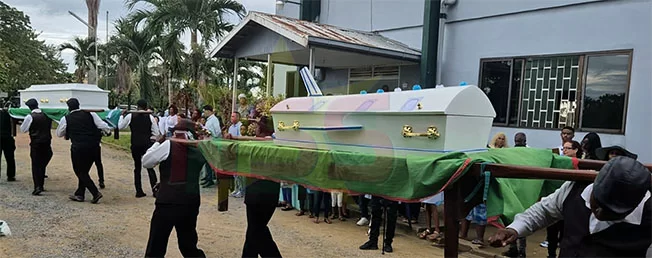
    Under a cloud of profound grief, Suriname laid to rest seven-year-old Javian Schattevoo and his 80-year-old grandmother Edith Brammerloo on Wednesday. The funeral service was marked by raw emotional outpouring as heart-wrenching cries of anguish echoed through the ceremony. In a poignant tribute to the young victim’s favorite toy, Javian’s casket was crafted in the distinctive shape of an airplane.

    Singing pallbearers carried the coffins from the service while trumpet music accompanied the ceremonial procession to the gravesites at René’s Hof cemetery, where mourners participated in traditional dancing carries as part of the burial rituals.

    The victims represent two of the ten lives lost in December’s horrific family massacre in Commewijne district. The perpetrator, Dennis Aroma, took nine lives including four of his own children before ending his own life within 24 hours of the atrocity.

    Aroma’s four children were buried on New Year’s Eve, while the assailant himself was laid to rest on Tuesday. Two survivors of the attack continue to recover from their injuries.

    In response to the tragedy, the Psychiatric Center Suriname (PCS) has deployed around-the-clock psychosocial support teams to assist grieving family members and affected community residents. Justice and Police Minister Harish Monorath attended Wednesday’s funeral to express official condolences and solidarity with the devastated families.

    The mourning process in Commewijne continues with Friday’s scheduled burial of married couple Oron, two additional victims of the massacre. The community remains deeply traumatized by a tragedy that has left permanent scars on this close-knit Surinamese district.

  • JCE launches first phase of national ID

    JCE launches first phase of national ID

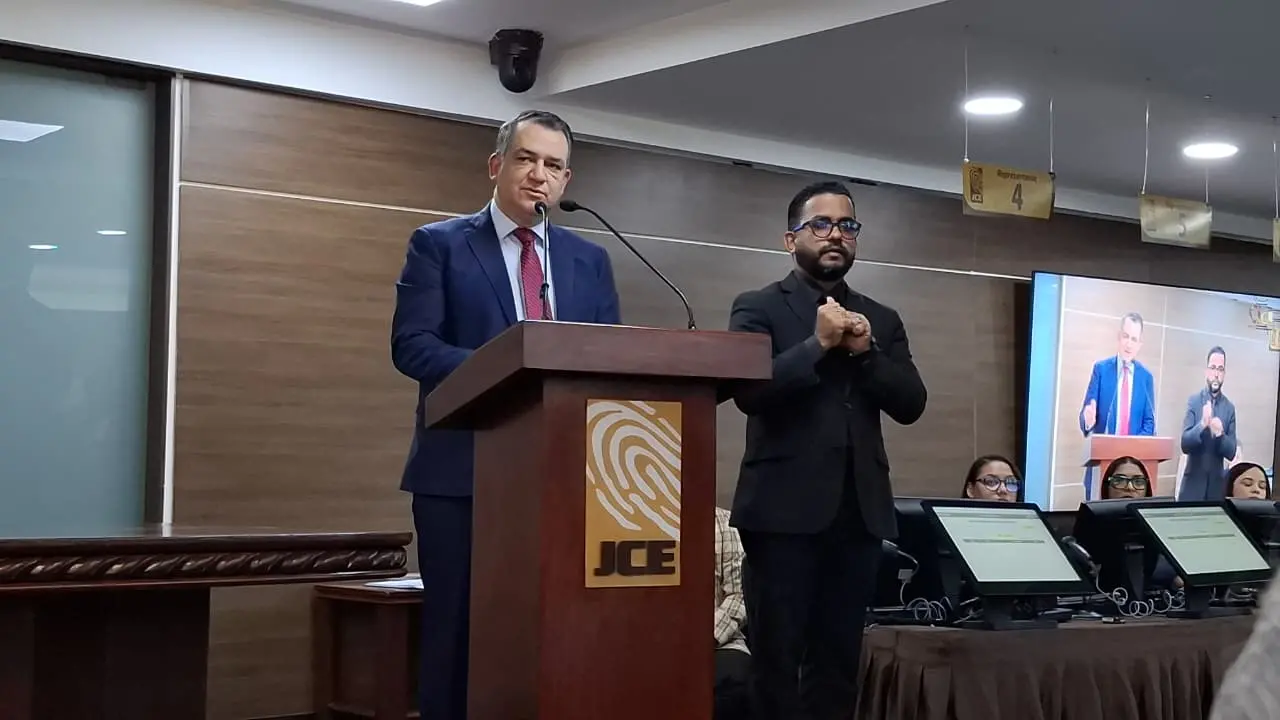
    Santo Domingo has initiated a landmark national identity modernization program as the Central Electoral Board (JCE) commenced the first phase of its comprehensive identity and electoral card renewal process on Monday. This pioneering effort centers on the collection of biometric data, signaling a technological leap in the country’s identification systems.

    The ceremonial launch featured Digna Mercedes, a distinguished JCE employee honored for her 52 years of service, becoming the first individual to undergo biometric data capture. This initial phase, running through January 23rd, is exclusively available to JCE personnel while deliberately excluding Plenary members from participation. The advanced laser-engraved identification cards are projected for delivery within a two-to-three month timeframe following data collection.

    President Luis Abinader is scheduled to receive the inaugural new-generation identity card during a special ceremony at JCE headquarters on January 26th. The limited rollout will expand throughout February and March to encompass employees of non-profit institutions alongside strategically selected groups including senators, deputies, judges, political party representatives, academics, athletes, business leaders, and civil society members—totaling approximately 4,000 identification documents.

    The comprehensive renewal initiative will transition to its second phase in April, marking the commencement of public accessibility. Citizens will be processed according to birth months in a systematically organized national rollout extending through March 2027, ensuring orderly implementation across the Dominican Republic.