分类: society

  • Grenada Bureau of Standards commemorates World Metrology Day 2026

    Grenada Bureau of Standards commemorates World Metrology Day 2026

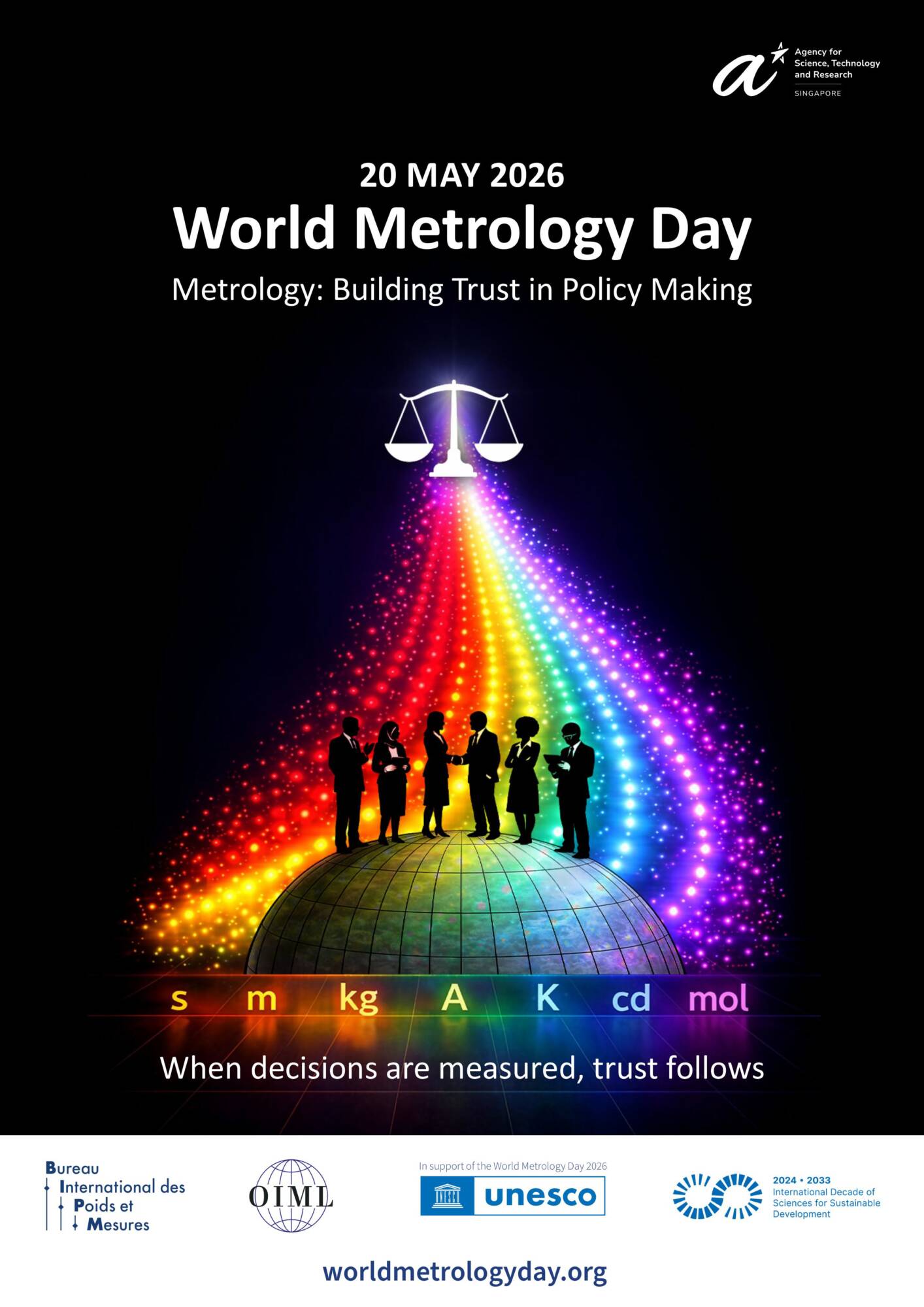
    Every year on May 20, nations across the globe come together to mark World Metrology Day, an occasion that honors the foundational international agreement that shaped modern measurement systems. In 2026, the Grenada Bureau of Standards (GDBS) is set to stand alongside the international community to celebrate this important day, centered around the 2026 global theme: “Metrology: Building Trust in Policy Making”.

    World Metrology Day traces its origins back to a pivotal moment in 1875, when diplomats and delegates gathered in Paris to sign the groundbreaking Metre Convention on May 20 that year. That historic treaty laid the groundwork for a universally coordinated, globally consistent system of measurement, creating the framework that underpins cross-border collaboration, fair trade, and scientific progress to this day.

    The 2026 theme was chosen to shine a spotlight on the critical, often underrecognized role that accurate, reliable metrology plays in shaping effective governance. Precise measurement is the bedrock of evidence-based policy design, consistent regulatory compliance, equitable international trade, robust consumer protection, evidence-led public health action, and ambitious global sustainability efforts. Without consistent, verifiable measurement data, policymakers lack the objective information needed to craft legislation, develop national programs, and enforce regulations that serve the public good.

    For example, modern climate and environmental policy depends entirely on consistent, accurate measurement systems to track greenhouse gas emission levels, monitor surface and groundwater quality, measure airborne pollutant concentrations, and track shifting climate indicators. Similarly, consumer protection relies on enforceable legal metrology frameworks that guarantee the accuracy of everyday measurement tools, from commercial supermarket weighing scales to retail fuel dispensers and residential utility meters that calculate water and electricity use.

    In Grenada’s tri-island nation of Grenada, Carriacou and Petite Martinique, all legal metrology operations are governed by the long-standing Weights and Measures Act of 1997 and its accompanying 1998 regulations. GDBS carries out regular inspection and mandatory verification of all commercial weighing and measuring devices used in trade and commerce across all three islands. These routine checks and regulatory oversight do more than ensure compliance: they protect consumers from unfair pricing and inaccurate measurements, foster a marketplace rooted in fairness and transparency, and boost public confidence in local commercial systems.

    As the country prepares to join the global 2026 World Metrology Day observance, GDBS has reaffirmed its long-standing commitment to upholding rigorous measurement standards, advancing nationwide quality assurance, and protecting the rights of Grenadian consumers. By consistently enforcing the island’s legal metrology laws and regulations, the bureau continues to nurture fairness and transparency in domestic and international trade, while strengthening public trust in the infrastructure and systems that shape daily life across Grenada.

    Accurate, dependable measurement remains an indispensable pillar of informed policy-making, consistent regulatory enforcement, rigorous environmental monitoring, responsive public health systems, and long-term sustainable national development. GDBS says it will maintain its mission to ensure that all measurements used across every public and private sector in Grenada are consistent, internationally traceable, and dependable, supporting sound policy decision-making and a fair, trusted marketplace for all residents of Grenada, Carriacou and Petite Martinique.

    This contributed piece was shared through NOW Grenada, which notes it does not take responsibility for the views or content included in contributor submissions. Readers may contact the platform to report any content that violates community guidelines.
  • Offerfeest dit jaar op woensdag 27 mei

    Offerfeest dit jaar op woensdag 27 mei

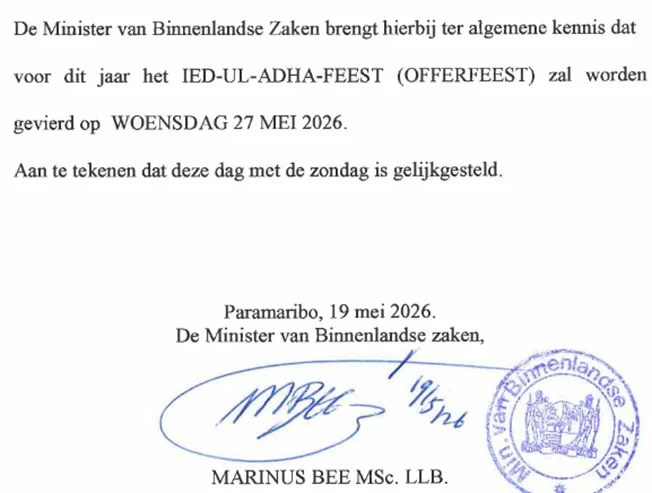
    Authorities in Suriname have formally confirmed the official date for this year’s observance of Eid al-Adha, known locally as Offerfeest, scheduling the major Islamic religious holiday for Wednesday, 27 May. The announcement came directly from the country’s Ministry of Internal Affairs, which has officially designated the holiday to hold the same legal status as a Sunday, granting it recognition as a nationwide public holiday for all residents.

    As one of the most sacred and widely celebrated religious observances in the Islamic faith, Eid al-Adha, also called the Feast of Sacrifice, centers on core themes of devout faith, willingness to sacrifice for one’s beliefs, communal unity and mutual solidarity. The holiday marks a key moment in Islamic tradition: it commemorates the prophet Ibrahim’s unwavering obedience to God, which saw him prepared to sacrifice his own son as an act of devotion. According to centuries-old Islamic lore, God ultimately accepted a sacrificial animal in the young man’s place, establishing the tradition of animal sacrifice that remains central to the celebration today.

    Across global Muslim communities, traditional observances of the holiday bring together worshippers for collective prayer services, held both in mosques and open-air prayer grounds across the world. A core pillar of the celebration is the value of sharing with others: after sacrifice, families customarily divide the meat between their own households, extended relatives, neighbors, and low-income community members who face economic hardship, ensuring that all can participate in the festive occasion.

    In Suriname, the Feast of Sacrifice holds deep cultural and social significance for the country’s large Muslim community, who mark the occasion annually with full traditional observances. This year’s designation as an official national public holiday will allow residents across the country to fully participate in long-standing customs, including communal prayer services, family gatherings and visits, and acts of charity that form the backbone of the celebration.

  • Government to upgrade delivery of social assistance

    Government to upgrade delivery of social assistance

    A two-week high-level assessment mission organized by the World Bank has wrapped up its work on the Caribbean island of Saint Lucia, concluding May 14 with clear progress toward upgrading the nation’s entire social assistance delivery infrastructure. The mission’s core outcome is a foundational framework for a new centralized Social Protection Information System, a digital upgrade designed to streamline access to social support, cut service wait times, and bring greater organization to fragmented existing programs.

    The proposed unified platform will address longstanding coordination gaps across multiple government-led social assistance initiatives, centralizing all beneficiary and program data in one accessible location to boost cross-agency accountability and improve end-to-end service delivery for residents. Throughout the mission, World Bank technical teams maintained close collaborative working relationships with key Saint Lucian government bodies, including the Ministry of Equity, the Saint Lucia Social Development Fund, the Ministry of Finance, and the National Emergency Management Organisation, among other relevant agencies.

    Nancy Banegas, Senior Social Protection Specialist at the World Bank leading the mission, outlined that the team’s review centered on three of the country’s most impactful social support programs: the Public Assistance Programme (PAP), the Koudmen Sent Lisi Programme, and the Shock Response Cash Voucher Programme. “These three programs have been identified as very important social assistance pillars for the country, and the government alongside the Ministry of Equity is committed to rethinking how services reach communities more effectively,” Banegas explained. She added that the new system will fundamentally reshape how government ministries deliver support and communicate with beneficiaries, delivering direct, tangible benefits to vulnerable people while strengthening the overall quality of support services available.

    According to an official statement from the Saint Lucian government, the system will modernize nearly every core function of social assistance delivery, from initial beneficiary registration and eligibility assessments to payment processing and benefit distribution. Beyond improving outcomes for recipients, the upgrade will also streamline daily workflows for social workers and ministry administrative staff, reducing redundant data entry and bureaucratic bottlenecks.

    Tanzia Toussaint, Director of Social Transformation in the Ministry of Equity, framed the initiative as a transformative milestone for Saint Lucia’s social protection ecosystem, particularly for improving data collection and evidence-based policy decision-making. “This means bringing together all stakeholders, particularly from within our Ministry, including Welfare, Human Services, Social Transformation and Community Development, all of which play a direct role in gathering and managing critical information,” Toussaint said. “We recognise that the flow of information and the capturing of relevant data from the units will improve considerably over time. The objective is to establish a system that reflects, unit by unit, the work being undertaken and the specific information that must be captured. Information is power, and without it, we cannot effectively drive the social protection agenda forward.”

    Planned development and implementation timelines set a target to have the full system up and operational by the first quarter of 2027. The Ministry of Equity emphasized that the project forms a core part of broader government efforts to build a more efficient, people-centered social protection framework that can better meet the needs of vulnerable individuals and families across the entire island.

  • Police seek driver in fatal hit-and-run crash in St Mary

    Police seek driver in fatal hit-and-run crash in St Mary

    Authorities in St Mary, Jamaica have launched a manhunt for a vehicle driver responsible for a fatal pedestrian collision that left an unidentified man dead on a major local roadway earlier this week. The tragic incident unfolded just after 9:00 pm on Tuesday along the Heywood Hall main road, close to the Hampstead entrance in the parish, according to official police accounts.

    Preliminary reports from law enforcement confirm the victim, described by officials as a man believed to be experiencing mental distress, was struck by the moving vehicle while walking along the public roadway. In what has become the core focus of the ongoing investigation, the driver of the vehicle that hit the man immediately fled the accident site rather than stopping to render aid or report the crash, as required by Jamaican law.

    Following the collision, members of the local community discovered the seriously injured victim along the roadside. Acting quickly to save his life, residents transported the injured man to the Port Maria hospital, where attending medical staff pronounced him dead shortly after arrival.

    The St Mary Police Division is now leading a full criminal investigation into the fatal hit-and-run, working to identify both the victim and the at-large driver. Law enforcement officials are urging members of the public who may have witnessed the crash, have information about the vehicle involved, or hold any other details that could advance the investigation to contact the St Mary police immediately. All submissions of information can be kept confidential to protect witnesses, authorities added.

  • Prevention 360 conference highlights Dominican Republic’s seismic and climate risks

    Prevention 360 conference highlights Dominican Republic’s seismic and climate risks

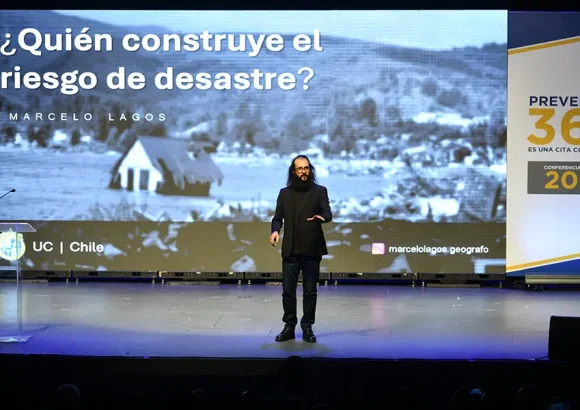
    In the capital city of the Dominican Republic, Santo Domingo, a landmark risk-prevention summit named “Prevention 360” has convened leading specialists from across the world and the country, spanning the fields of geology, meteorology, and emergency response. The gathering was organized to carry out a comprehensive evaluation of the dual threats of seismic activity and climate-driven disasters that the Caribbean nation currently confronts.

    Unlike routine academic conferences, this event centered its discussions on four high-priority areas that directly impact public safety: the vulnerability of dense urban centers to disasters, evidence-based land use planning, the structural resilience of buildings and critical infrastructure, and the urgent need to boost the general public’s disaster preparedness capabilities for major events including earthquakes, hurricanes, and flash floods. Distinguished international speakers headlined the summit: Marcelo Lagos, a prominent Chilean geographer; John Morales, a veteran meteorologist with decades of extreme weather forecasting experience; and Laís Pinto De Carvalho, an environmental psychologist. Each brought unique perspectives to the table, with their talks delving into the intersection of crisis response systems and human behavioral patterns when catastrophic events unfold.

    Local senior officials and technical experts also played a central role in the conference’s deliberations. Key participants included José Ignacio Paliza, Dominican geologist Osiris de León, and Juan Manuel Méndez, director of the country’s Emergency Operations Center (COE). During their presentations, they outlined the Dominican Republic’s existing capacities for local disaster response, while also drawing clear attention to the persistent challenges posed by aging infrastructure and uneven resource distribution across at-risk regions.

    aIn addition to seismic risk assessments, the conference repeatedly emphasized the escalating urgency of climate change impacts currently unfolding across the country. The Dominican Republic is currently grappling with record-breaking high temperatures, increasingly unpredictable rainfall patterns, and more frequent intense downpours that experts have linked to active tropical waves and abnormally warm surface temperatures in the Atlantic Ocean — trends that are expected to intensify in the coming years without targeted intervention.

  • Uruguayan energy expert to share insights at Maurice Facey Lecture

    Uruguayan energy expert to share insights at Maurice Facey Lecture

    KINGSTON, Jamaica — Jamaica’s energy sector is poised for a landmark conversation this June, as one of the world’s most successful clean energy transition trailblazers prepares to headline the sixth annual Maurice Facey Lecture, scheduled for June 10, 2026. The public event, set to kick off at 4:00 pm at the Jamaica Conference Centre, will center on the timely theme “Breaking the Grid: Charting Jamaica’s Path to Renewable Energy”, diving into the complex opportunities, obstacles and policy choices that will define the island nation’s clean energy future. Open to all attendees at no cost, the lecture arrives at a critical turning point for Jamaica’s energy ambitions. For decades, the country has grappled with an overreliance on imported fossil fuels, which currently supply nearly 88% of its total electricity generation. This dependence has left Jamaica exposed to volatile global fuel markets, pushed regional electricity prices to among the highest in the Caribbean, and exacerbated vulnerabilities to climate change that threaten the country’s power grid infrastructure. As a result, the push for energy independence has shifted from a long-term planning goal to an urgent national priority. To address these challenges, the Jamaican government has set an ambitious target to source 50% of its electricity from renewable sources by 2030. Industry and policy leaders broadly agree that hitting this target is a critical step to boost Jamaica’s international economic competitiveness, shore up long-term energy security, and bring much-needed relief from high energy costs for both households and businesses. To help the country navigate this transition, the 2026 lecture has drawn a keynote speaker with a proven track record of delivering transformative national energy reform: Dr. Ramón Méndez Galain, the internationally acclaimed energy transition expert who led Uruguay’s world-renowned shift to a nearly fully renewable electricity system. Dr. Méndez Galain’s work has earned global recognition, including a spot on Fortune magazine’s list of the 50 Greatest Leaders in the world, the 2023 Carnot Prize, and the 2025 Climate Breakthrough Award. His career in energy leadership began during his tenure as Uruguay’s national director of energy from 2008 to 2015, when he oversaw the country’s historic energy overhaul. When the transition was complete, 98% of Uruguay’s electricity came from renewable sources — with wind power accounting for roughly 40% of total generation — and the cost of producing electricity was cut by half. Today, Uruguay is held up as a global model for successful, affordable renewable energy adoption for small and medium-sized nations. Beyond his work leading Uruguay’s energy transition, Dr. Méndez Galain has served as Uruguay’s Secretary of Climate Change, where he played a central role in international negotiations for the Paris Climate Agreement. He has also held top roles at leading global climate and energy bodies, including Chairman of the Council of the International Renewable Energy Agency (IRENA) and board member of the Green Climate Fund (GCF). Since March 2025, he has served as President of REN21, the global network focused on advancing renewable energy policy, and leads Fundación Ivy, a nonpartisan think tank that advises governments and private sector groups on scaling up renewable adoption and implementing sustainable development strategies. Stephen Facey, Chairman of the Pan Jamaica Group and the C.B. Facey Foundation, which co-host the annual lecture series, emphasized that the event’s mission has always been to connect Jamaican audiences with world-leading expertise to spark actionable conversation about the country’s future. “Ramón’s experience demonstrates that ambitious renewable energy transition is achievable, even for relatively small nations, and his insights will be invaluable as Jamaica charts its own path forward,” Facey said. The Maurice Facey Lecture Series was launched in 2019 to honor the legacy of the late Maurice Facey, OJ, JP, a pioneering figure in Kingston’s modern urban development and a lifelong advocate for transformative progress across Jamaica. Each year, the series invites globally respected thought leaders to examine pressing issues tied to Jamaica’s long-term national development, and has grown into a leading high-level platform that bridges global innovation and local policy dialogue. It regularly draws audiences of senior government officials, private sector chief executives, urban planners, academic researchers, and international development practitioners. Beyond the main public lecture, event organizers have planned a full week of supplementary activities designed to facilitate deep, direct engagement between Dr. Méndez Galain and Jamaica’s key energy sector stakeholders. “We have structured a series of surrounding events around the lecture week designed to facilitate direct, high-touch dialogues between Dr Méndez Galain and key local stakeholders, policymakers and industry practitioners,” explained Gayon Douglas, Executive Director of the C.B. Facey Foundation. “Our goal is to ensure that his profound global experiences can serve as a practical resource as local leadership continues to shape and implement Jamaica’s sustainable energy strategies.” The 2026 lecture is co-hosted by the Pan Jamaica Group and the C.B. Facey Foundation, two organizations with longstanding commitments to advancing inclusive national development across Jamaica. This year’s event is supported by a roster of sponsors including ROK Hotel, the Caribbean Policy Research Institute, the Urban Development Corporation, the Jamaica Chamber of Commerce, and the Jamaican Institute of Architects.

  • St Mary contractor found dead, police investigating suspected suicide

    St Mary contractor found dead, police investigating suspected suicide

    ST MARY, Jamaica — Law enforcement agencies in Jamaica’s northern parish of St Mary have launched an official investigation into the death of a local construction professional, a case that local authorities are treating as the fifth suspected suicide recorded in the region since the start of the year. The 43-year-old victim, Oneero Roberts, who went by the nickname “Anif”, was a resident of the Comsee neighborhood in Highgate, a market town located in the heart of the parish.

    Per official police accounts, the grim discovery was made on an unspecified date in recent weeks after a close family member grew concerned when they detected an unusual putrid smell emanating from the overgrown bushy area at the rear of Roberts’ private property. Just after 10:00 a.m. local time, the relative ventured to the back of the land to trace the source of the odor, where they made the tragic finding.

    Investigators confirmed that Roberts’ body was located hanging from a tree in the thickly vegetated plot, and that the remains had already begun to partially decompose by the time they were discovered. Emergency response teams were called to the scene to retrieve the body, which has since been moved for a formal post-mortem examination to confirm the exact cause and timeline of death.

    Local policing officials have confirmed that this death marks the fifth suspected suicide to be recorded in St Mary parish in 2024, a statistic that has already raised quiet concern among local public health and community welfare stakeholders. As of the latest update, investigators from the St Mary Police Force are continuing their procedural inquiry into the circumstances surrounding Roberts’ death, with no further details released to the public at this stage.

  • Santiago de los Caballeros launches plan to modernize tourist horse-drawn carriages

    Santiago de los Caballeros launches plan to modernize tourist horse-drawn carriages

    In the Dominican Republic’s northern city of Santiago de los Caballeros, local municipal authorities have launched a groundbreaking new initiative designed to protect one of the city’s most cherished cultural legacies while addressing longstanding concerns over animal care and worker livelihoods. Titled “Tourist Carriages: Tradition, Well-Being and Protection”, the project marks a balanced approach to preserving a centuries-old iconic attraction that draws cultural tourists to the city, while updating outdated operating practices to meet modern animal welfare standards and support the generations of coachmen who rely on the trade for income.

    The program was formally introduced by Iris Cepín de Rodríguez at a public launch event, where she framed the initiative as a necessary response to the dual nature of horse-drawn tourism in Santiago. “The horse-drawn carriages of Santiago are part of our cultural identity and history, but they also represent an important social and urban challenge,” Cepín de Rodríguez noted. To address these challenges, the project establishes a clear set of binding rules for all operators, including designated authorized routes, mandatory regular veterinary check-ins for all working horses, strictly regulated work hours, specialized training for carriage drivers, and enforceable penalties for any documented cases of animal abuse.

    Deputy Mayor Mariana Moreno outlined the key structural changes the program will roll out to reduce strain on working animals. A core adjustment is the implementation of shorter, more manageable routes and structured, limited operating hours that cut down on overwork. Looking ahead, the municipal government also plans to gradually introduce electric or motorized support systems to further reduce the physical burden on horses. Beyond animal welfare, the initiative includes a dedicated social assistance component designed to support coachmen and their families, many of whom have long struggled with economic instability and limited access to health resources.

    Veterinarian Horacio Ceballos reported that the first phase of animal care has already been completed in the Bella Vista neighborhood, where more than 20 working horses received essential preventive care including vitamin supplements and deworming treatments. Another key welfare adjustment being rolled out is a shift in working schedules that prohibits horses from operating during the hottest midday hours, when heat exposure poses a major health risk to the animals.

    The multi-stakeholder project has brought together a cross-disciplinary team of experts to ensure its success, including legal specialists to draft and enforce regulations, experienced veterinarians to lead animal care, urban planners to map safe, appropriate routes, and sustainability specialists to guide the transition to lower-impact operations. Local tourism bodies VISIT Santiago and the Santiago Tourism Cluster have also thrown their support behind the initiative. Municipal leaders emphasize that the program’s ultimate goal is to deliver shared benefits: safeguarding a beloved cultural tradition for future generations, ensuring humane living and working conditions for the horses at the heart of the attraction, and lifting economic outcomes for the coachmen who keep the tradition alive.

  • Rose Heights Community Centre selected as St James’ Labour Day Project

    Rose Heights Community Centre selected as St James’ Labour Day Project

    ST JAMES, Jamaica — Local authorities in Jamaica’s St James parish have confirmed a major priority project for this year’s national Labour Day, tapping the flood- and storm-ravaged Rose Heights Community Centre as the parish’s flagship 2026 improvement initiative.

    While Jamaica observes Labour Day annually on May 23, the national holiday will be marked on Monday, May 25 this year because the actual date falls on a weekend.

    Montego Bay Mayor and Councillor Richard Vernon, who made the official announcement, shared that the selection followed weeks of careful consultations and on-site assessments of multiple community facilities across the parish. The Rose Heights site emerged as the clear top choice for several key reasons, most notably its large and consistent user base spanning the Rose Heights, Rosemount, and adjacent neighborhoods that rely on the space for regular community gatherings and events.

    This year’s national Labour Day focus is centered on upgrading public spaces, with a specific emphasis on community facilities that can serve as formal emergency shelters during natural disasters — a mandate that aligns perfectly with the plan for the Rose Heights centre. The Jamaican national government has already moved forward with a policy shift to end the longstanding practice of using primary and secondary schools as emergency hurricane shelters, a change designed to cut down on disruptive closures and learning interruptions for students across the island.

    “The St James Municipal Corporation is pleased to announce that the Rose Heights Community Centre will be the focus of the parish’s Labour Day this year,” Vernon shared in his statement. He noted that the facility suffered severe structural damage when Hurricane Melissa swept across the region last October, making targeted rehabilitation work a critical local need. “The intention is to ensure that it is rehabilitated with hurricane resistant capabilities,” he added. Once the upgrades are complete, the centre will be officially added to St James’ roster of approved emergency shelters, with renovations designed to bring it fully in line with national safety and infrastructure criteria for storm protection.

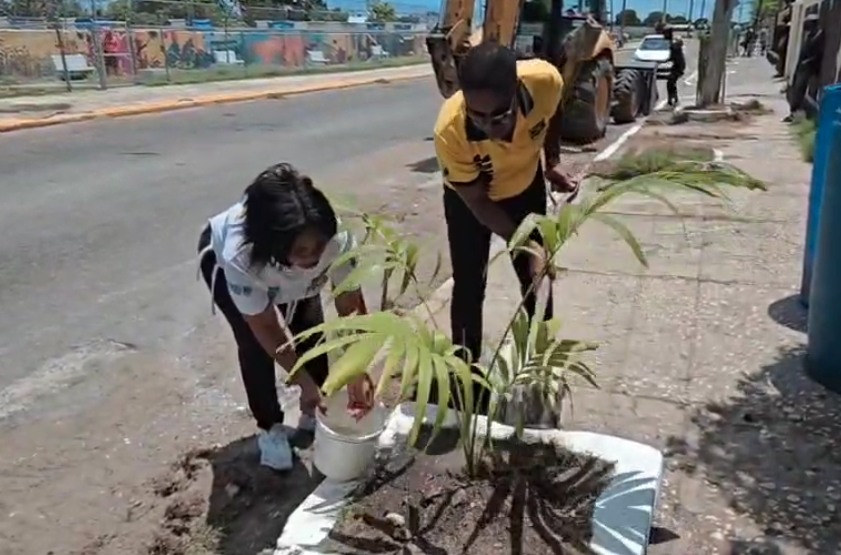
    Beyond the flagship project, Vernon urged local residents across St James to participate in either the Rose Heights initiative or any other registered Labour Day project that aligns with their community interests, emphasizing that collective volunteer effort drives meaningful local improvement. As of the pre-holiday deadline of May 18, the St James Municipal Corporation had registered 286 independent community projects for this year’s Labour Day, ranging from park cleanups and public space beautification to the repainting of pedestrian crossings and the rehabilitation of other small community buildings.

    In a separate announcement related to this year’s national observances, all preparations have been finalized for the annual floral tribute to Jamaican National Hero Samuel Sharpe, scheduled to take place as planned on the actual date of Labour Day, Saturday May 23, in Montego Bay’s Sam Sharpe Square. The ceremony, set to kick off at 8:00 a.m., marks the 194th anniversary of Sharpe’s execution by hanging in the same square in 1832, honoring his role as a leader in the movement that ended chattel slavery across the British Empire.

  • Unblocking PATH

    Unblocking PATH

    Jamaica’s government has announced sweeping, immediate reforms to the country’s flagship social assistance initiative, the Programme of Advancement Through Health and Education (PATH), after a systemic review identified crippling bureaucratic barriers that blocked eligible low-income Jamaicans from accessing critical support. Minister of Labour and Social Security Pearnel Charles Jr. outlined the changes Tuesday during his contribution to the 2026/27 Sectoral Debate in the House of Representatives, framing the overhaul as a major shift from inefficient bureaucracy to people-centered social protection.

    Prior to the reforms, accessing PATH benefits followed a rigid three-step process. Prospective beneficiaries first complete a preliminary assessment through the Beneficiary Management Information System (BMIS) at a local PATH office. After preliminary approval, applicants waited while social workers conducted in-person field verification, then finished with a mandatory orientation and training session. Charles explained that the review found months-long delays were common for the second and third steps, leaving qualified Jamaicans in limbo even after they passed the initial screening. Data from the assessment shows more than 80 percent of applicants who pass the preliminary BMIS check ultimately go on to pass full verification, making the extended wait unnecessary for the vast majority of eligible people.

    Under the new rules, which went into effect immediately after the announcement, all applicants who receive provisional approval through the BMIS preliminary assessment will automatically move to temporary payable status, eliminating unnecessary delays for vulnerable households while the full verification process is completed. The ministry will also modernize and strengthen the full verification and orientation process going forward, implementing clear mandatory timelines, upgraded operational standards, and more robust verification mechanisms. Charles emphasized that the reforms do not weaken accountability; instead, they remove unnecessary barriers to efficiency while strengthening oversight systems to ensure support reaches those who need it most.

    A second core set of reforms addresses longstanding problems with PATH’s mandatory recertification process, which requires the ministry to reassess a household’s eligibility every four years to reflect changes in household size, income, or dependent status. The review found that the old system failed to update legitimate changes to beneficiary status in a timely manner, leaving thousands of households stuck in the recertification pipeline with delayed or interrupted benefits. Common unprocessed updates included children transitioning from primary to secondary school — a change that alters benefit levels — and new children added to a household through birth.

    To resolve the backlog, the ministry will immediately begin progressively regularizing all beneficiaries who were stalled due to unresolved status updates, accelerating the process of reconciling and updating all affected cases. Moving forward, the recertification framework will be strengthened to process household changes faster, ensuring eligible families receive the full level of support they qualify for without unnecessary delays. Charles noted that recertification should serve as a pathway to fair, accurate support, not a barrier to assistance. The ministry will also continue targeted efforts to remove ineligible or no longer eligible recipients from the program to preserve resources for vulnerable groups.

    In his address, Charles shared that PATH delivered more than J$9.1 billion in direct cash assistance to over 240,000 beneficiaries across Jamaica in the 2025/26 financial year, making it the country’s largest social safety net program. The reforms are designed to ensure this critical investment reaches Jamaicans in need when they need it most, aligning the program with the core purpose of social protection: to adapt to the changing realities of the communities it serves.