
The Antigua and Barbuda National Accreditation Board (ABNAB) has officially confirmed upcoming adjustments to its mandatory service fees, with the revised pricing schedule set to go into effect starting July 1, 2026. According to the regulator, the updated fees are designed to sustain its core day-to-day operations, which include regular institutional evaluations, program accreditation reviews, and ongoing quality assurance work that underpins the credibility of the nation’s higher education sector. This maintenance of rigorous standards is critical to preserving the international recognition of Antigua and Barbuda’s academic and professional credentials, a key asset for students and workers seeking opportunities abroad. To avoid confusion for service applicants, ABNAB has outlined a clear transitional policy for processing submissions: any requests for institutional registration, academic program accreditation, or foreign credential evaluation that are submitted on or before June 30, 2026, will be charged at the existing lower rate. Only applications received after the June 30 deadline will be required to pay the new, higher fees. The board also issued a reminder to all clients about its approved payment protocols: all outstanding fees must be settled either via direct bank transfer to ABNAB’s official account, or through in-person cash payments made directly at the board’s central office. No other payment methods are authorized for processing accreditation and evaluation requests. In closing, ABNAB reaffirmed its long-term commitment to strengthening and refining Antigua and Barbuda’s national framework for higher education and professional accreditation, a system that supports both local educational institutions and workers seeking professional recognition. The organization encouraged any clients with questions or concerns about the upcoming fee changes to reach out to its administrative office directly for personalized clarification.
分类: society
-

Family Faces Dr. Bonilla’s Accused Killers in Emotional Court Scene
One week after the shocking killing of beloved Belizean physician Dr. Naun Bonilla, a charged and somber atmosphere enveloped the Belmopan Magistrates Court on June 5, 2026, as the two people accused of his murder appeared for their first court arraignment.
Hannah Foreman and Edwin Bethran Jr., the two defendants in the high-profile killing, were escorted by police into the courtroom to face the murder charges levied against them. Outside the courthouse walls, Dr. Bonilla’s family members, close friends, and community supporters gathered to confront the accused for the first time since the physician’s death. Overcome with grief that mixed faint hope for justice with overwhelming pain, family members clung to one another, shedding quiet tears as the suspects were led past the waiting crowd. No angry outbursts erupted, the weight of the loss too heavy to fuel anything but quiet sorrow.
Dr. Bonilla was not just a family member to those gathered, his brother Angel Bonilla emphasized to reporters – he was a lifesaver to the entire community, and his killing left a gaping void that can never be filled. “We cannot allow that these crimes go unpunished,” Angel Bonilla said. “It is sad to see where we have come as a society. They did not only take away a life, but a lifesaver, and that is crazy.” Looking back on the lead-up to the killing, which investigators link to a broken business relationship between Dr. Bonilla and Foreman that spawned ongoing disputes and civil court action, Angel Bonilla shared his deepest regret. “If I would have ever even in my wildest dream, consider this would have happen, I would have convinced my brother to drop the case and to leave it alone because nothing is worth a life. There is nothing than can replace the big void that has been left in our family.”
Dr. Bonilla’s sister echoed the family’s overwhelming pain while expressing faith that justice would ultimately be served. “The pain is too much and you can see us still but the pain is huge but we have a God and we know that he is our best lawyer and we are hoping for justice to be done in God’s will.”
When Arthur Saldivar, the attorney representing Edwin Bethran Jr., arrived at the courthouse, he was met with loud jeers from the gathered crowd outside. Speaking to reporters, Saldivar acknowledged the intense public scrutiny surrounding the case and stressed that all parties involved seek a just outcome. “We know that this is a very highly scrutinized case. The fact that Dr. Bonilla was murdered is not lost on anyone. Certainly on both sides of the bar we want justice to be done. Justice for Dr. Bonilla is important. Justice for Dr. Bonilla means that the right persons are before the court. If they are the right persons and the evidence holds up then the outcome will be what it should be. If it is that they are not the right persons, and all persons are presumed innocent until proven guilty, then the outcome will be justice in that respect as well.” Richard ‘Dickie’ Bradley, counsel for co-defendant Hannah Foreman, did not issue an on-the-record statement following the arraignment.
Explaining the legal framework of the charges against both defendants, ASP Stacy Smith, staff officer with the Belize Police Department, noted that the charges are rooted in the principle of joint enterprise. “The charge follows the principle of joint enterprise, which pretty much states that when two persons plan or commit an offense together, they can be liable for the independent conduct of each other. So even where a person may not have pulled the trigger that caused the demise of the other person, that person can still be liable for murder because there is some indication of their involvement in the planning of the act.”
Law enforcement moved swiftly to make arrests in the case, taking both suspects into custody just six days after Dr. Bonilla’s killing, and investigators continue to build out evidence for the prosecution. Smith detailed the cross-unit collaboration that led to the early arrests, noting that police relied on support from multiple specialized departments to piece together the timeline of events leading up to the killing. “We relied heavily on the Public Safety Monitoring Unit and the camera system that they have there. We also relied heavily on the Digital Forensics Unit of the Belize Police Department Cybercrime Unit. Similarly, great assistance came from the Financial Intelligence Unit and certainly the diligence of the police officers who spent extraordinary amount of time, the investigators, going through a number of footage which helped to paint a picture and take us to where we are now.”
Following Monday’s arraignment, the case has been adjourned until September, when the two accused will return to court for the evidence disclosure phase of the legal process. Today’s hearing marks the official opening of what is expected to be one of the most closely watched criminal trials in Belize in recent years.
-

Justice for Darnelle Puerto: Court Convicts Maskall Street Killer
Nearly three years after a fatal Christmas Eve shooting rocked the Maskall Street community, justice has been delivered for the family of Darnelle Puerto. A High Court judge has found 31-year-old Shaquille Perrera guilty on two counts: murder for the killing of Puerto, and attempted murder for the wounding of bystander Jehvon Ramclam.
The 2023 incident unfolded on one of the most celebrated nights of the year, turning a holiday gathering into a scene of violence. Multiple gunshot strikes left Puerto dead at the scene immediately after the attack, while Ramclam survived critical injuries to testify against the accused.
Justice Nigel Pilgrim delivered the guilty verdict late Thursday, basing his ruling largely on the firsthand testimony provided by Ramclam, the surviving victim and only eyewitness to the shooting. During the trial, Ramclam told the court he clearly identified Perrera as the gunman under the bright glow of a nearby streetlight moments before he fled the area to take cover. Perrera had pleaded not guilty to all charges, presenting an alibi that claimed he was in a different location at the time of the shooting. But Justice Pilgrim rejected this defense outright, noting that the prosecution had met its burden of proving beyond a reasonable doubt that Perrera committed the crime. In his ruling, the judge clarified that a formal identification parade was not required in this case, because Ramclam already knew Perrera personally before the shooting, making his identification immediate and reliable.Following the conviction, the court has scheduled sentencing for July 6. Pre-sentencing reports have been ordered to be completed ahead of the sentencing hearing, where Perrera will learn the term of his imprisonment for the convictions. The guilty verdict closes a key chapter in the high-profile case, bringing long-awaited closure to Puerto’s family and the local community that was shaken by the holiday violence three years prior.
-

Quick-Thinking Neighbor Helps Foil Armed Home Invasion in Cristo Rey
On June 5, 2026, a potential violent home invasion ended with one suspect in custody and most stolen property recovered, all thanks to an alert resident who acted fast in Cristo Rey Village, on the outskirts of San Ignacio.
The target of the invasion was a 66-year-old local woman, who escaped unharmed but shaken from the terrifying encounter. According to official details from Assistant Superintendent of Police Stacy Smith, the incident unfolded moments after the woman pulled into her driveway and exited her vehicle. Two armed male suspects accosted her immediately, forced her back into her home at gunpoint, and began ransacking the property to package up valuables for theft.
Before the intruders could finish collecting all their planned loot, a neighbor watching from a nearby property noticed the suspicious, alarming activity. The quick-thinking neighbor immediately placed an urgent call to San Ignacio Police, alerting them that an aggravated burglary was actively in progress.
Law enforcement officers wasted no time in responding to the call. As soon as they arrived at the residential property, they spotted the two suspects attempting to flee the scene. Officers launched an immediate pursuit, which ended with the arrest of one of the two men. Along with taking the suspect into custody, police recovered a loaded .22 caliber pistol, a quantity of live ammunition, and the single piece of jewelry the suspects managed to grab before fleeing.
Smith explained that the intruders only escaped with one small item because they panicked when they heard police vehicles approaching, cutting their burglary attempt short before they could carry off the other packaged valuables they had prepared.
In the aftermath of the foiled invasion, ASP Smith emphasized that the successful outcome was entirely dependent on the neighbor’s willingness to pay attention to their surroundings and report suspicious activity immediately. She noted that the fast resolution of the case serves as a clear reminder of the critical value of active neighborhood watch programs and investments in residential and community surveillance infrastructure, both of which enable rapid community responses to crime that help keep residents safe.
This report is a transcript of an evening television newscast, with all Kriol language comments transcribed using a standardized spelling system for accuracy.
-

Road expansion alone will not ease traffic congestion in Caribbean – CDB official
On Friday, June 6, 2026, a top official from the Caribbean Development Bank (CDB) pushed back against the widespread regional approach of expanding road networks to solve growing traffic gridlock, calling for a holistic, coordinated, and technology-enabled strategy to address what experts frame as a macroeconomic threat to Caribbean development.
Speaking at the CDB-hosted forum “Edge X by CDB: Unlocked – Stuck in Traffic: What Congestion Is Costing the Caribbean?”, William Ashby, Acting Division Chief of the Economic Infrastructure Division in the CDB’s Projects Department, argued that pouring resources into road expansion alone cannot fix persistent congestion. As Guyana — where the government has framed a surging vehicle count as a marker of growing national wealth, and has already completed multiple road widening projects and new highway construction in West and East Demerara — exemplifies the common reactive approach, Ashby emphasized that the region must shift its focus to integrated urban mobility planning rather than piecemeal road expansion.
Congestion is not just a local inconvenience, Ashby noted: it is a cross-cutting regional challenge that ripples across national economies, cutting into productivity, raising business costs, and slowing overall growth. It also carries far-reaching indirect impacts for public health, climate resilience, labor market function, and affordable housing access, he added.
To lay the groundwork for effective solutions, Ashby recommended that governments first build an analytical foundation through comprehensive mobility mapping, targeted congestion studies, and project feasibility assessments. The Barbados-headquartered CDB, he confirmed, stands ready to support this work through technical assistance, project preparation support, and policy-focused financing. For infrastructure investments, the bank can provide loans, grants, and concessional funding for integrated upgrades spanning public transit, active transport (walking and cycling) infrastructure, and smart traffic management systems.
Ashby warned against the common pitfall of ad-hoc, project-by-project reactive planning, urging decision-makers to adopt evidence-based, cross-sector coordinated strategies. He pointed out that fragmented institutional responsibility — where infrastructure development, transport planning, and traffic policing fall under separate, uncoordinated agencies — often worsens congestion even when new infrastructure is built. Beyond physical infrastructure, he said, the region needs to strengthen institutional coordination and clarify roles across government bodies to make solutions sustainable.
Capacity building is another critical gap, Ashby added: Caribbean nations need to invest in training for local experts in traffic engineering, transport modeling, and long-term mobility planning to design, roll out, and maintain effective congestion solutions.
Policy interventions to manage travel demand are also essential, he argued. Measures such as flexible or staggered working hours, structured parking pricing, and incentives for carpooling and ride-sharing can directly reduce peak-hour pressure on overstretched road networks. Ashby also made a strong case for integrating real-time digital tools into congestion management: leveraging data from road sensors, GPS tracking, centralized traffic control centers, and digital monitoring dashboards allows officials to shift from reacting to congestion after it forms to anticipating gridlock and responding in real time.
To test new approaches before large-scale deployment, Ashby suggested rolling out small targeted pilot projects, such as adaptive traffic signals, smart parking systems, and dedicated bus priority lanes in high-congestion zones.
“Congestion in the Caribbean is solvable but only if we treat it as the real development issue that it is,” Ashby concluded.
Joining Ashby at the forum, Dr. Rae Julien Furlonge, Managing Director of regional transport consultancy LF System, traced the roots of the region’s congestion crisis to a 30-year policy trend: governments have encouraged cheap vehicle imports as a source of tax revenue and business growth, but failed to invest in matching public transport infrastructure. This has created a “wicked cycle” where countries are forced to spend increasing amounts of foreign exchange on fuel imports and road repair bitumen, all while public transit systems remain underfunded, unreliable, and inadequate to meet commuter demand. Furlonge noted that more than 60 percent of regular public transit users across the region are women and children, who bear a disproportionate share of the burden of inadequate service.
Furlonge outlined the wide range of hidden costs of unaddressed congestion: lost worker productivity, wasted fuel, widespread travel delays, billions of hours of lost time, elevated driver stress and fatigue, increased air pollution, missed economic opportunities, and stunted national economic growth. He did note one unexpected local exception: some small business owners have asked for slower speed limits to allow passing commuters to spot their storefronts, a rare conflict of interest in congestion planning.
To reverse the trend, Furlonge called on Caribbean societies to fundamentally “rethink mobility” — focusing on removing private vehicles from roads during peak congestion periods rather than just diverting them to new or expanded roads, with the core goal of reducing total vehicle kilometers traveled. He pointed to developed economies that have achieved as much as a 30 percent reduction in peak vehicle use through these strategies.
Even with high private vehicle ownership across the region, Furlonge emphasized that most commuters still lack access to reliable, high-quality public transit, and ordinary commuters bear the brunt of congestion caused by unregulated private vehicle use. Among his proposed policy solutions are pay-as-you-drive insurance schemes that price driving based on actual road use, replacing traditional one-size-fits-all tolls, and offering income tax rebates to both employers and employees that adopt flexible work or shared commuting arrangements. For near-term parking and traffic management, he recommended targeted tweaks including structured parking regulation, expanded park-and-ride facilities, metered roundabouts, intersection design improvements, double-lane roundabout conversions, adjusted traffic signal timings, and cracking down on arbitrary bus stopping that blocks traffic flow.
-

Ambitious Domestic Violence Reform Faces Reality Check in Belize
As Belize’s National Assembly debates a landmark piece of legislation aimed at overhauling the country’s outdated domestic violence legal framework, growing implementation gaps are throwing the future of the reform into question, exposing the gap between ambitious policy intent and on-the-ground readiness.
Lawmakers are currently reviewing the proposed Domestic Violence and Intimate Partner Bill, a piece of legislation crafted to replace Belize’s existing legal provisions for domestic abuse cases with far stronger safeguards for survivors. The reform comes in response to persistent systemic gaps in addressing gender-based violence, with official data from the Belize Crime Observatory confirming that 70 to 80 percent of all domestic violence victims are women, and young adult women face the highest risk of harm across the country.
Prime Minister John Briceño, whose administration brought the reform forward, has publicly condemned the deep-seated cultural norms that enable abuse, noting that violence against women — whether physical, financial, or emotional — has no place in modern Belize. Briceño also acknowledged ongoing cultural barriers within law enforcement, pointing out that while many police officers work diligently to address cases, some still hold onto harmful macho attitudes that undermine survivor protection. He added that police also face unique frustrations, when survivors withdraw charges after initial reports as tensions de-escalate, a common dynamic in intimate partner abuse cases. Briceño’s wife Rossana, a prominent advocate for survivor rights, has even publicly called out law enforcement for persistent failures in responding to domestic abuse reports.
Despite widespread cross-party agreement that reform is long overdue, major obstacles to rolling out the new framework have already emerged. A core provision of the bill would allow select Senior Justices of the Peace to issue emergency interim protection orders, a critical tool to separate survivors from abusers while formal court proceedings move forward. But as of the legislative debate, required training for these judicial officers is still ongoing, and many stakeholders say the process is moving far slower than survivors and advocates would like.
Minister of State Dolores Balderamos-Garcia, speaking from the Office of the Prime Minister, confirmed that the training process is still in progress, saying “We do hope this can be rolled out very soon.” But even as the government pushes toward a launch, lawmakers from across the aisle are raising urgent questions about sustainable resourcing for the reform. Lee Mark Chang, Area Representative for Mesopotamia, pressed the administration during the debate, pointing out that while the bill looks strong on paper, no dedicated budget has been allocated for its implementation. Chang noted that the government recently cut $55 million from the national budget, drawing from capital projects including infrastructure repairs and public program funds, leaving observers uncertain where funding for the sweeping reform will come from.
For advocates and survivors across Belize, the emerging delays and funding gaps are a stark reminder that transformative change on gender-based violence requires more than just updated legislation — it demands sustained investment in training, infrastructure, and cultural shift to turn policy promises into tangible protection for those at risk.
-
PUC Urges Vigilance as Electricity Bills Climb
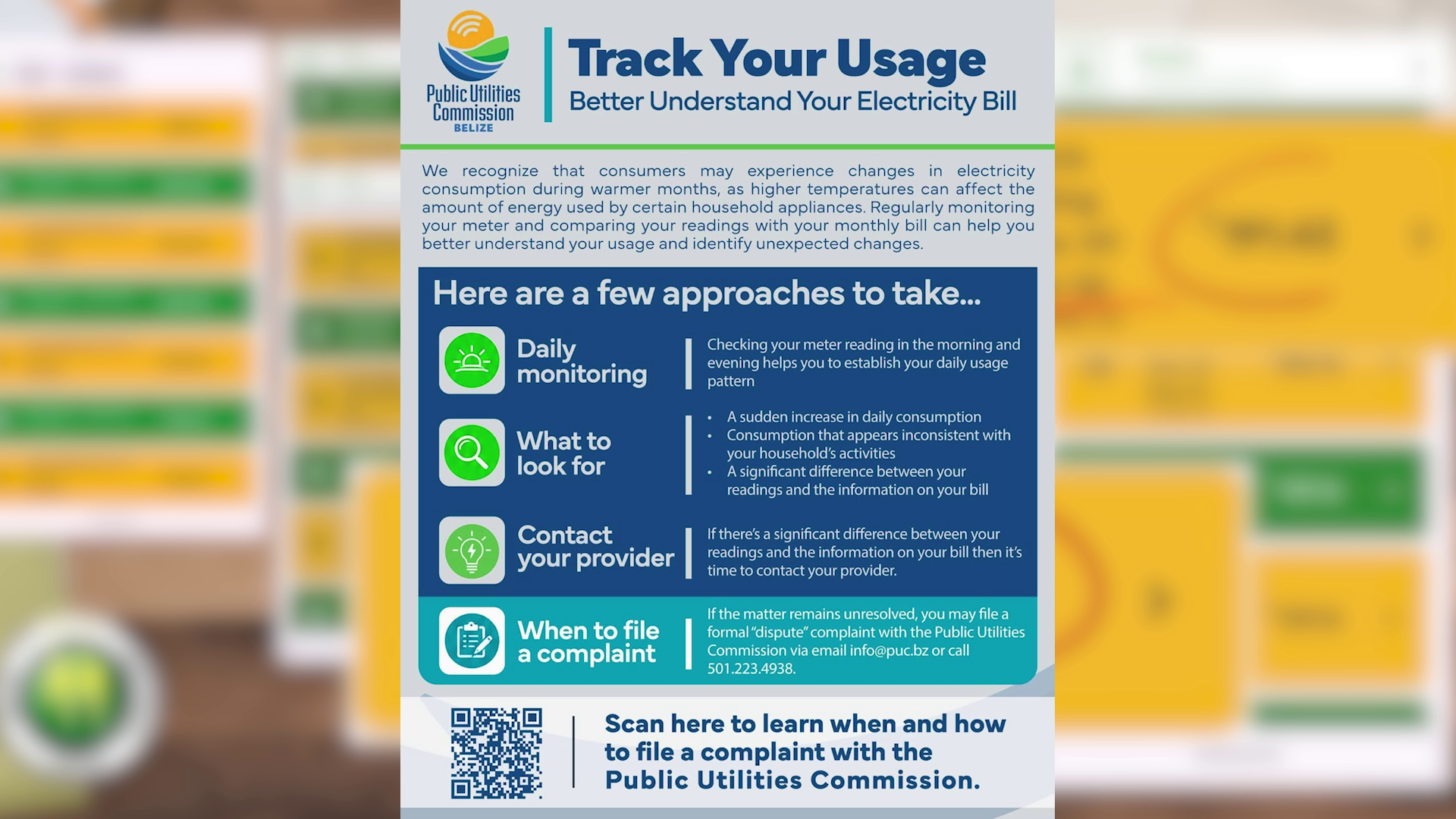
As summer temperatures climb across Belize, thousands of utility customers are taking to social media to voice growing frustration over sharply higher monthly electricity charges, prompting the nation’s Public Utilities Commission (PUC) to issue a formal consumer guidance notice urging proactive vigilance over energy usage and billing.
The issue first gained public traction when customers of Belize Electricity Limited (BEL), the country’s primary electricity provider, began sharing screenshots of unexpected bill spikes across social platforms, sparking widespread conversation about affordability and billing accuracy. In prior comments on the trend, BEL had linked the perceived increase to seasonal climate factors: higher outside temperatures push households and businesses to run cooling systems longer and more intensively, which directly drives up energy consumption and total monthly costs. The provider had also encouraged customers to adopt energy-saving cooling practices to keep expenses in check.
The PUC’s new public notice acknowledges that rising temperatures do contribute to higher overall energy use, but it also outlines a clear step-by-step process for customers who believe their bills do not align with their actual consumption. First, the commission advises customers to regularly check their physical meter readings and cross-reference those numbers with the usage listed on their monthly bills to catch discrepancies early. If an inconsistency is identified, customers should first reach out to BEL’s dedicated Customer Care Department to request a formal review and clarification. If the issue remains unresolved after engaging with the provider, customers can escalate their concerns through official PUC complaint channels, which are maintained specifically for consumer protection across all utility services.
Commission officials emphasized that this reminder is not a response to a sudden spike in confirmed billing errors, but rather an integrated part of the PUC’s ongoing consumer education initiatives. These programs are designed to help Belizean residents understand how their utility bills are calculated, know their rights as consumers, and familiarize themselves with the formal resolution process for any concerns that may arise.
The PUC notes that its complaint framework covers a broad spectrum of utility-related issues beyond just billing discrepancies. Customers can file formal complaints over issues including faulty metering equipment, unauthorized or incorrect service disconnections, unplanned service interruptions, problems with new equipment installations, property damage linked to utility work, public safety hazards related to utility infrastructure, and other unfair or incorrect industry practices.
As of the publication of this report, no new data on the overall volume of confirmed billing errors or systemic pricing issues has been released by either the PUC or BEL.
-

Police Investigating Death of Sheldon Dias After Mock Pond Altercation
The Royal Police Force of Antigua and Barbuda has confirmed that two people are in custody facing suspicion of murder, following the deadly attack on 35-year-old Sheldon Dias earlier this week. The incident unfolded just before midday on Friday, June 5, in the Mock Pond neighborhood of All Saints, where preliminary law enforcement inquiries confirm Dias became involved in a physical confrontation with the two accused individuals.
When first responders from the local police department arrived at the scene, they found Dias unresponsive at the back of a residential yard, with multiple wounds across his body. A licensed medical professional attended the location shortly after, and officially pronounced Dias dead at 1:45 p.m. local time.
Within hours of the incident, officers took a male suspect and a female suspect into custody on charges of murder-related suspicion. Both individuals are currently being held at a local police facility, where they are assisting lead investigators with ongoing inquiries into the death.
Senior leadership at the Royal Police Force has issued a formal statement of sympathy, extending heartfelt condolences to Dias’ family and loved ones as they navigate the grief of his unexpected, tragic passing. Investigations into the exact circumstances of the altercation and the events leading up to Dias’ death remain active and ongoing, law enforcement officials confirmed.
Local authorities are urging any member of the public who may have relevant information connected to the case that could advance the investigation to reach out directly to the department’s Serious Crimes Unit. Tips can be submitted via phone at 462-3913 or 462-3914, or anonymously through the regional Crimestoppers hotline at 800-TIPS (8477).
-

New DV Bill, Budget Unclear
As debate unfolds in Belize’s National Assembly over a transformative new Domestic Violence and Intimate Partner Bill designed to replace the nation’s decades-old existing Domestic Violence Act, unresolved questions about budget availability and implementation preparedness are casting uncertainty over the proposed legislation’s path forward.
The draft legislation, which lawmakers have framed as a critical step forward in safeguarding vulnerable populations, aims to expand legal protections for survivors of domestic abuse. A key new provision would authorize senior Justices of the Peace to issue immediate interim protection orders, enabling faster intervention for at-risk victims. Yet according to Minister of State Dolores Balderamos Garcia, mandatory training for the justices who would take on this new responsibility is still in progress.
In comments to the legislature, Balderamos Garcia acknowledged public impatience with the delayed rollout: “We do hope this can be rolled out very soon. The training is still taking place, and in the eyes of many people, it may be taking a bit longer than many would like to see.”
Training delays are not the only point of contention. Lee Mark Chang, the Area Representative for Mesopotamia, has challenged the ruling government over the bill’s financing amid recent sweeping government budget adjustments. Chang pointed to a recently enacted $55 million cut to the national budget, questioning where the resources to fully implement the new framework will come from.
Local data underscores the urgent need for robust domestic violence protections in Belize. Statistics from the Belize Crime Observatory show that between 70% and 80% of all domestic violence victims in the country are women, with young adults representing one of the most at-risk groups for abuse.
A full breakdown of the debate, including exclusive comments from Prime Minister John Briceño on the government’s plan for the bill, is set to air during the primetime broadcast of News 5 Live at 6 p.m. local time this evening.
-

Ferdinand Benjamin Wins Chromebook in Flow Antigua Promotion
A lucky customer from Antigua has walked away with one of the biggest prizes in a major local consumer promotion, marking an exciting win for the telecommunications provider Flow Antigua. Ferdinand Benjamin is the newest name added to the list of winners in the company’s long-running promotional campaign that has been designed to reward loyal customers and attract new users across the island nation.
Flow Antigua, the leading telecommunications service provider operating across the Caribbean region, launched the promotion several weeks prior to Benjamin’s win, with the goal of strengthening its connections with local consumers and giving back to the community that supports its operations. The Chromebook grand prize was positioned as a particularly valuable reward for participants, targeting both students, remote workers and general digital users who rely on portable computing devices for daily work, study and communication.
Local representatives from Flow Antigua confirmed the win in an official statement released this week, congratulating Benjamin on his successful entry and noting that the promotional campaign remains ongoing for other customers who have yet to enter. Representatives added that the company plans to roll out additional consumer-focused promotions in the coming months to continue engaging with the Antiguan community and deliver tangible benefits to its subscriber base.
For Benjamin, the win comes at an opportune time, with many local residents increasing their demand for reliable digital devices to support remote work, distance learning and connected living in the post-pandemic era. The prize Chromebook is expected to support Benjamin’s personal and professional digital needs, demonstrating the tangible value that Flow Antigua’s promotional activities deliver to everyday consumers.