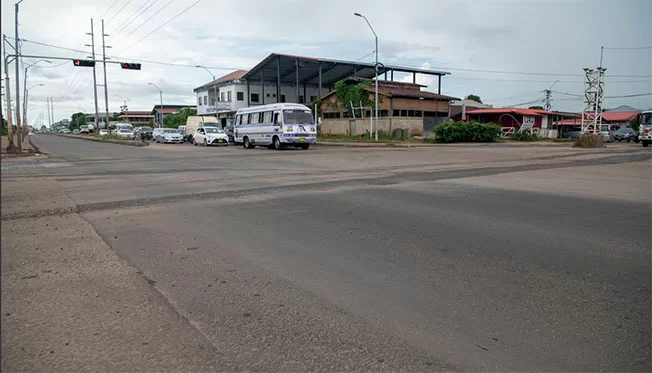
Paramaribo, Suriname – July 11, 2026 – Emergency rehabilitation work on one of Suriname’s busy urban corridors, Van ’t Hogerhuysstraat, is progressing strictly according to schedule and is on track to wrap up several days ahead of the official July 16 completion deadline, project officials confirmed this week.
Rodney Wongsosoeparto, project manager for the rehabilitation initiative, announced that nearly the entire stretch of the roadway has already been resurfaced with a fresh layer of asphalt. The final segment of the road’s eastbound lane, stretching from the existing roundabout toward the Surmac district, is scheduled to be paved on Friday evening. Once that work is complete, only the short section between the roundabout and the Slangenhoutstraat intersection will remain to be finished.
According to an official press statement from the Communication Service of Suriname, the scope of the emergency repairs covers three core phases: removal of the crumbling old asphalt surface, leveling and stabilization of the underlying road base, and application of a new five-centimeter thick asphalt layer. Workers are also upgrading connecting road surfaces at the Slangenhoutstraat junction to boost overall traffic flow through the high-traffic area.
Project leadership noted that unseasonable rain showers and adjustments to temporary traffic diversion routes have presented minor logistical challenges during the repair process, but these disruptions have not altered the project’s timeline. To minimize impacts on daily commuters and maximize work efficiency, the majority of resurfacing operations are carried out during evening and overnight hours, when traffic volumes in the area are at their lowest.
While emergency repairs near completion, planning work is already well underway for a far more extensive full reconstruction of the entire Van ’t Hogerhuysstraat corridor. The planned overhaul will widen the key section between Surmac, Slangenhoutstraat and Willem Campagnestraat from four lanes to six lanes, split evenly into three lanes in each direction. Slangenhoutstraat itself will also gain an additional travel lane to accommodate increased traffic, and the current roundabout will be reconfigured into a larger, more efficient traffic square. The section of roadway running from Willem Campagnestraat toward Molenpad will remain largely unchanged under the current plans.
Right now, technical pre-construction preparations for the full reconstruction are in full swing. Work teams are mapping out the position of all underground utilities and cables, holding coordination meetings with local utility providers, and getting ready for planned sewer system upgrades tied to the project. Wongsosoeparto reported that collaboration with participating utility companies has been smooth so far, emphasizing that close, proactive coordination is a non-negotiable requirement to deliver the large-scale project successfully and on schedule.
Even though the current emergency repairs are only a temporary fix to address immediate safety and usability issues, Wongsosoeparto stressed that quality control remains a top priority for the work. Both the application process and the material quality of the new asphalt are subject to continuous inspection to ensure the repair work delivers a durable, long-lasting result until full reconstruction can begin.
In the coming week, crews will focus on wrapping up the final resurfacing work at the Slangenhoutstraat junction, while pre-construction activities for the full corridor reconstruction will continue at full pace with no interruptions.