分类: politics

  • United Progressive Party extend condolence statement on the passing of Ian Pinard

    United Progressive Party extend condolence statement on the passing of Ian Pinard

    The small Caribbean nation of Dominica is in mourning this week following the sudden, unexpected death of Ian Pinard, a former government minister who had most recently taken up the post of Chief Executive Officer at the Dominica Air and Seaport Authority (DASPA). Leading the tributes to Pinard is the country’s United Progressive Party (UPP), headed by opposition leader Joshua Francis, which has released an official statement extending profound sympathies to the late public servant’s family, friends and close loved ones.

    Over decades of public life, Pinard occupied a range of senior roles across the Dominican public sector, consistently demonstrating unwavering dedication and high standards of service to the nation’s citizens. Even after holding senior cabinet office, he remained committed to advancing Dominica’s growth, answering the call once again to lead DASPA in his latest role – a decision that underscored his lifelong devotion to national progress.

    UPP officials emphasized that Pinard’s loss is felt far beyond his immediate family circle, rippling through every corner of the Dominican community. The passing of the long-serving public figure also offers a moment of national reflection: it serves as a reminder that public service to a country rises above partisan political divides, and that all contributions to national well-being deserve equal recognition and respect.

    On behalf of the entire party, Francis reiterated the UPP’s deepest condolences to Pinard’s family as they navigate their grief, noting that the widespread outpouring of support from across Dominica and the enduring impact of Pinard’s decades of work should bring some measure of comfort in this difficult time. The statement closed with a prayer for peaceful rest for Pinard’s soul.

  • Fingerprint Clock‑Ins Coming to Public Service, Union Raises Concerns

    Fingerprint Clock‑Ins Coming to Public Service, Union Raises Concerns

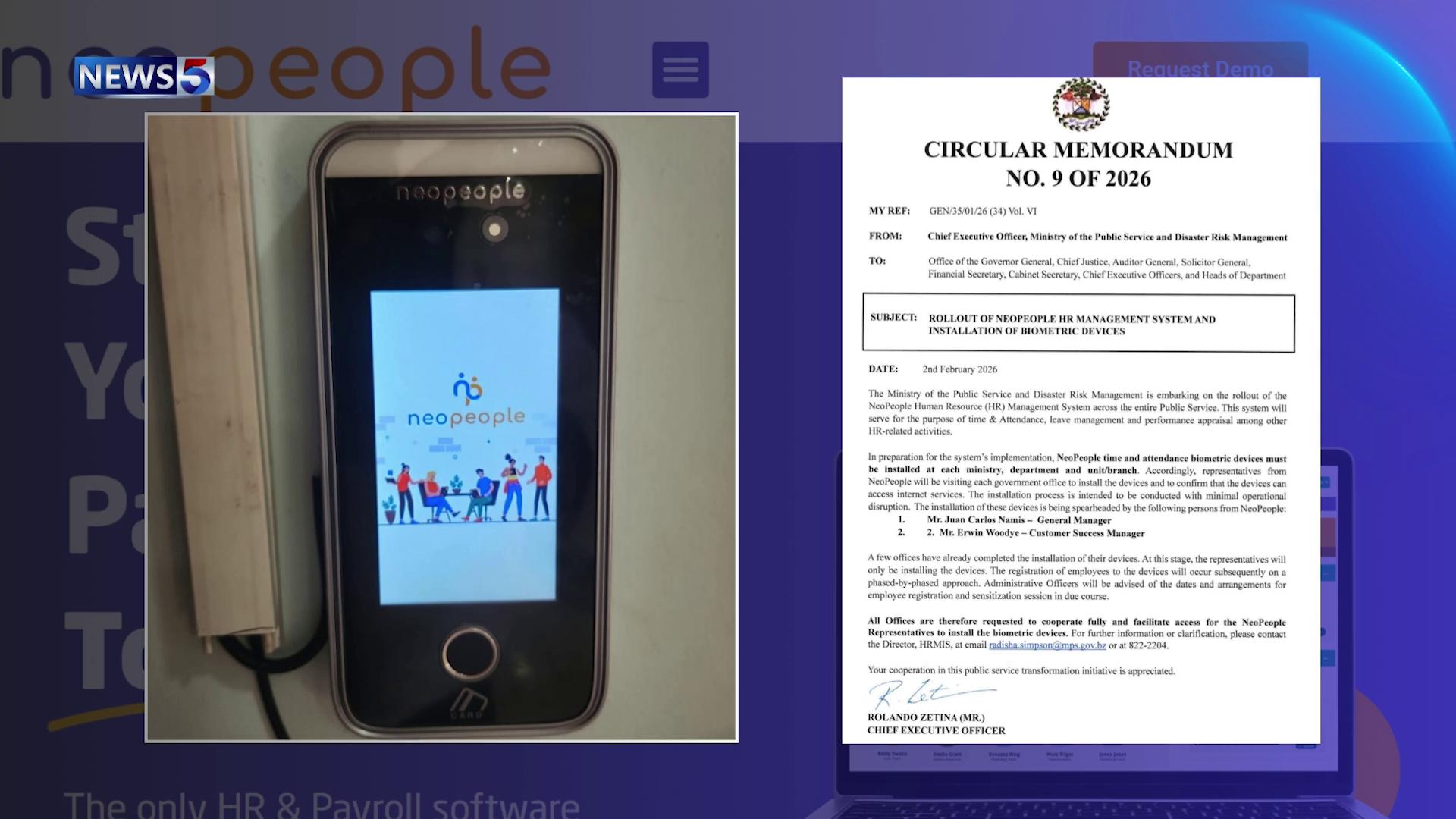
    In a growing conflict over public sector workplace reform, the Government of Belize is facing mounting pushback from public service employees over its planned national rollout of NeoPeople, a new human resources management platform that integrates biometric fingerprint clock-in technology for all government ministries and departments. Scheduled to launch in 2026, the initiative has been framed by state officials as a long-overdue modernization effort that will boost efficiency and transparency across the country’s public service. But the nation’s primary public employee union has emerged as a fierce opponent, raising alarms over procedural violations, data privacy risks, unchecked public spending, and potential violations of core worker rights.

    Dean Flowers, president of the Belize Public Service Union (PSU), laid out the organization’s core objections in an interview, emphasizing that the government failed to follow mandatory consultation requirements laid out in national labor law. Under existing regulations, any policy change that alters the terms and conditions of public service employment requires formal negotiation and discussion with recognized employee representatives. Flowers stressed that the rollout extends far beyond a simple shift in how workers clock in and out for shifts: the system will centralize the entirety of public employees’ personal records, known as p-files, on a third-party managed platform. These comprehensive files contain every detail of a public servant’s employment history, from initial appointment letters and salary information to performance appraisals, disciplinary records, medical leave history, loan documentation, and personal assistance requests. Essentially, Flowers explained, an employee’s entire professional life is stored in this single file.

    The union’s concerns extend beyond the lack of prior consultation to major violations of Belize’s Data Protection Act, Flowers argued. The national legislation grants specific data rights to individuals whose personal information is collected and stored, including the requirement to obtain explicit consent before sharing sensitive personal data with third parties. To make matters worse, Flowers warned that the system’s core management functions are guided by undisclosed algorithms. With no public information available about who developed these tools or what parameters they use to evaluate workers, the technology could easily be weaponized against employees who disagree with government policies, he claimed.

    Finances and procurement transparency are another major flashpoint in the conflict. The union has been unable to access any public tender documents for the NeoPeople contract, leaving critical questions unanswered about whether the contract was awarded through a fair competitive bidding process or an uncompetitive limited tender process. Unconfirmed public rumors put the annual maintenance cost for the system at nearly $3 million Belize dollars, a figure that translates to roughly $14 per year for each of the country’s 17,000 public servants. The union has also pressed for answers about the duration of the contract, full contract terms, and who retains legal ownership of the sensitive employee data. These questions have grown more urgent, Flowers noted, because there is no guarantee the government will renew the contract with the third-party provider when it expires, raising the risk of employee data being held hostage by the vendor if negotiations break down.

    After failing to get voluntary disclosure from state officials, the union submitted a formal information request under Belize’s Freedom of Information Act, asking for full details on procurement, contract terms, data access protocols, and privacy safeguards. To date, the request has gone unanswered. Flowers says the Financial Secretary has missed the legal deadline to respond to the request, putting the office in direct violation of the Freedom of Information Act. The union first turned to the Office of the Ombudsman to resolve the dispute, but that avenue is effectively blocked under the current administration: the government recently refused to renew the Ombudsman’s contract after he fulfilled his oversight duties independently, leaving the watchdog position effectively sidelined. With all other non-judicial recourses exhausted, the union has received approval to move forward with a judicial review of the Financial Secretary’s failure to disclose information, and the case is now in the hands of the union’s legal team.

    Flowers confirmed that legal action remains on the table if the government continues to refuse to address the union’s concerns, and the public will be kept updated as the case moves through the court system. News outlets will continue to track developments in this story to see whether the judicial process results in the information disclosure the union has requested.

  • Flowers Warns of Due Process Failures in Border Officers’ Case

    Flowers Warns of Due Process Failures in Border Officers’ Case

    A growing controversy is unfolding around eight immigration officers assigned to Belize’s Western Border, after the group was placed on administrative leave for taking sick leave within a shared time window, with union leadership now demanding accountability over what it calls blatant violations of basic administrative and legal protocols.

    The dispute, which emerged in April 2026, has escalated rapidly: at least one of the officers has retained legal representation to challenge the leave decision, setting the stage for what could become a high-stakes legal confrontation between the workers, their union, and government immigration officials.

    Public Service Union President Dean Flowers publicly amplified the union’s concerns this week, laying out detailed allegations of procedural misconduct in how government authorities have handled the case. Flowers explained that on the very same day the eight officers received their formal administrative leave notifications, they were simultaneously served with accusatory letters claiming the workers intentionally coordinated their absences as an act of sabotage against border operations.

    Far from being kept internal to the immigration department, Flowers said these accusatory letters were widely circulated among administrative staff across multiple government ministries, including the public service department, before copies ultimately made their way to media outlets. He emphasized that contrary to claims from Home Affairs Minister Kareem Musa that no individual officers were named in the documents, every officer was explicitly identified in the accusatory letters.

    “In my view, these letters are designed to damage the professional reputations of these public servants,” Flowers said in remarks during an evening news broadcast. “Legal experts have already confirmed that the letters contain false mischaracterizations that label the officers as intentionally undermining government operations, an accusation that carries significant professional and personal consequences.” Flowers added that the simultaneous delivery of the leave notice and the accusation recommending termination is a clear violation of established administrative protocol, especially given that the immigration department employs a full-time in-house legal counsel and is overseen by a minister who is himself a trained attorney.

    The case has cast a spotlight on labor relations between public sector unions and the Belizean government, with the union gearing up to defend the officers’ right to due process as the conflict moves toward potential litigation.

  • Flowers Fires Back at PM Over Sickout Comments

    Flowers Fires Back at PM Over Sickout Comments

    A fierce public dispute has erupted between Belize’s top public service union leader and the nation’s prime minister over recent comments tied to a planned worker sickout, dragging long-simmering tensions between the government and public sector employees into the spotlight.

    The clash began after Prime Minister John Briceño was questioned by reporters about the industrial action, when he publicly questioned why the Public Service Union (PSU) has refused to pursue closer collaborative working relations with his administration. Briceño also implied that PSU President Dean Flowers holds partisan alignment with the opposition United Democratic Party, a claim Flowers has rejected outright in a blistering response.

    In a fiery, unfiltered address, Flowers dismissed the prime minister’s accusations as a deliberate distraction tactic designed to politicize the union’s legitimate advocacy for the working rights and fair treatment of public sector employees across Belize. The union president went on to call out Briceño’s leadership style, saying the prime minister needs to mature beyond partisan political games and fulfill his obligations to the office he holds.

    Flowers laid out the union’s long-standing approach to addressing labor concerns: every time public officers face an infringement of their workplace rights, or when the government rolls out new policies that impact public sector workers without prior consultation with the PSU, the union first formally reaches out to the Briceño administration in writing to flag concerns. But Flowers claims that not a single one of these formal communications has ever received a response from the prime minister himself.

    “How dare he say I need to work with his administration?” Flowers asked, pushing back on Briceño’s narrative. “To confuse the Belizean people and to not address the issues as they are presented to him, factually, his quickest tool is to pretend he is in the circus called the House of Representatives and make it political.”

    Flowers also pushed back on the partisan accusation, openly confirming that he voted for the incumbent People’s United Party (PUP) area representative in his district during the 2020 general election, saying he has no shame in that choice and proving his alignment is not with the opposition. He closed his rebuke with sharp criticism of Briceño’s conduct, saying the prime minister is acting like an immature young man from Orange Walk rather than leading the country.

    Looking ahead, Flowers reaffirmed that the PSU will not back down from holding the Briceño administration accountable for any documented injustices against public sector workers. He added that the union will be closely monitoring the progress and outcome of ongoing administrative actions against a group of immigration officers, a case that has already stoked tensions between the government and the public service community.

  • Walters demands accountability over $160m IDB water loan

    Walters demands accountability over $160m IDB water loan

    A senior opposition lawmaker in Barbados is sounding the alarm over a multi-million-dollar Inter-American Development Bank (IDB) loan earmarked for national water infrastructure upgrades, calling on the ruling administration to embrace full accountability to the public over how the debt will be managed and repaid.

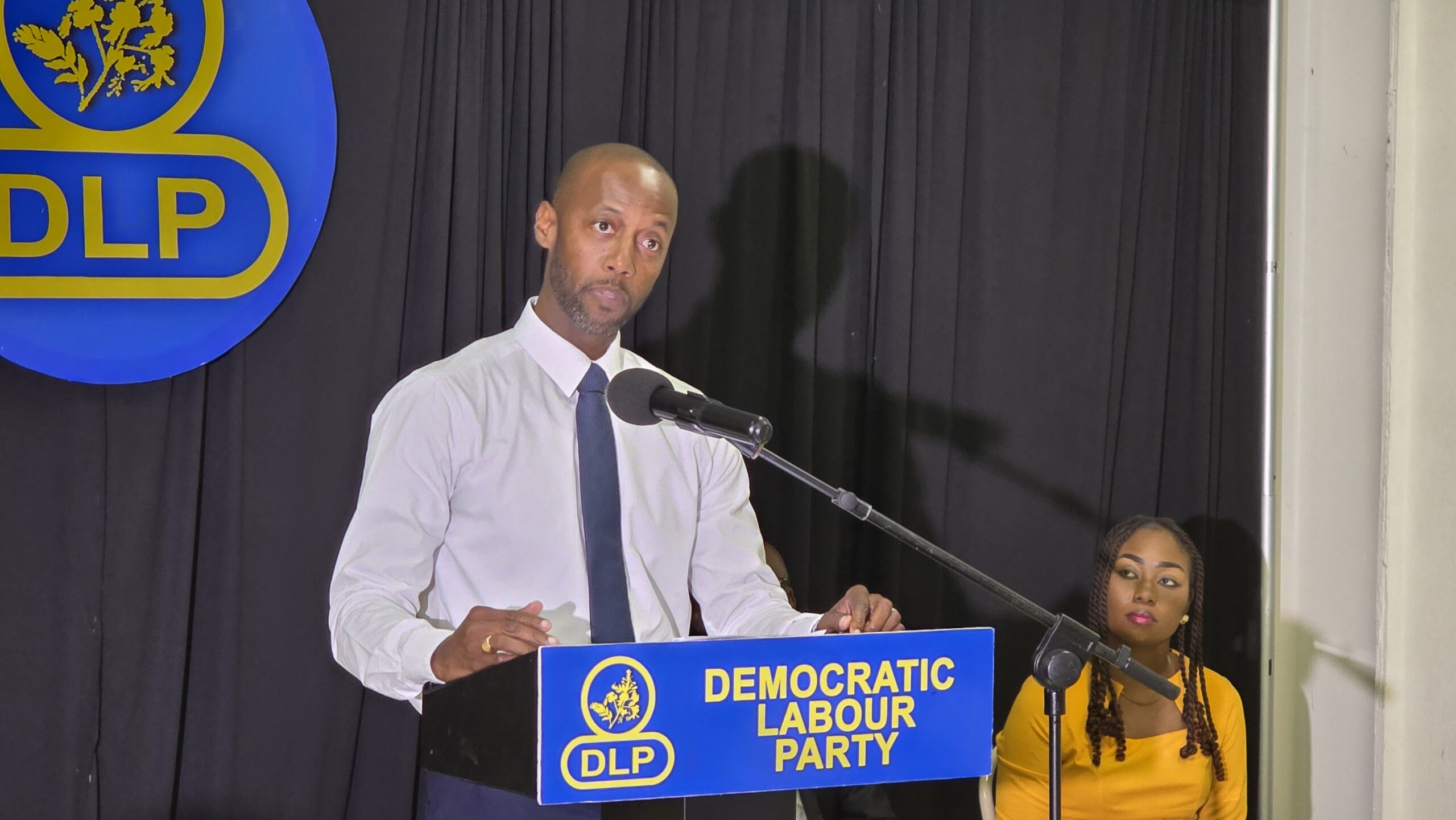
    Ryan Walters, finance and economic affairs shadow senator for the Democratic Labour Party (DLP), is pushing for what he terms “radical transparency” surrounding the $160m regional facility, an initial $80 million tranche of which has already been drawn down for key projects focused on rehabilitating decades-old leaking water mains and modernizing the state-run Barbados Water Authority (BWA).

    While Walters openly acknowledges the urgent need for infrastructure overhauls amid a national water security crisis, with non-revenue water loss reaching as high as 50 percent across the island’s distribution network, he warns that framing the borrowing as a simple “investment” risks masking the long-term repayment burden that will fall on Barbadian taxpayers.

    “The scale of what is being proposed here cannot be ignored but neither can the responsibility that comes with it,” Walters stated in his remarks. He emphasized: “There is no question that the rehabilitation of our water infrastructure is both necessary and urgent…. However, while the importance of the project is clear, the financing behind it deserves equal attention and transparency.”

    Structured with a 25-year repayment term and a 5.5-year grace period on principal payments, the IDB loan has left Walters questioning how the government will meet its financial obligations once the grace period ends. He has raised two pressing scenarios that could impact ordinary households: steep increases to residential water rates, or new broad-based taxation measures to cover the annual repayment costs.

    “These are not small sums, and while they are framed as ‘investments’, they remain loans that must be repaid by the people of Barbados,” he cautioned. “The question then becomes: how will these repayments be financed given the amount of debt the country is and will be servicing at that time?”

    A core pillar of Walters’ critique centers on the government’s longstanding lack of public accountability for prior water sector funding. He is demanding a full public status update on all completed and ongoing past infrastructure projects, including a breakdown of how previous disbursements were spent, the exact number of water mains replaced across the island, and a clear list of communities that received tangible benefits. He also raised the pressing question of whether this new round of borrowing is necessary to fix gaps and failures that should have been resolved under earlier, already funded programs.

    Walters stressed that without a full, auditable accounting of how past public funds were deployed, public trust in this new borrowing will remain fragile. He called on the government to publish a clear, incremental public timeline of project milestones, so Barbadians can track improvements in real time rather than waiting years to see tangible results from the new debt.

    Beyond fiscal transparency, Walters is also pressing the administration to guarantee that local Barbadian construction and engineering firms get a meaningful share of the project contracts. He questioned whether the government plans to award most of the high-value work to international contractors, rather than prioritizing domestic professionals and businesses that could reinvest earnings back into the local economy.

    “This project presents an opportunity not only to fix infrastructure but to build local capacity and create economic participation for Barbadian professionals and businesses,” he said. “That opportunity must not be missed.”

    Drawing a parallel to the government’s own messaging around water accessibility, Walters argued that if the administration claims to support transparent water governance, the implementation and oversight of this loan must match that standard. He confirmed that the DLP supports the critical goal of upgrading Barbados’ water infrastructure, but insisted that good governance requires clear public communication to accompany large-scale public borrowing.

  • PSU President Slams Immigration Officers’ Suspension as Breach of Procedure

    PSU President Slams Immigration Officers’ Suspension as Breach of Procedure

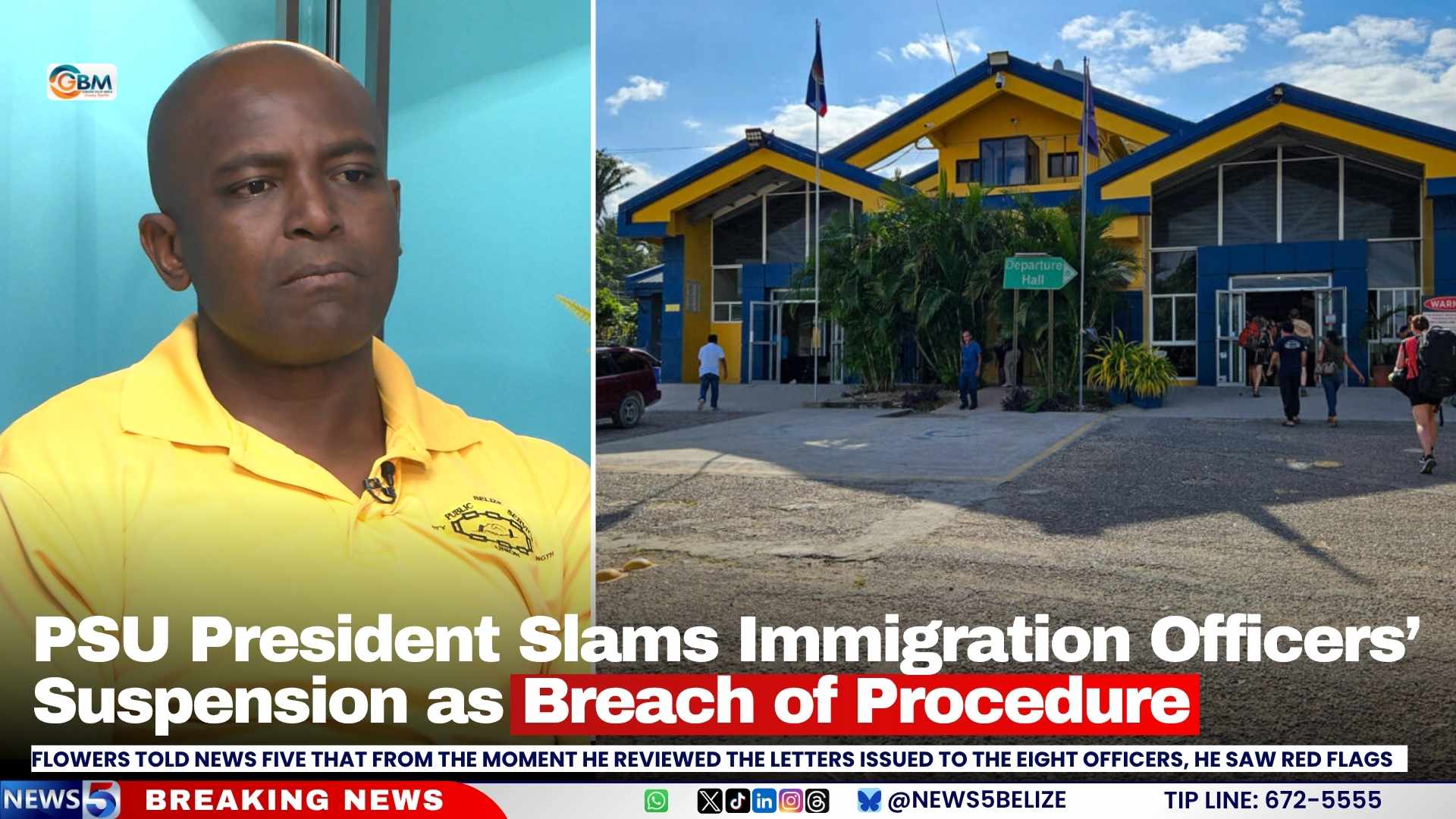
    A labor dispute over the administrative suspension of eight Western Border immigration officers has intensified, with the head of Belize’s largest public sector union accusing the national Ministry of Immigration of deliberate violations of long-standing administrative protocols. The conflict stems from an incident earlier this year when the eight officers called in sick, a move that prompted senior immigration officials to place all eight on paid administrative leave pending internal review. Now, Public Service Union (PSU) President Dean Flowers is speaking out against the government’s handling of the case, arguing that the process violated the basic due process rights owed to public employees.

    In an exclusive interview with local outlet News Five, Flowers explained that multiple procedural red flags appeared as soon as he reviewed the official documentation delivered to the affected officers. What makes the case particularly unusual, he emphasized, is the timing of the two separate notifications the officers received: within the same minute of getting their administrative leave letters, each officer was handed a second formal correspondence accusing them of coordinated work sabotage and formally recommending that they be terminated from their positions.

    Flowers described the simultaneous delivery of the two documents as an obvious cut to established public sector administrative process. “From straight administrative notification to, in the same minute and breath, I suspect you are sabotaging, and I will be recommending your dismissal,” he told reporters, reiterating that this sequence of actions constitutes a clear breach of administrative procedure.

    Beyond the procedural irregularity, Flowers highlighted severe damage the premature accusation has already done to the officers’ professional reputations. Under standard public sector disciplinary processes, formal charges of misconduct are not filed until a neutral investigation is completed to gather evidence and hear testimony from all involved parties. By leveling the grave charge of sabotage before any inquiry has concluded, the ministry has irreparably harmed the officers’ standing among colleagues and the public, Flowers argued. At least one of the affected officers has already retained legal counsel to challenge the suspensions, and the attorney representing that officer has already described the content of the accusatory letters as a deliberate misrepresentation of the officers’ actions.

    The controversy deepens further over a breach of confidentiality in the case. Despite public statements from Immigration Minister Kareem Musa claiming that the suspension notices did not name individual officers, Flowers confirmed that each letter explicitly identified the eight employees by name. The named documents were also widely circulated among administrative staff across multiple government departments, including the Public Service Ministry, before copies were leaked to local media outlets, bringing the conflict into public view.

    The dispute is the latest high-profile clash between Belize’s public sector unions and the current government over labor rights and administrative process, with the PSU expected to escalate the matter through formal grievance channels if the ministry does not reverse the suspensions and revise its disciplinary process.

  • Oproep tot Surinaamse Corporate Governance Code tijdens lezing juristen

    Oproep tot Surinaamse Corporate Governance Code tijdens lezing juristen

    On Thursday, April 17, the Suriname Bar Association (SJV) in partnership with the Suriname Law Journal hosted a public expert lecture focused on answering a critical policy question: Does Suriname need its own stand-alone national Corporate Governance Code? The event centered discussion on three core pillars of effective institutional management: strong governance, full operational transparency, and unwavering institutional integrity.

    The event’s lead presenters, legal experts Mirto Murray and Karan Doekhi, opened the discussion by breaking down Curaçao’s existing national Corporate Governance Code, drawing key parallels between Curaçao’s regulatory framework and the current institutional landscape in Suriname. Throughout the lecture, the concept of integrity — defined by speakers as “upholding ethical standards even when no one is watching” — served as the throughline for all conversation.

    The legal experts emphasized that robust corporate governance standards are particularly critical for state-owned enterprises, public utility providers, national port authorities, and financial institutions including the Central Bank of Suriname. These organizations, they noted, manage public financial resources and hold foundational roles in national economic activity, making it non-negotiable for them to adhere to strict requirements for transparency and public accountability.

    Following the presentation, a open discussion was held with attendees, who included senior policymakers, practicing legal professionals, law students, and representatives from both public and private sector institutions. Participants focused particular attention on the division of responsibilities between key institutional bodies: the state as primary shareholder, institutional executive leadership, and boards of commissioners. Attendees stressed that every governing body must operate within clear, legally defined boundaries to mitigate a range of risks, including legal liability for mismanagement.

    While Suriname currently does not have a dedicated national Corporate Governance Code, speakers highlighted that the country’s recently updated Civil Code already enshrines key core standards for careful, responsible institutional management, and these standards already apply to all organizations carrying out public tasks.

    The event concluded with a formal call to action for the development of a Suriname-specific Corporate Governance Code through a broad, inclusive consultation process that includes representation from the national government, national parliament, regulatory oversight bodies, the national business community, civil society organizations, and academic institutions.

    The SJV has publicly confirmed that it stands ready to serve a facilitating and advisory role throughout the process of developing the code. In a statement following the event, the association stressed that strong corporate governance is not an unnecessary luxury for Suriname, but a core requirement for protecting citizen and stakeholder rights, reducing the national risk of corruption, and unlocking sustainable long-term economic growth opportunities for the country.

  • Caye Caulker Residents Call for Referendum Over Use of Parcel 815 for Police Station

    Caye Caulker Residents Call for Referendum Over Use of Parcel 815 for Police Station

    On the small Belizean island of Caye Caulker, a growing community pushback over the stalled development of a long-planned local police station has ignited calls for a public vote to settle the fate of the project’s designated land. The Caye Caulker Village Council has launched a formal petition drive aimed at triggering a binding referendum on Parcel 815, the plot of land that was formally reserved years ago specifically for the construction of the new island police facility.

    In a public announcement shared with all local residents, the village council has called on every registered voter who supports retaining the parcel for its original intended use to add their signature to the petition. Physical copies of the petition are available for signing at the council’s local office, and all participants are required to present their official Social Security card and voter identification to sign, or submit digital photos of both documents for those unable to sign in person. In a unifying call to action, the council framed the effort as a collective community mission, stating, “Let’s save the police station as a community.”

    The current petition drive comes on the heels of two recent community gatherings centered on the dispute. First, a peaceful public demonstration held this past Monday drew dozens of residents, followed by a well-attended public town hall meeting on Wednesday, where attendees openly shared widespread frustration over years of unaddressed delays to the police station construction.

    Local officials have now clarified the government’s position on the stalled project. Andre Perez, the Minister for Belize Rural South, confirmed that the Ministry of Home Affairs secured official legal title to Parcel 815 back in 2023, with funding for the acquisition provided by the Central American Bank for Economic Integration (CABEI). Perez emphasized that the parcel remains official communal government land, held by the government of Belize for the exclusive use of the national police department.

    Even as he reaffirmed the government’s ownership, Perez acknowledged that construction on the project has been paused for an unanticipated reason: a third-party offer for the land was submitted while contractors were already mid-construction, prompting the work team to request a temporary halt to activities.

    Perez also pushed back against community speculation about hidden negotiations, noting that government officials were never given the space to make a public announcement about the unsolicited offer before widespread community concern erupted into public protest. For local residents who have waited years for improved police presence on the island, the referendum drive represents their best chance to weigh in directly on a project that impacts public safety across Caye Caulker.

  • PM Browne Alleges Opposition Linked to ‘Clandestine’ Pro-LGBTQ Campaign Material

    PM Browne Alleges Opposition Linked to ‘Clandestine’ Pro-LGBTQ Campaign Material

    As general election campaigning gains momentum in Antigua and Barbuda, Prime Minister Gaston Browne has ignited a heated political controversy by linking two senior opposition figures to the circulation of unauthorised, digitally created campaign material targeted at LGBTQ voters. Browne named opposition members Jamale Pringle and Harold Lovell as the forces behind the provocative graphic, which frames itself as a pro-inclusion statement on LGBTQ rights ahead of the vote. The altered visual, designed to look like an authentic campaign poster, features a composite image of two men presented as Browne and lawmaker Kendra Beazer sharing a kiss, set against a iconic rainbow pride backdrop decorated with heart motifs. Across the graphic, bold slogans champion LGBTQ inclusion: phrases like “LOVE & UNITY BRING US TOGETHER” and “Make Room for Everyone in Barbuda” are prominently displayed. Additional text explicitly calls for churches to open their doors to same-sex marriage, framing the push for equal rights as a call for national unity “as one family under God,” and closes with the welcoming message: “Barbuda welcome everyone, all a we is family!”. Critics have already pointed out a key gap in Browne’s accusation: the prime minister has not released any concrete evidence to back his claim that the material originated from or is being distributed by Pringle, Lovell or any other faction of the opposition. As of Friday evening, neither Pringle nor Lovell had issued a public response to Browne’s allegations, leaving the opposition’s side of the dispute unrepresented so far. The controversy has landed at a sensitive moment for Antigua and Barbuda’s electoral landscape, as all major parties ramp up outreach to court every key voting bloc ahead of the general election. LGBTQ rights, and especially the debate over same-sex marriage, remain deeply divisive issues in the country. Public opinion is sharply split on the topic, and for decades political candidates and parties have approached public discussion of LGBTQ policy with significant caution to avoid alienating voters on either side of the debate. Political analysts note that the unauthorised poster, regardless of its origin, has added a new polarizing issue to an already tight election race, forcing all parties to take public stances on a topic many have long preferred to avoid.

  • STATEMENT: Dominica Labour Party Mourns the passing of former deputy president, Ian Pinard

    STATEMENT: Dominica Labour Party Mourns the passing of former deputy president, Ian Pinard

    The Dominica Labour Party has announced the passing of one of its most respected long-serving members, Hon. Ian Pinard, leaving the nation’s political community and local constituents in deep mourning. Pinard held a number of key roles throughout his decades-long career of public service, including former Deputy President of the Dominica Labour Party, former Parliamentary Representative for the Soufriere Constituency, and former Minister for Public Works. Beyond his elected and appointed government positions, he also contributed to national progress through executive leadership roles at Petro Caribe Dominica and the Dominica Air and Sea Ports Authority (DASPA).

    Across every role he occupied, Pinard demonstrated unwavering loyalty to the Dominica Labour Party and an unshakable devotion to the people he represented. Colleagues and constituents alike remember him not for the prestige of his titles, but for his quiet humility, unassuming demeanor, and deep-seated compassion for others. Unlike many public figures who prioritize public recognition, Pinard led with gentle authority, consistently showing up for his community without seeking praise or credit for his work. His warm demeanor, approachable attitude, and constant friendly smile left an enduring mark on every person he interacted with throughout his career.

    Pinard shared a particularly deep, personal bond with the residents of his home constituency, Soufriere. He walked alongside community members through their challenges, worked tirelessly to advance local priorities, and held a genuine love for the people that showed in every action he took. A core part of his legacy lies in his commitment to lifting up the next generation: he made intentional, personal investments in mentoring young men in the Soufriere area, going beyond simply creating job opportunities to instill core values of discipline, mutual respect, and life purpose in the young people he guided. The impacts of this work will continue to resonate for decades in the many lives he shaped.

    In an official statement marking Pinard’s passing, the Dominica Labour Party emphasized that the nation has suffered a profound loss, extending far beyond the party’s own ranks. Hon. Roosevelt Skerrit, Prime Minister of Dominica and Political Leader of the Dominica Labour Party, shared reflections on Pinard’s decades of service, noting that Pinard’s leadership was defined by quiet strength, deep care for the public, and unwavering commitment to advancing the interests of all Dominicans. Skerrit highlighted that Pinard’s greatest legacy was not the offices he held, but the countless individual lives he improved through his kindness and service, a legacy of dedication and humanity that will continue to inspire the nation long after his passing.

    The party has extended its deepest condolences to Pinard’s family, particularly his young children, as well as to the residents of Soufriere, his former colleagues, and all who are grieving his loss. The statement reaffirmed that the entire Dominica Labour Party stands in solidarity with all those mourning during this difficult time, closing with a wish that Hon. Ian Pinard’s soul may rest in eternal peace.

    Disclaimer: The views and claims expressed in this statement are solely those of the original author and do not represent the official positions of Duravision Inc., Dominica News Online, or any of its affiliated subsidiary brands.