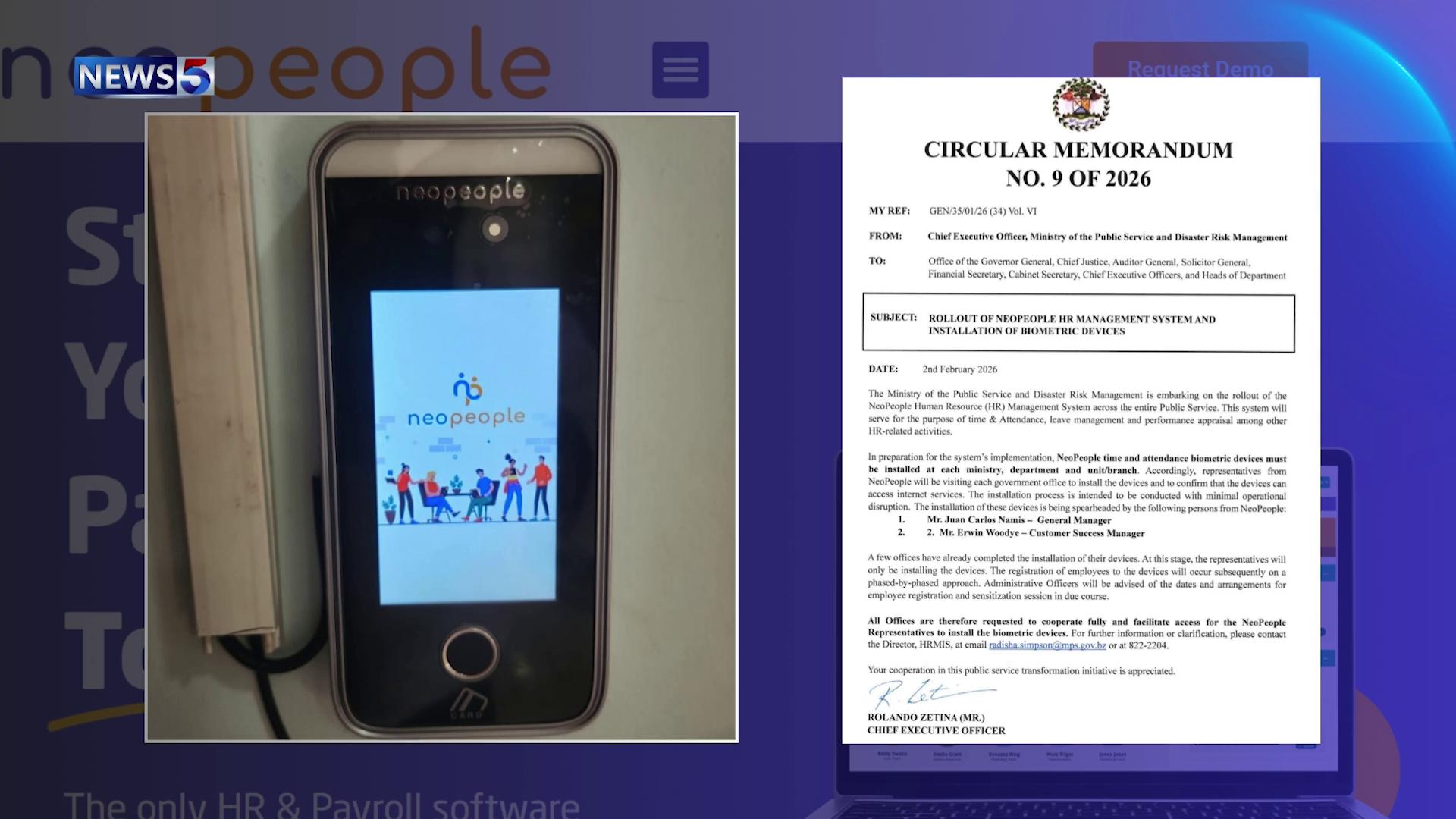
In a growing conflict over public sector workplace reform, the Government of Belize is facing mounting pushback from public service employees over its planned national rollout of NeoPeople, a new human resources management platform that integrates biometric fingerprint clock-in technology for all government ministries and departments. Scheduled to launch in 2026, the initiative has been framed by state officials as a long-overdue modernization effort that will boost efficiency and transparency across the country’s public service. But the nation’s primary public employee union has emerged as a fierce opponent, raising alarms over procedural violations, data privacy risks, unchecked public spending, and potential violations of core worker rights.
Dean Flowers, president of the Belize Public Service Union (PSU), laid out the organization’s core objections in an interview, emphasizing that the government failed to follow mandatory consultation requirements laid out in national labor law. Under existing regulations, any policy change that alters the terms and conditions of public service employment requires formal negotiation and discussion with recognized employee representatives. Flowers stressed that the rollout extends far beyond a simple shift in how workers clock in and out for shifts: the system will centralize the entirety of public employees’ personal records, known as p-files, on a third-party managed platform. These comprehensive files contain every detail of a public servant’s employment history, from initial appointment letters and salary information to performance appraisals, disciplinary records, medical leave history, loan documentation, and personal assistance requests. Essentially, Flowers explained, an employee’s entire professional life is stored in this single file.
The union’s concerns extend beyond the lack of prior consultation to major violations of Belize’s Data Protection Act, Flowers argued. The national legislation grants specific data rights to individuals whose personal information is collected and stored, including the requirement to obtain explicit consent before sharing sensitive personal data with third parties. To make matters worse, Flowers warned that the system’s core management functions are guided by undisclosed algorithms. With no public information available about who developed these tools or what parameters they use to evaluate workers, the technology could easily be weaponized against employees who disagree with government policies, he claimed.
Finances and procurement transparency are another major flashpoint in the conflict. The union has been unable to access any public tender documents for the NeoPeople contract, leaving critical questions unanswered about whether the contract was awarded through a fair competitive bidding process or an uncompetitive limited tender process. Unconfirmed public rumors put the annual maintenance cost for the system at nearly $3 million Belize dollars, a figure that translates to roughly $14 per year for each of the country’s 17,000 public servants. The union has also pressed for answers about the duration of the contract, full contract terms, and who retains legal ownership of the sensitive employee data. These questions have grown more urgent, Flowers noted, because there is no guarantee the government will renew the contract with the third-party provider when it expires, raising the risk of employee data being held hostage by the vendor if negotiations break down.
After failing to get voluntary disclosure from state officials, the union submitted a formal information request under Belize’s Freedom of Information Act, asking for full details on procurement, contract terms, data access protocols, and privacy safeguards. To date, the request has gone unanswered. Flowers says the Financial Secretary has missed the legal deadline to respond to the request, putting the office in direct violation of the Freedom of Information Act. The union first turned to the Office of the Ombudsman to resolve the dispute, but that avenue is effectively blocked under the current administration: the government recently refused to renew the Ombudsman’s contract after he fulfilled his oversight duties independently, leaving the watchdog position effectively sidelined. With all other non-judicial recourses exhausted, the union has received approval to move forward with a judicial review of the Financial Secretary’s failure to disclose information, and the case is now in the hands of the union’s legal team.
Flowers confirmed that legal action remains on the table if the government continues to refuse to address the union’s concerns, and the public will be kept updated as the case moves through the court system. News outlets will continue to track developments in this story to see whether the judicial process results in the information disclosure the union has requested.