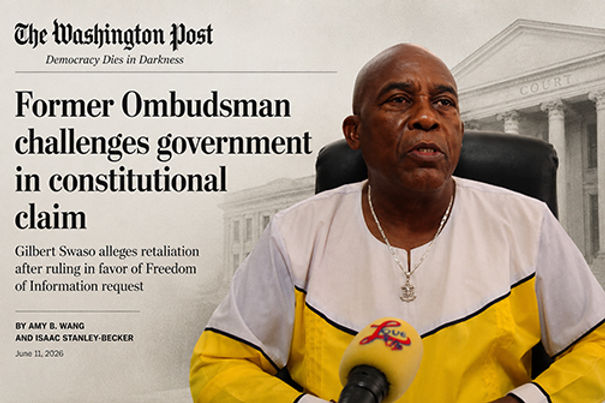
A high-stakes constitutional dispute has erupted in Belize after retired Major Gilbert Swaso, the nation’s former Ombudsman, launched a formal legal challenge against the government, accusing authorities of violating the constitutionally mandated independence of his former office by refusing to renew his appointment. Court documents submitted earlier this week detail Swaso’s allegation that the government’s decision to end his tenure was an act of retaliation tied directly to a landmark Freedom of Information (FOI) ruling he issued that ordered the disclosure of public records. That ruling centered on a request from activist and public-interest lawyer Jerry Enriquez, who sought transparency around millions in public funds paid by the government to private attorneys working on high-profile redistricting litigation. After Swaso ruled in favor of releasing the requested payment records, the Attorney General’s Ministry immediately contested the decision before the Court of Appeal, where the appeal remains unresolved as of 2026. According to the legal claim, tensions boiled over during a December 2025 meeting between Swaso and Minister of Public Service, Constitutional and Political Reform Henry Charles Usher. During that closed-door session, Swaso was reportedly confronted about the FOI ruling and a second separate report he had completed. Just 48 hours after that meeting, Swaso says he received formal notification that his appointment would not be extended when his term expired at the end of December 2025. The core of the constitutional challenge argues that the non-renewal of Swaso’s term is not just a personnel decision—it represents unlawful political interference in a constitutionally protected independent office, eroding the fundamental guardrail that allows the Ombudsman to operate free from partisan pressure. Swaso is asking the Supreme Court to issue formal declarations confirming the constitutional independence of the Ombudsman’s Office and ruling the government’s actions illegal. Beyond the tenure dispute, the lawsuit also raises serious questions about unpaid compensation, alleging Swaso never received the salary and benefits guaranteed to the office under existing Belizean law. The current Ombudsman Act, in Section 8(1), explicitly mandates that the Ombudsman’s emoluments must be no less than those paid to a Supreme Court Judge. In a parallel development that adds context to the dispute, the government tabled the Ombudsman (Amendment) Act 2026 in March 2026, which proposes repealing the existing Section 8(1) and removing the mandatory minimum salary provision tied to Supreme Court judicial pay. If passed, the amendment would leave the Ombudsman’s compensation entirely open to future adjustment by legislation or National Assembly resolution, a change that critics warn could further increase political leverage over the office. As the legal challenge moves forward, the Ombudsman’s Office remains unfilled more than 160 days after Swaso’s term expired at the end of 2025. This prolonged vacancy has already disrupted core functions of the office, including ongoing Freedom of Information proceedings that rely on the Ombudsman’s oversight. Under Belizean law, the Ombudsman serves as a critical independent watchdog tasked with investigating complaints against government departments and public authorities, covering everything from maladministration and abuse of power to corruption and disputes under the Freedom of Information Act.
分类: politics
-

Regering trekt SRD 2,4 miljard uit voor nieuwe elektriciteitssubsidie
Suriname’s government has unveiled key spending priorities in its 2026 draft budget, allocating SRD 2.4 billion to a revamped electricity subsidy framework as it phases out broad-based general subsidies to the national energy utility Energiebedrijven Suriname (EBS). The policy shift marks a major departure from the country’s long-standing subsidy model, replacing broad institutional support for the utility with direct, targeted support for end-user households, designed to protect household purchasing power during the transition to restructured electricity tariffs.
Government officials acknowledge that tariff restructuring will likely lead to a noticeable reduction in household disposable income during the transition period. The new targeted subsidy is explicitly intended to mitigate this impact, preventing the costs of tariff adjustments from placing an unsustainable financial burden on low- and middle-income households.
Alongside the electricity subsidy reform, the administration is establishing a dedicated Special Projects Fund (SPF) with a total endowment of SRD 2.549 billion, managed by the Ministry of Finance and Planning. The fund will serve as the core financing mechanism for a wide-ranging portfolio of national development projects spanning key economic and social sectors. Of the total fund volume, SRD 225 million comes from domestic government resources, while the remaining SRD 2.324 billion is earmarked to come from external financing sources.
Government digital transformation stands as one of the largest investment priorities under the SPF. Planned investments include expanding the national e-government platform, building infrastructure for secure cross-agency digital data exchange, and developing end-to-end digital public services for citizens. The country’s tax and customs authorities will also receive upgraded digital systems to streamline service delivery and improve operational and revenue management. Additional digitalization projects cover digital verification for social benefits and health services, as well as digital monitoring for public and school transport.
The agriculture sector, a cornerstone of Suriname’s economy and food security strategy, will also receive significant support. Through the Agro Stimulus Program, the government will fund land preparation, access to production inputs, and agricultural equipment to boost local output and strengthen national food sovereignty. A new food technology laboratory will also be established at the Anton de Kom University of Suriname (NATIN) to support food safety testing, product innovation, and workforce training for the agri-food sector.
In the health sector, the SPF allocates funding for urgent infrastructure and equipment upgrades, including the purchase of new surgical and diagnostic machinery, improvements to sterilization and safety protocols at public health facilities, and expansion of core medical services. The government also plans to advance the operationalization of community primary care posts, expand specialist care access, and secure a stable supply of affordable essential medications for all citizens.
Education and youth development represent another key focus area. The government will renovate existing primary school facilities, construct new classroom blocks, and upgrade water and sanitation infrastructure at schools across the country. Funding is also reserved for new school furniture, digital education tools, and the national school feeding program. For out-of-school youth, the government will roll out targeted programs focused on employment placement, skills development, and entrepreneurship support, alongside plans to renovate, expand, and build new youth community centers.
The fund also supports affordable housing construction and renewable energy expansion. New housing developments will be equipped with core public infrastructure and utility connections, while a dedicated solar energy program will deliver renewable energy systems to public health facilities, schools, and national drinking water distribution networks.
In a separate notable allocation, the government has set aside SRD 110 million to cover the costs of regular credit rating assessments by leading international rating agencies including Moody’s and Standard & Poor’s. Regular credible ratings are a critical prerequisite for Suriname to maintain access to international capital markets and sustain investor confidence in the country’s economy, as a favorable credit rating lowers borrowing costs for both public and private sector projects.
The 2026 budget proposals demonstrate the Suriname government’s dual policy focus: protecting household purchasing power during energy sector reform, while investing in long-term inclusive growth across multiple key sectors. However, the successful implementation of the full Special Projects Fund portfolio remains contingent on securing the projected SRD 2.3 billion in external financing, a key dependency that will shape the execution of the national development agenda over the coming year.
-

Contractor-General Amendment Mirrors Proposed Changes to Ombudsman Act
Two parallel constitutional and legislative shifts are unfolding in Belize, where changes to pay rules for the nation’s top independent oversight offices have sparked debate over institutional independence and government accountability. The developments come as former Ombudsman Major Gilbert Swaso proceeds with a constitutional legal challenge against the Belizean government, centered on disputed compensation claims from his time in office. At the same time, Belize’s National Assembly is advancing paired amendment bills that would rewrite remuneration rules for two constitutionally mandated watchdog agencies: the Office of the Ombudsman and the Office of the Contractor-General.
The most recently tabled proposal, the 2026 Contractor-General (Amendment) Act, targets Section 10(1) of the original Contractor-General Act. Under current legislation, the head of the office is guaranteed annual emoluments no lower than the salary paid to a sitting judge of Belize’s Supreme Court, a statutory benchmark designed to ensure competitive, politically protected pay for the oversight role. If approved, the amendment would strike this existing guarantee and replace it with a provision that lets the National Assembly set pay and terms of service via legislative act or formal resolution. The draft bill schedules the change to take effect on June 1, 2026.
A nearly identical amendment was introduced around the same time for the Ombudsman Act, a move that received public coverage upon its introduction. Before this proposal, Section 8(1) of the Ombudsman Act carried the same judicial salary benchmark, guaranteeing the Ombudsman compensation at least equal to that of a Supreme Court justice, matching the structure of the Contractor-General’s pay protections.
Both watchdog positions are enshrined in Belize’s Constitution under Section 61A, which grants the Senate authority over their appointments and ongoing oversight mandates. As independent bodies, the Ombudsman and Contractor-General are tasked with auditing public spending, investigating official misconduct, and holding government agencies accountable to the public.
Governance analysts and anti-corruption campaigners have long maintained that genuine institutional independence for oversight bodies relies on three core pillars: guaranteed job security, independent financial resourcing, and unrestricted operational autonomy. Global best practices, codified in frameworks like the United Nations Convention against Corruption, stress that independent oversight bodies must have secure remuneration structures and sufficient resources to carry out their mandates without political interference.
Debate over the amendments has split along competing lines of constitutional authority and accountability. Proponents of the changes argue that the amendments simply formalize the National Assembly’s inherent authority to set public official compensation, and bring greater clarity to the process for establishing pay for senior oversight roles. Critics, however, warn that removing the statutory tie to Supreme Court judicial salaries eliminates a longstanding safeguard designed to shield these watchdog offices from political pressure. Without fixed pay protections, they argue, the government could potentially use remuneration as a tool to influence the decisions of independent overseers, weakening Belize’s anti-corruption framework.
-
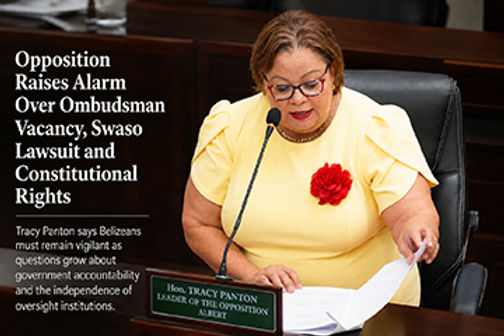
Opposition Leader Raises Alarm Over Ombudsman Vacancy, Swaso Lawsuit and Constitutional Rights
Belize’s Opposition Leader Tracy Taegar Panton is calling on all Belizean citizens to closely monitor mounting threats to core constitutional rights, government accountability, and the autonomy of national oversight bodies. Her warnings center on two interconnected issues: the months-long persistent vacancy in the Office of the Ombudsman, and a high-profile constitutional legal challenge filed by the office’s former head, Major Gilbert Swaso.
In multiple recent public addresses, Panton has emphasized that the legal questions raised by Swaso’s claim are far from a personal dispute. Instead, they cut to the heart of a critical national question: can independent constitutional bodies in Belize carry out their mandates without undue political pressure from the ruling government?
As outlined in this week’s reporting from *The Reporter*, Swaso moved forward with his constitutional challenge against the Government of Belize over his non-renewed appointment. The former ombudsman alleges his term was not extended after he ruled in favor of a Freedom of Information (FOI) request that sought public disclosure of government legal fees tied to a high-profile redistricting court case. He further claims that senior officials repeatedly attempted to interfere in official matters that fell exclusively under the Ombudsman Office’s jurisdiction. At this stage, none of Swaso’s allegations have been adjudicated or proven in court.
Panton stresses that these claims strike at the core of transparent governance and the protection of constitutional safeguards laid out in Belize’s founding document. She reiterated that the Ombudsman serves as one of the most critical checkpoints on state power, tasked specifically with shielding ordinary citizens from institutional abuse, maladministration, and unfair treatment by government agencies.
The opposition leader has doubled down on criticism of the ruling administration’s ongoing failure to fill the substantive Ombudsman position, which has been vacant since Swaso’s term expired on December 31, 2025. To date, Belize has operated without a permanent ombudsman for several months, leaving hundreds of citizen complaints against public agencies unaddressed and FOI review requests stalled in limbo.
Notably, existing Belizean law already creates a framework for temporary oversight during such vacancies. Section 7(1) of the Ombudsman Act explicitly states that when the Ombudsman seat becomes empty, the Governor-General, acting on formal recommendations from the National Assembly, has the authority to appoint an interim officeholder to serve until a permanent appointment can be finalized. Despite this legal provision, no acting appointment has been made.
Panton frames the Swaso dispute as part of a wider pattern of growing threats to constitutional governance in Belize. She points to two other recent high-profile matters: the case of former United Democratic Party Vice Chairman Alberto August and that of independent journalist Ryan Budna. While Panton acknowledges each case must be evaluated on its own unique set of facts, she argues that the cumulative allegations across these separate incidents raise serious questions about due process, equal treatment under the law, adherence to the rule of law, and the exercise of executive state power.
For Panton, constitutional rights and fundamental freedoms are not discretionary privileges granted by the sitting government — they are inalienable protections that belong to every Belizean by right. She has issued a sharp warning against the normalization of what she describes as creeping institutional overreach, even the perception of such overreach, noting that a functional democracy relies entirely on robust independent institutions, full government transparency, and meaningful accountability to the public.
The opposition has formally demanded the government answer three key questions: why no permanent Ombudsman has been appointed since the end of 2025, why no interim Ombudsman has been designated under existing law to keep the office operating, and what options are currently available to Belizean citizens whose rights complaints and FOI matters would normally fall under the Ombudsman’s mandate.
Panton concluded by urging Belizeans to stay well-informed and remain vigilant on developments that impact constitutional rights and democratic institutions, noting that public trust in national governance is directly tied to the strength and independence of the country’s oversight bodies.
-

National Kriol Council Calls for Recognition of Kriol Indigenous Identity
Against a backdrop of growing national dialogue around Indigenous rights, territorial ownership and cultural representation in Belize, the National Kriol Council (NKC) has released an official declaration cementing the Kriol people’s status as an Indigenous foundational population of the nation, rooted in centuries of ancestral connection to Belize’s land.
In the statement, the NKC pushes back against narratives that frame Kriol people as a recent arrival to the territory, emphasizing instead that the community is one of the core founding groups of modern Belize. Over generations, Kriol people have shaped every dimension of national life, the council argues, from economic development and institutional governance to cultural expression and national identity. The group ties its indigeneity to longstanding ancestral bonds with the Mosquitian Nation, a historic regional territory home to multiple Indigenous and Afro-descendant communities whose histories are inextricably linked to the formation of Belize as an independent nation.
A central grievance outlined in the declaration is the systemic exclusion of Kriol voices from national conversations centered on Indigenous rights, heritage protection, and ancestral land governance. The NKC stresses that Kriol communities, whose centuries-long continuous presence in Belize is well-documented, should not be forced to repeatedly justify their place in national history to gain access to equal rights and recognition. The council specifically names multiple long-standing Kriol communities across the country, arguing these groups cannot be sidelined from discussions or policy decisions related to land rights, territorial stewardship, cultural recognition, or any other issue that impacts their collective future.
Legally, the NKC asserts that Kriol communities are entitled to full legal protection under both Belize’s national Constitution and binding international human rights frameworks. The declaration cites core principles from the United Nations Declaration on the Rights of Indigenous Peoples (UNDRIP) and other global human rights standards, which enshrine the rights of Indigenous groups to preserve their cultural heritage, maintain their collective community identity, and participate in consultation processes for any decisions impacting their ancestral territories. Going forward, the council maintains that any policy, land use decision, resource allocation plan, or governance change affecting Kriol ancestral communities must include meaningful, representative consultation with the communities themselves, rather than being decided over their heads.
The declaration closes with a formal call to action, addressed to the Government of Belize, public agencies, non-governmental organizations, and global bodies, urging all stakeholders to formally recognize the Kriol community’s centuries of historical contribution and inalienable ancestral rights. The NKC frames this recognition as a foundational requirement for upholding fairness, equality, and respect for Belize’s rich multicultural national heritage. Beyond institutional advocacy, the council is also urging Kriol people both in Belize and in diaspora communities to actively document and preserve their family histories, cultural traditions, and records of ancestral settlement. This collective documentation, the council argues, is critical for protecting Kriol heritage for future generations and ensuring coming generations understand their community’s enduring role in building Belize.
For the NKC, recognition of Kriol ancestral communities is far more than a cultural issue: it is a matter of foundational justice, historical accountability, and equal citizenship for all Belizeans. The council emphasizes that the history, contributions, and heritage of the Kriol people are an irreplaceable part of Belize’s national identity, and as such deserve full respect and permanent protection. This declaration comes as Belize navigates broader national conversations about how to reconcile historical narratives, allocate land rights, and honor the contributions of all communities that make up the modern nation, and the NKC has made clear that its advocacy for formal recognition and protection of Kriol ancestral rights will continue in the months and years ahead.
-

Birth Certificates Can Be Printed on Any Paper, Attorney General Says
In response to widespread public outcry over changes to the appearance of birth certificates issued by Belize’s Vital Statistics Unit, Attorney General Anthony Sylvestre has publicly clarified the reasoning behind the government’s controversial policy shift, which marks a major overhaul of the country’s civil documentation system.
Sylvestre explained that the transition away from traditional pre-printed official birth certificates is a intentional policy designed to expand public access to vital record services. Under the new framework, residents can now obtain their birth certificates entirely digitally, eliminating the requirement to visit a government office in person to collect a physical printed document.
Previously, all official birth certificates were produced on specialized pre-formatted paper that included unique serial numbers and a widely recognized standardized official design that Belizeans had relied on for decades. When the government was developing the new system, officials initially considered keeping both the traditional printed format and the new electronic option available to the public. However, that plan was ultimately scrapped over key concerns from government agencies that regularly verify birth documents.
Sylvestre noted that maintaining two visually distinct versions of the same legal document would create significant verification challenges for institutions including the Social Security Board and the Immigration Department, which process thousands of document checks annually. To avoid confusion and streamlining verification processes, the government opted to fully transition to the new electronic model.
“You won’t necessarily have to come into the office or have your birth paper printed on a ‘pretty paper’,” Sylvestre told the public. “Having accessed the service and received your e-copy, you could print it on any paper.”
The attorney general added that residents who prefer a more polished physical copy still have the option to print their electronic birth certificate on high-quality or specialty paper of their own choosing. The only change is that the government will no longer provide the specialized pre-printed paper that was used under the old system.
-
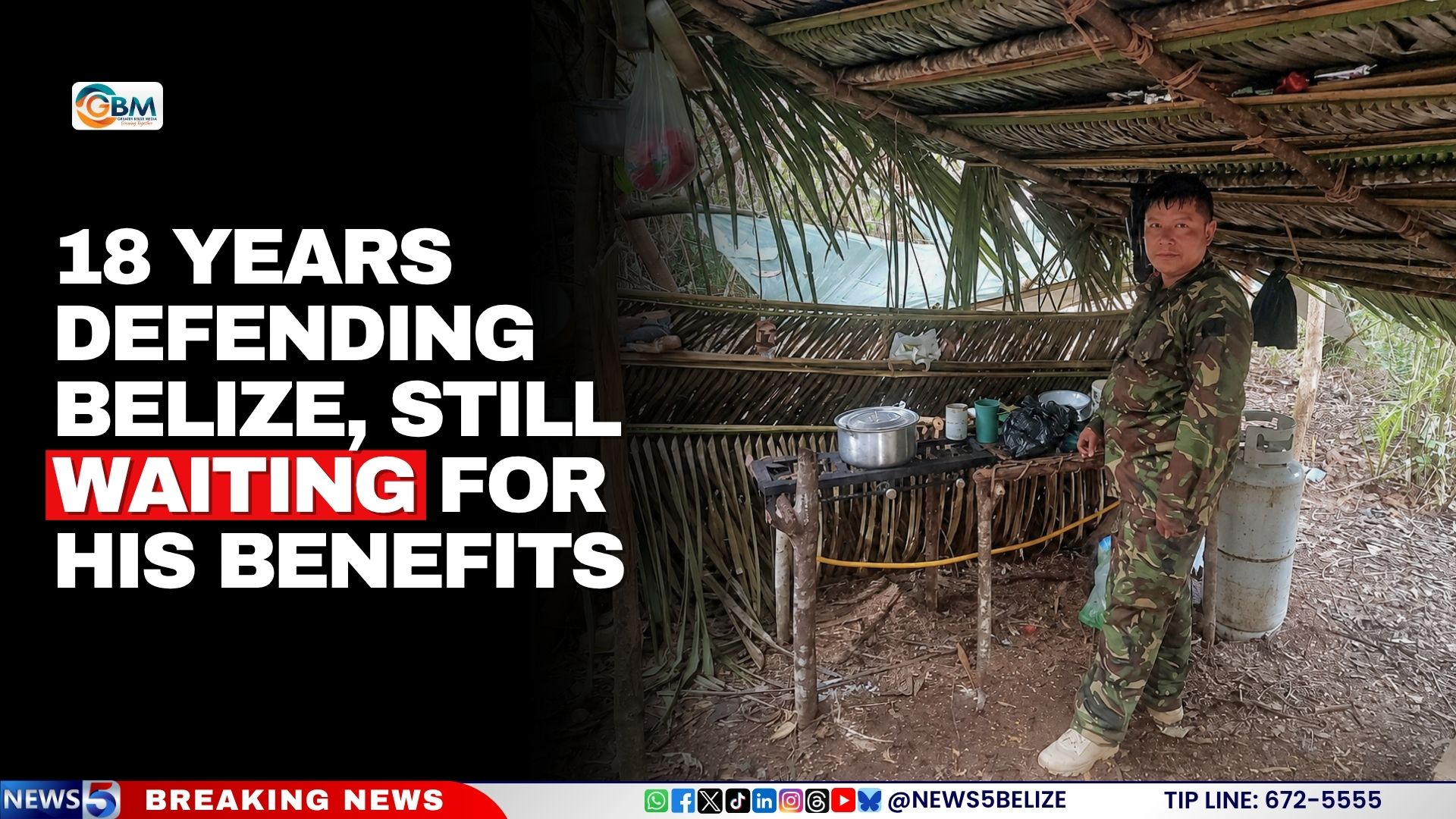
18 Years Defending Belize, Still Waiting for His Benefits
For nearly two decades, Felix Ack patrolled Belize’s borders, facing off against Guatemalan military personnel at the contested Sarstoon border in service to his country. Now, five months after hanging up his uniform at 37, the retired Belize Defence Force soldier is still waiting to receive the retirement pension and gratuity he earned through 18 years of service. Ack is far from alone in this bureaucratic limbo: local outlet News 5 has received identical complaints from multiple retired service members across the force.
Ack joined the BDF straight out of adolescence at 18, dedicating the entirety of his early adulthood to national border security. To make ends meet amid the ongoing delay, he has been forced to take casual work on Caye Caulker, a remote island that has left him separated from his family. “I really need my benefits. I believe I’ve served my time already, and waiting for it makes me frustrated that I have to seek another job,” Ack explained in an interview. “I believe the government can do better by facilitating our benefits as fast as possible. Five months is too much to wait.” For Ack and his fellow retired soldiers, their personal files have remained stuck at Price Barracks for half a year, with no visible movement in the benefits approval pipeline.
When approached with the veterans’ collective complaints, Francis Usher, Chief Executive Officer of Belize’s Ministry of Defence and Border Security, openly acknowledged the systemic delays. Usher explained that the multi-stage bureaucratic process, while designed to ensure accuracy in benefit calculations, creates unavoidable long wait times for retiring soldiers. He walked through the full approval chain a retirement file must complete before any payment is issued: starting at BDF headquarters, moving to the Ministry of Defence, then to the Security Services Commission, a body that only convenes once per calendar month. If a file arrives just after a monthly meeting, the veteran must wait a full 30 days before their case is even added to the meeting agenda. After clearing the commission, the file moves to the national treasury for a full review of the soldier’s entire career salary and increment history, then to the Ministry of Finance, the Public Service Commission, and finally back to the Ministry of Defence before payment processing can begin.
As a long-term solution to the backlog and delays, Usher confirmed that the government is working to digitize all service records for both the BDF and the Belize Coast Guard. The digitization project aims to eliminate the slow, clunky chain of physical file transfers that currently slows every step of the approval process. “The hope is that by doing that, it can speed up the process because we don’t have to wait for physical files to get to the ministry. It can then be an electronic review, a click of the button,” Usher said. However, he also admitted that the rollout of the new digital system is progressing far slower than officials and veterans would like. Usher sympathized with the veterans’ frustration, noting that after decades of service, retired soldiers have more than earned their benefits, but added that bureaucratic caution is necessary to protect public funds and ensure accurate disbursements. “But I also now understand the other side because we do have to be stewards of the public purse. We do have to make sure that we are administrating it responsibly,” he said.
For the time being, the delays persist. Many retired soldiers wait months for their earned benefits, and some have been stuck in the approval pipeline for more than a year, with no end to their wait in sight.
-

Humphrey: Barbados needs infrastructural upgrades
Against the backdrop of growing global economic uncertainty and the unique climate challenges faced by small island developing nations, Barbados has laid out a transformative, multi-sector infrastructure development strategy designed to reinforce national resilience and elevate the country’s standing in the global competitive landscape. The announcement was made by Kirk Humphrey, Barbados’ Senior Minister Coordinating Infrastructure and Minister of Transport and Works, during his address at the 12th China-Latin America and the Caribbean (LAC) Infrastructure Forum held in Macau.
Humphrey framed the current moment as a critical turning point for the island nation, arguing that the global understanding of infrastructure has shifted dramatically in recent decades. “Infrastructure must no longer be reduced to just physical assets like roads, bridges and buildings,” he emphasized during the forum. “Today, it encompasses interconnected systems, cutting-edge technologies and cross-border partnerships that all work together to lift living standards, unlock new economic opportunities and reinforce a nation’s ability to withstand systemic shocks.” He went on to anchor the entire infrastructure agenda in human-centric values, noting: “At its core, infrastructure development is about people. Its ultimate goals are to expand opportunity, enhance quality of life, and build societies that are more resilient, deeply connected, and fully prepared to tackle the challenges of tomorrow.”
In his remarks, Humphrey singled out inter-island connectivity as one of the Caribbean region’s most underutilized pathways to inclusive economic growth and deeper regional integration. He proposed that the deployment of a modern, interconnected regional ferry network could drive transformative change across the Caribbean, boosting cross-regional trade, expanding tourism activity, strengthening regional food security, and streamlining the movement of people between neighboring island nations.
Beyond physical transportation infrastructure, Humphrey stressed that digital modernization is a non-negotiable priority for 21st century development. He called for expanded cross-border and cross-stakeholder collaboration to build out smart transportation networks, integrate artificial intelligence into public infrastructure management, expand digital electronic government services, strengthen regional cybersecurity frameworks, and roll out advanced, high-speed communications systems across all participating nations.
Alongside digital transformation, Humphrey highlighted that Small Island Developing States (SIDS) have a unique imperative to lead on climate resilience and renewable energy expansion. He noted that these climate-vulnerable nations must continue to pursue innovative, locally adapted solutions that reinforce long-term energy security while advancing inclusive, sustainable economic growth that leaves no community behind.
Looking forward, Humphrey reaffirmed Barbados’ unwavering commitment to building global and regional partnerships centered on innovation, environmental sustainability and shared prosperity. He added that Barbados is positioned to take on a leading role across the Caribbean in advancing next-generation transport innovation, digital infrastructure integration, and climate change adaptation strategies that can serve as a model for other SIDS around the world.
The address came ahead of a key milestone in Barbados-China bilateral relations, with Humphrey noting that the two countries will mark 50 years of formal diplomatic ties in 2027. He extended sincere gratitude to the Chinese government for its consistent long-term financial and development support, which has delivered tangible improvements across key sectors of Barbados’ economy including healthcare, agriculture, education, sports and transportation infrastructure. He highlighted several high-impact joint collaboration projects as clear examples of the mutually beneficial partnership, including extensive national road rehabilitation work, new bridge construction, the full modernization of Barbados’ Queen Elizabeth Hospital, and the major redevelopment of the country’s National Stadium – all of which have directly improved daily life for people across Barbados.
-

Trump Cancels Iran Strikes, Says Deal Is Close
In a late-night surprise announcement shared on his Truth Social platform Thursday, former and current (as of 2026) US President Donald Trump has scrapped pre-planned military airstrikes and bombing operations targeting Iran, just hours after issuing a fiery public threat of a massive attack. The sudden reversal comes amid claims that a wide-ranging peace agreement between Washington and Tehran has secured approval from Iran’s top leadership, capping months of fraught negotiations mediated by regional powers.\n\nThe week leading up to the announcement had seen a dramatic escalation of hostilities between the two nations. Over two consecutive days, Iran’s Revolutionary Guard Corps carried out targeted strikes on US military bases stationed across the Middle East. By Thursday morning, Trump had ramped up rhetoric, warning that a “very hard” US strike would hit Iran that same night, and even publicly vowed to seize Kharg Island—an infrastructure critical node that processes roughly 90% of Iran’s total oil exports.\n\nIn his official statement, Trump confirmed that the final outstanding terms of the framework agreement have been signed off by all involved parties, including more than a dozen third-party stakeholder countries ranging from Israel and Saudi Arabia to Qatar and Turkey. As a confidence-building measure while the deal moves toward formal signing, the existing US-led naval blockade on Iranian territorial waters will remain in place, with the time and location of the official signing ceremony set to be revealed to the public in the coming days.\n\nQatar, which has long served as a neutral go-between for US-Iran talks, took a central role in bridging the divides that had stalled negotiations for months. This week alone, Qatari diplomatic officials held closed-door talks with their Iranian counterparts in Tehran to work through the two most contentious sticking points: progress on limiting Iran’s nuclear program and the terms of economic and financial relief to lift crippling sanctions on Tehran.\n\nGlobal financial and energy markets reacted instantly to the news of de-escalation. Wall Street’s benchmark Dow Jones Industrial Average surged more than 800 points in after-hours trading as investor risk appetite rebounded. Meanwhile, global crude prices plummeted: Brent crude, the global benchmark for oil, dropped nearly 4% to trade just under $90 per barrel, reversing a weeks-long upward trend driven by conflict fears.\n\nDespite the optimistic turn, significant uncertainty remains. This is not the first time Trump has announced a near-completed deal with Iran—past announcements have ultimately collapsed into deadlocked talks. Iran’s top military command also doubled down on a stark warning Thursday, reiterating that any unprovoked future US attack on Iranian territory would trigger a retaliatory response “even more severe than before.”\n\nDomestic pressure on the White House had also been building ahead of the announcement. Senior energy industry executives privately warned the Biden administration (wait, correction: the Trump White House in this 2026 timeline) that US strategic petroleum reserves have dropped to critically low levels. According to industry sources who spoke to CNN, a continued escalation of conflict through July would have likely pushed US fuel prices to unsustainable highs, creating political headaches for the administration ahead of any upcoming legislative cycles.
-
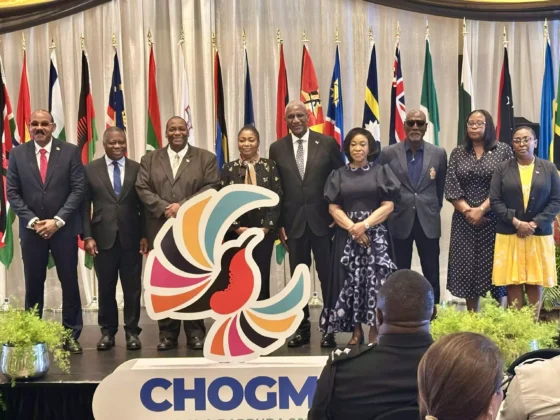
Antigua and Barbuda Reports Progress on CHOGM 2026 Preparations
As the Caribbean nation Antigua and Barbuda gears up to host the 2026 Commonwealth Heads of Government Meeting (CHOGM), senior government officials have confirmed that all preparatory work remains firmly on schedule, with mounting international engagement and backing for the upcoming high-profile summit.
This week, the country’s Cabinet received a comprehensive progress briefing from two key stakeholders: Antigua and Barbuda’s High Commissioner to the United Kingdom, and a team of senior officials from the Ministry of Foreign Affairs. The update outlined tangible advances across every critical operational domain, from security protocol and public transit infrastructure to guest accommodation, diplomatic procedure, cross-sector logistics and end-to-end event coordination.
According to official briefings, a number of Commonwealth member states have already locked in accommodation blocks for their delegations, while the remaining countries are in the final stages of confirming travel itineraries for their attending parties. When the summit convenes, Antigua and Barbuda is projected to welcome a sizable cohort of sitting Commonwealth heads of government, senior diplomatic delegates, alongside official representatives from leading global intergovernmental bodies and international development partners.
The Cabinet was also informed that a network of international partner organizations has made formal pledges of targeted support to the host nation. This assistance covers priority areas that include public and event security, cybersecurity infrastructure, enhanced transportation capacity, digital accreditation systems, specialized equipment and on-demand technical expertise throughout the summit.
To accommodate the expected sharp influx of visitors to the small island nation ahead and during the event, local organizers are continuing to advance preparedness measures. Active discussions are currently underway with major international and regional airlines to add extra flight capacity to Antigua and Barbuda, alongside ongoing planning to guarantee sufficient ground transportation, robust communications networks and fully staffed emergency response services across the host locations.
Public enthusiasm and engagement with the summit has held strong across the country, with the latest figures showing more than 800 local residents have already registered their interest in volunteering their time for the event. Additionally, organizers have already completed the selection process for more than 130 dedicated Delegation Liaison Officers, who will be deployed to provide dedicated support to visiting national delegations throughout their stay.