分类: politics

  • Belize Signs US “Safe Third Country” Deal for Migrants

    Belize Signs US “Safe Third Country” Deal for Migrants

    Belize has entered into a landmark agreement with the United States to serve as a ‘safe third country’ for migrants seeking asylum in the US. Prime Minister John Antonio Briceño announced that the deal, pending approval by the Belize Senate, will enable migrants deported from the US to apply for asylum in Belize rather than being returned to their countries of origin. The US State Department hailed the agreement as a significant step toward curbing illegal immigration and addressing abuses of the US asylum system. This arrangement mirrors similar agreements recently established with Paraguay, Panama, Costa Rica, El Salvador, and Honduras, all of which have accepted deportees from the US. However, human rights organizations have raised concerns, arguing that such agreements could expose migrants to persecution or harm in the receiving countries. Belize’s Ministry of Foreign Affairs emphasized that the agreement includes robust security measures to safeguard national sovereignty, with Belize retaining full authority to approve or reject transfers and conducting thorough background checks. Prime Minister Briceño framed the initiative as a ‘job program,’ allowing qualified migrants to contribute to Belize’s economy, particularly those from Central America. Opposition Leader Tracy Taegar Panton expressed concerns about the potential financial and sovereignty implications of the deal. The US State Department reiterated the agreement’s role in addressing regional migration challenges and strengthening bilateral cooperation.

  • COMMENTARY: Bridges Over Water: Enhancing the U.S.–Caribbean Partnership

    COMMENTARY: Bridges Over Water: Enhancing the U.S.–Caribbean Partnership

    The vast ocean separating the United States and the Caribbean is not a divide but a potential bridge, waiting to be crossed through visionary leadership and decisive action. The future, as the waves suggest, belongs to those who invest in people, innovation, and trust. The Caribbean does not seek charity; it seeks genuine partnership. Similarly, the United States must move beyond mere influence to establish credibility. Together, these regions can forge a relationship rooted in tangible impact, shared prosperity, and enduring stability.

    Economic collaboration must be both bold and practical. In Antigua and Barbuda, U.S. investments in solar-powered microgrids can reduce energy costs and enhance resilience against natural disasters. In St. Kitts and Nevis, joint ventures in sustainable tourism can generate employment while preserving the region’s natural heritage. Barbados, Guyana, and St. Martin could become hubs for technology incubators, supported by U.S. partners, fostering local entrepreneurship and connecting regional talent to global markets. These initiatives demonstrate that economic cooperation is not about aid but about creating a shared pathway to prosperity.

    Security and stability must prioritize prevention over reaction. In St. Lucia, community-based programs offering training and employment for youth can diminish the allure of illicit activities. Joint maritime surveillance across the Eastern Caribbean can strengthen disaster response while safeguarding fisheries and trade routes. Supporting environmental and social resilience ensures that security is sustainable and grounded in opportunity rather than force. When safety stems from empowerment, it becomes both durable and credible.

    Diplomacy must be rooted in partnership and respect. The United States should engage Caribbean leaders as equal voices in regional initiatives, co-designing projects in renewable energy, digital innovation, and climate adaptation. Recognizing the leadership and sovereignty of nations like St. Vincent and the Grenadines, Jamaica, Barbados, and Trinidad and Tobago fosters trust. Policies aligned with Caribbean priorities build credibility while advancing mutual interests. True partnership emerges when dialogue transforms into action and shared vision translates into shared impact.

    The ocean between the United States and the Caribbean is not a barrier but a bridge. By focusing on economic opportunity, education, security, and respectful diplomacy, both regions can rise together, anchored in trust, propelled by collaboration, and united by the belief that shared prosperity secures a safer, stronger, and more vibrant hemisphere.

    Actionable Suggestions:
    – Launch solar microgrid projects in Antigua and Barbuda and renewable energy hubs in Barbados.
    – Develop sustainable tourism and entrepreneurship partnerships in St. Kitts and Nevis.
    – Expand scholarships, student exchanges, and summer internships with practical learning in Jamaica, Guyana, St. Lucia, Dominica, and Barbados.
    – Implement joint maritime surveillance and disaster preparedness programs across the Eastern Caribbean.
    – Engage in co-designed initiatives and regional leadership support to build mutual trust and credibility.

    About the Author:
    Dr. Isaac Newton is a strategist and scholar trained at Harvard, Princeton, and Columbia. He advises governments and international institutions on governance, public transformation, and global justice. His work blends visionary thinking with practical insight, helping Global South nations address historical injustice, advance human dignity, and engage global issues of peace, sovereignty, and shared prosperity. Dr. Newton envisions societies where innovation and responsibility evolve together to promote human flourishing and where partnerships between nations create enduring opportunity, stability, and trust.

  • PM Browne: Tenders Board Members to Be Rotated for Accountability

    PM Browne: Tenders Board Members to Be Rotated for Accountability

    Prime Minister Gaston Browne has unveiled plans to implement a rotation system for members of the Tenders Board and other key public offices as part of a broader strategy to enhance governance and prevent complacency. Speaking on the Browne and Browne Show, Browne emphasized the need for balance and accountability in oversight roles. He clarified that the initiative is not a response to any wrongdoing but a proactive measure to ensure no individual becomes too entrenched in their position. ‘The Tenders Board, for example, I’m going to rotate the people serving the Tenders Board too. They must not get comfortable,’ Browne stated. He extended this policy to senior officials, including Diane Black-Layne at the Department of Environment, and even within his own Cabinet, to foster growth and development among other capable individuals. This move aligns with Browne’s ‘national reset’ initiative, launched following a government vehicle procurement controversy. The reset encompasses reforms in the Treasury, Public Works Department, and procurement systems to bolster transparency and public trust. Browne reiterated his commitment to creating a culture of renewal and balance in leadership roles, asserting, ‘What I want to ensure is that this government, this country, is governed better.’

  • LISTEN: Pringle Denies Involvement in Vehicle Scandal, Calls Allegations Political Distraction

    LISTEN: Pringle Denies Involvement in Vehicle Scandal, Calls Allegations Political Distraction

    Opposition Leader Jamale Pringle has vehemently refuted allegations linking him to the ongoing controversy surrounding government vehicle procurement, labeling the accusations as politically driven distractions. In a strongly worded audio statement, Pringle demanded that those making the claims provide concrete evidence and take full responsibility for their assertions. He emphasized that accountability should be based on verifiable facts rather than unsubstantiated rumors. Pringle also called for an independent investigation not only into the vehicle procurement issue but also into the broader operations of the Public Works Department, hinting at potential systemic irregularities. He argued that focusing solely on the vehicle scandal without examining the department’s overall conduct would be shortsighted. Additionally, Pringle dismissed calls for his resignation as premature and unfounded, urging a measured approach to addressing the controversy. His remarks come at a time when the vehicle procurement scandal has sparked widespread public debate and cross-party scrutiny, raising questions about transparency and governance.

  • Parmessar: Suriname bewijst dat humanitaire waarden in de praktijk kunnen bestaan

    Parmessar: Suriname bewijst dat humanitaire waarden in de praktijk kunnen bestaan

    At the 151st General Assembly of the Inter-Parliamentary Union (IPU) in Geneva, Rabin Parmessar, an Assembly member and leader of the NDP faction, highlighted Suriname as a nation that not only advocates for humanitarian values but actively embodies them. Parmessar emphasized the unique social harmony in Suriname, where diverse religions and ethnic groups have coexisted peacefully for decades. He described the country as ‘a United Nations in miniature,’ underscoring its strength in diversity, inclusion, and human dignity.

    Parmessar pointed to the coexistence of a mosque and synagogue in Paramaribo and the pivotal role of the Interreligious Council in maintaining societal stability as tangible examples of this harmony. He also marked two significant milestones: the 50th anniversary of Suriname’s independence on November 25, 2025, and the election of Jennifer Simons, the nation’s first female president, as a symbol of progress in equality and inclusive leadership.

    Looking ahead, Parmessar outlined Suriname’s economic transformation, particularly its planned offshore oil production starting in 2028. He stressed the importance of transparency, local involvement, and maintaining the country’s carbon-negative status. Protecting the rainforest, he argued, is not an economic advantage but a global responsibility.

    Parmessar called on parliaments worldwide to ensure humanitarian principles are reflected in governance, legislation, and crisis response. He urged lawmakers to uphold the rule of law, social protection, and impartial emergency aid, stating, ‘Parliamentarians are not just legislators but leaders with moral responsibility. No voice should go unheard, and no one should be left behind.’

  • The genocide against the Cuban people in denouncing its civil society

    The genocide against the Cuban people in denouncing its civil society

    The Cuban Association of the United Nations (ACNU) is set to convene the 21st Forum of the Cuban Civil Society against the Blockade on October 24. This significant event will serve as a platform for denouncing and reflecting on the detrimental effects of the US-imposed economic blockade, which has been criticized for violating human rights and impeding Cuba’s national development. The forum coincides with an upcoming United Nations vote addressing the economic siege, offering a timely opportunity to explore the profound human, social, and economic repercussions of the policy on the Cuban population. Recent reports presented by Bruno Rodríguez Parrilla, a member of the Political Bureau and Cuba’s Foreign Minister, reveal that the blockade has caused an estimated $7.5 billion in damages over the past year alone, with cumulative losses exceeding $170 billion over six decades. Rodríguez Parrilla highlighted that over 80% of Cubans have lived their entire lives under the blockade’s shadow, enduring daily hardships. The forum aims to galvanize international support to demand an immediate end to what is described as an unjust and illegal policy.

  • Law on Science, Technology and Innovation, a legal standard for the whole of society

    Law on Science, Technology and Innovation, a legal standard for the whole of society

    The October session of Cuba’s National Innovation Council marked a pivotal moment in the nation’s pursuit of scientific and technological advancement. Chaired by President Miguel Díaz-Canel Bermúdez, the council conducted an in-depth examination of the draft Science, Technology, and Innovation Act, initiating a nationwide debate on its provisions. This legislative effort aims to address existing barriers, fill regulatory gaps, and align with the aspirations of Cuban scientists, as highlighted in numerous consultations. The President emphasized the necessity of broad public engagement, ensuring the law reflects diverse perspectives from the science, technology, and innovation sectors, as well as other societal stakeholders. Armando Rodríguez Batista, Minister of Science, Technology, and Environment (CITMA), presented the draft, underscoring its comprehensive approach to fostering a robust innovation ecosystem. The draft identifies key challenges, including fragmented regulations, inadequate funding, and insufficient integration of social sciences with natural sciences. It proposes 20 foundational principles, such as establishing a high-ranking legal framework, enhancing governance, and recognizing innovative enterprises as integral to the system. The proposed law, structured into eight chapters, seeks to integrate innovation, transition to a knowledge economy, and international collaboration. Over 1,500 individuals, including academics, researchers, and government officials, have already contributed to the consultation process, reinforcing the draft’s potential to drive Cuba’s economic and social development.

  • Column: Etnische zuivering is geen vraag; het is taal van oorlog

    Column: Etnische zuivering is geen vraag; het is taal van oorlog

    On Monday, Suriname celebrated Diwali, a festival symbolizing light, harmony, and spiritual purity. The nation prides itself on being a “mini United Nations,” yet ethnic tensions persist, particularly in politics. Suriname’s strength lies in its diversity, where no single group dominates another. However, during a recent government press conference, President Jennifer Simons faced a contentious question: whether the removal of individuals from key positions appointed by the previous administration amounted to “ethnic cleansing.” The president responded sharply, emphasizing that such terminology is inappropriate in a democracy, especially in a nation nearing 50 years of independence and celebrated for its ethnic coexistence. She clarified that Suriname’s governance is built on reality, not ethnic chess games. Her pointed question to the journalist—”Did you understand my answer?”—highlighted the need for responsible language in public discourse. A free press is essential, but critical questions must not devolve into misleading narratives. No political party in Suriname represents a single ethnic group. The country is a mosaic of minorities, and suggesting otherwise undermines its foundation. The real issue is not “Whose people are these?” but “How do we design a system where state positions are not seen as personal property?” As Suriname approaches its 50th anniversary of independence, it must move beyond ethnic politics. Those who stoke ethnic tensions in a nation built on peace are playing with fire.

  • West Kingstown youth avoid being seen with Cummings — Peters

    West Kingstown youth avoid being seen with Cummings — Peters

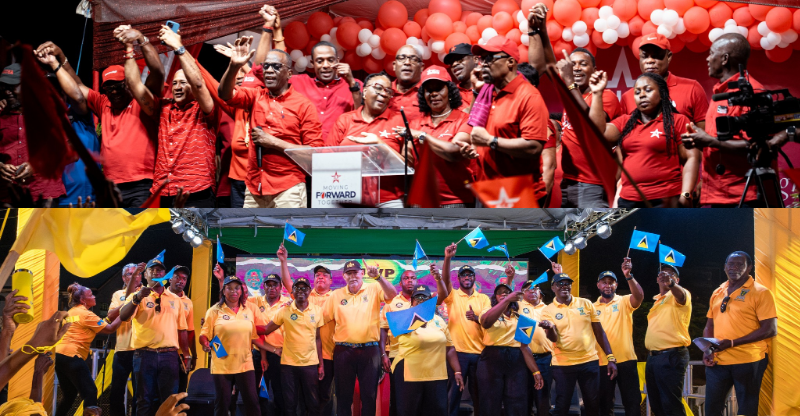
    Keisal Peters, the Unity Labour Party (ULP) candidate for West Kingstown, has vowed to bring significant change to the constituency, currently represented by the New Democratic Party’s (NDP) Daniel Cummings since 2010. Peters, a trailblazing lawyer and St. Vincent and the Grenadines’ first female Minister of Foreign Affairs, emphasized that young voters in the area are disenchanted with Cummings, who secured his third term in 2020 with a narrow margin of 714 votes. Speaking at a ULP campaign rally in Calliaqua, Peters accused the NDP of planning to privatize healthcare, sell national assets, and compromise the country’s future. She criticized the NDP’s alleged intentions to sell the EC$700 million Kingstown port, the Arnos Vale hospital under construction, and even the nation’s passports. Peters declared, ‘We cannot allow the NDP to lead us down a path of unrighteousness for their political agenda.’ She highlighted the ULP’s commitment to progress, including scholarships, housing, and the development of a Beaches Resort in Mt Wynne, a $500 million project in collaboration with Sandals Resorts International. Peters also outlined her vision for West Kingstown, promising innovative ideas, modern business complexes, and support for local initiatives like the seafood festival at Lowmans Bay. She criticized Cummings for relying on the legacy of the late John Horne, a former NDP representative, and accused him of offering nothing to the youth. Peters underscored the ULP’s role as the ‘last line of defence’ for St. Vincent and the Grenadines, contrasting it with the NDP’s alleged mismanagement and private debts. She urged voters to choose progress over empty promises, asserting that the ULP is ‘red and ready’ to lead the nation forward.

  • Security: Monitoring of the latest targeted operations of the GSF (ex MSS)

    Security: Monitoring of the latest targeted operations of the GSF (ex MSS)

    In a concerted effort to combat gang violence and restore public safety, Haiti’s Gang Suppression Force (GSF), alongside the Haitian National Police (PNH) and the Haitian Armed Forces (FAD’H), has executed a series of targeted operations across key regions. Over the past week, the GSF focused on clearing the Petite-Rivière–Liancourt–Pont Sondé route in the Artibonite Department, ensuring the safe transportation of PNH officers and essential supplies to St. Marc. These actions aim to bolster security in the area and protect local communities from gang-related threats. A significant operation took place on October 17, 2025, from 6:30 AM to 10:00 PM, during which the joint forces successfully cleared the main road between Pont Sondé and Verret. Despite resistance from the Gran-Griff gang, which included barricades, trenches, and Molotov cocktail attacks, the GSF and PNH units neutralized the threats and secured the delivery of armored vehicles to local police stations. These vehicles are expected to significantly enhance the region’s security infrastructure. The GSF also refuted false social media claims regarding the death of a Kenyan officer during the operation, expressing gratitude for the Haitian population’s cooperation. In Port-au-Prince, joint patrols continued across multiple neighborhoods, including Kenscoff, Downtown, and the airport area, with objectives ranging from intelligence-led counter-gang operations to securing critical infrastructure and combating arms trafficking. The GSF praised the dedication of its officers, emphasizing their commitment to restoring peace and stability in Haiti.