分类: business

  • Unions prep for public sector pay talks

    Unions prep for public sector pay talks

    Barbados’ labor movement has formally announced its preparedness to initiate pivotal wage negotiations with the government, marking a significant development in ongoing discussions about public sector compensation. Three major labor organizations—the Barbados Workers’ Union (BWU), the National Union of Public Workers (NUPW), and the coordinating body Congress of Trade Unions and Staff Associations of Barbados (CTUSAB)—have all confirmed their operational readiness for upcoming talks.

    The BWU, while expressing commitment to constructive dialogue, has raised substantive concerns regarding prolonged delays in the government’s job regrading initiative. General Secretary Toni Moore emphasized that while her organization stands prepared for immediate engagement, the union permitted uninterrupted completion of the job evaluation process recognizing its fundamental importance to both wage structures and broader employment conditions. However, Moore explicitly noted growing concern among workers about the extended timeline, while expressing hope that the final report would meet expectations without further unnecessary delays.

    Simultaneously, the NUPW has activated its negotiation machinery through the establishment of a specialized committee tasked with developing comprehensive proposals. General Secretary Richard Greene indicated this committee would conduct a sweeping review of public service compensation, identifying both deficiencies and improvement opportunities across salary structures, allowances, and working conditions.

    CTUSAB, representing the collective voice of multiple labor organizations, is adopting a research-driven approach to the negotiations. General Secretary Dennis De Peiza revealed the organization has commissioned detailed economic research to inform their bargaining position. This methodological approach will establish evidence-based parameters for their negotiation strategy, combining ongoing service conditions with new economic data.

    The timing of these developments coincides with the government’s presentation of its 2026-27 Estimates of Revenue and Expenditure to Parliament, which outlines projected spending including public sector wage allocations, setting the fiscal context for the impending negotiations.


  • GIAB: Insurance prices not the fuel to uninsured vehicle surge

    GIAB: Insurance prices not the fuel to uninsured vehicle surge

    A significant dispute has emerged between Barbados’s insurance sector and its financial regulator regarding the root causes of uninsured vehicles on the island. The General Insurance Association of Barbados (GIAB) has publicly refuted claims made by Financial Services Commission (FSC) CEO Warrick Ward, who attributed the problem to premium affordability and structural market weaknesses. Instead, the GIAB identifies recent modifications to the vehicle registration framework as the primary catalyst.

    In a formal statement, the industry body expressed strong disagreement with the regulator’s characterization of the market. The GIAB emphasized the financial robustness of its member companies, several of which maintain AM Best ratings—a global benchmark for assessing insurers’ financial strength and claims-paying capability. The association challenged the notion that insurance premiums are prohibitively expensive, noting that rates have not kept pace with inflation over the past decade and a half.

    The core of the GIAB’s argument centers on a digital modernization initiative launched in March 2025. This new system, introduced by the Barbados Revenue Authority in collaboration with several agencies, allows vehicle owners to renew registrations online. A critical change involved removing the mandatory requirement to present proof of insurance before paying road tax, shifting the burden of compliance solely onto vehicle owners. The GIAB contends this procedural alteration, rather than affordability, explains the prevalence of uninsured vehicles.

    Official police data estimates that approximately 50,000 of the island’s 180,000 vehicles are either uninsured or untaxed, a situation industry executives say contributes to three out of every ten accidents involving uninsured drivers or unlicensed motorists.

    While FSC CEO Ward acknowledged the scale of the problem and pointed to financial inclusion challenges, reinsurance costs, and low insurance penetration as contributing factors, he clarified that enforcement falls under the police’s purview, not the FSC’s regulatory mandate.

    The GIAB concluded by asserting that its members employ risk-based pricing models and exercise due diligence before implementing any premium increases. The association has formally requested a meeting with the FSC to discuss the regulator’s concerns directly.

  • BTL Counters Union, Insists Severance Dispute Is Resolved

    BTL Counters Union, Insists Severance Dispute Is Resolved

    Belize Telemedia Limited (BTL) has publicly countered allegations from the Belize Communications Workers for Justice (BCWJ), asserting that all court-mandated severance obligations have been fully satisfied. The telecommunications provider maintains that payments ordered by the Caribbean Court of Justice have been completely disbursed, while additional settlements for qualifying former employees under Section 183 of the Labour Act are currently being processed.

    At a recent press conference, BTL’s Internal Legal Counsel Kileru Awich characterized the severance issue as having ‘evolved significantly’ since November 2025. The company initially limited payments to former employees within a six-year limitation period but has since expanded its position to include earlier separations. This shift in policy, according to Awich, fundamentally alters the calculation considerations, particularly regarding interest payments.

    The negotiation impasse centers on whether interest should apply to outstanding severance amounts. Chief Human Resource Officer Kendra Santos stated that while BTL maintains no legal obligation to pay interest for out-of-court settlements, the company has offered to pay interest dating from November 2025—the benchmark established in the CCJ ruling. This concession, Santos emphasized, represents a premium beyond statutory requirements and reflects the company’s commitment to equitable resolution.

    BTL strongly refutes characterizations of bad-faith negotiation, noting that their position consistently improved throughout discussions without withdrawal from the bargaining table. The company attributes the breakdown to fundamental differences in negotiation approach and expectations regarding court-equivalent settlements outside judicial proceedings.

    With direct negotiations suspended, BTL is now encouraging former employees to pursue claims individually through direct communication channels, asserting that the BCWJ’s representation is no longer necessary to access approved severance packages.

  • Imports Surge Past Quarter‑Billion Dollars

    Imports Surge Past Quarter‑Billion Dollars

    Belize’s economy demonstrated vigorous trading activity in January 2026, recording substantial growth in both import and export sectors according to the latest data from the Statistical Institute of Belize. The nation’s import expenditure surged to $271 million, marking an 11.7% increase equivalent to $28.5 million compared to January 2025, while exports climbed to $19.5 million.

    The import expansion was predominantly driven by capital investments in machinery and equipment, which escalated from $61.6 million to $76.1 million, indicating robust industrial development. Consumer goods including athletic apparel, footwear, agricultural inputs, and tobacco products contributed significantly to the import growth. However, construction materials experienced a modest decline, suggesting a temporary cooling in the building sector.

    Agricultural exports emerged as the standout performer, with banana shipments generating $7.8 million compared to $6.1 million the previous year. The pepper sauce industry achieved remarkable growth, more than doubling its export revenue. While marine products and sugar experienced slight contractions due to fluctuating global demand, the overall agricultural sector demonstrated strong competitiveness in international markets.

    Geographically, European markets dramatically increased purchases from Belize, with exports soaring from $2.1 million to $4.9 million. The United States also expanded imports, particularly conch and pepper sauces, rising from $3.5 million to $4.4 million. Conversely, CARICOM nations and the United Kingdom reduced imports, primarily reflecting decreased banana shipments to these traditional markets.

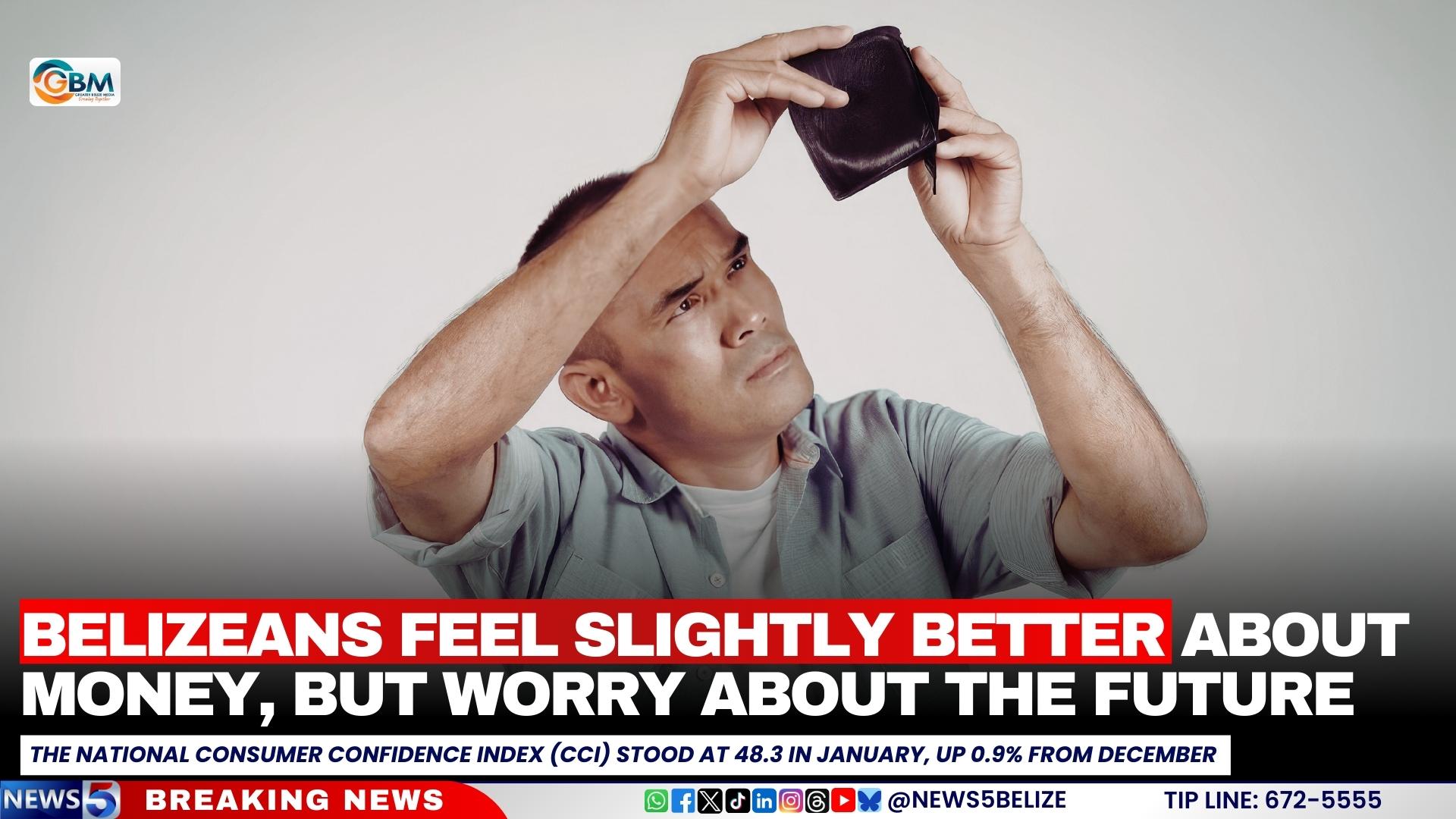
  • Belizeans Feel Slightly Better About Money, But Worry About the Future

    Belizeans Feel Slightly Better About Money, But Worry About the Future

    BELIZE CITY – Belizean consumers entered 2026 with cautiously improved economic sentiment, though underlying concerns about future prospects persist. According to newly released data from the Statistical Institute of Belize, the national Consumer Confidence Index (CCI) registered at 48.3 points in January, marking a modest 0.9% increase from December 2025’s reading.

    The marginal uplift reflects a complex economic psychology among citizens, characterized by slightly improved perceptions of current conditions alongside growing apprehension about the coming year. The sub-index measuring present economic circumstances and household financial health demonstrated notable improvement, climbing 3.8% from 43.4 to 45.1 points. This indicates more households perceived their immediate fiscal situation as strengthened compared to the previous month.

    Consumer willingness to consider major acquisitions—including real estate, vehicles, and high-value appliances—showed tentative improvement. While maintaining general caution, Belizeans demonstrated slightly greater openness to substantial purchases compared to the previous assessment period.

    However, forward-looking optimism experienced a slight contraction, declining 0.7% as respondents expressed diminished confidence in the twelve-month economic outlook. This divergence suggests consumers feel better about current conditions while growing more apprehensive about future developments.

    Regional analysis revealed significant geographic disparities. Corozal District recorded the most substantial confidence surge at 7.1%, propelled by strengthened expectations and improved present conditions assessments. Conversely, Stann Creek witnessed the sharpest decline at 13.7%, with residents reporting heightened pessimism regarding both durable goods purchases and future economic prospects.

    Ethnic demographic breakdowns showed pronounced variations, with the ‘Other’ category and Maya community registering strengthened confidence. Meanwhile, Mestizo/Hispanic and Garifuna populations reported diminished economic sentiment compared to previous measurements.

    The mixed indicators present policymakers with a complex economic landscape, requiring targeted approaches to address both immediate consumer concerns and longer-term confidence building.

  • Cheaper Fuel Brings Relief as Other Costs Climb

    Cheaper Fuel Brings Relief as Other Costs Climb

    Belize’s economic landscape presented a mixed picture at the start of 2026, with the Statistical Institute of Belize reporting a near-flat national inflation rate of just 0.04% for January compared to the previous year. This marginal increase indicates remarkable stability in the overall cost of living, masking significant fluctuations across different consumer sectors.

    While the aggregate numbers suggest price stability, Belizean households faced substantial increases in essential categories. The food sector experienced noticeable inflation, with fresh meats, bakery products, and beverages including coffee and juices all recording higher prices. Stewed pork demonstrated the most dramatic surge, escalating by nearly 18% year-over-year.

    The housing and healthcare sectors similarly trended upward, with rental costs climbing and medical expenses becoming more burdensome. Surgical fees rose approximately 6%, while pharmaceutical products and physician services also saw increased pricing. Household energy costs climbed as well, with the standard 100-pound LPG cylinder reaching $130.63—representing a $5 increase from January 2025.

    Substantial relief arrived at gasoline stations nationwide, where significant price reductions provided counterbalance to other inflationary pressures. Premium gasoline prices declined by $1.12 per gallon, regular gasoline dropped by $1.03, and diesel fuel decreased by $0.52 per gallon.

    Regional analysis revealed considerable disparities across Belize’s districts. Punta Gorda recorded the highest inflation rate at 2.6%, driven by increased costs for food, liquefied petroleum gas, and personal items. Conversely, Orange Walk experienced deflation at -1.9%, benefiting from both reduced fuel prices and decreased costs for locally grown produce including tomatoes, carrots, and beans.

    The period between December 2025 and January 2026 actually saw a 0.5% decrease in overall prices, primarily attributable to the declining fuel costs that helped stabilize the nation’s economic outlook.

  • BTL Cuts Out the Middleman, Offers Severance Directly to Worker

    BTL Cuts Out the Middleman, Offers Severance Directly to Worker

    In a significant corporate development, Belize Telemedia Limited (BTL) has announced it will voluntarily provide severance packages to all qualifying former employees, including those whose claims technically fall outside the statutory six-year limitation period. The company’s legal representative, Kileru Awich, confirmed this decision during a press briefing on February 26, 2026.

    Awich emphasized that while BTL maintains its legal position regarding statutory limitations, the telecommunications provider has chosen to extend payments as a gesture of good faith. This move comes despite the complete breakdown of negotiations with the Belize Communication Workers for Justice (BCWJ) union, primarily due to disagreements over interest calculations on back payments.

    The company’s counsel revealed that over 500 severance requests are currently being processed under Section 183 of Belize’s Labour Act. This provision covers employees with at least five continuous years of service terminated without cause, plus those with ten years who resigned and qualify for gratuity-equivalent payments.

    Awich notably stated that the decision represents no admission of liability by BTL, but rather a practical resolution to benefit former workers. The announcement follows sustained protests by BCWJ outside BTL’s headquarters demanding severance payments, with additional demonstrations expected due to the collapsed negotiations.

    The legal counsel shared that some union-represented workers have independently contacted BTL expressing willingness to accept the company’s terms, highlighting divisions within the former employees’ group regarding the negotiation strategy.

  • STATEMENT: National Beekeepers Cooperative Society condemns sale of adulterated honey

    STATEMENT: National Beekeepers Cooperative Society condemns sale of adulterated honey

    The National Beekeepers Cooperative Society Ltd. has issued a formal response to a viral social media graphic raising concerns about adulterated honey products in the Dominican market. The cooperative organization released a strong statement condemning all aspects of honey adulteration—from production and distribution to retail sales—reaffirming its unwavering commitment to preserving honey’s status as a pure, natural product.

    The Cooperative confirmed it has received and formally documented specific concerns regarding certain honey brands currently available to consumers. In response to these allegations, the organization has initiated active engagement with relevant regulatory bodies to ensure all honey products comply with established quality and safety protocols.

    Emphasizing its core priorities, the Cooperative highlighted three fundamental commitments: ensuring consumer safety, protecting legitimate beekeepers who maintain authentic production methods, and safeguarding the reputation of the Dominican Honey Brand as a mark of quality and authenticity.

    The statement concluded with a call for enhanced transparency throughout the industry, advocating for rigorous testing procedures and strict adherence to national standards. These measures, the Cooperative asserts, are essential for maintaining public confidence in the honey industry and preserving the integrity of this valued agricultural sector.

  • Paramount acquires Warner Bros. in US$110 billion mega-merger

    Paramount acquires Warner Bros. in US$110 billion mega-merger

    NEW YORK—In a landmark transaction reshaping the global media landscape, Paramount Skydance has emerged victorious in acquiring Warner Bros. Discovery for a total enterprise value of $110 billion. The deal, announced Thursday, concludes an intense five-month bidding war that saw streaming giant Netflix withdraw from negotiations after declining to match Paramount’s final offer.

    The merger creates an unprecedented entertainment conglomerate, combining Paramount’s assets with Warner Bros. Discovery’s extensive portfolio. The new entity will control some of the world’s most recognizable media brands, including CNN, HBO, Nickelodeon, and powerhouse franchises such as Harry Potter, Game of Thrones, the DC Universe, Mission Impossible, and SpongeBob SquarePants.

    Under the acquisition terms, Paramount will pay $31.00 per share in cash for all outstanding Warner Bros. Discovery shares, representing an equity valuation of $81 billion. The transaction, which includes assumption of debt, has received unanimous approval from both companies’ boards of directors, with expected closure scheduled for the third quarter of 2026.

    Paramount Chairman and CEO David Ellison stated the strategic move was ‘guided by a clear purpose: to honor the legacy of two iconic companies while accelerating our vision of building a next-generation media and entertainment company.’

    The merger’s significance extends beyond corporate consolidation, raising questions about political connections and regulatory scrutiny. The Ellison family, which will control the expanded media empire, maintains notable political ties—Larry Ellison, Oracle billionaire and father of Paramount’s CEO, is a longstanding ally of former President Donald Trump. Both Paramount and Netflix had reportedly sought favor with the current administration during bidding negotiations.

    Financing arrangements include backing from three Middle Eastern sovereign wealth funds (Saudi Arabia, Qatar, and Abu Dhabi), potentially attracting additional regulatory examination. Paramount has proactively addressed regulatory concerns by offering a $7 billion termination fee should the deal fail to clear regulatory hurdles, while also covering the $2.8 billion breakup fee Warner Bros. Discovery owed Netflix upon terminating their previous agreement.

  • Sagicor X Fund delivers historic year, surpassing billion-dollar profit mark

    Sagicor X Fund delivers historic year, surpassing billion-dollar profit mark

    KINGSTON, Jamaica – Sagicor Real Estate X Fund Limited has concluded its 2025 fiscal year with unprecedented financial results, announcing a record-breaking net profit of J$1.01 billion. This achievement marks a staggering 121 percent year-over-year growth, positioning the fund as a standout performer in the Caribbean real estate investment sector.

    The remarkable performance was primarily fueled by a 70 percent surge in net profits from core operations, which escalated from J$454.02 million to J$772 million. This substantial growth underscores the effectiveness of the fund’s strategic initiatives and operational excellence.

    A key driver of this success was the fund’s strategic expansion of its direct real estate portfolio, including a significant investment property acquisition in September 2024. This move dramatically improved commercial operations’ profit contribution, which soared to 11.2 percent from negative 7 percent the previous year.

    The hospitality division emerged as another powerful earnings engine, with the DoubleTree Orlando property reporting a 36 percent increase in net profit to J$659.42 million. Enhanced occupancy levels and elevated average daily rates, coupled with effective cost management strategies, contributed significantly to this performance.

    Additional operating activities generated profits of J$236.31 million, representing substantial growth of J$233.62 million year-over-year. These gains were attributed to favorable fair value adjustments, foreign exchange advantages, and capital gains from investment note redemptions.

    Howard Mitchell, Chairman of Sagicor Real Estate X Fund Limited, emphasized that these results stem from deliberate strategic decisions rather than temporary market conditions. ‘Surpassing the billion-dollar net profit mark confirms that our strategy is working, our portfolio is resilient, and our focus on disciplined growth creates meaningful shareholder value,’ Mitchell stated.

    The fund’s financial strength was further demonstrated through earnings per share reaching J$0.45 – a 125 percent increase from the previous year’s J$0.20 – and operating cash flows of J$922.59 million. Despite challenges including Hurricane Melissa’s impact in Jamaica, the fund maintained minimal exposure (1 percent) to Jamaican real estate through Sigma holdings, highlighting its diversified risk approach.

    Mitchell expressed optimism for future prospects, noting the continued benefits from international tourism recovery, stable investment yields, and high occupancy rates across the portfolio. The fund remains committed to pursuing opportunities that meet return thresholds while supporting regional recovery efforts.