
A groundbreaking initiative aimed at empowering women entrepreneurs in the Caribbean was unveiled on November 6, 2025, in Dominica. The Caribbean Export Development Agency (Caribbean Export), in collaboration with Global Affairs Canada (GAC), introduced GRIT – Caribbean Women Entrepreneurs Generating Resilient and Inclusive Trade. The launch event took place at Barana Aute in the Kalinago Territory, marking a significant step toward reshaping the region’s economic landscape. GRIT focuses on supporting women-led businesses by addressing trade barriers, fostering green transition, promoting digital innovation, and expanding market access. The initiative aligns with broader goals of inclusive development and economic resilience. The event brought together key stakeholders, including government officials from Dominica and Canada, representatives from the Dominica Export Import Agency (DEXIA), and women entrepreneurs from across the island. Dr. Damie Sinanan, Executive Director of Caribbean Export, emphasized the transformative potential of GRIT, stating, ‘This initiative is not just about empowering women; it’s about shaping the future of Caribbean trade, where businesses, especially MSMEs, can thrive in global markets.’ High Commissioner Brenda Wills of Canada to Barbados and the Eastern Caribbean reiterated Canada’s commitment to gender equality and inclusive growth, highlighting trade as a catalyst for equitable economic opportunities. Chief Anette Thomas Sanford of the Kalinago Territory underscored the importance of empowering indigenous and female entrepreneurs in driving local development. Paula Platsko, General Manager of DEXIA, emphasized the role of collaboration in enhancing trade prospects for women across the region. Funded with CAD $3.16 million from the Canadian government, GRIT is a four-year program designed to increase women’s participation in export markets, particularly to Canada, by providing resources, training, and business linkages in Dominica, Belize, Grenada, Jamaica, Saint Lucia, and Saint Vincent and the Grenadines. Hon. Cozier Frederick, Minister for Environment, Rural Modernisation, Kalinago Upliftment and Constituency Empowerment, delivered the keynote speech, celebrating the resilience and contributions of Kalinago women to Dominica’s development. The event also featured a Fireside Chat with Dominican entrepreneurs Lana Athanaze and Natasha Green, who shared insights into the challenges and triumphs of women in the creative sector. Caribbean Export highlighted GRIT as a pivotal step toward achieving inclusive and sustainable trade in the region.
分类: business
-
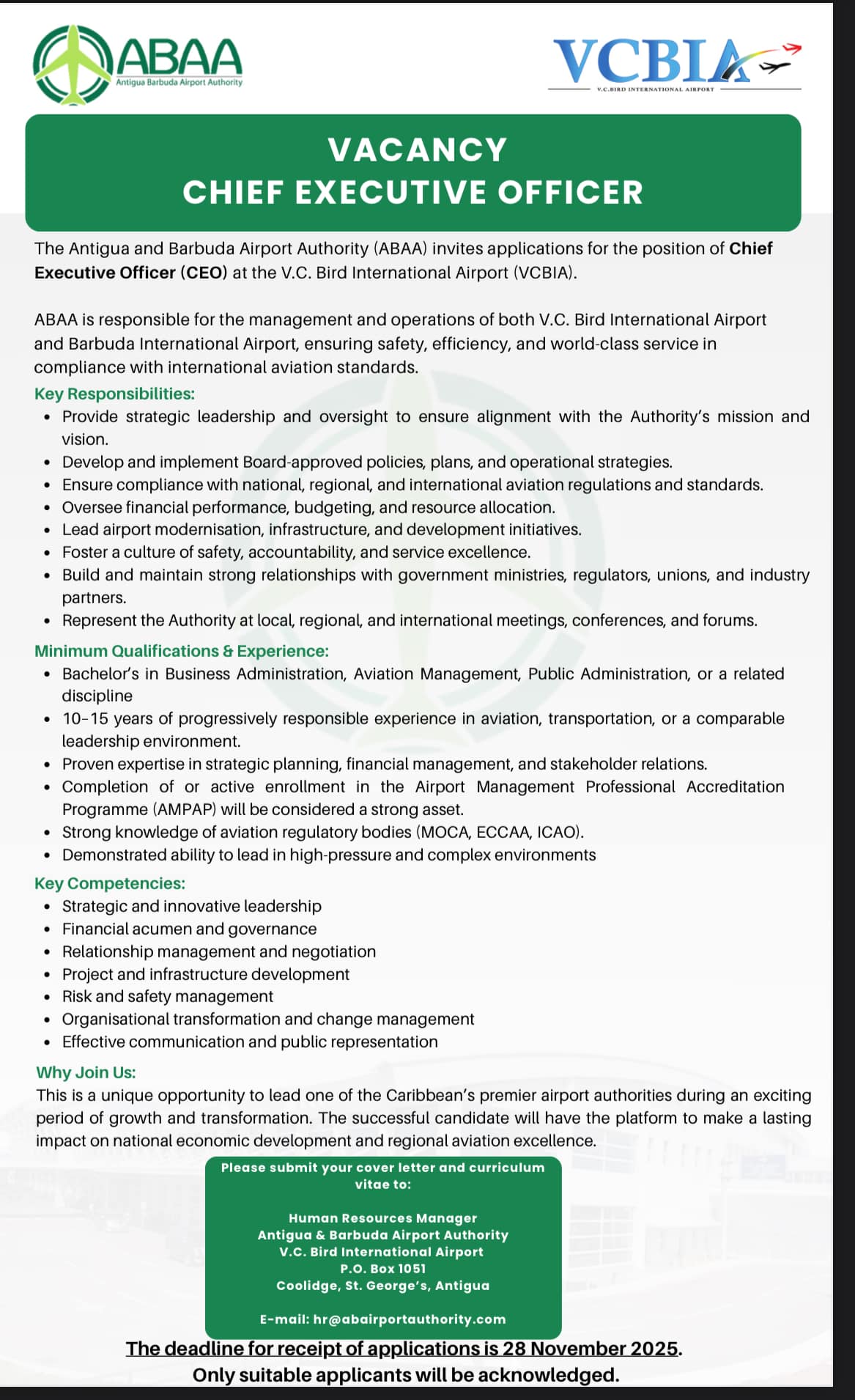
VACANCY: Chief Executive Officer
The Antigua and Barbuda Airport Authority (ABAA) has announced a high-profile vacancy for the position of Chief Executive Officer (CEO) at the V.C. Bird International Airport (VCBIA). This pivotal role offers a unique opportunity to lead one of the Caribbean’s most significant aviation hubs during a period of dynamic growth and transformation. The successful candidate will spearhead the management and operations of both V.C. Bird International Airport and Barbuda International Airport, ensuring adherence to international aviation standards while fostering safety, efficiency, and world-class service. Key responsibilities include providing strategic leadership, implementing Board-approved policies, overseeing financial performance, and driving airport modernization and infrastructure development. The CEO will also be tasked with building robust relationships with government ministries, regulators, unions, and industry partners, while representing the Authority at local, regional, and international forums. Applicants must possess a Bachelor’s degree in Business Administration, Aviation Management, Public Administration, or a related discipline, along with 10–15 years of progressive leadership experience in aviation or transportation. Expertise in strategic planning, financial management, and stakeholder relations is essential, while completion of the Airport Management Professional Accreditation Programme (AMPAP) will be a strong asset. The ideal candidate will demonstrate a proven ability to lead in high-pressure environments, coupled with strong knowledge of aviation regulatory bodies such as MOCA, ECCAA, and ICAO. This role demands strategic and innovative leadership, financial acumen, and exceptional communication skills. Interested candidates are invited to submit their cover letter and curriculum vitae to the Human Resources Manager at the Antigua & Barbuda Airport Authority by 28 November 2025. Only suitable applicants will be acknowledged.
-

Sandals Grenada: Now Hiring – Dream Big With Us!
Sandals Resorts International, renowned for transforming dreams into reality through opportunity, training, and education, is now inviting passionate individuals to join its team at Sandals Grenada. The resort is offering a wide array of positions, including Human Resources Coordinator, Front Office Agent, Chief Engineer, Restaurant Server, and many more, each with the potential to foster personal and professional growth. Successful candidates will enjoy a comprehensive benefits package, including health and life insurance, education and training opportunities, pension plans, staff transportation, and competitive salaries. Applicants are encouraged to submit their curriculum vitae via email to The Recruitment & Compliance Specialist by the deadline of 14 November 2025. A clean police record and flexibility to work nights, weekends, and public holidays are essential requirements. While all applications are appreciated, only shortlisted candidates will be contacted. Sandals Grenada continues its mission to create unforgettable Caribbean experiences, inspiring individuals, families, and communities to dream bigger and lead more prosperous, sustainable, and fulfilling lives.
-

GBCL career opportunity: Trade Activations Coordinator
Grenada Bottling Company (GBCL), a leading beverage production facility in the KOSCAB supply chain, is renowned for its innovative, high-quality solutions and commitment to fostering an inclusive and diverse workplace. The company is now seeking a highly qualified professional to fill the role of Trade Activations Coordinator, a pivotal position aimed at driving commercial success and strengthening customer relationships. The successful candidate will be responsible for developing and implementing commercial strategies, managing customer relationships, and achieving key sales objectives. Key duties include delivering exceptional customer service, creating joint business plans to enhance strategic partnerships, and collaborating with Sales and Marketing teams to execute impactful commercial programs. Additionally, the role involves monitoring and evaluating initiatives to ensure alignment with set objectives and providing recommendations for future improvements. Applicants must possess a Diploma/Certificate in Sales and Marketing or Business Administration, at least two years of experience in a sales or merchandising environment, and strong organizational and analytical skills. Knowledge of ISO Standards and IMS policies is advantageous. Interested candidates are invited to submit their Cover Letter and Curriculum Vitae by Friday, 21 November 2025, to [email protected] with ‘Trade Activations Coordinator’ as the subject. Only suitable applicants will be contacted.
-
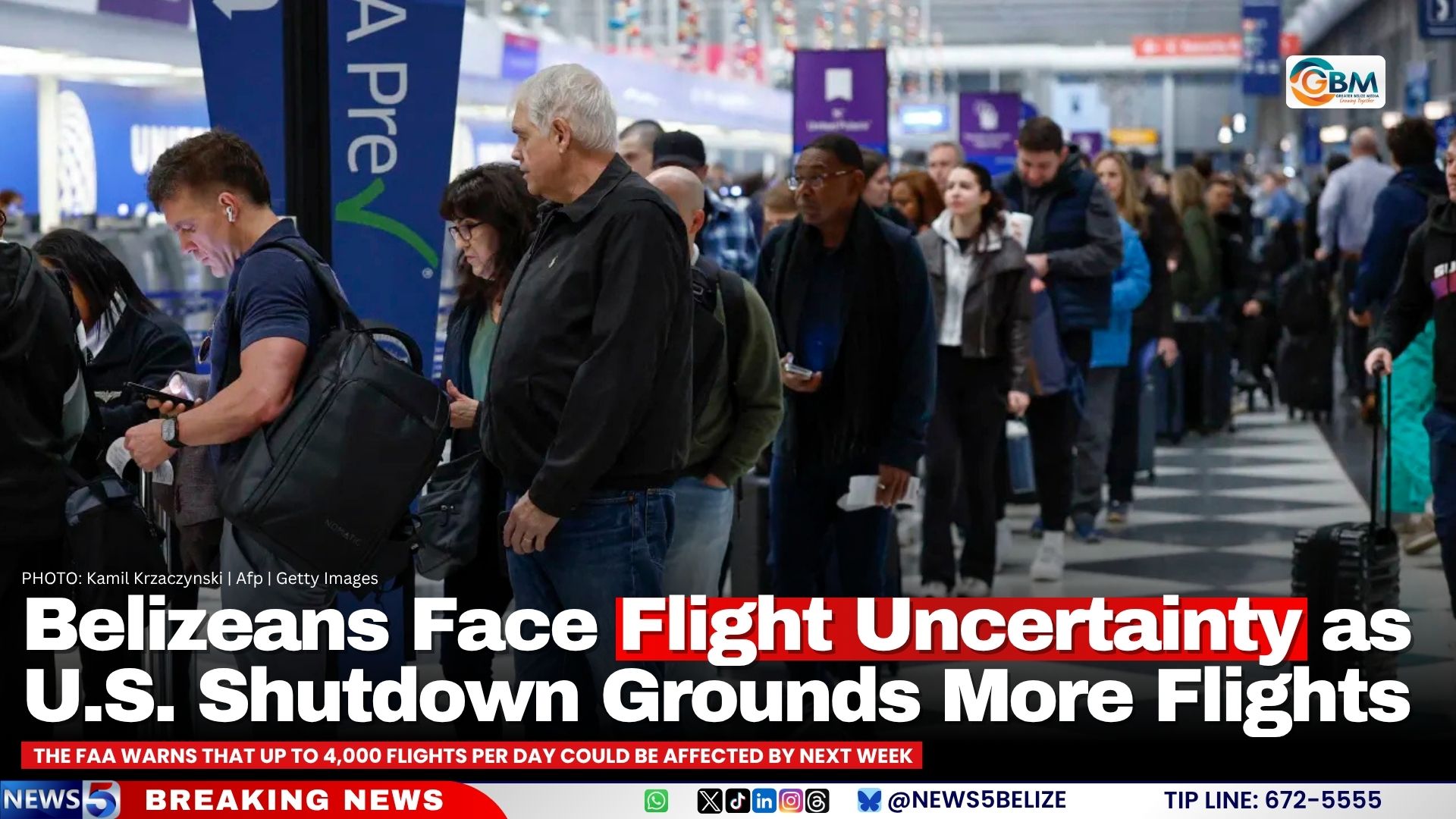
Belizeans Face Flight Uncertainty as U.S. Shutdown Grounds More Flights
The ongoing U.S. federal government shutdown, now in its fifth week, has led to widespread flight cancellations and delays, raising concerns for Belize’s tourism industry. Over 2,000 flights were disrupted today, with the Federal Aviation Administration (FAA) announcing traffic reductions at 40 major airports. The FAA predicts up to 4,000 daily flights could be affected by next week as operations are scaled back to alleviate pressure on unpaid air traffic controllers. Belizeans with travel plans to the U.S. are receiving alerts about potential disruptions. American Airlines has issued a temporary waiver for change fees, allowing passengers booked between November 7–14 to rebook without penalty, provided the origin and destination remain unchanged. Evan Tillett, Director of the Belize Tourism Board, stated that the situation is being closely monitored, with United Airlines confirming that international flights will remain unaffected. The shutdown, which began on October 1, has already impacted food aid programs and left hundreds of federal workers unpaid. Nick Daniels, president of the National Air Traffic Controllers Association, warned that the situation is deteriorating and urged Congress to reopen the government.
-

CIIE 2025: Handel als brug naar een gedeelde, welvarende toekomst
The China International Import Expo (CIIE) 2025, held in Shanghai, has once again proven to be a cornerstone of global trade and economic collaboration. With its largest exhibition space to date and a record number of exhibitors, the event attracted 4,108 foreign participants from 155 countries and regions, showcasing over 430,000 square meters of innovation and opportunity. The expo, themed ‘New Era, Shared Future,’ featured 461 new products, technologies, and services, highlighting advancements in new materials, energy, and environmental protection technologies. Chinese Premier Li Qiang, during the opening ceremony, emphasized the importance of maintaining equality and mutual benefit in international trade. He called for fairness and justice in global economic governance and reaffirmed China’s commitment to high-quality development and openness. Li also highlighted China’s role in promoting the Global Governance Initiative and improving the WTO-based multilateral trading system. The event coincided with the release of the World Openness Report 2025 and the World Openness Index at the Hongqiao International Economic Forum, further solidifying Shanghai’s position as a hub for international economic dialogue. The CIIE not only celebrates the ancient tradition of trade but also paves the way for a future of shared prosperity and innovation.
-

$1-B roast
Jamaica’s renowned Blue Mountain coffee industry has been severely impacted by Hurricane Melissa, with estimated losses reaching $1 billion, according to Norman Grant, chairman of the Jamaica Coffee Exporters Association. Grant revealed that approximately 100,000 boxes of coffee, valued at $10,000 each, were lost due to the hurricane, which also damaged coffee trees and infrastructure. This latest blow compounds the sector’s struggles, as it has faced consecutive losses during wet seasons over the past four years, accumulating a staggering $2.5 billion deficit. The hurricane’s aftermath has left critical roads to coffee factories impassable, with some areas still cut off days after the storm. Grant emphasized the urgent need for government intervention, including the implementation of the Coffee Crop Resuscitation and Establishment Programme (CREP), to revive production and support 5,000 affected farmers. He also called for immediate restoration of electricity and communication services in key areas. While acknowledging the devastation in western Jamaica, Grant urged authorities to prioritize aid for the Blue Mountain coffee industry, which is vital to the nation’s economy. Jamaica, the 58th largest coffee exporter globally, generated $26.2 million in coffee exports in 2023, making the sector’s recovery crucial for economic stability.
-

Sabgas ‘excited’ by Kamla’s plan
At the recent unveiling of Trinidad and Tobago’s Revitalisation Blueprint, Ansa McAl’s executive chairman, A. Norman Sabga, and his son, group CEO Anthony N. Sabga III, shared their optimism about the government’s ambitious plans. The blueprint, introduced by Prime Minister Kamla Persad-Bissessar, outlines over 100 construction projects aimed at creating more than 50,000 jobs and revitalizing key areas across the country. Sabga described the initiative as ‘huge’ and emphasized the importance of dreaming big to drive national progress. Speaking at the launch of Ansa McAl’s financial results for the year ending September 30, Sabga III echoed his father’s sentiments, calling the government’s vision ‘ambitious’ and ‘colourful.’ He highlighted the group’s commitment to supporting the government’s efforts, noting that Ansa McAl, which will celebrate its 145th anniversary next year, remains apolitical and focused on sustainable development. The blueprint includes projects such as transforming the Port of Spain waterfront, redeveloping Invaders Bay, and converting prisons into cultural centers and luxury resorts. The Sabgas’ matching yellow ties, coincidentally aligned with the ruling United National Congress’s color, sparked curiosity, but Sabga III dismissed any political connotations, emphasizing the group’s neutrality and dedication to economic growth.
-

TTMA delegation prepares for trade mission to Chile
The Trinidad and Tobago Manufacturers’ Association (TTMA) is set to embark on its inaugural trade mission to Chile from November 10 to 14, marking a significant step in expanding business opportunities and fostering economic ties with Latin America. The mission was officially celebrated during a reception hosted by Chilean Ambassador Hernán Núñez at his residence in Ellerslie Park, Maraval, on November 6. Ambassador Núñez emphasized the importance of this initiative, describing Chile as a nation with a globally open economy and a strategic gateway connecting the Caribbean to Asian markets. He highlighted Chile’s robust export figures, exceeding US$100 billion in 2024, and its network of 35 commercial attachés worldwide. TTMA CEO Dr. Mahindra Ramdeen noted that the delegation includes representatives from 14 companies across sectors such as agro-processing, chemicals, services, and health. He expressed optimism about forging lasting partnerships and accessing new markets. Ismail Ali, the mission’s leader, underscored the significance of this venture as TTMA’s first business engagement in South America, driven by three bilateral agreements signed last year. The mission aims to explore opportunities in Chile and beyond, with plans to expand into markets like Panama, Colombia, and other Caribbean nations. This initiative reflects TTMA’s broader strategy to internationalize Trinidad and Tobago’s manufacturing sector, building on recent successful trade missions to New York and the Trade Mission on the Seas 2025. The association has also outlined plans for additional missions to China and follow-up initiatives in New York, signaling a strong commitment to global economic collaboration.
-

Caribbean Airlines unaffected by FAA orders to reduce flights
Caribbean Airlines Ltd (CAL) has confirmed that its operations remain unaffected despite recent guidance from the US Federal Aviation Authority (FAA) urging airlines to reduce flights at 40 of the nation’s busiest airports. The FAA’s directive, issued as the US government shutdown extended into its 38th day, calls for a ten per cent reduction in flights to alleviate congestion. CAL, which operates flights to and from four major US airports—John F. Kennedy (JFK) in New York, Miami International (MIA), Fort Lauderdale-Hollywood International (FLL), and Orlando International (MCO) in Florida—has assured passengers that all its US-bound and departing flights are proceeding as scheduled. However, the airline has advised travelers with connecting domestic flights within the US to stay in touch with their respective airline representatives for updates. CAL also encouraged passengers to register for real-time travel notifications via its official website and social media channels to stay informed. The FAA’s list of affected airports includes prominent hubs such as Hartsfield-Jackson Atlanta International (ATL), Los Angeles International (LAX), and Chicago O’Hare International (ORD), among others. While the broader aviation sector grapples with the impact of the shutdown, CAL remains steadfast in maintaining its service continuity.