作者: admin

  • New continuous assessment plan quizzed over group project weighting

    New continuous assessment plan quizzed over group project weighting

    A tense town hall gathering held this Thursday brought Barbadian parents face-to-face with education leaders, as families pushed for clear answers about how new continuous assessment rules will protect individual student achievement under the government’s planned primary-to-secondary school placement overhaul. The proposed framework is set to replace the long-standing Barbados Secondary School Entrance Examination, with continuous assessment set to make up half of a student’s final placement score moving forward.

    One of the most vocal critics at the meeting was Raphael Saul, a father whose 9-year-old child is set to become part of the first cohort to enter the new system when it launches this September. Saul clarified that he does not oppose project-based learning or dismiss the importance of building collaborative skills among young students, but he warned that tying group work to high-stakes secondary placement creates an unfair risk: a hardworking, high-contributing student could see their overall score dragged down by underperformance from other group members.

    When Saul asked officials to clarify whether only individual contributions would count toward a student’s continuous assessment score, or if group results would also factor in, Deputy Chief Education Officer for Planning and Development Reverend Stephen Scott confirmed that both components would be weighted and combined for the final grade. Scott drew a parallel between this new structure and the School-Based Assessment (SBA) model already used for Caribbean Secondary Education Certificate (CSEC) English courses, where students work together on early research stages before completing a final standalone individual assignment. Under that system, students earn marks for both the group collaboration phase and their individual final work, Scott explained.

    Saul pushed back on this framing, arguing that while group projects have clear value as a classroom teaching tool, they have no place in a high-stakes assessment that determines which secondary school a child will attend. “I am very on the same page with you as it relates to group projects and their value,” Saul said. “The challenge I have, though… is that a child who may work well individually and who may even contribute well in his or her group can end up in a situation… where the group’s grade ends up reducing their overall score.” He added that the current structure runs counter to the Ministry of Education’s own stated goal of gaining a more accurate, holistic picture of each student’s individual ability, and recommended that only individual work be counted toward the continuous assessment placement score, with group activities retained solely for learning purposes.

    Acting Chief Education Officer Julia Beckles pushed back on concerns, stressing that the assessed projects are not last-minute, one-off assignments, but rather the end result of a structured two-year learning journey. “When we talk about the projects, we are talking about the end of a process,” Beckles explained. “All along the process, the child is being taught. Yes, the child is being evaluated. The teacher is taking note of strengths, taking note of weaknesses, and more importantly, the teacher now has the time to try to assist in the child’s improvement in the areas where weaknesses have been identified.” She emphasized that students do not get thrown into unguided groups for assessment; instead, they build collaboration skills incrementally with ongoing teacher support over the full two-year period.

    Acting Deputy Chief Education Officer Denise Charles urged parents to reframe their understanding of the new assessment model, noting that it is rooted in project-based learning rather than the traditional, rigid school projects many families are familiar with. “What our students will be doing will not just be projects. It is project-based learning. The emphasis is on creativity, individual expression,” Charles said. Unlike traditional assessments that only allow written reports or static presentations, Charles explained that students will be able to showcase their knowledge through diverse, creative formats including videos, music, dance, and visual art. “It is going to be far more dynamic and creative than that,” she added.

    Charles framed the new system as a reflection of a modernizing Barbados, designed to equip students with the soft skills—collaboration, creativity, critical problem-solving—that are increasingly demanded in a rapidly changing global workforce. “This is not the Barbados of the Common Entrance exam as we know it,” she said. “This is a different Barbados.”

    Saul’s concern about group grading was not the only question raised at the meeting. Other parents asked why the new assessment will start as early as Class Three, and voiced particular worry about the first cohort, widely referred to as “COVID kids” who began their primary education through remote learning and have already faced significant educational disruption. By the end of the town hall, multiple parents reported leaving the meeting without the clear answers they had sought, saying key questions were not addressed directly by education officials.

  • NHC Monitoring Low-Risk Weather Disturbance Off US Southeast Coast

    NHC Monitoring Low-Risk Weather Disturbance Off US Southeast Coast

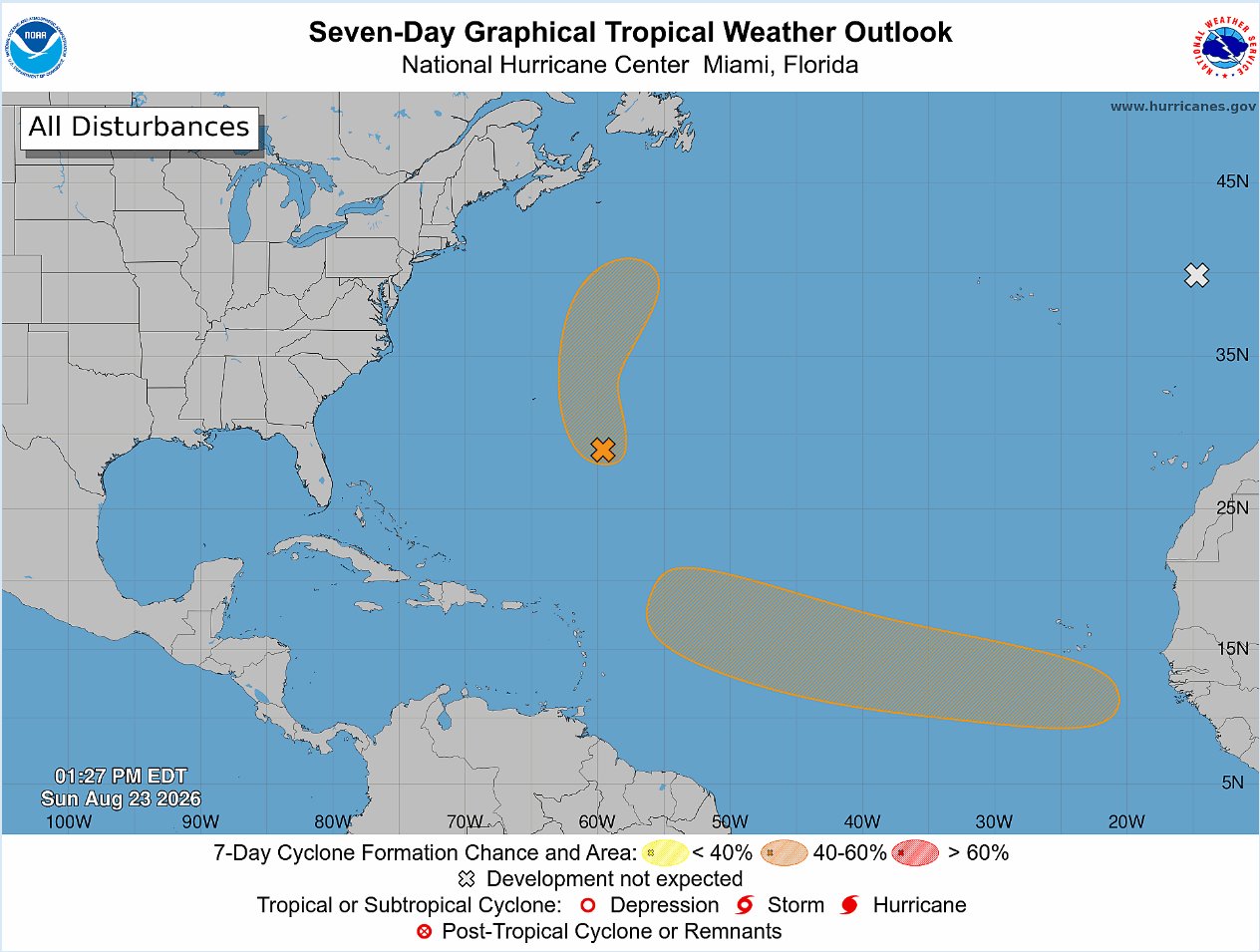
    In a recent tropical weather update issued at 8 a.m. EDT Saturday, the United States National Hurricane Center (NHC) has launched continuous monitoring of a broad, disorganized weather system emerging over Atlantic waters off the southeastern U.S. coastline. Forecasters project that the disturbance will drift slowly westward over the coming week, and current atmospheric and oceanic conditions may support limited, gradual organization of the system as it moves.

    Despite the potential for slow development, NHC analysts have emphasized that any significant strengthening of the weather system is unlikely in the near future. As of the latest update, the agency has assigned just a 20 percent probability that the disturbance will strengthen into a fully formed tropical cyclone over the next seven days.

    At this stage of monitoring, the system does not present any immediate risk to Antigua and Barbuda or other nations across the Eastern Caribbean. Current forecast models show the disturbance will remain anchored near the southeastern United States for the coming week, keeping it far from Eastern Caribbean island chains.

    The NHC has committed to ongoing surveillance of the weather system, and has issued guidance urging residents in any areas that could potentially be impacted to stay alert and regularly check updated forecasts for any unexpected shifts in the system’s track or intensity.

  • Prime Minister Browne Granted Lifetime Style of “The Right Honourable” Under New National Protocol Rules

    Prime Minister Browne Granted Lifetime Style of “The Right Honourable” Under New National Protocol Rules

    Antigua and Barbuda has introduced a formalized, codified system for regulating the use of official honorific titles and styles, bringing the Caribbean nation’s protocol in line with longstanding Commonwealth norms while honoring its own unique constitutional heritage. The new regulatory framework was enacted via a Vice-Regal Warrant signed off on December 10, 2025, by Governor-General Sir Rodney Williams, who exercised his constitutional authority to issue the order with the required countersignature from Prime Minister Gaston Browne.

    The core objective of this new regulatory structure is to bring consistent, dignified, and clear standards to the conferral and use of official titles for the country’s constitutional officeholders and prominent distinguished citizens. Under the newly outlined rules, the prestigious lifetime style of “The Right Honourable” is automatically granted to five categories of individuals: sitting and former Governors-General, incumbent Prime Ministers once they begin their fourth term in office, former Prime Ministers who completed at least four full terms in office, and all members of His Majesty’s Most Honourable Privy Council. In addition to these automatic conferrals, the warrant grants the Governor-General the power to bestow the honorary lifetime style on other deserving former prime ministers or distinguished private citizens, provided any such appointment is countersigned by the sitting Prime Minister.

    For elected representatives, the rules maintain the longstanding convention that sitting members of both the Senate and the House of Representatives retain the style “The Honourable” for the duration of their time in office. The Governor-General also holds the authority to issue a special warrant allowing former officeholders or other noteworthy individuals to keep the style “The Honourable” for life. Recipients of the Order of the Caribbean Community (OCC) are also formally designated as eligible to use the “The Honourable” style under the new regulations. The title “Excellency” remains reserved for relevant high-ranking officeholders in line with longstanding diplomatic and constitutional practice.

    To allow for future adaptation of the protocol, the warrant includes provisions that permit the sitting Governor-General to amend, expand, reinterpret, or fully revoke the rules at any point via a subsequent official warrant, issued with the Governor-General’s official seal and signature and countersigned by the Prime Minister. In line with the warrant’s text, the new system formalizes unwritten national protocol for official appellations, aligning Antigua and Barbuda’s framework with widely accepted Commonwealth practices while preserving the country’s distinct constitutional and national traditions. As one of the first beneficiaries of the new rules, Prime Minister Gaston Browne has already been formally granted the lifetime style of “The Right Honourable” under the new regulations.

  • GHS student dies of cancer on her graduation day

    GHS student dies of cancer on her graduation day

    On what should have been a day of celebration and new beginnings for graduating students at St. Vincent Girls’ High School, the entire community was plunged into mourning Thursday with news that one of their own, 17-year-old Form 5 Technical student Morica DaSilva, had lost her years-long battle with stage 4 cancer just hours after being honored for her extraordinary courage.

    As family and fellow students gathered inside the school’s graduation ceremony, a plea for prayers and support for DaSilva, who had been hospitalized amid a worsening of her condition, began spreading rapidly across local social media platforms. Within hours of that post going viral, school administration officially confirmed the devastating passing of the young student.

    In a heartfelt public tribute shared to the school’s social media channels, administrators remembered DaSilva as a bright, kind young woman whose warm presence and creative spirit left an indelible mark on the entire school community. Beyond her academic accomplishments, DaSilva was an active and valued member of the school’s Loyal Hearts Ad Alta Choir, where she shared her passion for singing and performance. When she was not rehearsing or studying, she could often be found crocheting, a hobby that let her creativity shine and brought joy to everyone who knew her.

    Earlier the same day, before her passing was announced, DaSilva was posthumously awarded the Celina Cordice-Primus Award for Perseverance — a distinction created to recognize students who demonstrate extraordinary resolve in the face of overwhelming hardship. School officials called the award a fitting reflection of the grit, courage, and strength of character DaSilva displayed through every step of her cancer journey.

    “ We extend our deepest and most heartfelt condolences to Morica’s parents, family, friends, classmates, and all who knew and loved her,” the statement read. “During this time of profound grief, we keep them in our thoughts and prayers and hope they find comfort in the love and support of those around them. Though she is no longer with us, her memory will forever remain a cherished part of the Girls’ High School family.” School officials added that further details about DaSilva’s funeral arrangements will be released to the public once they are finalized by her family.

    The grief over DaSilva’s passing extended beyond the school walls to the St. Vincent and the Grenadines Teachers’ Union, where DaSilva’s mother Marva has long served as a member. Union president Fiona Charles-Williams personally reached out to share condolences with the DaSilva family, the school’s headmistress and staff, and the entire 2026 graduating class in a voicenote addressed to all union members.

    “… we are in sympathy and we offer condolences to Morica’s extended family and Marva’s extended family,” Charles-Williams said. “We are saddened by this loss, and we ask the Lord to give them comfort in their time of bereavement.”

  • SLBMC Launches Mandatory Ebola Preparedness Training

    SLBMC Launches Mandatory Ebola Preparedness Training

    As Caribbean nations continue prioritizing proactive public health infrastructure, Antigua and Barbuda’s Sir Lester Bird Medical Centre has rolled out a mandatory Ebola response training program for all clinical personnel, a key step in shoring up the facility’s capacity to handle potential infectious disease outbreaks.

    The joint effort is being led by two internal hospital departments: the Infectious Disease and Employee Health Division, and the Learning and Development Unit. Unlike one-off emergency drills, this program is designed to build sustained, practical competence among frontline workers. Trainees walk through hands-on modules covering key skills ranging from early identification of suspected Ebola cases to the correct implementation of stringent infection control protocols. The curriculum also emphasizes safe patient management protocols that cut transmission risk for both healthcare staff and other patients within the facility.

    Hospital leadership stresses that this preparedness push is not a reaction to an active threat. To date, Antigua and Barbuda has recorded zero confirmed Ebola cases. Instead, administrators frame the initiative as a reflection of the medical center’s long-standing commitment to maintaining a gold standard of emergency readiness, even when no immediate danger is present.

    The rollout is proceeding in a phased approach to avoid disrupting routine patient care. The first cohort of clinical professionals has already finished the full training program, with subsequent groups of staff scheduled to complete the course in staggered waves in the coming weeks.

    Hospital officials note that continuous education and proactive preparedness are non-negotiable pillars of the facility’s broader infection prevention strategy. By equipping every clinical worker with the right knowledge and skills now, the center aims to ensure that it can mount a rapid, fully coordinated response if any infectious disease threat—including Ebola—ever emerges in the region.

  • Sheila Roseau elected to membership of prestigious gender equality and human rights body at the United Nations

    Sheila Roseau elected to membership of prestigious gender equality and human rights body at the United Nations

    In a landmark development for global gender advocacy and human rights leadership, Sheila Roseau has secured a prestigious membership at one of the United Nations’ most influential bodies focused on gender equality and human rights protections. The election marks a critical milestone, both for Roseau’s decades-long work advancing marginalized communities and for the global movement to center grassroots gender justice in multilateral decision-making. For years, Roseau has been a prominent voice pushing for systemic change to address gender-based disparities, expand reproductive rights, and amplify the voices of underrepresented groups in global policy spaces. The United Nations’ gender equality and human rights body, which counts leading experts and advocates from across the globe among its members, plays a central role in setting global standards, monitoring state compliance with international human rights agreements, and shaping global agendas around gender equity. Membership in this body requires a demonstrated track record of impactful work in the field, as well as broad support from UN member states and global civil society groups. Observers note that Roseau’s election brings a fresh perspective rooted in frontline advocacy to the UN body, strengthening its ability to address evolving challenges ranging from the gendered impacts of climate change to rising backlash against women’s rights in multiple regions. Global gender justice organizations have widely welcomed the result, framing it as a positive step toward making the UN’s human rights machinery more responsive to the actual needs of communities most affected by gender inequality. As Roseau prepares to take up her role, stakeholders across the international community are looking forward to the contributions she will make to advancing the UN’s core mandates of gender equality and universal human rights for all.

  • Charles F Broome ‘A’ retains primary schools chess crown

    Charles F Broome ‘A’ retains primary schools chess crown

    The Garfield Sobers Gymnasium played host to a dramatic and tightly contested Primary Schools’ Team Chess Championship this year, where Charles F Broome ‘A’ turned in a masterclass performance to successfully defend their national title. The defending champions entered the tournament as one of the favorites to win, and they did not disappoint, taking every match they played en route to a first-place finish with a total score of 21 tournament points. Their narrow margin of victory held off a fierce challenge from St Gabriel’s ‘A’, who claimed second place with a solid 19.5 points after five rounds of competitive play.

    Heading into the final round of the multi-team tournament, the race for the championship title looked set to come down to a showdown between three leading teams. Charles F Broome ‘A’ held the top spot with 17 points, followed closely by Providence “A” at 15.5 points and St George Primary “A” at 15 points. Analysts and spectators alike predicted that the overall winner would emerge from this leading trio. In a pivotal matchup, Charles F Broome ‘A’ faced off against second-place Providence “A” — and delivered an emphatic 4-1 win that sealed their undefeated run. Victories from team members Nathan Culpepper, Daesha Rose Parris, Nia Snow Clarke and Naja Howard pushed the team over the finish line, while Caelynn Gordon of Providence “A” earned the only consolation win for her side with a defeat of Kymani Gayle.

    The battle for the third and final podium spot delivered just as much excitement for chess fans. St Jude’s and St Cyprian’s ‘B’ finished the tournament tied on 18 and a half points, forcing a tie-break to determine the final ranking. St Jude’s ultimately claimed the third-place position after the tie-break resolution.

    This year’s championship win solidifies Charles F Broome ‘A’s reputation as the dominant force in Barbadian primary school chess, marking the latest in a consecutive string of championship victories for the program over recent years.

    In total, 29 teams drawn from roughly 20 primary schools across the region took part in the 2024 championship, bringing 150 total young chess players to compete. Each participating school was allowed to field a core roster of five players, plus two reserve players who could step in for matches throughout the tournament.

    Along with team honors, the tournament also recognized standout individual performances from players across all competing schools. Nine players walked away with board prizes after winning every one of their individual matches throughout the competition. The honorees included Caelyn Gordon of Providence “A”, Liam Lowe of St Cyprian’s “B”, Naja Howard of Charles F Broome, Tyriq Goddard of St George “A”, Nia Sow-Clarke of CFB “A”, Rydun Jones-Jordan of St George “B”, Janea Clarke of St Judes, Dominic Cadogan of St Cyprian’s A, and Benjamin Luciene of St Gabriel’s “A” — who also earned distinction earlier this year as the top performer on the national Common Entrance exam. Minister of Education Chad Blackman presented the individual awards to the winning players.

  • Ghana deploys 47 health workers to Saint Kitts and Nevis under migration initiative – MyJoyOnline

    Ghana deploys 47 health workers to Saint Kitts and Nevis under migration initiative – MyJoyOnline

    In a strategic move that creates mutual benefits for two Caribbean and West Indian nations, Ghana has deployed 47 trained health professionals to the Federation of Saint Kitts and Nevis as part of its flagship Health Workforce Migration Initiative. Launched by Ghana’s Ministry of Health, this structured program strikes a careful balance: it creates valuable temporary international employment opportunities for Ghanaian health workers while protecting the capacity of Ghana’s own domestic public health system.

    Unlike unregulated migration of medical personnel that can leave source nations understaffed, this program operates under a formal managed migration framework. All participating health professionals sign fixed-term contracts that require them to return to Ghana once their overseas assignment concludes. For this cohort heading to Saint Kitts and Nevis, contract lengths are set between two and three years, after which the workers will rejoin Ghana’s national health sector to apply the skills they gain abroad.

    Ahead of the group’s departure from Accra International Airport, many of the deployed health workers shared their enthusiasm for the unique opportunity. They expressed eagerness to deliver high-quality clinical care to patients in Saint Kitts and Nevis while showcasing the expertise and professionalism of Ghana’s health workforce on a global stage. The workers also extended gratitude to the Ghanaian government for developing the platform, framing the assignment as a transformative chance to advance their professional growth and clinical skills.

    Senior Ghanaian government officials, including Deputy Chief of Staff Nana Oye Bampoe Addo and Deputy Minister of Health Grace Ayensu-Danquah, attended the send-off ceremony at the airport to formally bid farewell to the deployed team.

    Speaking at the event, Deputy Minister Ayensu-Danquah reaffirmed the government’s expectation that all 47 professionals would return to Ghana at the end of their two-year contracts. She highlighted that the program includes significant benefits for participating workers, including competitive compensation, improved working conditions, and other financial and professional incentives that make the overseas assignment attractive.

    Ayensu-Danquah characterized the bilateral arrangement as a clear win-win for both Ghana and Saint Kitts and Nevis. Beyond filling immediate staffing gaps in both nations’ health systems, the initiative exposes Ghanaian health workers to global clinical practices and specialized international training, equipping them with advanced experience that will strengthen Ghana’s health sector when they return home.

  • Corporate Sponsors Boost Entrepreneurship Training for Barbuda Students

    Corporate Sponsors Boost Entrepreneurship Training for Barbuda Students

    Barbuda’s next generation of young innovators is gaining unprecedented access to practical business skills, thanks to a growing wave of corporate sponsorships investing in local entrepreneurship training programs. For years, students on the small Caribbean island faced limited opportunities to explore self-employment and business creation, with most secondary and post-secondary institutions focusing on traditional career pathways that left little room for innovative, homegrown business ideas. Today, that narrative is shifting as local and international companies step in to fund curriculum development, bring industry mentors into the classroom, and provide small seed grants for student-led prototype projects.

    The programs, embedded in both secondary schools and the island’s community training centers, cover core skills ranging from business plan development and digital marketing to financial management and supply chain logistics. Unlike generic classroom lectures, the training is designed around Barbuda’s unique economic context, encouraging students to build businesses that leverage local assets such as sustainable tourism, artisanal crafts, blue economy initiatives, and local agriculture. Corporate partners not only provide funding, but also send active business leaders to work one-on-one with students, offering real-world insights that cannot be found in textbooks.

    Program organizers report that early outcomes have exceeded expectations, with more than 60% of participating students reporting increased interest in starting their own ventures after graduation, compared to just 15% before the expanded programs launched. For the island of Barbuda, which has worked to rebuild its local economy following major climate disasters in recent years, developing a new cohort of young entrepreneurs is seen as a critical step toward building more resilient, self-sufficient economic growth. Local education officials note that the corporate sponsorship model has created a sustainable partnership that aligns the private sector’s goal of nurturing future talent with the community’s goal of expanding economic opportunity for young people. Moving forward, partners plan to expand the program to reach every secondary school on the island by 2026, and add a annual student business pitch competition that will connect top ventures with additional regional investment opportunities.

  • Workers At Hammock Cove Set To Benefit From Union Representation

    Workers At Hammock Cove Set To Benefit From Union Representation

    Workers at Hammock Cove Resort & Spa, a luxury Caribbean property under the Elite Island Resorts umbrella, have formally voted to recognize the Antigua and Barbuda Workers’ Union (ABWU) as their official collective bargaining agent, closing a years-long push for formal worker representation at the resort and delivering tangible gains for its entire staff.

    This milestone was cemented earlier this week, with the resort’s workforce gathering Wednesday for their first official collective meeting with ABWU leadership following the union’s official certification. Attendees heard opening remarks from Kem Riley, ABWU President and Senior Industrial Relations Officer, who walked attendees through the next steps for worker representation and the terms of the newly agreed collective bargaining framework.

    Riley confirmed that resort management has formally agreed to adopt all existing provisions laid out in the master collective bargaining agreement that already covers all other Elite Island Resorts properties across Antigua and Barbuda. This alignment brings Hammock Cove workers in line with their peers across the group, standardizing working conditions and benefit guarantees across the brand.

    Among the most noteworthy provisions for workers is a scheduled 50-cent hourly wage increase set to take effect on July 1, 2026, a win that will raise base pay for all hourly employees at the property. The agreement also formalizes the resort’s obligation to uphold public holiday pay entitlements, codifying a rule that guarantees workers either a full day of pay or an alternative paid day off if they are scheduled to work on a recognized public holiday—closing a gap in previous informal workplace policies that left many workers undercompensated for holiday shifts.

    In addition to wage and scheduling protections, Riley highlighted the value of the joint ABHTA/ABWU Comprehensive Health Insurance Plan, which is now available to all Hammock Cove workers. He emphasized that the plan is designed to be affordable for working households, extending coverage not just to employees, but also their immediate family members, addressing a key unmet need for many resort workers who previously lacked access to affordable family healthcare.

    Closing the meeting, Riley reaffirmed the union’s ongoing commitment to advocating for Hammock Cove staff. He noted that the certification of the union and adoption of the collective agreement is just the first step, and that ABWU will continue to work with workers to negotiate further improvements to working conditions, compensation, and overall quality of life for all employees at the resort.