作者: admin

  • VS stopt tijdelijk immigrantvisa uit 75 landen; Suriname en Guyana niet erbij

    VS stopt tijdelijk immigrantvisa uit 75 landen; Suriname en Guyana niet erbij

    The United States Department of State has implemented a temporary suspension of immigrant visa processing for citizens from 75 countries worldwide, citing concerns about potential dependence on public assistance programs. The policy shift, which takes effect January 21st, significantly impacts 26 nations across the Caribbean and Latin America including Cuba, Brazil, Colombia, Guatemala, Nicaragua, Uruguay, and Belize.

    Caribbean nations affected by the suspension include Antigua and Barbuda, Barbados, Dominica, Grenada, Saint Kitts and Nevis, and Saint Lucia. Notably exempted from the measure are Suriname, Guyana, and Trinidad and Tobago.

    Under Secretary Marco Rubio’s leadership, the State Department has instructed consular officials to halt processing immigrant visa applications from these countries while continuing to process non-immigrant visas such as tourist and business permits. The suspension aligns with broader immigration policy reforms announced last November that establish stricter criteria to prevent newcomers from becoming reliant on social welfare programs.

    The temporary visa freeze comes amid anticipated increased demand for non-immigrant visas ahead of major international events hosted by the United States, including the 2026 World Cup and 2028 Olympic Games. Most affected countries have adopted a wait-and-see approach pending formal notification, with the Caribbean Community (CARICOM) yet to issue an official response.

    The global list extends beyond the Western Hemisphere to include nations from Africa, Asia, and Europe, with Afghanistan, Iran, Russia, and Somalia among the designated countries.

    New consular guidelines require enhanced vetting of visa applicants based on multiple criteria including age, health status, family circumstances, financial resources, educational background, professional skills, history of public assistance, and English language proficiency. These assessments supplement existing medical screenings and vaccination requirements.

    The policy reflects continuity with the previous administration’s immigration framework aimed at restricting entry of individuals who might potentially burden American social support systems.


  • Belize among 75 countries affected by new U.S. immigrant visa processing pause

    Belize among 75 countries affected by new U.S. immigrant visa processing pause

    The United States has officially designated Belize among 75 countries facing an indefinite suspension of immigrant visa processing, effective January 21. This decisive action represents a significant expansion of the Trump administration’s immigration enforcement policies, directly impacting pathways for employment-based immigration and family reunification.

    According to the U.S. State Department, the suspension exclusively targets immigrant visas—those permitting permanent residency—while non-immigrant categories such as tourist, business, and student visas remain unaffected. The policy shift stems from an ongoing reassessment of procedures related to the ‘public charge’ provision of U.S. immigration law. This provision allows authorities to deny status to individuals deemed likely to depend primarily on government assistance programs.

    State Department spokesperson Tommy Pigott confirmed the administration will exercise its statutory authority to pause processing during this evaluation period. The affected nations span multiple continents, including Caribbean neighbors like Jamaica, Haiti, and Cuba; Latin American countries such as Colombia; African states including Egypt and Somalia; and even European nations like Russia. The global scope underscores the widespread implications of this immigration policy recalibration, which prioritizes economic self-sufficiency among prospective immigrants.

  • Speednet–BTL Deal Highlights Concerns Over Trust Funds and Transparency

    Speednet–BTL Deal Highlights Concerns Over Trust Funds and Transparency

    A proposed BZ$80 million acquisition of Speednet Communications Limited by Belize Telemedia Limited (BTL) has ignited significant concerns regarding financial transparency and the potential diversion of funds from public benefit. The transaction structure, featuring substantial deferred payments through loan notes, has drawn scrutiny from analysts who fear historical financial loopholes may be exploited once again.

    According to official documentation, the Waterloo Group Charitable Trust maintains a 77.5% ownership stake in Speednet, with Jaime Briceño and Renan Briceño holding the remaining shares. Lord Ashcroft’s office has explicitly stated he retains no economic interest in the Trust, which claims charitable purposes benefiting Belizean citizens.

    The acquisition arrangement specifies that BTL would disburse BZ$10 million in immediate cash payment, while the substantial balance of BZ$70 million would be settled through loan notes issued across a four-year period, carrying a 4.5% interest rate. While proponents emphasize operational synergies, enhanced efficiency, and improved competitive positioning against international providers like Starlink, critical attention has focused on the financial mechanics.

    This scrutiny stems from the 2015 Settlement Agreement between the Government of Belize and Ashcroft-affiliated entities, subsequently reviewed by the Caribbean Court of Justice (CCJ). Judicial examinations revealed that the settlement permitted significant reductions in compensation destined for Belize through broadly interpreted ‘liabilities’—encompassing not merely legal expenses but also internal corporate lending and financing costs.

    The CCJ determined that the agreement’s wording enabled Ashcroft-controlled entities to claim substantial expenses against funds originally intended for national benefit, with the government retaining no veto power over liability calculations. Financial analysts now warn that the Speednet sale could establish similar conditions for expense deductions, particularly given the loan note payment structure that creates extended financial flows between BTL and the Trust.

    Critics identify persistent vulnerabilities including intentionally vague financial terminology, inadequate oversight mechanisms, and structural incentives to maximize claimed costs. These concerns carry particular significance given BTL’s status as a major public utility and telecommunications provider.

    Regulatory responsibility for monitoring the transaction’s execution falls primarily to the Public Utilities Commission, which will oversee pricing and service quality considerations. However, transparency advocates argue that without enhanced safeguards and financial oversight, Belize risks repeating scenarios where substantial sums pass through complex corporate structures while delivering minimal public benefit.

  • Drug Use Disorders Rising Across the Americas, PAHO Warns

    Drug Use Disorders Rising Across the Americas, PAHO Warns

    A comprehensive new report from the Pan American Health Organization (PAHO) reveals an escalating public health emergency across the Americas, with drug use disorders emerging as a critical threat to regional wellbeing. The study identifies these disorders among the top ten causes of mortality and disability throughout the hemisphere, signaling an urgent need for coordinated intervention.

    According to the 2021 data, approximately 17.7 million individuals throughout the Americas were living with substance use disorders, with nearly 78,000 fatalities directly attributed to these conditions. This staggering death rate exceeds global averages by approximately 400%, highlighting the disproportionate impact on the Western Hemisphere.

    The crisis is predominantly driven by opioid consumption, accounting for over three-quarters of all drug-related fatalities. Powerful synthetic opioids, particularly fentanyl, have contributed significantly to this alarming trend. While young adult males remain the most affected demographic, researchers note a concerning rise in mortality rates among women in recent years.

    Disability metrics paint an equally troubling picture. Disability-adjusted life years, which quantify years lost to premature death or impaired health, nearly tripled between 2000 and 2021, indicating substantially reduced quality of life for affected populations.

    Regional analysis reveals distinct patterns across the hemisphere. North America experiences rapid escalation of opioid and amphetamine use, exacerbated by the COVID-19 pandemic. Meanwhile, Caribbean, Central American, and South American nations contend primarily with cannabis and cocaine-related disorders.

    The broader impact extends beyond direct overdose deaths. PAHO estimates over 145,000 fatalities in 2021 were connected to drug use through associated causes including liver disease, cancer, and suicide. This places substance abuse alongside hypertension, obesity, poor nutrition, and tobacco as a premier public health risk factor.

    PAHO emphasizes that evidence-based interventions could prevent and treat these disorders, but notes critical shortages in service availability across many member states. The organization advocates for expanded youth prevention initiatives, improved access to treatment and harm reduction services, and integration of substance use care into primary healthcare systems.

    Enhanced surveillance mechanisms feature prominently among PAHO’s recommendations, particularly for tracking synthetic drugs and polydrug use patterns. The report also stresses the need for gender-responsive approaches as the crisis increasingly affects women.

    Public health experts warn that without immediate, coordinated action to strengthen mental health and addiction services, drug-related mortality and disability will continue their alarming upward trajectory across the Americas.

  • Authorities report success of Preventive Cell Phone Verification program

    Authorities report success of Preventive Cell Phone Verification program

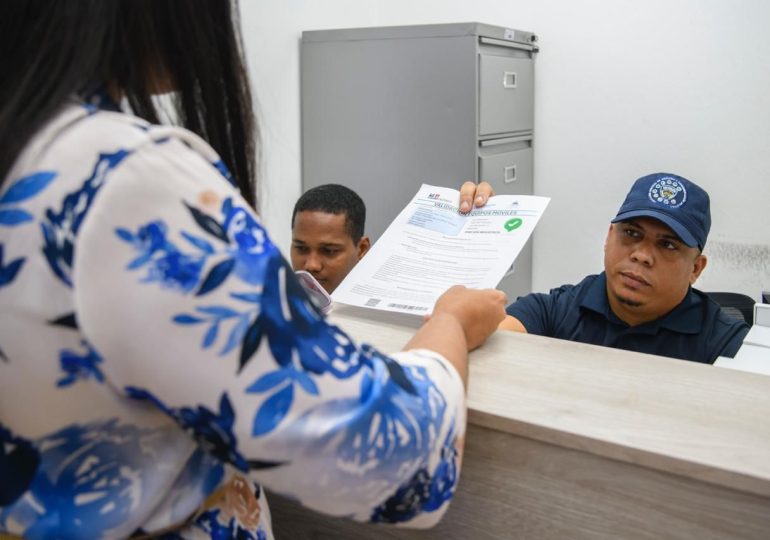
    Santo Domingo – The Dominican Republic’s innovative approach to combating mobile phone theft through its Preventive Cell Phone Inspection Center has yielded substantial success since its December 2025 launch. Operating from Plaza Central’s second level, this groundbreaking facility represents a cornerstone of the government’s comprehensive public safety strategy targeting technology-related crimes.

    This multi-agency collaboration brings together the Ministry of the Interior and Police, the Attorney General’s Office, the Dominican Institute of Telecommunications (Indotel), and the National Police in a unified effort against device theft. Interior Minister Faride Raful has confirmed plans for nationwide expansion of the program, ensuring broader public access to device verification services across the country.

    Citizens can utilize a free verification service by simply texting their device’s unique IMEI number to 809-251-3521. This process cross-references the device against multiple national and international databases, including those maintained by the National Police, Indotel, and the globally recognized GSMA Device Check system. The comprehensive verification helps consumers avoid purchasing stolen devices while simultaneously creating significant barriers for thieves attempting to resell stolen merchandise.

    The initiative’s success demonstrates how coordinated technological solutions can effectively address urban crime patterns while protecting consumers from financial losses. By establishing robust verification protocols, authorities have created a deterrent effect that disrupts theft networks and reduces the profitability of mobile device crimes.

  • North-West gets another ferry; Parika-Bartica to get more vessels

    North-West gets another ferry; Parika-Bartica to get more vessels

    The Government of Guyana has significantly enhanced its national maritime infrastructure with the acquisition of a state-of-the-art ferry, marking a strategic advancement in regional connectivity and transport modernization. The newly arrived vessel, currently named Kalliopi N, represents a multimillion-dollar investment in Guyana’s transportation ecosystem.

    Constructed in Greece in 2025 and procured for approximately US$4 million, the Kalliopi N underwent comprehensive modifications to meet stringent international maritime standards prior to its departure. These enhancements included structural reinforcements to fuel capacity, rigorous testing of ballast tanks and bulkheads, and the installation of redundant navigation and communication systems to ensure maximum safety during ocean transit.

    With an operational capacity of 284 passengers and 51 vehicles (or equivalent truck space), the vessel features air-conditioned accommodations and is powered by three Hyundai engines supported by dual generators. Operating at speeds of 10-12 knots, the ferry is projected to substantially reduce travel duration along coastal routes serving Region One (Barima-Waini) and connecting ports.

    President Irfaan Ali, during an inspection tour at Georgetown Wharf, emphasized that this acquisition forms part of a systematic fleet renewal strategy designed to progressively replace aging vessels across all regions. The presidential delegation, including Minister Deodat Indar, MARAD Director General Captain Stephen Thomas, and Parliament Member Thandi McAllister, examined the vessel’s technical specifications and operational readiness.

    Concurrently, the administration revealed parallel plans to strengthen the Parika-Bartica corridor in Region Seven through additional vessel acquisitions. This expansion aims to augment capacity along the critical Parika-Supenaam-Bartica circuit, facilitating improved movement of both passengers and commercial goods throughout the Essequibo corridor.

    The modernization initiative extends beyond vessel procurement to include comprehensive port infrastructure upgrades at key locations including Region One, Kingston, and Parika. These developments are engineered to accommodate front-loading vessels and integrate with the broader transport network.

    President Ali commended the coordinated efforts of maritime professionals, technical teams, and regulatory authorities whose synergistic work ensured the vessel’s compliant delivery. The administration’s sustained investment in maritime infrastructure demonstrates its commitment to building a modern, efficient transport network that supports economic vitality, enhances regional connectivity, and improves quality of life for citizens across all regions.

  • Wereldbank verhoogt groeiverwachting 2026, waarschuwt voor ongelijkheid

    Wereldbank verhoogt groeiverwachting 2026, waarschuwt voor ongelijkheid

    The World Bank has issued a cautiously optimistic yet concerning assessment of global economic prospects in its latest Global Economic Prospects report, published Tuesday. While upgrading its 2026 global growth forecast to 2.6%—a 0.2 percentage point increase from June’s projection—the institution simultaneously warned of significant headwinds including cooling international trade and widening disparities in living standards across nations.

    This modest upward revision still represents a slowdown from 2025’s 2.7% growth rate, continuing what the Bank describes as potentially “the weakest decade for global economic growth since the 1960s.” The report acknowledges unexpected economic resilience throughout the past year despite what it characterizes as “historic escalation of trade tensions and policy uncertainty.”

    Much of this uncertainty stemmed from the return of U.S. President Donald Trump to power last year and his administration’s implementation of broad import tariffs against major American trading partners. These measures significantly disrupted international supply chains and amplified volatility across global markets.

    The economy’s relative resilience was attributed partially to accelerated goods imports by U.S. companies stockpiling ahead of anticipated tariffs, alongside surging investments in artificial intelligence technologies that provided substantial economic stimulus.

    Looking ahead, the World Bank anticipates noticeable deceleration in global trade growth throughout 2026 as businesses complete inventory replenishment and the full effects of new trade restrictions become more pronounced. A tentative recovery in trade expansion isn’t expected until 2027, when nations presumably adapt to the new policy environment and uncertainty diminishes.

    Perhaps most alarmingly, the report highlights growing disparities in living standards between countries despite moderate overall growth. World Bank Chief Economist Indermit Gill warned that the global economy faces slower growth in coming years than even during the economically troubled 1990s, while simultaneously confronting record levels of both public and private debt.

    To avert prolonged stagnation and rising unemployment, Gill advocates for comprehensive policy measures including robust liberalization of private investments and trade, curtailment of government consumption growth, and substantial investments in emerging technologies and education systems across both emerging and developed economies.

  • IDB predicts higher food import prices, increased forex demand, but “robust” economy

    IDB predicts higher food import prices, increased forex demand, but “robust” economy

    The Inter-American Development Bank (IDB) has presented a complex economic outlook for Guyana, forecasting simultaneous challenges and strengths in its latest Caribbean Economics Quarterly. While the South American nation’s economy remains fundamentally robust with expected growth averaging 14% between 2026-2030, several headwinds threaten to create economic pressures.

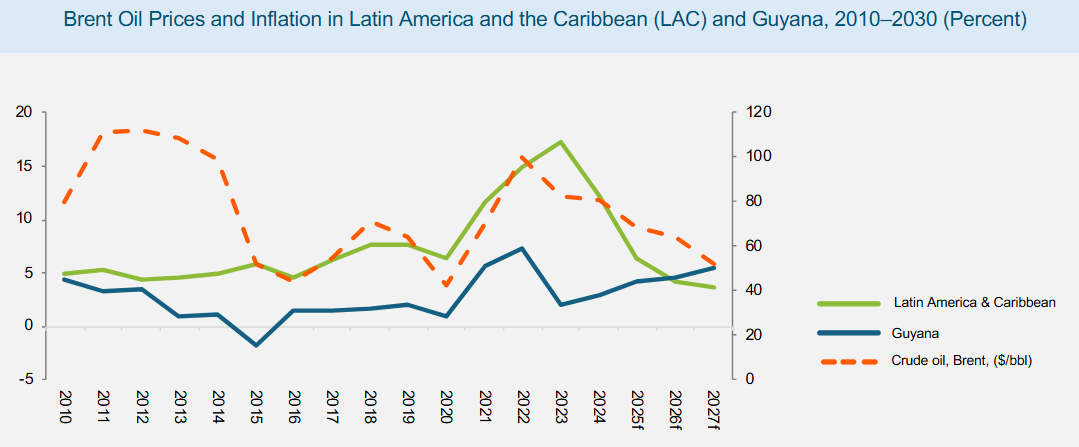
    The analysis identifies falling global oil prices—projected to reach approximately US$60 per barrel in 2026—as a dual-edged development. While lower prices typically reduce petroleum revenues, Guyana anticipates offsetting this through expanded production capacity. Three additional oil wells are expected to come online, potentially doubling current output to 1.5 million barrels daily by 2029.

    Concerning developments emerge in the trade sector, where Guyana’s terms of trade have deteriorated significantly. According to IMF data referenced by the IDB, the terms of trade index declined by 32.4% in 2023 and 0.3% in 2024, stabilizing at 47% by September 2025. This decline stems from persistent increases in import prices coupled with contracting oil prices.

    The bank warns that ongoing global tariff wars and policy uncertainty could further elevate import costs, particularly for food items. With annual food prices already rising 8.2% by August 2025, inflation is projected to reach 3.6%, exceeding the previous year’s 2.9% rate. These factors may increase foreign exchange demand and complicate monetary policy management.

    Despite these challenges, the IDB notes Guyana’s oil sector remains profitable above US$28 per barrel—the country’s break-even price. The government has implemented strategic responses including free tertiary education, vocational training programs, and initiatives to encourage re-migration of skilled professionals like teachers and nurses to address human capital needs.

    The report concludes that while Guyana’s medium-term economic trajectory appears strong, vigilant monitoring of potential Dutch Disease symptoms—including exchange rate appreciation, non-oil sector competitiveness erosion, and inflationary pressures—remains essential for sustainable development.

  • Haitian Police destroy gang leader Barbecue’s house in drone strike

    Haitian Police destroy gang leader Barbecue’s house in drone strike

    In a significant escalation of anti-gang operations, Haitian law enforcement authorities have successfully destroyed the residential headquarters of notorious gang leader Jimmy Cherisier, commonly known as ‘Barbecue,’ through a precision kamikaze drone strike. The targeted operation, conducted Wednesday in the Delmas 6 district of downtown Port-au-Prince, represents a coordinated effort by multiple security agencies to reclaim control of gang-occupied territories.

    The Haitian National Police (PNH) confirmed the tactical strike via an official statement on their Facebook platform, emphasizing their strategic objective to dismantle armed factions and restore public safety. Visual evidence circulating across social media channels depicted a distinctive structure outfitted with extensive solar panel arrays being struck by an unmanned aerial vehicle, resulting in a substantial explosion and subsequent structural collapse. Post-strike imagery revealed complete devastation of the property alongside damaged vehicles and scattered debris.

    This sophisticated military operation involved unprecedented collaboration between the Haitian National Police, the national Armed Forces (FAD’H), a specialized task force commissioned by Prime Minister Alix Didier Fils-Aimé, and the United Nations-mandated Gang Repression Force (FRG). While official communications remain deliberately limited, the surgical precision of the strike resulted in no reported casualties, indicating advanced intelligence gathering and operational planning.

    The targeted demolition of Cherisier’s operational base signals a paradigm shift in Haiti’s approach to combating rampant gang violence that has paralyzed the capital city. Security analysts interpret this operation as demonstrating the government’s enhanced capabilities in employing advanced surveillance technology and coordinated tactical responses against criminal enterprises. Public anticipation grows for subsequent operational updates as authorities continue their methodical campaign to restore constitutional order and civilian security.

  • Education : Installation of members of the Council of Higher Education and Scientific Research

    Education : Installation of members of the Council of Higher Education and Scientific Research

    In a significant move to revitalize Haiti’s education system, the Presidential Transitional Council (CPT) formally installed members of the Council of Higher Education and Scientific Research on January 14, 2026. The inauguration ceremony, held at the Villa d’Accueil, marked a pivotal moment in the nation’s ongoing educational reform efforts.

    The event was attended by Prime Minister Alix Didier Fils-Aimé, government officials, and representatives from the diplomatic and consular corps, underscoring the importance of this initiative to Haiti’s development agenda.

    Laurent Saint-Cyr, President pro tempore and Coordinator of the Transition Council, delivered a keynote address emphasizing the transformative potential of this new governing body. He characterized the establishment of the National Agency for Higher Education and Scientific Research (ANESRS) as a fundamental commitment by the state to provide quality education that creates tangible opportunities for Haitian youth while advancing national progress.

    Saint-Cyr articulated the Council’s primary mission: to enhance the recognition, quality, and prestige of Haitian academic credentials internationally. This strategic focus aims to create improved integration pathways, mobility options, and excellence standards for students, simultaneously strengthening Haiti’s position within global academic and scientific communities.

    The Council’s formation represents Haiti’s deliberate strategic decision to center intelligence, scientific knowledge, and research within its national development framework. Members were reminded of their responsibility as guardians of academic excellence, particularly in an era where science, innovation, and education serve as critical drivers of economic, social, and institutional advancement.

    The newly installed Council leadership includes Dr. Hérold Toussaint as President, Dr. Jean Fénol Métellus as Vice-President, and Dr. Jacques Abraham as High Commissioner for Higher Education and Scientific Research. Additional members comprise Dr. Jean Judson Joseph as Secretary General, along with Dr. Evens Emmanuel, Dr. Kitty Balthazard-Accou, and Dr. Serge Philippe Pierre as Council members.