The recent Roseau North by-election delivered a clear victory to the Dominica Labour Party (DLP) over the United Workers Party (UWP) candidate Danny Lugay, a win that carries extra weight after the opposition framed the contest as a moral struggle between good and evil, wrapped in rhetoric of advancing democracy and social justice. For the UWP, this contest was far more than just another parliamentary by-election—it was a make-or-break moment for the party’s political future.
Having boycotted the 2022 general elections, the Roseau North vote marked the UWP’s first electoral contest since 2019, and the first major test of new party leader Dr. Fontaine’s leadership and campaign coordination. Plagued by internal divisions, inconsistent policy messaging, and a lack of a clear, credible vision to unseat the long-ruling DLP, the UWP had pinned its hopes on this by-election as a launching pad for a political comeback, a stepping stone to re-establishing its presence in parliament. That makes its defeat even more devastating: the result signals that the UWP’s path back to electoral relevance is far more difficult and uncertain than party leaders had anticipated, potentially spelling an existential threat to the opposition party’s future.
Beyond the partisan win-loss narrative, the most critical takeaway from the by-election lies in what it reveals about voter participation in Dominica. While many observers have decried the low voter turnout recorded in the contest, this is far from an isolated issue. Data shows that voter turnout—a core metric of democratic engagement—has declined steadily in every national election since 1985, falling by an average of 4.02% per electoral cycle. Following independence in 1978, Dominica saw its highest turnout in 1980 at 80.31%, but just one cycle later in 1985, that number dropped to 75.56%, a 4.75% decline. The steepest drop on record came in 1990, when turnout fell by 8.92%, though a rare uptick was recorded in 2014—coinciding with two major political milestones: the DLP’s 15th consecutive year in power, and the appointment of Lennox Linton as UWP leader and head of the official opposition.
This long-running downward trend paints a worrying picture: Dominica now has a voting population that is increasingly disengaged and reluctant to turn out to the polls, a pattern that undermines the very foundations of the country’s democracy. Fixing this issue requires confronting more than just widespread voter apathy. Academic research from scholars André Blais (2006) and Mark N. Franklin (2004) demonstrates that electoral participation is shaped by a combination of institutional structures, the intensity of political competition, voters’ sense of political efficacy, access to accurate information, and the public’s belief that their vote actually matters. While low turnout does not automatically invalidate an election’s democratic legitimacy, it does erode its representativeness. When large numbers of citizens skip voting, political leaders are more likely to make assumptions about voter preferences that may be incorrect, leading to policy decisions that do not reflect the actual will of the public.
Worse still, when only a small subset of the electorate participates in elections, political parties have little incentive to address the needs of non-voting groups. If specific demographic groups or geographic communities consistently turn out at lower rates, their interests are pushed to the political margins, social divides widen, and public disenchantment with politics deepens. The cumulative impact of these trends poses a severe threat to social stability and long-term national development. For this reason, Dominica cannot continue to treat low voter turnout as a problem that only needs attention during election season. It must be recognized for what it is: a critical threat to the country’s socio-economic progress that requires deliberate, long-term strategic intervention.
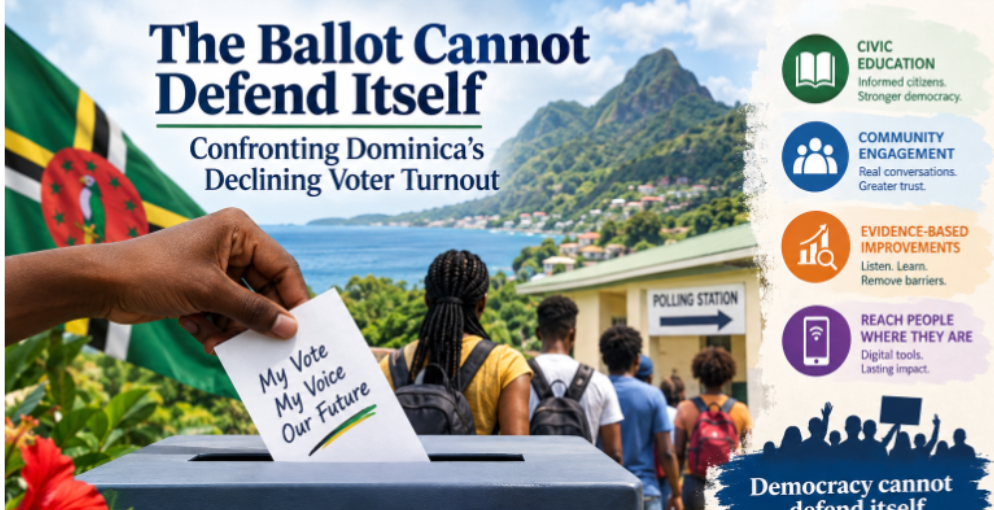
Three key strategic shifts can help address this growing crisis. First, Dominica must institutionalize permanent electoral and civic education across the country. There is a critical difference between the two: voter information teaches citizens how to cast a ballot, while civic education helps them understand why casting that ballot matters. The Ministry of Education, in partnership with the national Electoral Office, should establish a fully funded, adequately staffed Electoral and Civic Education program that operates year-round, not just during campaigns. This program should be introduced to students long before they reach voting age, incorporating activities like mock elections, parliamentary simulations, student-led debates, student councils, and hands-on constitutional education to build democratic participation as a lifelong civic habit, rather than a once-every-few-years chore.
Through this program, citizens will learn the role of parliament, the responsibilities of elected representatives, how votes translate into legislative representation, how to evaluate competing political claims, and how to hold elected officials accountable for their promises. This approach has already proven successful elsewhere in the Caribbean: Jamaica’s Electoral Commission has implemented similar voter and civic education initiatives designed to boost public understanding and engage young and first-time voters. The lesson for Dominica is clear: waiting until citizens reach voting age to teach them about democracy is waiting far too long.
Second, civic and electoral education must meet citizens where they are, at the community level. The Electoral Office should partner with local community groups, schools, churches, youth organizations, and civil society groups to host regular Community Democracy Forums in every constituency and village across the country. These forums will address the practical questions voters often have: How do I register to vote? Where is my polling station? What does a Member of Parliament actually do on a day-to-day basis? What happens to my ballot after I cast it? How can I evaluate political promises and identify misinformation? This local outreach is particularly effective in Dominica’s tight-knit communities, where existing social networks can either reinforce disengagement or build a shared culture of participation. The Electoral Office can guarantee neutral, accurate information, while local community organizations bring the trust and on-the-ground reach to connect with residents.
Third, all efforts to boost turnout must be rooted in empirical evidence and continuous improvement. After every election, the Electoral Office should conduct a systematic survey to identify why eligible citizens chose not to vote. Was it due to distrust in politicians, political alienation, out-migration, difficulties with voter registration, lack of transportation, inaccessible polling locations, or a general belief that voting would not change anything? When administrative barriers are identified, they should be addressed immediately through improved voter information, more accessible polling arrangements, simplified registration processes, and targeted outreach to groups that consistently have low turnout rates. Digital communication should also be a permanent part of the program: short-form videos, social media content, podcasts, and shareable messaging for platforms like WhatsApp can reach citizens who do not engage with traditional electoral advertising.
At its core, the crisis of low turnout in Dominica raises an uncomfortable question that goes far beyond simple voter apathy: have democratic institutions, political parties, and civic organizations done enough to make participation meaningful for ordinary citizens? A democracy where increasing numbers of citizens choose to stay home on election day may still function legally, but it becomes less representative with every cycle. When citizens do not express their will through the ballot box, politicians end up speaking for them. That is the real danger: the most consequential vote in any election may not be the one cast for the wrong candidate, but the vote that is never cast at all.
If Dominica is serious about advancing electoral reform and modernization to strengthen its democracy, electoral and civic education cannot remain an afterthought only addressed during election campaigns. It must become a permanent national institution, and increasing voter participation must be treated as a core democratic priority on par with economic development and national resilience. The Roseau North by-election should push the country to confront questions larger than just which political party won or lost. Its deeper meaning lies in what it reveals about the relationship between Dominica’s citizens and their democracy.
Political parties will always frame elections as existential battles for their own survival, but democracy ultimately depends on something far more fundamental than the electoral fortunes of any single party: it depends on whether citizens still believe that their participation matters. Dominica does not need another cycle of last-minute campaigns just telling citizens to “go out and vote.” It needs a permanent, embedded culture of democratic participation. After all, democracy cannot defend itself. It requires active, engaged citizens to show up and protect it.