作者: admin

  • BDF Soldiers Question Transparency in Equipment Procurement

    BDF Soldiers Question Transparency in Equipment Procurement

    Growing unease has emerged within the ranks of the Belize Defense Force regarding the transparency of military equipment procurement procedures. Service members have expressed concerns about recent structural changes that transferred authority for sourcing essential gear—including weapons and footwear—from military personnel to the Ministry of Defense.

    The shift in procurement responsibility has sparked questions about contract allocation processes and overall transparency in governmental decision-making. The concerns circulating among soldiers highlight potential issues in how critical defense resources are acquired under the new system.

    Former Defense Minister Oscar Mira addressed the matter cautiously, noting, “It would not be appropriate for me to comment on a ministry I no longer lead.” Mira detailed the established tender process during his administration, emphasizing strict adherence to procedural protocols. “When I was at the Ministry of National Defense, that tender process was followed to the letter,” he stated, describing a system designed to prevent issues through comprehensive oversight, including final approval from the contractor general.

    When questioned about potential familial connections to defense contracts, Mira acknowledged that relatives had previously participated in tender processes and received contracts under prior administrations. His comments come amid ongoing discussions within military circles about whether current procedures maintain the same level of transparency as previous systems.

    The emerging internal dissent highlights broader questions about governance and accountability within Belize’s defense infrastructure, with soldiers seeking reassurance that equipment procurement remains free from preferential treatment or procedural irregularities.

  • Double Cold Front to Chill Belize This Weekend

    Double Cold Front to Chill Belize This Weekend

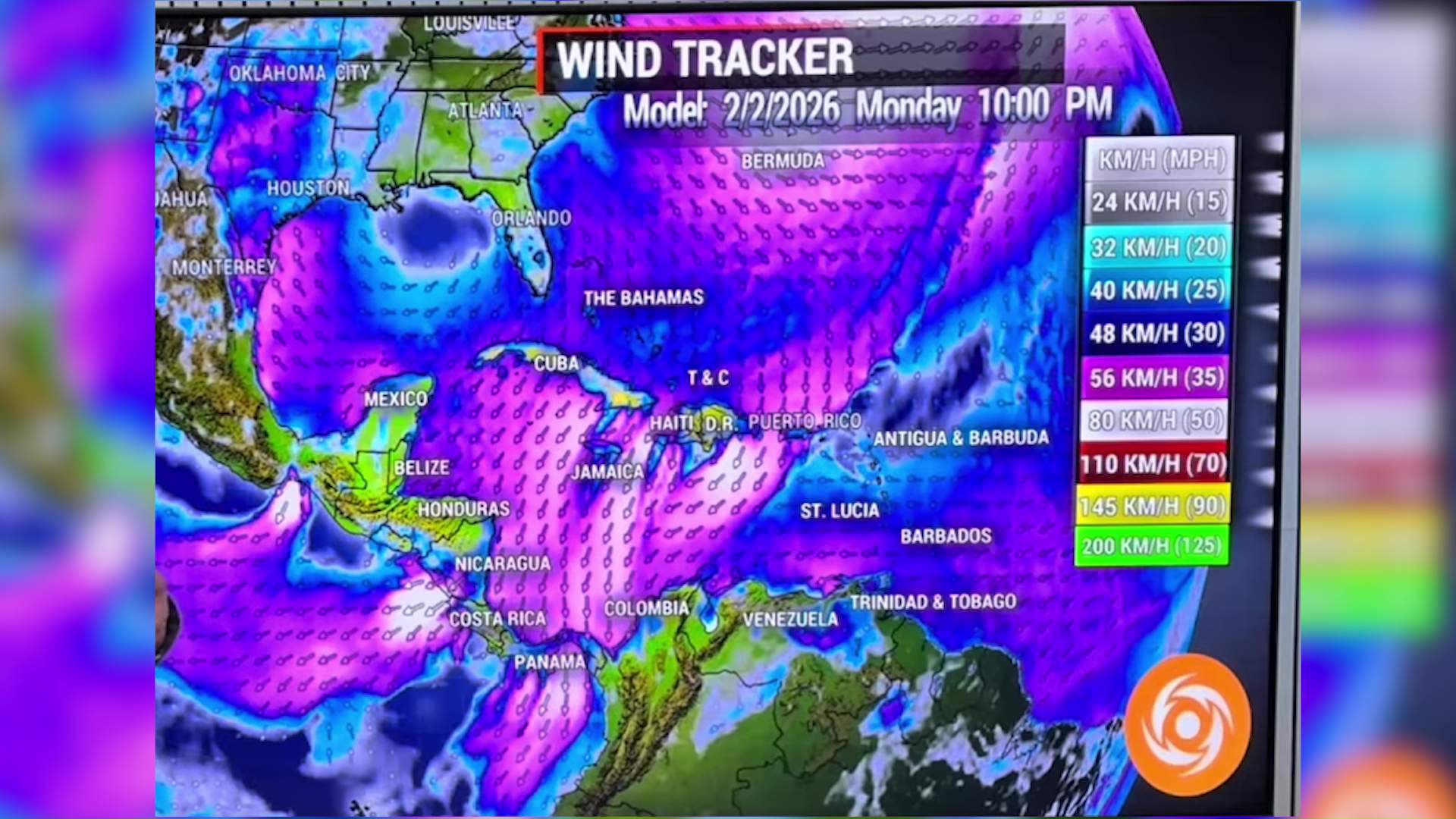
    Meteorological authorities in Belize have issued a weather advisory warning citizens to prepare for significantly cooler conditions as two consecutive cold fronts approach the nation. The first frontal system is projected to arrive by Saturday afternoon, with a secondary, more potent front following closely behind.

    The most pronounced temperature drop is anticipated from Sunday evening through Monday morning, creating unusually cold conditions for the region. Coastal areas should expect temperatures descending into the low 60s Fahrenheit, while interior regions may experience mid-50s readings. The elevated mountain districts could see temperatures approaching the upper 40s Fahrenheit—exceptionally cold by Belizean standards.

    Chief Meteorologist Ronald Gordon provided historical context, noting that while these temperatures represent a substantial cool snap, they are not expected to break historical records. “These are quite low for Belize in the Belizean context, but they are not record lows,” Gordon stated after reviewing archival data.

    Historical records indicate that the lowest temperature recorded for February 2nd was 59°F (15°C) at Central Farm, with the absolute monthly minimum being 46°F (7.8°C) at the same location. For Philip Goldson International Airport, the historical minimum for February 2nd stands at 56°F (13.3°C), with the monthly record being 52°F (11.1°C) from February 22, 1978.

    Gordon characterized the event as “a very cold snap, an arctic blast as some people might say” while emphasizing that temperatures may approach but not exceed historical extremes. Residents are advised to take appropriate precautions, including wearing warmer clothing and using additional bedding, as the Belizean population is generally unaccustomed to such cool conditions.

  • Chasing Dreams, Creating Community: The Sol Clay Story

    Chasing Dreams, Creating Community: The Sol Clay Story

    In an inspiring entrepreneurial narrative, Belizean creative Landee Longsworth has transformed pandemic isolation into a thriving jewelry business and community movement. The founder of Sol Handmade Clay Jewelry recently shared her five-year journey with reporter Sabreena Daly, revealing how a leap of faith during COVID-19 quarantine evolved into a meaningful enterprise.

    Longsworth’s brand name ‘Sol’—Spanish for sun—draws inspiration from her mother’s affectionate nickname ‘Sunshine.’ What began as experimental curiosity with polymer clay has grown into a distinctive jewelry line featuring intricate designs inspired by Belizean flora and fauna, including Scarlet Macaws, hibiscus varieties, and Monstera Leaves.

    The entrepreneurial path required significant courage, with Longsworth initially balancing her creative venture alongside full-time employment before committing fully to her business ambitions. She credits her mother Denise as her foundational support system, noting how she dedicated weekends to assisting with pop-up events despite maintaining her own professional responsibilities.

    Beyond creating wearable art, Longsworth has cultivated what she affectionately calls her ‘solshines’—a community of supporters who have become integral participants in her journey. This connection has inspired her latest initiative, ‘Clay and Connection,’ which brings creative workshops directly to customers’ chosen venues, fostering hands-on artistic experiences.

    Reflecting on her unexpected entrepreneurial evolution, Longsworth acknowledges the challenges of self-teaching business fundamentals like accounting and taxation. Despite the obstacles, she expresses profound gratitude for the growth achieved and wishes she had trusted her capabilities sooner. Her story stands as testament to how passion, family support, and community building can transform creative curiosity into sustainable enterprise.

  • FLASH : Nearly 6,000 dead and 3,000 injured by 2025 due to insecurity

    FLASH : Nearly 6,000 dead and 3,000 injured by 2025 due to insecurity

    A stark United Nations assessment has revealed Haiti’s escalating humanitarian catastrophe, with nearly 6,000 fatalities and over 2,700 injuries documented throughout 2025. The comprehensive report from the UN Integrated Office in Haiti (BINUH) details a devastating fourth quarter alone, recording 1,523 killings and 806 injuries between October and December.

    The analysis indicates that criminal gangs maintained persistent control over portions of Port-au-Prince throughout 2025, though law enforcement operations successfully prevented further territorial expansion. These armed groups continued systematic human rights violations including targeted assassinations, widespread kidnappings, extortion networks, property destruction, and child trafficking for criminal exploitation.

    Beyond the capital, rural regions including Artibonite and Centre departments faced indiscriminate assaults as gangs attempted to consolidate power. Agricultural communities suffered particularly severe targeting, with attacks on farmers and their livelihoods triggering mass displacement, economic collapse, and intensified humanitarian needs.

    The report identifies a complex security landscape where approximately 6% of casualties resulted from actions by self-defense groups and participants in the ‘Bwa Kalé’ movement targeting alleged gang collaborators.

    Notably, over 62% of recorded casualties occurred during law enforcement operations, some conducted with support from a private military company employing drone technology and helicopter strikes. This foreign security contractor significantly expanded its operational reach beyond Port-au-Prince and Kenscoff into new territories including Cabaret and Pétion-ville. Airstrikes resulted in at least 32 civilian casualties, including two young girls.

    The UN document further highlights ongoing allegations of summary executions involving police personnel, while noting three officers killed and five wounded during the quarter, alongside one injury within the FRG forces.

  • 50th CARICOM Heads of Gov’t Meeting Convenes in St. Kitts and Nevis in February

    50th CARICOM Heads of Gov’t Meeting Convenes in St. Kitts and Nevis in February

    The Caribbean Community (CARICOM) is poised to convene its historic 50th Regular Meeting of Heads of Government from February 24-27, 2026, in Basseterre, St. Kitts and Nevis. This landmark summit represents a significant milestone in regional cooperation, bringing together leaders from across the Caribbean basin to address pressing regional challenges and opportunities.

    Under the leadership of current CARICOM Chairman Dr. Terrance Drew, Prime Minister of St. Kitts and Nevis, the assembly will operate under the transformative theme “Beyond Words: Action Today for a Thriving, Sustainable CARICOM.” This thematic focus emphasizes the critical need for concrete implementation of regional initiatives rather than mere dialogue.

    The comprehensive agenda features multifaceted discussions on climate financing mechanisms, regional food security strategies, enhanced security cooperation, transportation infrastructure development, and the ongoing pursuit of reparations for historical injustices. These priority areas reflect the most urgent concerns facing Caribbean nations in the contemporary geopolitical landscape.

    The summit will welcome distinguished international participants, including Saudi Arabia’s Minister of State for Foreign Affairs Adel Al-Jubeir and Afreximbank President George Elombi, signaling CARICOM’s expanding global partnerships and diplomatic reach. Their participation underscores the growing international recognition of CARICOM’s strategic importance in global affairs.

    This golden anniversary gathering provides a pivotal platform for Caribbean leaders to consolidate regional integration efforts, strengthen collective bargaining power on the international stage, and chart a coordinated course toward sustainable development and economic resilience. The outcomes of this quadrennial meeting are expected to shape regional policy directions for the foreseeable future, potentially establishing new frameworks for multilateral cooperation and resource mobilization across the Caribbean community.

  • Almost a month has passed since Brianna Genao disappeared, and the silence is deafening in Barrero, Puerto Plata.

    Almost a month has passed since Brianna Genao disappeared, and the silence is deafening in Barrero, Puerto Plata.

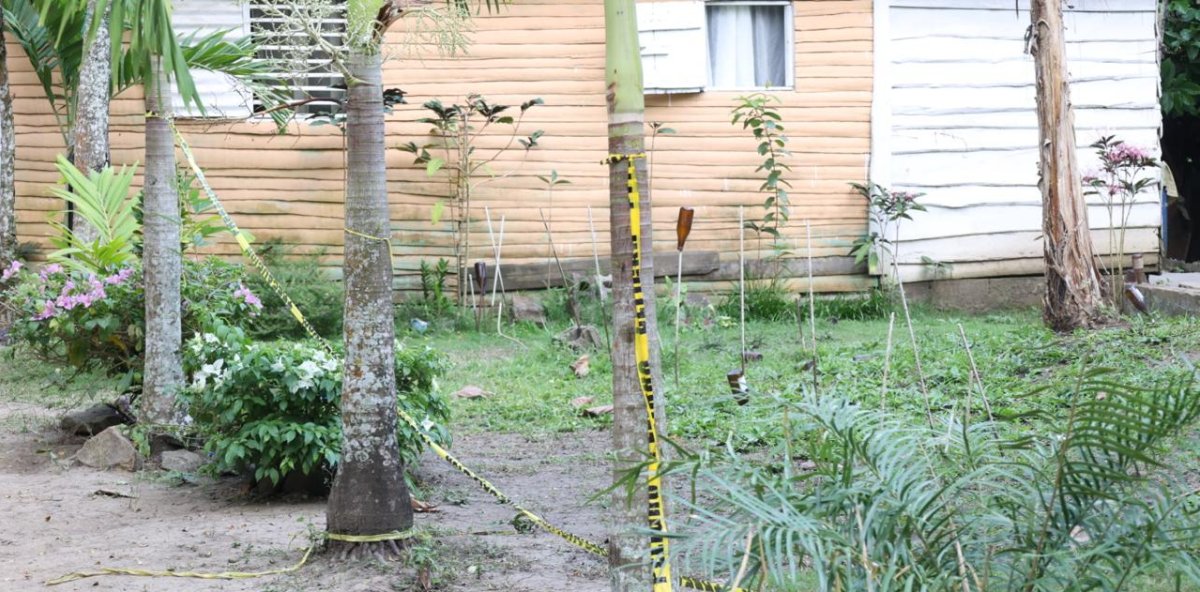
    A profound silence has descended upon the community of Barrero de Imbert in Puerto Plata, Dominican Republic, where the unsettling disappearance of young Brianna Genao nearly a month ago has irrevocably altered daily life. The once-vibrant village now exists in a state of suspended animation, gripped by collective fear and pervasive uncertainty.

    The focal point of the investigation remains the maternal grandmother’s residence, which continues to be encircled by military personnel under stringent security protocols. This cordon effectively restricts media access and inhibits normal neighborly interactions, creating an atmosphere where residents observe all activities with heightened suspicion and apprehension.

    Longtime inhabitants describe the current climate as unprecedented in recent memory. Anonymous community members revealed, ‘We haven’t experienced this level of fear in over four decades,’ reflecting concerns about potential reprisals that have silenced open discourse.

    Despite daily visits from authorities including Governor Claritza Rochtte, who personally surveyed the area, residents report no substantive breakthroughs or clear explanations regarding the investigation’s progress. The absence of international organizations at the scene has further compounded community anxieties about the thoroughness of the search efforts.

    Each passing day without resolution intensifies the anguish felt by Brianna’s family and neighbors alike, with their desperate calls for justice and the girl’s safe return echoing through the unnaturally quiet streets. The community remains trapped between fading hope and growing dread, their collective psyche marked by what has become a watershed moment in Barrero de Imbert’s history.

  • Belmopan Businesses Say Trade Licence Fees Went Up

    Belmopan Businesses Say Trade Licence Fees Went Up

    Business owners in Belmopan are raising concerns over unexpected increases in trade licence fees for 2026, directly contradicting official government assurances that costs should have remained unchanged. The discrepancy emerges despite a December 2025 announcement that postponed implementation of the new Trade License Act of 2024, which was designed to establish a revised licensing framework for both urban and rural enterprises.

    Under the postponed system, only businesses operating within town and city jurisdictions were slated to pay licensing fees, while rural enterprises were to maintain their fee exemption status. However, multiple business proprietors have reported receiving inflated bills, creating confusion and financial strain.

    Oscar Mira, Belmopan Area Representative and Minister of Home Affairs, acknowledged the erroneous fee increases, confirming they were not implemented intentionally. Minister Mira attributed the error to administrative confusion regarding the legislative status of the new licensing regime, which failed to pass Senate approval and therefore cannot be legally enforced.

    The minister confirmed he is collaborating with the Belmopan City Council to rectify the situation, ensuring trade licence fees revert to previous levels. Additionally, officials are conducting a comprehensive review of affected accounts to identify discrepancies and process reimbursements to businesses that were overcharged.

  • Sugar Farmers Struggle as Bad Roads Delay Crop

    Sugar Farmers Struggle as Bad Roads Delay Crop

    Northern Belize’s sugar industry is confronting a severe logistical crisis just eleven days into the 2025 harvest season, with farmers reporting massive financial losses due to impassable road networks preventing crop delivery to processing facilities.

    The agricultural emergency stems from weeks of torrential rainfall that government officials cite as the primary cause for delayed infrastructure repairs. However, cane growers contend that despite improved weather conditions, restoration efforts have failed to reach critical farming regions, leaving harvest transportation routes virtually unusable.

    Salvador Martin, Chairman of the Belize Sugar Cane Farmers’ Association, revealed that his community alone faces a deficit exceeding one thousand tonnes of undelivered cane. “With eleven days elapsed since the harvest commencement, we’ve already fallen short by over a thousand tons,” Martin stated, emphasizing the urgency of the situation.

    The association leader expressed profound frustration with governmental response, noting: “While I don’t doubt the government’s good intentions, survival cannot depend on promises alone. We require tangible solutions.” Martin described his embarrassment and sense of disrespect after having assured villagers that road repairs would be completed promptly.

    Financial impacts are escalating daily, with farmers losing thousands of dollars as transportation vehicles remain immobilized. The crisis has created stark disparities between regions, with some branches managing to initiate deliveries while others remain completely paralyzed by the infrastructure collapse.

  • Bouwprijzen blijven stijgen: bijna 15 procent hoger dan een jaar geleden

    Bouwprijzen blijven stijgen: bijna 15 procent hoger dan een jaar geleden

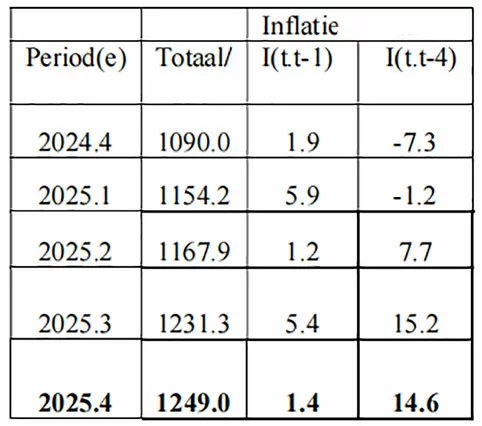
    Suriname’s construction sector continues to face significant cost pressures as latest data reveals persistent price increases throughout 2025. According to preliminary statistics released by the General Bureau of Statistics (ABS), the Construction Price Index (BPI) climbed by 1.4% in the fourth quarter of 2025 compared to the previous quarter. More strikingly, when measured against the same period in 2024, construction prices have surged by 14.6%.

    The BPI, which tracks average price fluctuations across a fixed basket of 107 construction goods and services categorized into 16 major groups, collects pricing data from approximately fifty monitoring points across Paramaribo and Wanica. The index covers residential buildings, utility structures, and civil engineering works, providing a comprehensive overview of the construction industry’s cost dynamics.

    Quarterly analysis demonstrates a consistent upward trajectory throughout 2025, with the overall index climbing from 1154.2 in Q1 to 1249.0 by year’s end. The third quarter proved particularly volatile, registering a sharp quarterly increase of 5.4% and pushing year-over-year inflation to 15.2%.

    Labor expenses constitute the most substantial cost component within the index, representing 41.73% of total weighting. Unlike other categories, labor costs maintain a constant share without separate price monitoring. Other significant cost drivers include steel and concrete works (13.50%), paving works (13.35%), and masonry and pouring works (12.38%).

    This sustained inflationary trend poses considerable challenges for housing affordability and infrastructure development. Elevated material and operational costs directly impact both private and public sector construction initiatives, potentially delaying new projects and renovations across the nation.

  • APNU scolds WIN leader over call for removal of GECOM commissioners; silence on GECOM Chairman

    APNU scolds WIN leader over call for removal of GECOM commissioners; silence on GECOM Chairman

    A significant political rift has emerged within Guyana’s opposition bloc following contentious remarks by PNCR-APNU Leader Aubrey Norton regarding WIN leader Azruddin Mohamed’s approach to electoral commission reforms. Norton publicly criticized Mohamed’s singular focus on removing three opposition-nominated Guyana Elections Commission (GECOM) commissioners while allegedly ignoring deeper systemic issues.

    During his party’s weekly news conference, Norton characterized Mohamed’s actions as politically naive, stating that the WIN leader should have conducted proper preliminary consultations rather than publicly demanding the removal of commissioners Vincent Alexander, Charles Corbin, and Desmond Trotman. “It shows you’re not doing your homework. You might be obsessed with getting rid of those who were appointed before but you need to do your homework so that you can deal with the issue properly,” Norton asserted.

    The controversy stems from WIN’s position that as the new main opposition party, it deserves representation on the seven-member GECOM. However, Norton emphasized that appointed commissioners maintain permanent positions unless legal changes occur, citing constitutional provisions that make removal procedures complex and tribunal-dependent.

    In a revealing development, Mohamed countered that he had attempted to contact Norton days prior without receiving a response. He has subsequently invited the three commissioners to a meeting scheduled for Sunday, while maintaining that “the law is clear” regarding their right to remain in position.

    The PNCR-APNU leadership redirected criticism toward GECOM Chairman Retired Justice Claudette Singh, whom they accuse of consistently favoring the ruling People’s Progressive Party Civic (PPPC). Dr. Terrence Campbell, APNU parliamentary leader, identified the Chairperson as “the source of most of the problems rather than the opposition commissioners.” Norton concluded that WIN’s exclusive targeting of opposition-aligned commissioners while ignoring the Chairman’s alleged partisan behavior suggests concerning political alignment with the ruling party’s interests.