作者: admin

  • Bahamas says Middle East war putting pressure on local economy

    Bahamas says Middle East war putting pressure on local economy

    NASSAU, The Bahamas — The Bahamian government has identified the escalating military conflict in the Middle East, involving the United States, Israel, and Iran, as the primary catalyst for a severe disruption at one of the world’s most critical energy transit corridors. This strategic chokepoint is vital for the global transportation of oil and liquefied natural gas (LNG), with a substantial percentage of shipments routinely passing through the region.

    Prime Minister Phillip Davis confirmed that the geopolitical turmoil has precipitated a dramatic surge in international oil prices. Values have skyrocketed from approximately US $70 per barrel at the start of the year to figures well exceeding US $100, marking one of the most acute energy price shocks witnessed globally since the onset of the Ukraine crisis. ‘This increase, and the uncertainties about what will come next, are putting immense pressure on oil prices, shipping, and international supply chains,’ Davis stated.

    Addressing domestic concerns, the Prime Minister acknowledged that citizens are acutely aware of the overseas events and are anxious about the potential repercussions on their cost of living. He emphasized the disproportionate impact on a small island nation, where rising global fuel costs directly inflate electricity bills, freight charges, transportation expenses, and ultimately, grocery store prices.

    In response, the government is leveraging policy reforms enacted over recent years to insulate the local economy. Davis highlighted that significant energy sector overhauls, which introduced major efficiencies, infrastructural improvements, and risk mitigation strategies, have enhanced national resilience. Consequently, he assured the public that household electricity bills, which have already decreased due to these changes, will remain unaffected by the current international crisis.

    Further demonstrating proactive measures, Prime Davis convened a meeting with the Retailers Association to coordinate a unified stakeholder effort. The discussions centered on implementing a scheduled reduction of the Value Added Tax (VAT) on unprepared food, effective April 1, to alleviate financial strain on families. Davis framed this collaborative initiative as a testament to a government committed to easing economic pressure on its citizens. He expressed confidence that the VAT reduction would help families retain more of their income and make essential goods more affordable.

    Beyond economic strain, Davis also cautioned that such periods of international instability often breed secondary challenges, including a potential rise in illegal migration, maritime smuggling, and other unlawful activities across the Caribbean region.


  • Rowley dismisses accusation that drug money funded party headquarters

    Rowley dismisses accusation that drug money funded party headquarters

    PORT OF SPAIN, Trinidad – In a forceful rebuttal, former Prime Minister Dr. Keith Rowley has categorically denied allegations that his People’s National Movement (PNM) party headquarters was financed through drug trafficking proceeds. The accusations were leveled by current Prime Minister Kamla Persad-Bissessar during a parliamentary session last Friday, where she characterized the PNM as a “narco-party” in league with criminal elements.

    Addressing journalists at a press conference, Rowley expressed profound disappointment with what he termed “evidence-free allegations” from the sitting prime minister. The former PNM leader, who stepped down following his party’s electoral defeat in April 2025, emphasized his five-decade association with the party since 1974, including 15 years at its helm.

    “For 70 years, the PNM has participated in Trinidad and Tobago’s political landscape both in government and opposition,” Rowley stated. “To suggest that Balisier House’s operations under my stewardship were funded by narco-terrorists represents a reckless disregard for truth.”

    Rowley drew parallels between Persad-Bissessar’s allegations and the treatment of former Venezuelan president Nicolas Maduro, suggesting the prime minister’s close alignment with U.S. President Donald Trump’s security policies could lead to similar extraterritorial actions against himself. He questioned whether the government’s participation in the U.S.-led Shield of Americas initiative – a multinational security pact established in March 2026 – effectively endorsed extrajudicial measures in anti-narcotics operations.

    The former prime minister raised grave concerns about the initiative’s implications for due process, noting that Guyana remains the only CARICOM member participating in the project. He referenced the Attorney General’s reported legal advice that lethal force could be employed against suspected traffickers without evidence gathering or judicial oversight.

    “This policy effectively permits our Coast Guard to eliminate suspected individuals based merely on suspicion, without any evidentiary requirements or legal proceedings,” Rowley warned. “Such approaches risk devastating our societal fabric and international standing.”

  • Jamaica Broilers cuts losses but weak US unit still drags results

    Jamaica Broilers cuts losses but weak US unit still drags results

    Jamaica Broilers Group Limited has achieved a remarkable financial turnaround during the nine-month period ending January, substantially narrowing losses through strengthened domestic operations that have helped stabilize the poultry conglomerate following last year’s accounting crisis. While the company’s challenging US division continues to negatively impact overall performance, the Jamaican operations have emerged as the primary engine driving the group’s recovery.

    The third-quarter interim financial report reveals a net loss of approximately $1 billion, representing a dramatic improvement from the $3.5 billion deficit recorded during the same period last year. This significant recovery stems from a complete reversal in operating performance, with the company posting an operating profit of about $2 billion compared to an operating loss of $1.2 billion in the previous year.

    Revenue for the nine-month timeframe reached $73.6 billion, accompanied by a 22% surge in gross profit to $13.5 billion, indicating substantially improved margins despite modest revenue growth. Company management credited this margin enhancement to refined operational execution across all business units, emphasizing their continued focus on efficiency measures and disciplined implementation strategies.

    The financial resurgence occurs against the backdrop of Jamaica Broilers’ ongoing efforts to stabilize its financial position after accounting irregularities discovered in its US operations prompted a massive $46 billion restatement of financial statements. This development led to the planned transition from long-standing auditor PricewaterhouseCoopers to Ernst & Young.

    Currently, the company is negotiating the resolution of approximately $120 million in debt associated with its US operations, while a $24 billion refinancing arrangement with local banks has provided essential liquidity during balance sheet restructuring. Despite these challenges, Jamaica Broilers maintains its commitment to enhancing operational efficiency and strengthening performance across all business segments as it works toward restoring sustained profitability.

  • Food price swings mask underlying pressures as inflation dips

    Food price swings mask underlying pressures as inflation dips

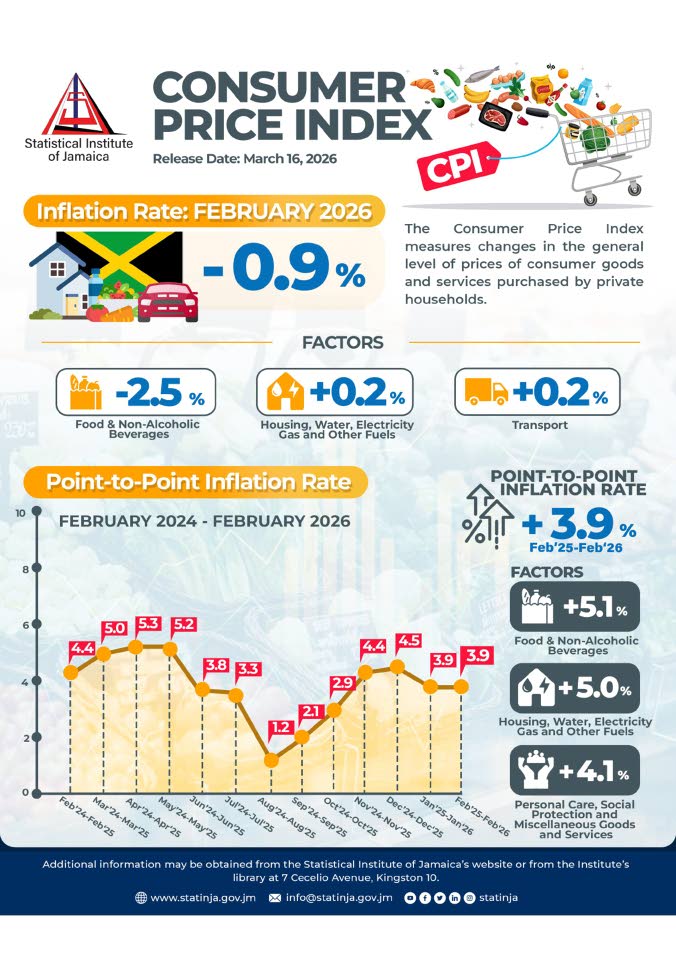
    Jamaica experienced a significant downturn in inflation during February, with official statistics revealing a 0.9% monthly contraction in the All-Jamaica Consumer Price Index. This substantial decline was predominantly propelled by a dramatic 11.3% collapse in vegetable prices alongside reductions in tubers, plantains, and pulses, culminating in a 2.5% decrease within the food and non-alcoholic beverages category. Superficially, these figures position annual inflation at 3.9%—comfortably within the Bank of Jamaica’s target corridor of 4-6%—suggesting economic stability.

    However, beneath this apparent tranquility lies a more complex economic narrative. Despite the dramatic monthly food price correction, annualized food inflation persists at 5.1%, maintaining its position as the primary driver of overall price increases. Concurrently, housing utilities and fuels recorded 5% inflation while personal care services rose 4.1%, indicating sustained pressure across essential expenditure categories.

    The February data reveals critical sectoral divergences: while agricultural products experienced deflationary trends, housing-related costs including electricity advanced 0.2% alongside similar increases in transportation fueled by rising petrol prices. This dichotomy underscores Jamaica’s fundamental inflation characteristic—volatile food prices creating optical illusions that mask structural cost increases in energy-dependent sectors.

    This presents policymakers with a formidable challenge, as monetary tools designed to combat demand-driven inflation remain largely ineffective against supply-side volatility in agricultural production. The current stability thus appears contingent upon unpredictable factors including harvest yields and global energy markets, creating a fragile equilibrium that could rapidly reverse.

    For Jamaican households, the statistical decline offers limited relief as reduced grocery expenses are offset by mounting utility and transportation costs, maintaining constant pressure on household budgets. The economy consequently demonstrates superficially controlled inflation while remaining vulnerable to sudden shifts in commodity markets and energy pricing.

  • GK delivers on solar savings despite Melissa disruptions

    GK delivers on solar savings despite Melissa disruptions

    Jamaican conglomerate GraceKennedy Limited is reporting exceptional performance from its renewable energy initiatives, achieving greater-than-anticipated financial savings despite significant infrastructure damage from Hurricane Melissa. The corporation’s solar power transition program has yielded over US$700,000 in energy savings for 2025, substantially exceeding its initial target of US$600,000 and advancing toward its ambitious goal of US$1 million in annual savings by 2026.

    Group CEO Frank James revealed during a recent investor briefing that the savings would have been even more substantial had Hurricane Melissa not destroyed the solar installation at the company’s meat processing facility. The catastrophic Category 5 hurricane—the most intense storm ever recorded in Jamaican history—caused extensive operational disruptions across the conglomerate’s network.

    The renewable energy program, launched in 2022 under former CEO Don Wehby, represented a US$3 million investment to convert multiple operations to solar power. The initiative had already demonstrated its viability with approximately US$400,000 in savings during 2024 as the program began scaling across the organization.

    James emphasized the company’s commitment to rebuilding stronger solar infrastructure despite the hurricane’s impact: ‘We continue to see the savings from solar, so we’re not daunted and we’ll be rebuilding bigger and better.’

    The hurricane’s devastation extended beyond energy infrastructure, particularly affecting the Savanna-la-Mar meat processing plant (Grace Food Processors Meats), which sustained substantial damage requiring temporary closure. The facility, described by James as a profitable operation, resumed production by December’s end following repairs, restoring key product lines including Vienna sausages and frankfurters to supermarket shelves.

    Financially, the hurricane generated approximately J$1.4 billion in one-time profit impacts primarily from business interruptions and increased insurance claims. This marked the first instance where a majority of GraceKennedy’s profits originated from international operations rather than domestic markets, as Jamaican operations absorbed the storm’s consequences.

    Additional hurricane-related challenges included inaccessibility to one of the company’s three spring water sources in the Blue Mountains’ Newcastle area due to road damage. James confirmed that despite this setback, the company has maintained uninterrupted supply through its two remaining sources, ensuring continued availability of spring water products while awaiting road repairs.

  • Bring case to ICJ for Melissa damage, says Golding

    Bring case to ICJ for Melissa damage, says Golding

    Jamaican Opposition Leader Mark Golding has issued a compelling call for the nation to pursue legal action against major carbon-emitting countries through the International Court of Justice (ICJ). The demand comes in response to the catastrophic devastation wrought by Hurricane Melissa, which struck Jamaica as a Category 5 storm in October 2025, causing an estimated US$12.2 billion in damages.

    During his address in the House of Representatives’ 2026/27 Budget Debate, Golding articulated that developed nations bear historical responsibility for persistently ignoring scientific consensus regarding climate change while continuing carbon-intensive economic practices. These actions, he argued, have effectively exported climate-related costs to vulnerable developing nations and small island states like Jamaica.

    The legal foundation for this claim stems from a landmark ICJ advisory opinion delivered in July 2025, which established that states must actively address fossil fuel emissions and could be held financially accountable for climate-related damages. The ruling, championed by Vanuatu and supported by numerous small island nations, represents a transformative development in international environmental law.

    Golding emphasized that Jamaica should assemble an expert legal team to prepare a comprehensive brief exploring compensation avenues through the ICJ’s contentious jurisdiction. Alternatively, he proposed that Jamaica lead efforts at the United Nations General Assembly to seek the court’s advisory opinion on appropriate compensation levels from major contributors to global warming.

    The Opposition Leader highlighted the increasing frequency and intensity of climate disasters affecting Jamaica, noting that four major hurricanes (Ivan, Dean, Beryl, and Melissa) have struck the island since 1988, causing over US$1 billion in damages prior to Melissa’s unprecedented destruction. He characterized Melissa’s unusual intensification patterns as unequivocally climate-related, exacerbated by Caribbean waters measuring 1.4 degrees above pre-industrial temperatures.

    Golding concluded that Jamaica, as a minimal contributor to greenhouse gas emissions, should not bear alone the enormous financial burden of climate disasters caused primarily by industrialized nations. The pursuit of climate justice through international legal channels represents both a moral imperative and practical necessity for the nation’s sustainable development.

  • Jah Rockaz delivers ‘music medicine’

    Jah Rockaz delivers ‘music medicine’

    Emerging from a decade-long friendship forged through musical collaboration, Jamaican duo Jah Rockaz has officially launched their creative partnership with the release of their debut album, ‘Reggae Is Healing.’ The group, consisting of vocalist Chris Rockers and producer O’Brian Williams, represents more than just a musical act—they embody a philosophical movement centered on reggae’s transformative power.

    The duo’s origins trace back to their early connection through music, with Chris developing his vocal talents in church environments while O’Brian honed his production skills. Their transition from friends to professional collaborators proved seamless due to their established rapport and clearly defined roles within the partnership.

    Their name, Jah Rockaz, carries intentional symbolism: ‘Jah’ reflects their spiritual foundations and Rastafarian influences, while ‘Rockaz’ signifies their dynamic sonic identity centered on rhythm and movement. This conceptual framework informs their 10-track album produced under O’Brian’s Briwills Music label.

    Rather than pursuing conventional commercial success, Jah Rockaz aims to cultivate what they term a ‘lifestyle movement.’ They classify their sound as ‘reggae/pop’—a deliberate fusion designed to appeal to diverse audiences while maintaining spiritual authenticity. The album’s title track, ‘Reggae Is Healing,’ encapsulates their core belief that reggae music serves as therapeutic medicine for the soul rather than mere entertainment.

    Building a dedicated community stands as their primary objective, with both members emphasizing the importance of developing super fans rather than chasing streaming numbers. They’ve implemented a strategic ecosystem approach to audience development, focusing on direct artist-fan relationships.

    The partners acknowledge the challenges of maintaining consistency in the music industry, particularly when balancing multiple creative perspectives. However, their shared sense of purpose and belief in their mission provides strong foundation for their artistic journey. Both view music as their destiny—a calling they hope will inspire others to pursue their dreams with similar conviction.

  • Plug the leaks!

    Plug the leaks!

    In a forceful address during Jamaica’s 2026/27 Budget Debate, Opposition Leader Mark Golding presented a comprehensive critique of the government’s fiscal approach, advocating for enhanced tax compliance mechanisms rather than implementing new revenue measures. Golding articulated that Jamaica’s existing tax system suffers from significant leakage, resulting in billions of uncollected revenue that could be recovered through modernized enforcement and technological integration.

    Golding characterized the government’s pursuit of new taxes—including proposed levies on sugar-sweetened beverages, alcohol, cigarettes, and digital services—as ‘lazy and unimaginative’ policy that would further burden households and businesses still recovering from Hurricane Melissa’s economic impact. He emphasized that Jamaica’s fiscal strategy should pivot from increasing tax rates to capturing legally due revenue through systemic reforms.

    The opposition leader highlighted the success of recent compliance initiatives, noting that the 2025 tax amnesty generated over $10 billion in outstanding payments—demonstrating the substantial revenue existing outside the formal system. Golding argued that persistent enforcement weaknesses create an unfair burden on compliant taxpayers while allowing others to operate without consequences.

    Central to Golding’s proposal is the implementation of electronic invoicing and digital validation systems, similar to those adopted across Latin America, Europe, and Asia. These technologies enable real-time transaction verification, automated return population, and reduced opportunities for under-reporting and fraud. Golding cited documented revenue increases of 5-15% in jurisdictions that have implemented such systems.

    Specifically addressing Jamaica’s General Consumption Tax (GCT), Golding noted that current processes allowing delayed remittances create discrepancies and payment delays. He projected that even a conservative 2% improvement in GCT and special consumption tax realization could yield $8.6 billion annually without rate increases.

    The opposition leader also identified inefficiencies in income tax, Customs duties, and the construction sector, advocating for improved data-sharing between agencies to detect inconsistencies and reduce evasion. He estimated that comprehensive reforms could generate revenue equivalent to approximately 2% of GDP annually, creating fiscal space equivalent to 10% of GDP over five years without increasing tax burdens.

    Golding framed tax compliance reform as fundamentally promoting economic fairness rather than punishing taxpayers. He argued that systemic improvements would protect compliant businesses from non-compliant competitors, reduce bureaucratic discretion, minimize corruption opportunities, and strengthen investor confidence.

    The opposition’s position forms part of a broader critique of the government’s fiscal approach, which they argue relies excessively on new taxes and National Housing Trust withdrawals rather than structural reforms to drive growth and efficiency.

  • CLAMPING DOWN

    CLAMPING DOWN

    The Bank of Jamaica (BOJ) is introducing comprehensive minimum standards to regulate how financial institutions handle customer grievances, addressing longstanding inconsistencies and delays in dispute resolution processes. This regulatory intervention comes as a direct response to the absence of industry-wide standards that has resulted in uneven treatment of consumer complaints across deposit-taking institutions (DTIs).

    According to the central bank’s 2025 annual report, the newly developed framework mandates that all DTIs establish robust governance and accountability mechanisms to ensure complaints are addressed with fairness, transparency, and promptness. This initiative represents a critical component of Jamaica’s broader transition toward a Twin Peaks regulatory model, which will separate prudential oversight from consumer protection functions.

    Recent data reveals persistent challenges within the banking sector. The Office of Consumer Complaints (OCC), which handles cases escalated beyond individual banks, received 443 complaints in 2025—a slight decrease from 463 the previous year. Nearly half (206 cases) involved account-related issues, particularly concerning electronic banking channels and automated banking machines (ABMs), indicating significant customer difficulties in accessing funds and resolving routine banking problems.

    While complaint resolution rates showed remarkable improvement—jumping to 84% in 2025 from 57.4% in 2024—the BOJ emphasized that underlying systemic issues necessitate stronger regulatory action. The absence of uniform standards has created inconsistent complaint handling practices across institutions, prompting enhanced regulatory scrutiny.

    The central bank completed development of the new standard in 2025 and plans to issue a consultation paper to the banking industry this quarter before finalizing the regulations. Beyond account-related disputes, the OCC also addressed complaints concerning fraud, loan practices, fee structures, and fund accessibility issues.

    Notably, the BOJ reported a temporary surge in complaints related to the Real Time Gross Settlement (RTGS) system during December 2025, attributed to operational challenges during the JamClear®-RTGS transition to ISO 20022 standards. The institution also acknowledged that previous standards implemented for ABMs in 2024 have already yielded improvements in system uptime and recovery durations.

    As part of this regulatory overhaul, the BOJ will introduce a structured online complaints intake mechanism requiring customers to submit grievances through a dedicated web-based form rather than written correspondence. This platform will initially be hosted on the BOJ’s website before transitioning to the Financial Services Commission under the Twin Peaks framework.

    The OCC’s role is expected to expand significantly beyond complaint resolution to encompass broader market conduct supervision, including a thematic review of financial offerings initiated in October 2025. These developments reflect Jamaica’s comprehensive approach to strengthening consumer protection mechanisms and enhancing financial sector resilience.

  • MERRICK’S THE MAN

    MERRICK’S THE MAN

    Jamaican football has discovered a new talisman in 22-year-old midfielder Dwight Merrick, whose exceptional performances for Montego Bay United have earned him a coveted spot in the national squad for the upcoming FIFA World Cup intercontinental play-offs. The rising star will join the Reggae Boyz as they face New Caledonia and DR Congo in critical qualification matches beginning next week.

    Interim Head Coach Rudolph Speid has recognized Merrick’s outstanding contributions in the Jamaica Premier League, where the attacking midfielder has delivered 10 goals and 5 assists in 24 appearances this season. His technical prowess and physical presence have made him one of the league’s most consistent performers, catching the attention of national team selectors during recent international friendlies against Grenada and Martinique.

    Merrick’s journey to national recognition represents a triumph of local development. The former Jamaica College standout, who won the prestigious Manning Cup during his schoolboy career, began his professional journey with Mount Pleasant in 2022, immediately winning the JPL title in his debut season. His transfer to Montego Bay United last summer marked a turning point in his career, with coach Xavier Gilbert utilizing him primarily as a central playmaker rather than a winger.

    Football analyst Leijeigh Williams, who has followed Merrick’s career since his schoolboy days, attributes the player’s success to increased confidence and tactical versatility. “Merrick has been the best player in the Jamaica Premier League this season,” Williams noted. “His impact on games has increased significantly because his confidence has increased, and we’ve seen him evolve from a final-third player to someone who can operate deeper in midfield.”

    The inclusion of local-based players like Merrick and Mount Pleasant defender Kyle Ming signals a potential shift in selection philosophy under the interim coaching staff. This approach contrasts with previous management, where locally developed talents often received limited opportunities despite strong domestic performances.

    Merrick’s unique combination of physical stature (standing 6’1″) and technical ability draws comparisons to modern attacking midfielders like Jude Bellingham. His capacity for ball-carrying, creativity in open play, and physical presence offers Jamaica tactical options previously unavailable in the number 10 position.

    As the Reggae Boyz prepare for their crucial World Cup qualifying matches, Merrick represents both immediate tactical solution and long-term prospect for Jamaican football. His selection demonstrates that exceptional performances in the domestic league can indeed pave the way to international recognition, potentially inspiring a new generation of local talents.