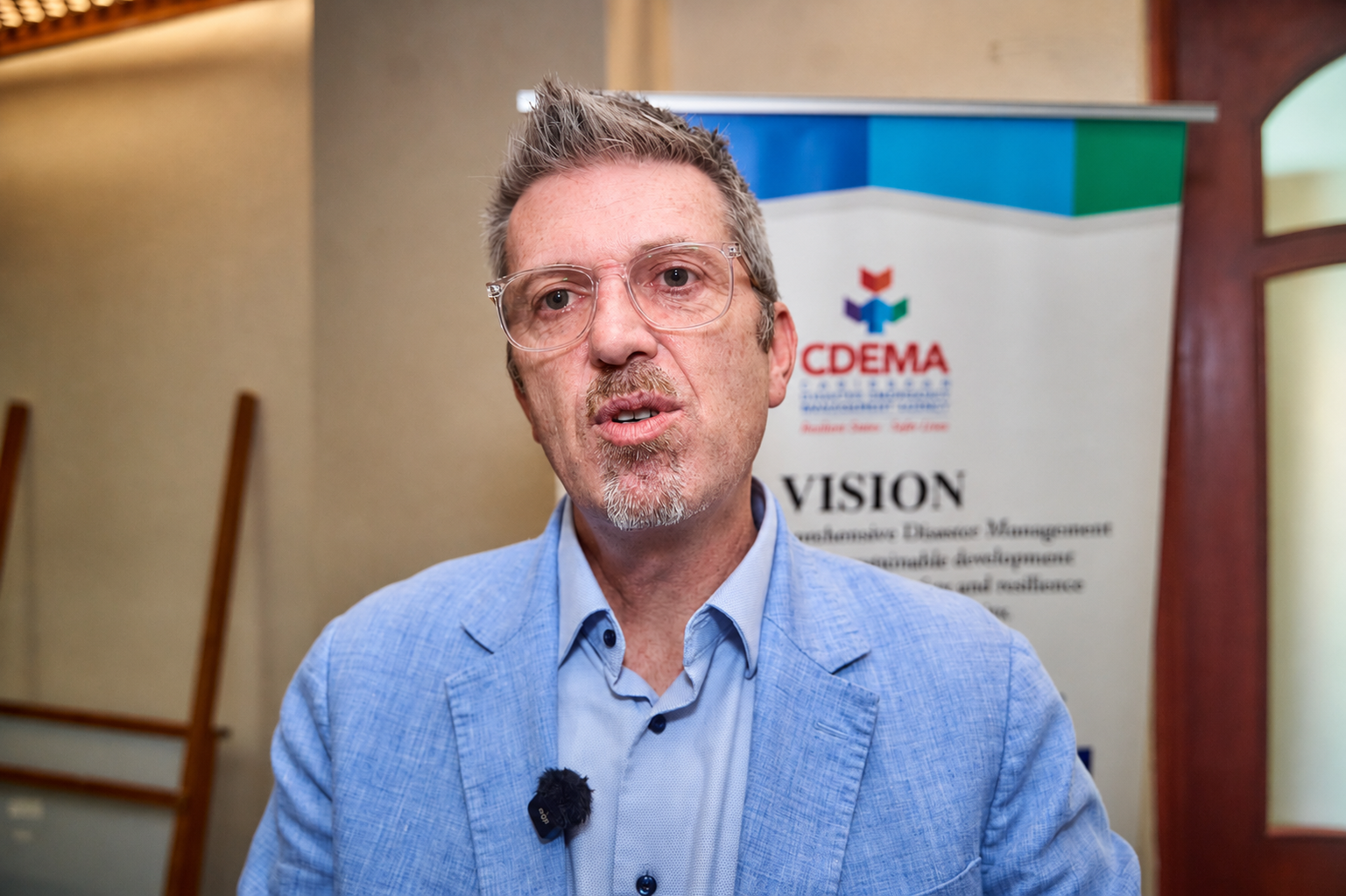
As climate change amplifies the intensity and frequency of destructive natural disasters across the Caribbean, a top World Food Programme (WFP) leader is urging regional emergency response bodies to place robust food security frameworks and accessible, real-time data at the core of their crisis preparedness strategies. Brian Bogart, WFP’s Representative and Country Director for the organization’s Caribbean Multi-Country Office, outlined the urgent call to action during a recent regional consultation workshop hosted by the Caribbean Disaster Emergency Management Agency (CDEMA) at Barbados’ Accra Beach Hotel & Spa. The three-day gathering brought together representatives from CDEMA’s 20 member states to revise and update the bloc’s flagship Comprehensive Disaster Management Strategy, a guiding document for regional crisis planning and response. In an interview with Barbados TODAY conducted on the sidelines of the workshop, Bogart highlighted that fragmented information coordination remains one of the most persistent and costly gaps in the region’s disaster response infrastructure, leaving vulnerable communities overlooked in the immediate aftermath of catastrophic events. While Bogart emphasized that national governments, UN agencies, local non-governmental organizations and international charitable groups all bring critical capacities to emergency responses, he noted that disjointed data systems often prevent consistent, equitable aid delivery to every impacted population. “One of the principal challenges we have with regards to food security is coordination and data,” Bogart explained, adding that response teams require immediate, accurate insights to map the location of affected communities, measure the scale of infrastructure and food system damage, and align available resources with on-the-ground needs. “What we really need to do is make sure that we have those systems in place for mapping needs [and] ensuring that we have regular coverage of affected populations so that no one is affected by hunger in the event of natural disasters in the Caribbean.” To illustrate the severity of coordination gaps and the scale of response required for major Caribbean disasters, Bogart pointed to the 2023 response to Hurricane Melissa, the most powerful storm on record to strike Jamaica. After the Category 5 hurricane made landfall in late October 2023, devastating large swathes of the island and leaving multiple rural communities completely cut off from access to food and basic supplies, the WFP moved nearly 1,000 metric tonnes of emergency relief goods from the Caribbean Regional Logistics Hub based in Barbados to Jamaica in February 2024. Beyond the immediate threat of increasingly severe natural disasters, Bogart also warned that overlapping global shocks continue to erode the Caribbean’s long-term food security, a vulnerability amplified by the region’s heavy dependence on imported food to meet local demand. Currently, most Caribbean nations import between 60 and 90 percent of their food supply, leaving the region exposed to global supply chain disruptions and international commodity price volatility. Bogart referenced the CARICOM “25 by 2025 plus 5” initiative, which sets a target of cutting the region’s food import bill by 25 percent by 2030, to argue that regional governments and stakeholders must ramp up investment in local agricultural production and expand intra-Caribbean food trade to reduce this systemic vulnerability. “The Caribbean is very vulnerable to shocks generated by supply chain disruptions and global food price inflation,” Bogart said, noting that ongoing geopolitical instability in the Middle East and persistently high global fuel costs have already driven up retail food prices across the region. “What we really need to do is look at how we can offset those short-term impacts by ensuring that the most vulnerable people have access to the food they need for a healthy diet, while also doubling down on the investments required to reduce reliance on imports and promote agriculture and food trade between Caribbean countries.”
作者: admin
-

Fatal Massade shooting renews calls for mental health reform
The tight-knit neighborhood of Massade in Gros Islet, Saint Lucia, is enveloped in grief following the fatal shooting of 34-year-old Julien Cedrick Agian, who was allegedly killed by his own cousin in a late-night incident on Sunday, May 17, 2026. The senseless homicide has not only left a family and community shattered, but has also reignited urgent public conversations about three pressing, long-unaddressed issues plaguing the island nation: gaps in mental health care, lax public safety protocols, and the persistent scourge of gun violence.
According to official police reports, officers assigned to the Gros Islet Police Station were dispatched to the Massade shooting location at approximately 10:45 p.m. on the day of the incident. First responders found Agian with multiple gunshot wounds; he was rushed to the Gros Islet Polyclinic in a private vehicle by bystanders, but medical staff were unable to save his life. To date, one person has been taken into custody and is cooperating with law enforcement investigators, and multiple family sources have confirmed the suspect is Agian’s close cousin. A post-mortem examination to confirm the official cause and manner of death has been scheduled for a future date, as the investigation remains ongoing.
Those who knew Agian remember him as a warm, generous, and uplifting presence, whose sudden death has left loved ones in profound shock and disbelief. “He was always the life of the party,” one heartbroken family member shared in an emotional interview. “You could always go to him for advice. He always had something positive to say and always tried to guide people in the right direction. You could go to him feeling completely beat down, and he would make you feel like yourself again. He would tell you, ‘Relax, things happen. Think about the positive that will come out of it.’”
The tragedy carries an extra layer of heartbreak for the family: Agian’s wife is currently pregnant, and he will never get to meet his unborn child. Even days after the shooting, many relatives are still struggling to accept their loss. “I’m in denial,” the relative added. “I just kept thinking he got shot and he would pull through. I was waiting for him to call and say he was okay.”
Across the community, Agian’s reputation as a kind, approachable person who was always willing to lend a hand is widely shared. A close friend of the victim noted that the entire neighborhood has been shaken to its core by the violence. “He was a very nice guy,” the friend said. “He used to sit around, joke with everybody and help people. Everybody knew him as a good person.”
In the wake of the killing, many community members are speaking out about systemic failures that they say allowed this tragedy to happen. Multiple residents interviewed highlighted deep concerns over the treatment of people living with severe mental illness, particularly in cases where prior threats of violence have already been made. One close associate of the community argued that the country’s mental health system is failing to adequately monitor and support people experiencing acute psychiatric instability. “When somebody mentally unstable keeps threatening people, we can’t keep taking it lightly,” he said. “People say, ‘That’s your cousin, leave him alone,’ until something like this happens.” He called for extended, long-term inpatient psychiatric care for people who pose a threat to themselves or others, arguing that unstable patients should not be released back into the community before they have made a full recovery. “If somebody needs treatment, keep them there until they recover,” he said. “You can’t send them out the next day and expect everybody to be safe.”
Beyond mental health reform, the incident has also sparked renewed demands for tougher enforcement against illegal firearms and intervention to stop violent crime among young men. One local resident emphasized that communities cannot afford to be passive in addressing these issues, arguing that collective action is needed to prevent future tragedies. “We cannot leave everything for the government and police,” he said. “If we see problems, we have to speak about it and try to stop it before things happen.”
As the investigation into Agian’s homicide continues, Saint Lucia police are asking the public for any information that could help advance the case. Anyone with details related to the shooting is encouraged to contact the Gros Islet Police Station at 456-3830. Anonymous tips can also be submitted via the national Crime Hotline at 555, or through the RSLPF Crime Hotline mobile app available on the Google Play Store.
-

NODS to Host National Hurricane Season Thanksgiving Service on May 31
As the twin-island nation of Antigua and Barbuda gears up for the 2026 Atlantic hurricane season, the country’s National Office of Disaster Services (NODS) has opened an open invitation to all residents to join a special National Hurricane Season Thanksgiving Church Service scheduled for later this May.
The collective prayer and worship event is set to take place at 4 p.m. local time on Sunday, May 31, hosted at the Bible Speaks Seventh-day Adventist Church, just one day before the official start of the annual Atlantic hurricane season on June 1.
Centered around the unifying theme “A Nation Prepared, A People Protected,” the service is designed to bring together community members from across the country to join in collective prayer and reflection ahead of the high-risk weather period. Unlike routine disaster preparedness briefings, this gathering frames seasonal readiness around communal gratitude and shared hope for safety throughout the coming months.
In an official statement released by the agency, NODS extended a warm call to all residents: “Come and worship with us as we pray and give thanks for a safe and hurricane-free nation.” The disaster management office also specifically encouraged attendees to bring their family members, close friends, and neighbors to build a sense of collective community resilience ahead of the season.
The event forms part of NODS’ broader seasonal preparedness outreach, combining spiritual preparation with community building to help the nation align for the potential challenges of the Atlantic hurricane season, which typically runs from June through November each year in the region.
-

Emergency housing to be increased, says Gibbs
Barbados’ top housing official has laid out a sweeping multi-part agenda that prioritizes disaster preparedness, repairs to aging public housing developments, and long-overdue justice for uncompensated landowners, signaling a major push to upgrade the country’s housing infrastructure ahead of potential extreme weather events. Housing Minister Chris Gibbs, who represents the St Michael West constituency, outlined his policy priorities during a Sunday branch meeting held at St Leonard’s Boys’ School, framing new emergency housing construction as a non-negotiable responsibility for his administration.
Against the backdrop of recent extreme weather events across the Caribbean, including the devastating impact of Hurricane Melissa on nearby Jamaica, Gibbs emphasized that Barbados cannot afford to delay preparations for future disasters. Though the island nation has escaped catastrophic damage from recent weather events including Hurricane Elsa, an unexpected severe storm, and multiple wildfires, Gibbs warned that this streak of good fortune cannot be counted on indefinitely. His ministry is currently finalizing innovative design plans to expand the country’s emergency housing stock, a project that is backed by the full Cabinet and spearheaded by the Prime Minister, with Gibbs leading implementation on the ground as the ministerial lead for housing in Parliament.
In addition to building new emergency accommodation, Gibbs’ ministry is also turning its attention to longstanding structural issues in existing public housing estates that have gone unaddressed for years. The government has allocated funding in this financial year’s budget to carry out critical upgrades across existing public housing developments, ensuring residents can live in safe, dignified conditions. The first wave of upgrades will target three high-need estates: the 10-year-old Grotto housing complex, Country Park Towers, and Kensington Lodge, with additional developments added to the schedule in future phases.
At Grotto, the ministry will resolve well-documented flaws in the original development design, including inadequate parking infrastructure, insufficient exterior lighting that has created public safety risks, and widespread roof leaks that have plagued residents for years. After extensive testing and consultation, officials have selected high-quality sealants to repair and reinforce the roofs, making them more resilient to heavy rain and extreme weather events. Similar upgrades will be carried out at the other two initial sites to improve quality of life and disaster preparedness across the portfolio.
Beyond new construction and infrastructure repairs, Gibbs highlighted a commitment to addressing historical injustices related to government land acquisition, noting that hundreds of small landowners have waited decades for compensation after the state compulsorily acquired their property for public projects. Gibbs stressed that correcting these decades-old wrongs is a core part of the ministry’s social justice mandate, not just building new housing stock. As an example of progress already made, he shared that the government recently compensated an elderly woman who had lost a portion of her land for a bus lay-by 40 years prior, with the issue resolved through Cabinet approval after being brought forward by his ministry.
Gibbs concluded by reaffirming that equitable, accessible, and resilient housing remains the top priority for his tenure, with work on all initiatives already underway to deliver tangible results for Barbadian residents.
-

Call for change in approach to fighting NCDs
Barbados President Jeffrey Bostic, a former health minister who led the country’s public health response through the peak of the COVID-19 pandemic, has issued an urgent appeal to shift current approaches to the island’s worsening non-communicable disease (NCD) crisis, warning that existing interventions are failing to curb rising rates of conditions including diabetes and hypertension.
Bostic made the remarks during the opening ceremony of the two-day “Live Stronger, Longer” Blue Wellness Conference, hosted by the Diabetes and Hypertension Association of Barbados at The University of the West Indies. He emphasized that health leaders and policymakers have long focused their messaging on populations already aware of NCD risks, and must redirect their outreach to the communities and individuals who need lifestyle changes most.
“Right now, our fight against NCDs is like being stuck in a battle where we cannot break through the enemy’s lines,” Bostic said. “That fact alone should signal that our current approach is not working. After years of intervention, case numbers are still climbing – we cannot avoid asking the hard questions about why we have not made more progress.”
The President argued that Barbados does not need to build a new public health framework from scratch; instead, the country should revitalize the proven community-centered model that forms the foundation of its public health system. He noted that the island’s public health infrastructure was built by frontline workers who engaged directly with communities across every parish and village, and that returning to these grassroots outreach methods is critical to making meaningful gains.
“We cannot keep preaching to people who already understand the risks of NCDs,” Bostic explained. “We will never move the needle unless we reach into every corner of this country, into every community that has been left behind by current outreach efforts. We do not need to reinvent the wheel here – we just need to go back to the successful community-focused model that has always served Barbados well.”
Bostic praised the longstanding work of the island’s polyclinics, local medical officers and community nurses, whose on-the-ground work built the country’s modern public health system. While he acknowledged that policy tools such as sugar taxes and mandatory food labeling play an important role in combating NCDs, he argued these measures are incomplete without corresponding action to make healthy lifestyles more accessible and affordable for all Barbadians.
Pointing to the country’s existing tax on sweetened beverages as an example, Bostic noted that many residents currently see the policy as nothing more than an unfair financial burden, rather than a public health intervention, because there is little tangible support for affordable healthy alternatives. “If the revenue we collect from this tax does not go toward lowering the cost of nutritious foods that we want people to eat, we never connect the policy to its actual public health goal,” he said.
Bostic framed the rising prevalence of NCDs as a full-blown national crisis, with impacts that stretch far beyond individual patient health. “Even with all our current efforts, case rates keep growing,” he said. “The costs are not just personal – this crisis strains our national health system, erodes family financial stability, and drags down national economic productivity. This is not someone else’s problem to solve; it is a collective challenge that all of us must own and address together.”
The President also outlined key priority areas where government and health leaders need to ramp up action: stronger school nutrition standards, updated urban planning to create safe public spaces for physical activity, expanded access to free or low-cost NCD screening, and greater availability of affordable medication for at-risk populations. He added that frontline health workers must shift their practice beyond just writing prescriptions, instead taking on more active coaching roles to help patients make incremental sustainable lifestyle changes.
“Every 10-minute consultation with a patient needs to include more than just a prescription,” Bostic said. “It needs to include a conversation: what small change can you make this week that will leave you healthier next week?”
-

Choisuel crush Soufriere after Athanaze blitz to reach SPL Final
The final lineup for the 6th edition of the Saint Lucia Premier League (SPL) is now confirmed, following a high-scoring dramatic second qualifier clash held on Sunday at the iconic Francis “Baba” Lastic Grounds. In the latest installment of the league’s storied West Coast rivalry, the Choiseul Craft Masters secured a convincing 62-run victory over the Soufriere Titans to punch their ticket to the championship decider.
The path to this critical qualifier for both sides had been carved out in earlier knockout fixtures. Fresh off an energetic win over Micoud Eagles in the eliminator match just three days prior, the Craft Masters—known affectionately to their fans as the Men In Orange—carried that momentum into Sunday’s do-or-die clash. For the Soufriere Titans, a narrow defeat to the undefeated City Blasters in the first qualifier left them with one final shot at the final, setting the stage for a high-stakes battle on the same Saint Lucian ground.
Winning the toss, Choiseul Craft Masters elected to bat first, and their opening pair immediately turned the matchup on its head. Opener Jason Simon and debutant Alick Athanaze put together a blistering 96-run opening partnership that set the tone for a record-breaking innings. Simon departed after a rapid 57 runs off just 25 deliveries, but Athanaze refused to let the scoring slow, putting on a clinic of power hitting that wowed the on-site crowd.
Making his first ever appearance in SPL competition, Athanaze finished with a stunning 138 runs off only 57 balls, hammering 13 maximum sixes and 10 fours along the way. With valuable contributions of 20 or more runs from three other lower-order batters, the Craft Masters posted an all-time SPL record total of 290 runs, a mark that put immense pressure on the Soufriere batting lineup from the first over.
Chasing the second-highest run target in the league’s history, the Titans got off to a disastrous start. Most of their top-order batters fell while attempting to match Choiseul’s explosive run rate, with seamer Kevin Sinclar picking up key early wickets that left the side reeling at 98 for six wickets after just 8.2 overs. Young left-arm spinner Jeanille Williams claimed four key wickets for the Craft Masters, though he conceded 52 runs in a high-scoring outing.
A late-order fightback led by number seven batsman Mateo Boulogne gave Soufriere fans a glimmer of hope. Boulogne smashed an attacking 80 runs off 41 deliveries, combining with Kevin Gassie—who remained unbeaten on 45 off 30 balls—to add 101 runs for the seventh wicket. Despite the valiant late rally, the Titans ran out of overs, finishing 62 runs short of the required target. Bowler Shawnil Edward turned in a standout performance for Choiseul, claiming two wickets for just 33 runs to cap the win.
Following the match, the player of the match Athanaze spoke to reporters about his record-breaking debut, crediting the playing conditions and crowd energy for his performance. “To be honest, it wasn’t much of an acclimatisation for me. I came in yesterday and had to play today. The vibe is good, the competition is good, and the wicket is good as well. So, you know, it’s a good place to play cricket,” he said.
With the win locked in, the Choiseul Craft Masters now advance to the SPL 6 grand final, where they will face the tournament’s only undefeated side, City Blasters, for the league title and regional bragging rights.
-

A Push to Get More Women Into the Maritime Industry
To mark International Women in Maritime Day 2026, the Central American nation of Belize is bringing well-deserved attention to a quiet, transformative shift underway in one of its most economically critical industries: a centuries-old field that has long been almost exclusively dominated by male workers. At the forefront of this grassroots movement is Jada Sutherland, a rising industry leader whose personal mission to open doors for women has evolved into the formal Women in Maritime Association of Belize, a national advocacy platform. What started as an individual vision to challenge systemic barriers has quickly grown into an initiative dedicated to expanding women’s visibility, delivering targeted professional support, and broadening access to career pathways across all segments of Belize’s maritime sector. Sutherland’s trailblazing work and growing influence took center stage at a recent national maritime summit, where government and industry officials highlighted her as a defining voice of a new generation working to rebuild and reshape the sector from the inside out. Kaylon Young, Ports Commissioner at the Belize Port Authority, shared that he has observed Sutherland’s remarkable professional journey firsthand. Unlike many industry leaders, Sutherland did not enter the field with a formal academic background in maritime studies; instead, her passion and expertise grew organically through hands-on on-the-job experience and repeated exposure to the sector’s inner workings. “She never formally studied the maritime sector, but she came into the field, fell deeply in love with the work, and recognizes the transformative opportunities this industry holds not just for herself, but for all Belizeans — and especially for Belizean women,” Young explained in an interview at the summit. For Young and many other industry stakeholders, the push to bring more women into Belize’s maritime industry is about far more than advancing gender equity alone. It is a strategic change that stands to strengthen the entire sector by bringing new perspectives to the table. “Every one of us has a unique role to contribute in the maritime space, and bringing more women into the fold adds a completely fresh dynamic to how we approach challenges and envision the future of our industry,” Young said. “Diverse points of view let us expand our reach, take on more ambitious projects, and grow as a sector far more than we ever could with a homogeneous workforce.” This developing story will be covered in full during News 5 Live’s primetime broadcast at 6 p.m. local time tonight.
-
Humphrey: Don’t disadvantage Transport Board workers
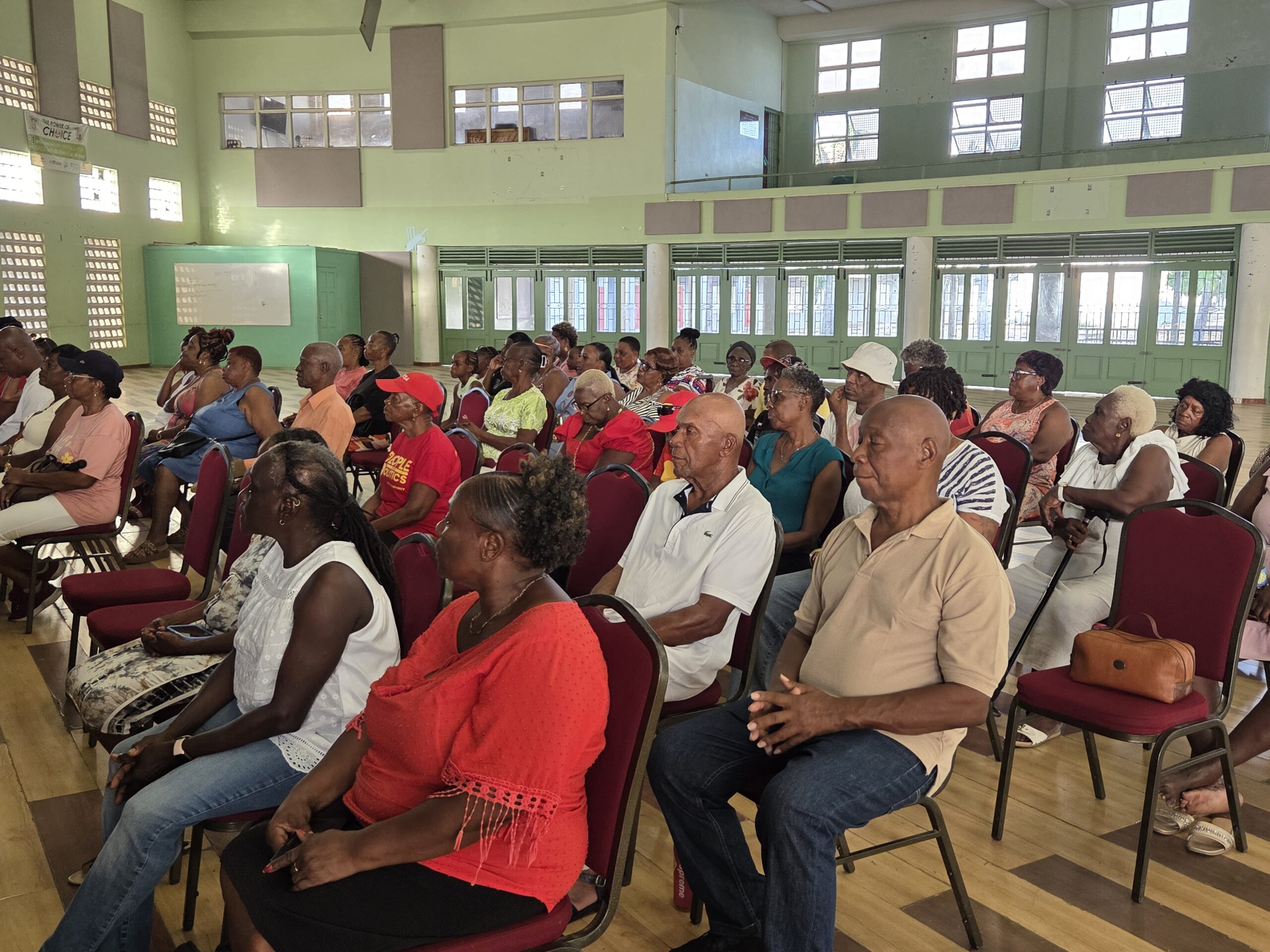
Amid upcoming restructuring plans for Barbados’ state-owned Transport Board, a senior government official has publicly called on domestic financial institutions to halt discriminatory lending practices against the agency’s workers, after multiple employees reported being locked out of credit over unfounded rumors of imminent mass layoffs. Senior Minister and Minister of Transport and Works Kirk Humphrey raised the alarm over the trend during a Sunday evening branch meeting of the ruling Barbados Labour Party in St Michael West, describing the unfair credit blocks as a deeply troubling development that harms working Barbadians.
Humphrey stressed that widespread claims of impending job losses among Transport Board staff are entirely unsubstantiated, and that the government has no plans to disenfranchise current employees during the restructuring process. “Many team members who choose to stay with the organization under the new arrangement will actually end up in a better position than they are in today,” he explained, noting he would share full details of the restructuring once negotiations with labor unions are finalized. “No employee of the Transport Authority will face unfair disadvantage from these changes. To the banks, I say this: when Transport Board workers come to you for credit, do not reject their applications just because you assume they will soon be unemployed. That assumption is not true, and it is unfair to stop people from accessing the money they need to feed their families, purchase a vehicle, or repair their homes.”
In addition to addressing the lending issue, Humphrey used the meeting to clear up widespread public confusion over the government’s recently signed Stand-By Arrangement with the International Monetary Fund (IMF), pushing back against misinformation spread by the political opposition that frames the deal as a costly new national loan. He emphasized that the agreement is not a loan, and carries no financial burden for the Barbados government or public. Instead, it functions as a pre-approved financial safety net that gives the country rapid access to emergency resources if a future crisis hits – eliminating the lengthy formal approval processes that normally delay access to IMF support.
To illustrate the arrangement for the public, Humphrey drew a parallel to an unused credit line. “It’s exactly like having a credit card with a $10,000 limit that you never actually use. You only pay a small annual fee to keep the line open, but you don’t owe anything if you don’t spend the money. That’s what this IMF arrangement is,” he said. He dismissed the Opposition’s claims that the agreement poses risks to Barbados as unfounded and misleading, noting that the pre-arranged access to funding will let the government respond rapidly to any emergency, from natural disasters to economic shocks, to rebuild infrastructure, clear roadways, and put critical support directly into the pockets of working Barbadians when it is needed most.
-

Helmet Laws Are Changing. Here Is What Riders Need to Know:
Across Belize, nearly 40 percent of all fatal road collisions involve motorcyclists, and head trauma consistently ranks as the leading cause of death in these incidents. That grim statistic is pushing the Central American nation’s Ministry of Transport to pursue sweeping legislative reforms aimed at strengthening motorcycle helmet safety standards and reducing preventable road deaths.
Current national regulations require all motorcycle operators to wear helmets while riding, but contain a critical gap: there is no legal definition of what qualifies as a safety-approved helmet. Chief Transport Officer Leon Gentle explained that this regulatory oversight has allowed unfit, low-protection headgear to be used in place of certified motorcycle helmets.
“On Belize’s roads today, you see every type of headgear passed off as safe motorcycle protection – from standard bicycle helmets to partial half-helmets that offer almost no impact protection,” Gentle noted in an interview. “That is why we are taking a close look at updating and formalizing binding safety standards for all helmets used by motorcyclists.”
The updated helmet regulations are just one component of a broader package of motorcycle safety reforms the transport department has spent months developing. The package will also introduce new rules governing pillion riders – passengers who travel behind the motorcycle operator.
Gentle pointed to dangerous, common unsafe practices involving passengers that the new rules will address, including underage passengers riding without properly certified helmets and small children placed on bikes with no properly sized footrests to keep them secure. “These are avoidable hazards that put vulnerable riders at unnecessary risk, and we have to address them proactively,” he added.
Belize recorded an encouraging drop in overall traffic fatalities across the country last year, but officials stress that motorcyclists remain the most at-risk group of road users. The full details of the reform package, including additional rules for pillion passengers, will be shared during a primetime broadcast on News 5 Live at 6 p.m. local time.
-

Water supply advisory Petite Martinique 18–19 May 2026
Residents of the Grenadian island of Petite Martinique have received an official advisory from the National Water and Sewerage Authority (Nawasa) regarding an upcoming scheduled operational shutdown for reservoir recharge at the island’s desalination plant. The mandatory maintenance work is set to begin at 10 a.m. on Monday, May 18, 2026, and will run continuously through to 5 a.m. the following day, Tuesday, May 19. Throughout this 19-hour maintenance window, regular water distribution services will be temporarily interrupted to allow crews to safely complete the reservoir recharge work.
In anticipation of the temporary service halt, Nawasa has issued a clear call to all residential and commercial customers across the area: begin setting aside adequate water supplies in advance of the scheduled start date to cover daily needs during the interruption. The authority also emphasized the importance of practicing strict water conservation for the full duration of the maintenance period, even for households that have stored extra water, to prevent unnecessary shortages.
Nawasa has extended a formal apology to the local community for any disruption to daily routines that this necessary work may cause. The agency also expressed its gratitude in advance for the patience and cooperation of local residents, noting that this scheduled maintenance is a critical part of ongoing efforts to sustain a consistent, reliable water distribution network for Petite Martinique long-term. This proactive upkeep aligns with Nawasa’s stated core mission of meeting the evolving water access needs of all its customers across Grenada.
This advisory was published by NOW Grenada, which notes that it is not liable for any opinions, statements, or third-party content shared in official contributor advisories, and provides a channel for users to report content that violates platform guidelines.