作者: admin

  • Iran Arrives in Mexico for World Cup, Key Officials Blocked From the US

    Iran Arrives in Mexico for World Cup, Key Officials Blocked From the US

    As the 2026 FIFA World Cup draws ever closer, Iran’s national men’s football team has landed in the Mexican border city of Tijuana, but a lingering visa dispute with the United States has thrown the team’s tournament preparations into uncertainty just days before their opening match.

    The squad was forced to abandon its pre-tournament training camp in Tucson, Arizona, and relocate across the U.S.-Mexico border over complications tied to long-running geopolitical tensions involving Iran. While all 26 members of the playing squad have received approval for U.S. visas to compete in the World Cup – which co-hosted across the U.S., Mexico and Canada – multiple high-ranking members of the Iranian national delegation remain locked out of the U.S. due to rejected visa applications.

    Among those denied entry are the Iranian Football Federation’s secretary-general and vice-president, as well as several key coaching staff members whose roles are considered integral to the team’s on-pitch performance. Speaking to reporters over the weekend after the team’s arrival in Tijuana, veteran defender Ehsan Hajsafi publicly called out governing body FIFA to intervene and resolve the administrative crisis before Iran kicks off their campaign.

    “First of all, we’re very happy that the team has finally arrived, and we’re delighted about that,” Hajsafi told reporters. “Unfortunately, several key members of our coaching staff, whose roles are very important within the team, were not granted visas.” He added that the whole squad is hoping FIFA can use its authority to push for a solution before their first fixture.

    A senior U.S. official confirmed to ABC News that all first-team players received visa approvals, but stated that some non-playing applicants were rejected after applying under what the U.S. government calls “false pretences.” The controversy comes amid long-standing heightened geopolitical tensions between the U.S. and Iran, and U.S. authorities have raised sharp security concerns around members of the Iranian delegation ahead of the tournament.

    U.S. Secretary of State Marco Rubio made the country’s position clear in comments to reporters on Friday, confirming that U.S. consular officials are vetting all delegation members to screen for any links to the Islamic Revolutionary Guard Corps (IRGC), which is designated as a terrorist organization by the U.S. government.

    “We have no problem with the athletes or their support staff. But what we’re not going to allow is for them to embed in their delegation people that we know have nothing to do with athletics and have ties to the IRGC,” Rubio said.

    Iran is drawn into Group C of the 2026 World Cup, and is scheduled to play their opening match against New Zealand on June 15 in Inglewood, California. They will face Belgium in Los Angeles on June 21, before wrapping up their group stage fixtures against Egypt in Seattle on June 26. All three of the team’s group matches are scheduled to take place on U.S. soil, leaving the visa dispute as a critical unresolved issue that could upend the team’s tournament if not resolved quickly.

  • Record Sargassum Is Winning Against Cleanup Efforts

    Record Sargassum Is Winning Against Cleanup Efforts

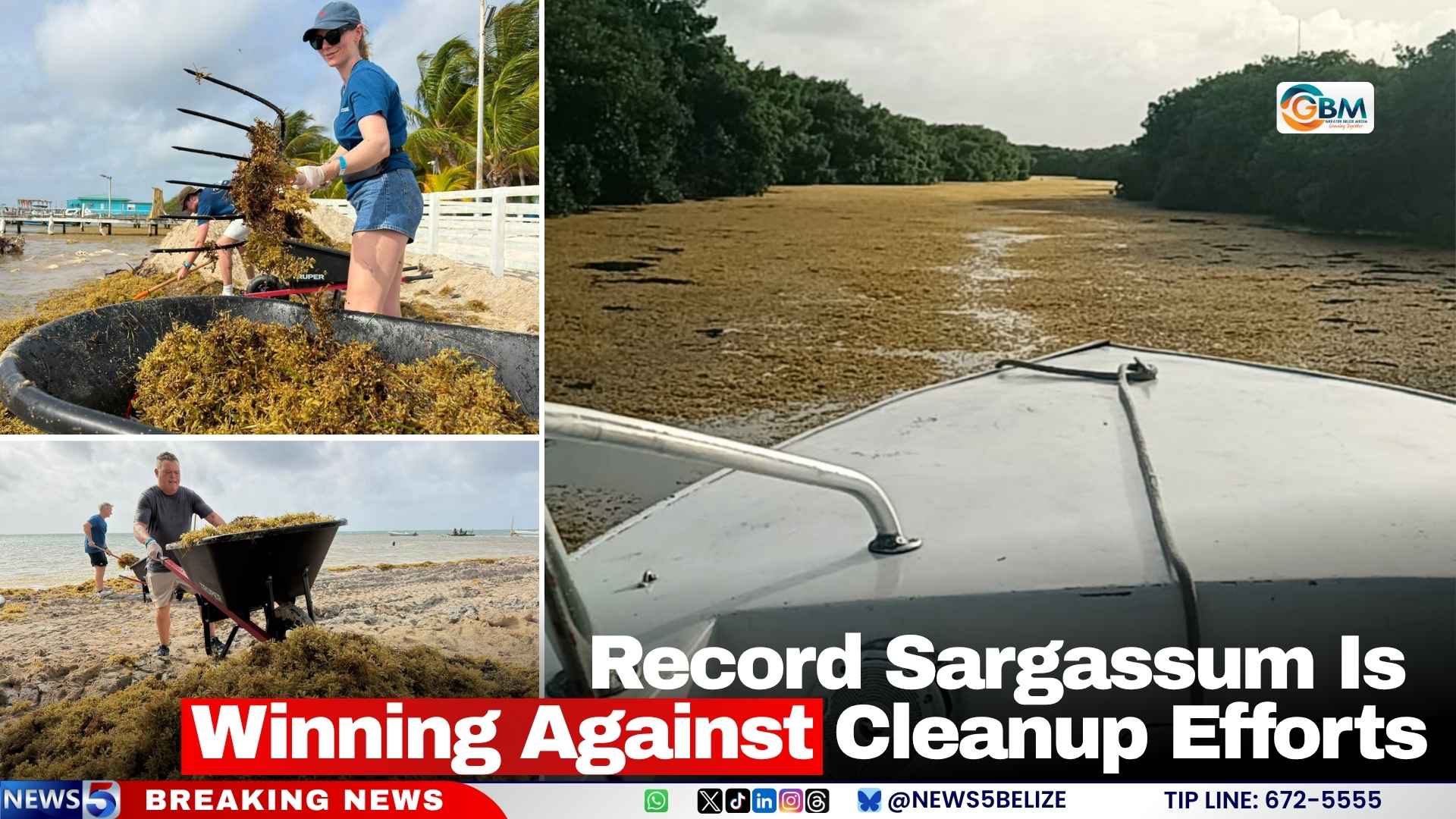
    Just over one week after a collaborative community revitalization project transformed Boca del Rio on Ambergris Caye, a persistent ecological crisis has undermined the initiative’s progress: massive influxes of sargassum seaweed continue to choke the Belizean coastline, overwhelming all ongoing cleanup efforts.

    The recent makeover project was a partnership between global tech firm Dassault Systèmes and the San Pedro Town Council. Over the course of the initiative, teams repainted public park infrastructure, planted native vegetation to stabilize sand dunes, installed new public safety and conservation signage, planted hundreds of young mangrove seedlings, upgraded local open-air palapa structures, and removed tons of accumulated sargassum from public beaches. The San Pedro Town Council praised the work, noting that the project left the popular coastal recreational area with a fresh, welcoming new look.

    But the sargassum threat has reemerged faster than local teams can manage. A local resident recently shared new footage and photographs captured during a boat trip through Boca del Rio’s old river corridor, showing the entire waterway saturated with thick layers of drifting seaweed. The visual documentation confirms that despite last week’s cleanup, the unrelenting inflow of sargassum has already returned the area to its previously degraded state.

    This crisis is not isolated to Belize’s shorelines. Across the border in neighboring Mexico, federal environmental authorities have issued a red alert for multiple top tourist destinations along the Yucatán Peninsula, including Playa del Carmen, Tulum, Puerto Morelos, and Mahahual. In all four locations, daily sargassum accumulation is outpacing the capacity of local cleanup crews to remove it, leaving popular beaches blanketed in rotting seaweed that drives away tourists and harms coastal marine life.

    Region-wide, 2026 is on track to shatter all previous records for sargassum blooms. Data from the University of South Florida’s Optical Oceanography Lab shows that sargassum biomass continued to grow across most of the Caribbean and Gulf of Mexico regions through May 2026, hitting the highest volume ever recorded for the month of May since systematic monitoring began. Scientists warn that warming ocean temperatures and increasing nutrient runoff from major river systems have created ideal conditions for sargassum growth, turning what was once an occasional natural event into an annual ecological and economic crisis for coastal communities across the region.

  • Historic Papal apology highlights Vatican’s role in sanctioning slavery

    Historic Papal apology highlights Vatican’s role in sanctioning slavery

    In a watershed moment for the global Catholic Church, Pope Leo XIV has delivered what leading theologians and historians broadly agree is the most unreserved papal apology in history for the institutional Church’s centuries-long role in legitimizing chattel slavery and delaying its formal condemnation, framing the long-overdue step as a critical prerequisite for meaningful redress.

    The apology was formally unveiled in the pontiff’s May 25, 2026 encyclical *Magnifica Humanitas* (“Magnificent Humanity”), a document that opens with a discussion of artificial intelligence before turning to confront the Church’s historical sins, drawing a direct line between the transatlantic slave trade authorized by past papal edicts and the new forms of exploitative power and neocolonialism taking shape in the digital age.

    Historical records confirm that while the Vatican has long claimed it always upheld the inherent dignity of all people as children of God, 15th-century papal directives explicitly granted European rulers permission to conquer Indigenous lands across Africa and the Americas and enslave non-Christian populations. The 1452 papal bull *Dum Diversas*, issued by Pope Nicholas V, gave the Portuguese crown authority to “invade, conquer, fight and subjugate” non-Christian communities and force them into “perpetual slavery”. A second 1455 bull, *Romanus Pontifex*, expanded these powers and laid the legal and theological groundwork for the Doctrine of Discovery, a framework that would be used for centuries to justify colonial land grabs and the systematic enslavement of African and Indigenous peoples. According to Jesuit historian Christopher J. Kellerman, these policies received endorsement from multiple successive popes over generations.

    In his address accompanying the encyclical, Pope Leo characterized the transatlantic slave trade as an “open wound in Christian memory.” He explicitly acknowledged that the apostolic See repeatedly intervened to regulate and legitimize systems of subjugation, including the enslavement of people labeled as “infidels” by Church leaders.

    Prior papal efforts to address the Church’s role in slavery have been far more limited. In 1888, Pope Leo XIII — the current pontiff’s namesake — became the first pope to formally condemn slavery, a step that came decades after most nations had already abolished the transatlantic trade. More recently, in 1992, Pope John Paul II delivered a speech on Senegal’s Gorée Island, once a central departure point for enslaved people bound for the Americas, in which he asked for forgiveness for the “heinous acts” of “baptized people” who failed to live out their faith. However, he stopped short of holding the institutional Church itself accountable.

    By contrast, Pope Leo’s apology is the first to explicitly recognize the Vatican’s institutional responsibility for legitimizing slavery, a distinction that scholars and activists have emphasized. Anna Rowlands, a professor of Catholic thought at Durham University who took part in the encyclical’s official presentation, told the National Catholic Reporter that the document frames this reckoning as a collective responsibility for the entire global Church, not just a failure of individual Christians.

    Historians have long documented that slavery was embedded within Church institutions for hundreds of years, drawing sustained criticism from Pan-African and radical thinkers. One of the most well-documented examples, cited in an NPR report, involves the U.S.-based Society of Jesus (the Jesuits). In 1838, Jesuit leaders sold 272 enslaved men, women, and children from their Maryland plantations to slaveholders in Louisiana, a transaction that propped up the Church’s financial standing in the young United States. Journalist and author Rachel Swarns chronicled this history in her book *The 272: The Families Who Were Enslaved and Sold to Build the American Catholic Church*, revealing that Jesuit priests prayed for the souls of the enslaved people they owned, while violently exploiting their labor.

    Caribbean intellectuals have also long called out the Church’s role as a core participant in colonial systems of exploitation. Guyanese historian Sir Walter Rodney, in his 1972 foundational work *How Europe Underdeveloped Africa*, framed the gap between Christian teachings of equality and the Church’s active participation in slavery as a defining example of institutional hypocrisy. Rodney argued that the Church-sanctioned ideology of European “divine right” to Africa and its resources created a deeply ingrained racist system that formed the backbone of global colonial infrastructure whose harms persist today.

    The historic apology has been widely welcomed by Black Catholic scholars and activists, who have spent decades organizing to pressure the Vatican to directly confront its institutional role in slavery. Shannen Dee Williams, a historian and author at the University of Dayton, told America Magazine that the pope’s statement marks a “monumental step” toward collective truth-telling and reparative justice. Williams noted that generations of Black Catholics have waited for the Vatican to openly acknowledge the Church’s involvement in the transatlantic slave trade, chattel slavery, and the ongoing legacy of anti-Black racism, saying: “The Catholic Church has never been an innocent bystander in the history of white supremacy.”

    With more than 200 million Black Catholics across the globe, the apology comes amid a growing global movement demanding reparations for the harms of slavery and colonialism. Observers expect the announcement will open new avenues for ongoing dialogue about institutional accountability and redress within the global Catholic Church in the coming years.

  • Commonwealth Observers Urge Timely Resolution of Election Petitions

    Commonwealth Observers Urge Timely Resolution of Election Petitions

    Against the backdrop of the April 30, 2026 general election held in Antigua and Barbuda, the Commonwealth Observer Group has published its final assessment, calling for urgent procedural reform to cut down the duration of election petition proceedings across the twin-island nation. In the document, observers warn that extended legal battles over electoral disputes do more than clog court dockets — they gradually erode public trust in both the country’s electoral system and its independent judiciary, threatening the foundational credibility of democratic governance.

    The core recommendation put forward by the group targets both the Antigua and Barbuda Electoral Commission (ABEC) and the national judicial branch. Observers stress that resolving all stages of election-related petitions in a timely, fair and equitable manner is a non-negotiable requirement to safeguard the integrity of electoral outcomes and guarantee that all parties have unimpeded access to justice. “To uphold the credibility of the democratic process, protect electoral integrity, maintain trust in the judicial process and ensure access to justice, it is recommended that all stages of election petitions be concluded in a timely and equitable manner,” the report reads, formalizing the group’s key priority for reform.

    Commonwealth election monitors also note that, while the nation’s existing legal and regulatory framework already provides a sufficient foundation for hosting competitive democratic elections, establishing clearer, binding timelines for election petition processing is one of several critical areas that require targeted updates. This call for reform comes amid a well-documented history of high-stakes election petitions in Antigua and Barbuda’s recent political landscape, where previous contests have spawned legal challenges to sitting elected representatives and disputes over candidate eligibility that dragged on for months or even years.

    On the whole, the observer team’s assessment of the 2026 general election remains largely favorable. Monitors confirmed that the poll was carried out across the country in a peaceful, orderly and transparent fashion. Even so, the group emphasizes that incremental, continuous reforms to electoral administration, dispute resolution protocols and independent oversight mechanisms are necessary to further bolster public confidence in Antigua and Barbuda’s democratic institutions and strengthen the resilience of its electoral system moving forward.

  • Ministry Deletes Statement After Matron Roberts Clinic Assault

    Ministry Deletes Statement After Matron Roberts Clinic Assault

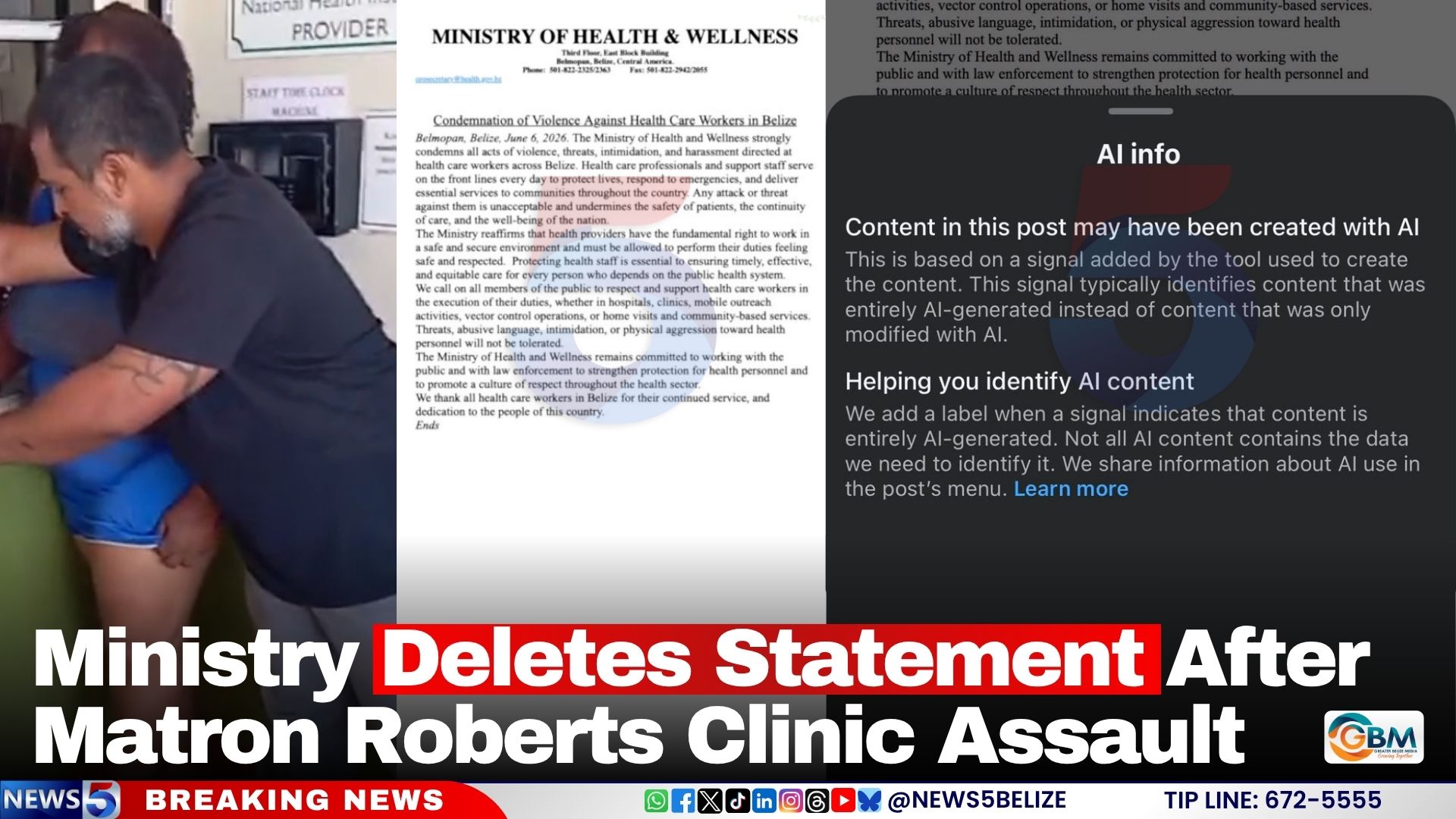
    A viral incident at Belize City’s Matron Roberts Clinic has sparked controversy after Belize’s Ministry of Health and Wellness was forced to retract an official statement addressing the event, when social media users uncovered the text had been entirely generated by artificial intelligence. The incident at the center of the public debate unfolded when 38-year-old Nichole McDonald arrived at the public clinic seeking urgent medical care for a pre-existing injury. Frustrated by extended wait times for a physician to see her, McDonald became physically confrontational with clinic staff, and cell phone footage of staff removing and restraining McDonald outside the clinic spread rapidly across social media platforms over the past week.

    In the immediate aftermath of the video going viral, the Ministry of Health and Wellness released a formal public statement that focused exclusively on condemning violence against healthcare workers. In the deleted text, the ministry emphasized its commitment to protecting healthcare staff, noting that all medical providers hold a fundamental right to carry out their professional responsibilities in an environment free from violence, intimidation, and harm. The statement added that the government body would not accept any form of verbal abuse, threats, intimidation, or physical aggression directed at healthcare personnel working in any public or private health setting across the country, and called on the general public to extend consistent respect to all medical workers.

    But within hours of the statement being published to the ministry’s official channels, members of the public noticed inconsistencies and generic phrasing in the text that suggested it had not been written by ministry staff. After multiple users pointed out the AI origins of the statement, the ministry moved quickly to remove the text from all of its public platforms. As of June 7, 2026, the ministry has not issued a replacement statement addressing the incident, nor has it commented publicly on why an AI-generated text was released in the first place. The incident has sparked new discussion online about government use of artificial intelligence for official communications, as well as ongoing conversations about long-standing issues of overcrowding and extended wait times at public health clinics across Belize.

  • Begroting DNA stijgt met 53%; SRD 125 miljoen extra voor nieuwe vergaderzaal

    Begroting DNA stijgt met 53%; SRD 125 miljoen extra voor nieuwe vergaderzaal

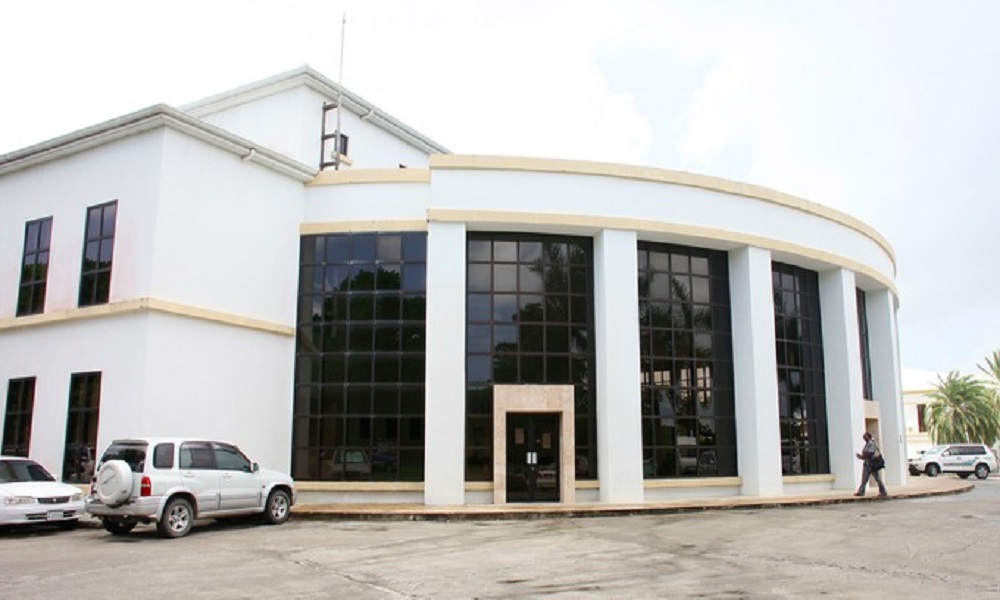
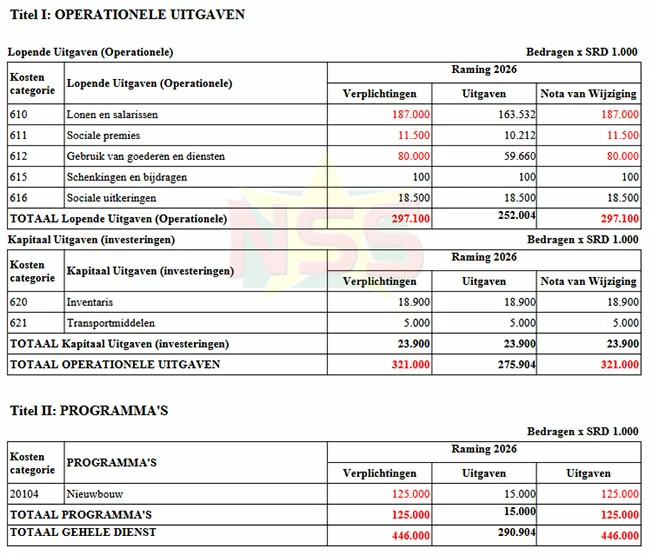
    Suriname’s National Assembly (De Nationale Assemblee, DNA) has greenlit a dramatic budget increase for its 2026 operating and capital expenditures, according to recently released amended budget documents. The legislative body’s total annual budget will jump from an initial projection of 290.9 million Surinamese dollars (SRD) to a revised 446 million SRD, representing a net increase of more than 155 million SRD, or a 53% growth from the original proposal. Budget analysts confirm the overwhelming majority of this additional funding is earmarked to advance the multi-year construction project of a new parliamentary meeting chamber, which has faced repeated delays over the past two years.

  • Grenada community group considers legal action over Woodford’s Rayneau Development

    Grenada community group considers legal action over Woodford’s Rayneau Development

    A local community advocacy group in Grenada has formally notified the national Planning and Development Authority (PDA) of impending judicial review action, contesting the agency’s approval of a large-scale industrial project in the Woodford district of St. John. Founded in 2025 specifically to push back against threats to local environmental and public health, the Woodford Environmental Alliance for Community Transformation (WEACT) represents hundreds of area residents and is being represented in the looming legal battle by international human rights law firm Leigh Day, in partnership with Grenada-based Ciboney Chambers. The disputed development, branded the Rayneau Development, is a sprawling industrial complex combining active quarrying operations, an asphalt manufacturing plant, a concrete batching facility, and a new coastal jetty, all situated in a heavily residential coastal zone.

    While portions of the project secured planning approval via a General Development Order in December 2025, the approval came with explicit conditions: developers were required to complete a full independent Environmental Impact Assessment (EIA), draft and receive approval for an Environmental and Social Management and Monitoring Plan (ESMMP), and complete all mandatory environmental assessment processes before breaking ground. WEACT alleges that these preconditions were never met, and developers launched site work early despite the outstanding regulatory requirements.

    To date, the group confirms that land clearing, road grading, and large-scale excavation have already been completed, with immediate negative impacts already documented across the local area. Ecological harm already recorded includes the destruction of critical protected habitat for the endangered Grenada dove, a species found almost exclusively on the island. Sediment runoff from the exposed construction site has already contaminated the Douce River, disrupting local water access, while heavy construction activity has damaged local public infrastructure and blocked long-established access routes to small-scale local farms.

    Beyond immediate environmental harm, WEACT warns of significant looming public health risks for the thousands of residents living within close proximity of the site, which is also near multiple local schools and places of worship. The group points to expected chronic air pollution from asphalt and concrete production, as well as constant noise, fine particulate dust, and ground vibration from ongoing quarrying operations that will disrupt daily life and raise long-term respiratory and cardiovascular health risks for local people.

    The development also threatens core community livelihoods that have depended on the Woodford coastal area for generations, WEACT argues, particularly small-scale traditional fishing operations that will be displaced by the jetty and industrial activity. Early archaeological surveys of the area have also identified unexamined cultural and historical heritage sites that could be permanently destroyed by construction, with no mitigation plans in place.

    In the formal pre-action protocol letter delivered to PDA, WEACT outlines multiple counts of unlawful action by the planning authority. These include claims that PDA unlawfully withdrew or abandoned the required full EIA, failed to conduct any meaningful consultation with affected local residents, improperly split the single integrated industrial project into smaller segments to evade stricter planning scrutiny, misused a General Development Order to approve a large specific project that does not qualify for the streamlined process, failed to enforce the binding planning conditions including the requirement for an approved ESMMP, ignored critical environmental, public health, and cultural heritage considerations during approval, failed to implement mandatory safeguards under Grenada’s coastal protection legislation, and acted irrationally and disproportionately in allowing the project to move forward.

    On May 20, 2026, WEACT submitted a formal request for the disclosure of all key internal documents related to the project’s approval, including records of environmental assessment decisions, planning approval meeting minutes, and compliance monitoring reports. The group has given PDA a three-week window to provide full disclosure and address its concerns.

    If the authority fails to deliver a satisfactory response, WEACT will move forward with full judicial review proceedings, asking the court to invalidate the original planning approvals and force the project to comply with all statutory environmental and planning requirements before any further construction can proceed. The legal challenge is supported by the Legal Empowerment Fund managed by the Fund for Global Human Rights, a global non-profit that supports community-led rights advocacy.

    Christelene Henry, a representative of WEACT, emphasized that the community exhausted all other avenues before turning to legal action. “We have watched our community and environment change rapidly without the proper safeguards being followed,” Henry said. “We are already experiencing impacts from dust, noise and disruption, and are deeply concerned about what this development means for our health, livelihoods and natural surroundings. We have tried to raise these concerns but feel we have been left with no option other than to pursue legal action to ensure the law is properly followed and our community is protected.”

    Jacqueline McKenzie, a partner at Leigh Day leading the legal team, noted that the case raises broader questions about regulatory accountability and transparent development decision-making in Grenada. “Our clients have serious concerns this development has been allowed to proceed in breach of Grenada’s planning and environmental laws,” McKenzie said. “The requirement for proper environmental assessment and community consultation is not optional; it is a fundamental safeguard to protect both people and the environment. This case raises important issues about the rule of law, transparency and accountability in decision-making. Our clients hope these matters can be addressed without the need for court proceedings, but they are prepared to pursue further action if necessary.”

  • Woman endures emotional abuse, threats and financial exploitation

    Woman endures emotional abuse, threats and financial exploitation

    A Jamaican adult child has reached out to prominent women’s rights legal advocate Margarette May Macaulay for urgent help, detailing years of escalating abuse and exploitation their mother has endured at the hands of her husband. In a distressing plea shared with Macaulay’s public advice column, the child explains that their mother has been trapped in a toxic marriage for over a decade, and the ongoing abuse has now reached a point where the mother’s life is at imminent risk.

  • From Jamaica to New York: Netania Mundell’s journey into global marketing

    From Jamaica to New York: Netania Mundell’s journey into global marketing

    Career paths are rarely the straight, pre-planned trajectories many young professionals are taught to pursue. For 29-year-old Jamaican marketing leader Netania Mundell, the journey from a university accounting major to a leading digital activation role at global beverage giant Diageo is a masterclass in following natural talent rather than rigid expectations, and turning personal roots into professional superpower.

    Today, Mundell serves as an associate of digital activation at Diageo, where she shapes marketing strategies for two of the company’s most iconic North American brands: Guinness and Smirnoff Ice. What makes her approach unique is a perspective rooted in her Jamaican upbringing: she rejects the idea that brands only exist in corporate boardrooms and polished campaign documents, instead arguing that brands live in the everyday moments, casual conversations, shared memories and cultural rituals of consumers. This people-first perspective blends perfectly with her own multi-faceted identity as a strategist, storyteller, cultural observer and creative.

    Mundell’s personality is as dynamic as the brands she elevates: quick-witted, unapologetically authentic, and infectiously upbeat, she brings humor and transparency to every project she touches. “I am very unserious in the best way,” she joked in an interview. But beneath that approachable, lighthearted energy lies a sharp, empathetic professional with an innate ability to read people, culture and untold brand stories — a skill that has become her greatest competitive advantage.

    That instinct was cultivated long before she entered the global marketing industry, in the close-knit, family-focused community of Portmore, St Catherine, where she grew up. Her father emerged as one of the most foundational influences in her life, offering unwavering support that helped her build the confidence to take calculated risks even when the future was unclear. That confidence would prove critical during her years at the University of the West Indies, where she enrolled to study accounting, only to slowly realize that the career she had mapped out on paper did not align with the creative, people-focused person she was growing into.

    Rather than sticking to the pre-planned path, Mundell began leaning into her growing curiosity for marketing: she got involved in campus activities, joined the UWI Marketing Association, and opened herself up to new opportunities. That proactive choice paid off in 2018, when she landed a coveted internship at telecommunications leader Digicel, her first formal step into the marketing industry.

    Around the same time, a second side of her professional identity began to grow organically on social media. On Twitter, audiences connected deeply with Mundell’s sharp humor, unique insights and unfiltered personality. As she navigated the uncertainty of post-graduation life, she turned that online following into the Netschat podcast, honing her skills as a creator and conversationalist. In an era where modern brands are expected to be culturally attuned, digitally native and emotionally intelligent, that hands-on creator experience gave her a rare edge that traditional marketing training could not provide.

    One of Mundell’s most celebrated early career wins came during her time at agency Mystique, where she managed the KFC Jamaica account. For 2022 Valentine’s Day, she pitched a simple but clever concept for an Instagram Reel: a romantic video shot in the style of a love letter addressed to a partner, with a playful twist that revealed the deep affection was actually for KFC’s popular Big Deal meal. The campaign went viral organically, becoming one of the highest-performing organic Instagram posts in the brand’s history — a testament to Mundell’s ability to blend humor, relatability and smart brand storytelling.

    For Mundell, what draws her to marketing above all else is the space the industry creates for unconventional, creative ideas. In 2022, she made another bold life and career choice: she left Jamaica to pursue a master’s degree in Integrated Marketing at New York University, rooting herself in one of the world’s most dynamic marketing hubs while still carrying her Jamaican identity with pride.

    Now at Diageo, she brings that unique perspective to a global business environment that demands equal parts creative innovation and disciplined execution. Focused on Diageo’s North American beer and flavored malt beverage segment, she manages brand strategy for Guinness and Smirnoff Ice across the region, but sees her role as far more than just a regional position: it is an opportunity to infuse global marketing with the cultural awareness and human-centered perspective she gained growing up in Jamaica.

    Looking ahead, Mundell expects her career to continue evolving at the intersection of creative storytelling, data-driven strategy and human behavior. Her advice for young professionals navigating uncertain career paths echoes her own journey: “Passion really has to drive you to be prepared. When opportunity comes knocking, you never want to be caught unprepared.” For Mundell, that willingness to follow her passion and prepare for new opportunities has turned an unconventional accounting detour into a thriving global marketing career.

  • Crime an emotional burden on Jamaicans, says cop once held hostage by prisoners

    Crime an emotional burden on Jamaicans, says cop once held hostage by prisoners

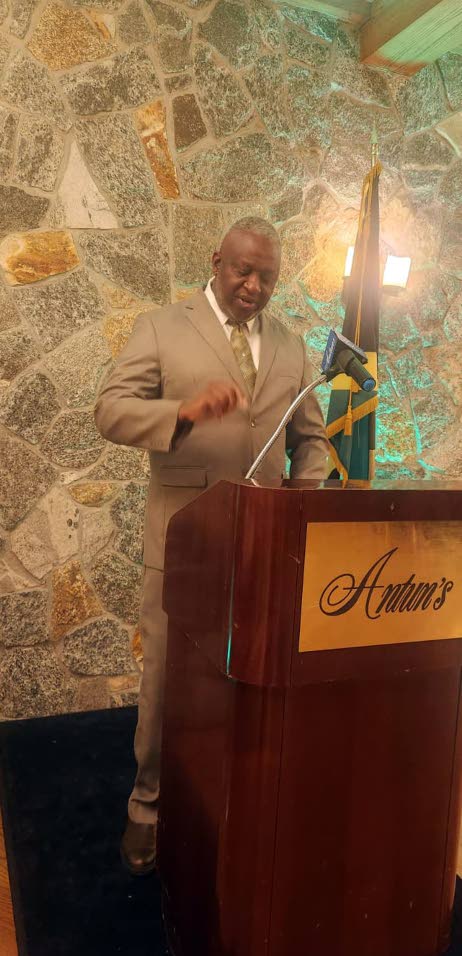
    QUEENS, N.Y. — At the 17th annual Fundraising and Awards Banquet hosted by the Ex-Correctional Officers Association of Jamaica, a 35-year veteran of the Jamaica Constabulary Force delivered an impassioned call to action, urging the hundreds of thousands of Jamaicans living in the diaspora to join the fight against violent crime and weapons trafficking back home.

    Superintendent Errol Adams, a former correctional officer who survived being held hostage by death row inmates during a 1998 prison uprising at the St Catherine District Prison in Spanish Town, framed crime not as a localized Jamaican issue, but as a collective emotional weight carried by Jamaican communities spanning every corner of the globe. Even for families who have built new lives in New York, Toronto, London, Miami, or Fort Lauderdale, the fear of harm hitting elderly relatives, children, or loved ones who remain on the island weighs heavily, he said.

    “Crime therefore has become more than a local issue, it has become an emotional burden carried by Jamaicans everywhere,” Adams told the gathered crowd of attendees, who included community leaders, diaspora organizers, and former Jamaican law enforcement officers.

    Central to Adams’ address was the revelation that criminal networks have systematically exploited one of the diaspora’s most beloved traditions: the decades-long practice of sending barrels packed with household goods, food, and school supplies to support family members back home. What began as an act of love and mutual aid, he explained, has been manipulated by transnational criminal groups to smuggle illegal firearms into the country.

    Adams outlined how traffickers hide weapons in seemingly ordinary shipments, stashing guns inside refrigerators, generators, industrial equipment, and shipped furniture. Contraband moves through a variety of channels, including commercial shipping containers, official cargo ports, private courier services, national postal systems, and unmonitored informal coastal landing spots scattered along Jamaica’s extensive shoreline. These operations are not opportunistic, Adams stressed; they are planned, strategic, and directly tied to global transnational criminal networks.

    Adams called for the diaspora to take intentional, concrete steps to disrupt these networks. “The Diaspora must never allow love for family to be manipulated into support for criminality,” he said. Key steps for community members include rejecting unregulated proxy or informal shipping arrangements, verifying both the contents and intended recipient of every shipment they arrange, only using official, legal trade and shipping channels, and refusing any requests to participate in even seemingly minor illegal activities. He added that diaspora members also hold a unique role in sharing critical intelligence with law enforcement to help track and break up trafficking rings.

    The veteran law enforcement officer acknowledged the ongoing challenges Jamaican security forces face in stemming the flow of weapons. Traffickers are highly adaptable, he noted: every time authorities upgrade security protocols at ports or entry points, criminals quickly pivot to exploit new vulnerabilities. Jamaica’s more than 1,000 kilometers of jagged coastline also creates nearly insurmountable logistical hurdles, as monitoring every remote beach, small fishing dock, and informal entry point is logistically impossible for even the most well-resourced security teams.

    “When criminal creativity combines with organised trafficking networks, the consequences usually become deadly,” Adams emphasized.

    He also laid out the far-reaching economic and social damage that persistent crime inflicts on Jamaica’s long-term development. Each year, the Jamaican government spends billions of dollars on policing, security operations, judicial processing, incarceration, and emergency medical response to violent crime — resources that could otherwise be invested in public education, critical infrastructure, universal healthcare, technological innovation, and youth development programs that lift communities across the country.

    Adams did highlight recent progress in Jamaica’s crime reduction efforts, sharing official data showing significant gains between 2024 and 2025. In 2024, Jamaican security forces seized 833 illegal firearms, while recording roughly 1,141 murders and more than 1,000 non-fatal shooting incidents. By comparison, 2025 saw 1,201 illegal firearms seized, and the national murder count dropped to 673 — the lowest recorded total in 30 years. To continue this downward trend, Adams argued, Jamaica’s crime-fighting strategy must remain holistic, coordinated, and centered on partnership between security forces and communities at home and abroad.

    Beyond the keynote address, the 2026 banquet served as a celebration of diaspora giving and community support. Three students from Copiague High School on Long Island were awarded the association’s annual 2026 scholarships, and the organization distributed monetary donations to three causes: the youth soccer team of the North Bronx Seventh-day Adventist Church, Team Jamaica Bickle, and the Tulloch Legacy Foundation’s Hurricane Melissa recovery efforts.

    The night’s top honor, the 2026 Community Service Award, was presented to Caribbean Food Delights, the food conglomerate founded by iconic Jamaican entrepreneur and philanthropist Vincent HoSang. The organization was recognized for decades of sustained investment in community development projects across both the Jamaican diaspora and Jamaica itself. Janice Julian accepted the award on behalf of Caribbean Food Delights from association president Ronnie Hammick.