作者: admin

  • Dominican Republic and Guatemala create bilateral forum to strengthen economic relations

    Dominican Republic and Guatemala create bilateral forum to strengthen economic relations

    In a landmark step to boost cross-border economic collaboration, the foreign ministries of the Dominican Republic and Guatemala have formalized an agreement to establish a joint Political and Business Forum, designed to deepen trade ties and unlock new investment opportunities between the two Latin American nations.

    The memorandum of understanding was signed during an official ceremony by Roberto Álvarez, Dominican Minister of Foreign Affairs, and his Guatemalan counterpart Carlos Ramiro Martínez Alvarado. Once operational, the forum will serve as a structured, recurring platform that brings together public sector leaders and private business delegates from both countries. Its core mandates include mapping untapped commercial opportunities, streamlining access to each nation’s consumer and industrial markets, and advancing collaborative investment projects that benefit both economies.

    Beyond facilitating direct business connections, the new bilateral mechanism will also promote the sharing of critical industry data, practical policy experiences, and proven regulatory best practices across three key areas: trade process simplification, national commercial promotion strategies, and the design of competitive investment incentive frameworks.

    Per the terms of the agreement, the forum will hold full plenary meetings once every year, with the host nation rotating between the Dominican Republic and Guatemala. A permanent dedicated working group will also be established to monitor progress on agreed initiatives, coordinate follow-up actions, and ensure consistent implementation of forum outcomes.

    Lead officials from both governments have framed the new forum as a transformative milestone in bilateral relations, noting that it will not only deepen longstanding economic ties but also create more pathways for private sector engagement in shaping cross-border cooperation. Notably, the initiative is structured to maximize the trade and investment benefits already available under the Dominican Republic–Central America Free Trade Agreement (DR-CAFTA), marking the first time the two countries have launched a standalone bilateral framework exclusively focused on expanding trade and investment collaboration.

  • Environmental Groups Back Cargo, Flag Cruise Port Expansion

    Environmental Groups Back Cargo, Flag Cruise Port Expansion

    As of April 23, 2026, a heated debate over Port of Belize Limited’s proposed expansion project has emerged, pitting environmental advocacy groups against government regulators who have already granted the initiative formal approval. Contrary to common assumptions that environmental organizations uniformly oppose large coastal infrastructure projects, a coalition of leading local NGOs is not opposing the entire scheme – in fact, it is throwing its full support behind the proposal’s cargo expansion component, which groups frame as a non-negotiable driver of long-term economic growth for Belize City and the broader nation.

    Dr. Melanie McField, founder of the prominent environmental initiative Healthy Reefs for Healthy People, outlined the coalition’s nuanced position in recent comments, drawing a clear line between the two distinct elements of the expansion plan. The most environmentally destructive component of the project, McField explained, is the proposed deepwater channel straightening work earmarked for the cruise terminal side of the expansion. Unlike standard sand dredging, this work requires cutting and excavating solid bedrock, a process that would cause far greater and irreversible harm to fragile coastal marine ecosystems. Critically, McField emphasized that this disruptive work is entirely unnecessary for the cargo expansion: while it would simplify navigation slightly, it is not a required upgrade to support the commercial cargo operations that Belize’s economy depends on.

    On the cruise terminal component of the expansion, McField argued that no final decision should be made without a full national strategic planning process, referencing a 2010 sustainable tourism framework developed by the Belize Tourism Board that already outlines clear guidelines for appropriate cruise port siting. The coalition maintains that large-scale cruise development requires a nation-wide approach to environmental and economic planning that is entirely separate from the justified expansion of commercial cargo capacity.

    Dr. Elma Kay, chairperson of the Belize Network of NGOs, expanded on these warnings, noting that Belize is rapidly approaching a tipping point for unplanned coastal development. With multiple large cruise port proposals currently under consideration across the country, Kay emphasized that existing feasibility studies consistently show Belize can only realistically support one large cruise terminal both economically and environmentally. Without a cohesive national port development strategy, Kay argued that ad-hoc approval of multiple projects would create unsustainable cumulative strain on both Belize’s natural ecosystems and its tourism economy.

    “Without a clear plan, development becomes fragmented and uncoordinated,” Kay explained. “We recognize the critical economic need for cargo port expansion, but the cruise terminal component requires far more deliberation and a public social contract to guide decision-making.”

    Despite these formal concerns raised by the environmental coalition, the National Environmental Appraisal Committee (NEAC) has already granted the expansion project approval to move forward. Government leaders have pushed back against criticism, noting that previous iterations of the proposal were rejected over unaddressed environmental flaws, and that those gaps have been resolved in the current plan.

    Prime Minister John Briceno has publicly committed to taking the coalition’s concerns seriously throughout the construction process, while Sustainable Development Minister Orlando Habet defended the government’s approval decision in recent remarks. Habet explained that the current proposal addresses all of the deficiencies that led NEAC to reject an earlier version of the project submitted by a private developer: the previous plan failed to outline adequate containment for dredged and excavated materials, a gap that has been fixed in the government’s revised proposal after the state acquired the Port of Belize. Habet also noted that regulators held extensive consultations with the local Port Loyola community, and that the government never received any formal communication or concerns from the Belize Mangrove Alliance, despite the group’s claims of being excluded from the process.

    As the project moves into the development phase, local journalists will continue to cover updates on how the government addresses outstanding environmental concerns and navigates the coalition’s calls for a national cruise development planning process.

  • Relief for Commuters as Bus Fare Deal Reached

    Relief for Commuters as Bus Fare Deal Reached

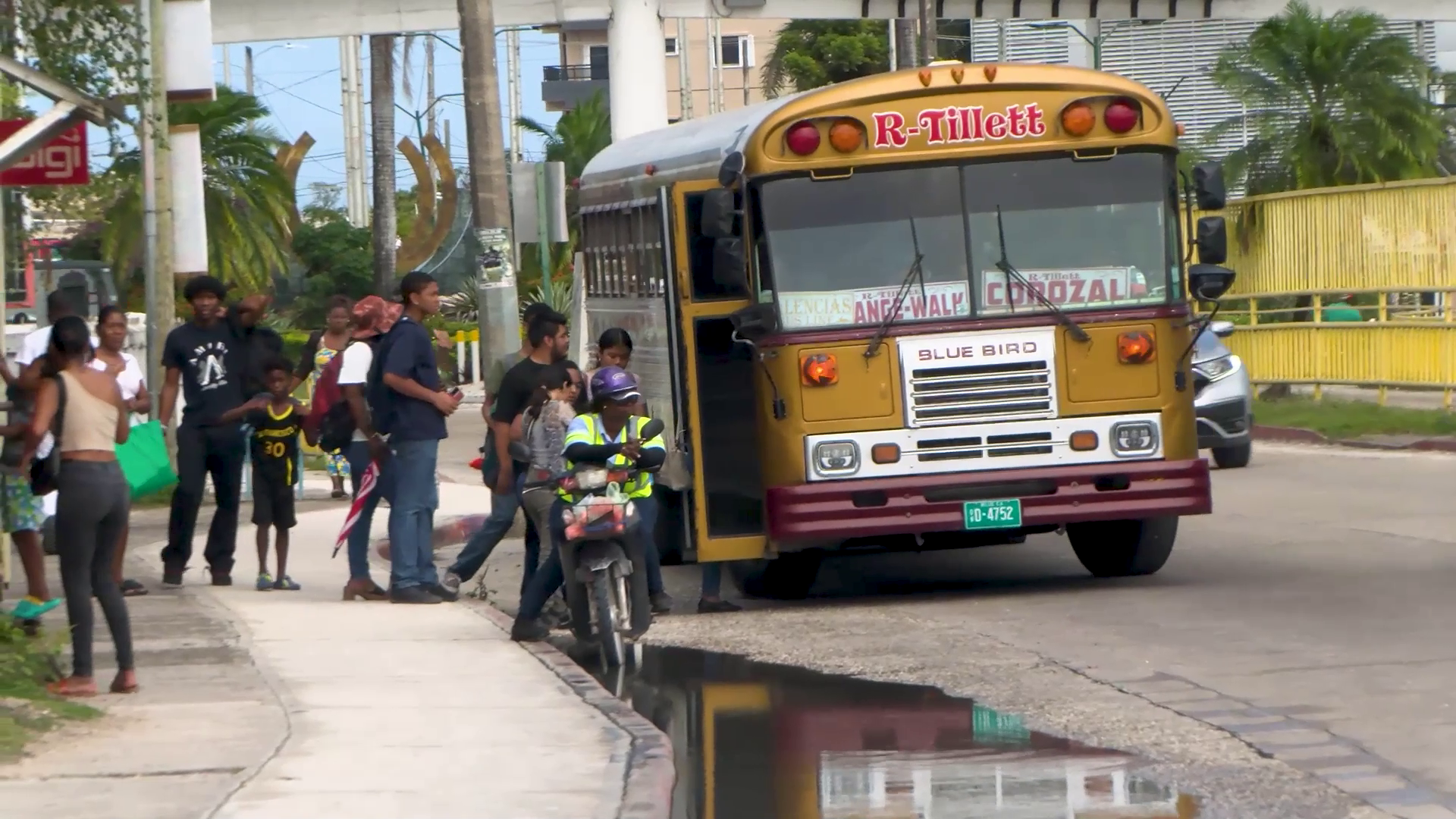
    Weeks of tense negotiations that brought the threat of a full shutdown of public bus service across Belize have ended in a landmark agreement between national government officials and bus operators that will keep services running while adjusting fare structures to offset spiking fuel costs.

    The breakthrough came out of a high-stakes meeting convened on the orders of Belize’s Cabinet, which was called to formally address the mounting concerns raised by the Belize Bus Association (BBA) and independent private bus operators, who had warned that ongoing volatility in global fuel prices threatened to push many operations into insolvency without fare adjustments.

    Phillip Jones, president of the BBA, announced that the deal will create a standardized, aligned fare structure that replaces the uneven pricing that left some commuters overpaying for certain routes while other routes were priced unsustainably low for operators. Under the new framework, many routes will see reduced fares: some routes that previously cost between $5 and $6 will drop to $3 or $4, while longer routes that were priced at $7 will also see modest reductions. For other routes that were underpriced relative to operational costs, small fare increases will take effect, ranging from 25 cents to a maximum of $1.50. A standardized price for short trips within a 10-mile radius will also be implemented, adjusting the short-drop fare from the previous $2.50 to $3.

    Jones emphasized that both negotiating sides prioritized minimizing the financial burden on regular daily commuters, taking into account ongoing global economic pressures tied to international geopolitical conflict that have driven up cost of living across the country. “It was a tedious process, with back and forth, but we kept the public’s need for affordable transportation at the center of every conversation,” Jones noted in remarks following the agreement.

    Before the new fares can go into effect, the adjusted pricing structure must be formally gazetted and finalized by Belize’s Department of Transport, with final approval required from the Transport Minister. Currently, existing fares remain in place, and implementation will not begin until at least next week once the regulatory process is completed and an official start date is announced.

    The deal eliminates the immediate threat of service disruptions that had left thousands of daily commuters uncertain about how they would travel to work, school, and essential appointments in the coming weeks.

  • Gun Board Lifts Restrictions While Tightening Requirements

    Gun Board Lifts Restrictions While Tightening Requirements

    Scheduled to take effect on June 1, 2026, a sweeping overhaul of Belize’s gun licensing framework will bring mixed changes for firearm owners and dealers across the country. The Firearms and Ammunition Control Board (FACB), a newly convened body that first convened in December 2025, has unveiled a revised set of rules that eases certain long-standing restrictions while strengthening oversight, pre-application requirements, and public transparency around the licensing process.

    After months of cross-stakeholder consultations with the general public, licensed firearm dealers, current gun owners, and agricultural industry groups, the board announced it will end a 28-month moratorium on new .223 caliber rifle licenses. The ban was initially implemented in February 2024 following a high-profile public incident involving a .223 rifle at a funeral, and was meant to allow time for a full audit of existing regulations governing the caliber. While that audit remains incomplete, FACB officials cite urgent pressure from Belize’s cattle industry as the key catalyst for lifting the restriction early.

    Cattle ranchers operating in northern Belize and along the Guatemala border have faced a growing crisis: widespread coyote predation that is killing as many as two to three head of cattle per night for some operations, translating to thousands of dollars in lost income per week. According to Francis Usher, Chief Executive Officer of Belize’s Ministry of National Defense and Border Security, smaller-caliber weapons and shotguns are ineffective for managing the predator population, as coyotes’ strong sense of smell prevents hunters from getting close enough for a lethal shot. While the moratorium is being lifted, Usher emphasized that strict vetting criteria for .223 rifle licenses remain fully in place, and the change will also allow existing .223 owners to legally access regulated ammunition for their firearms.

    Alongside the eased restrictions on .223 rifles, the board has updated its rules on permitted firearm accessories, eliminating the requirement for additional government approval for common modifications including scopes, red dot and green dot sights, weapon-mounted flashlights, lasers, and micro-conversion kits. The board draws a clear regulatory line between accessories that do not alter a weapon’s muzzle velocity or bullet discharge mechanics, and modifications that change a firearm’s core classification or lethality. Usher explained that since licensed firearm owners have already passed rigorous background and safety vetting, allowing approved accessories that improve shooting accuracy aligns with the board’s core goal of promoting safe, legal gun ownership.

    To address a long-standing public complaint that clear information on the licensing process was not readily accessible, the board has published a full public outline of all application requirements, in an effort to crack down on unlicensed agents that exploit confused applicants. Usher stressed that no third-party agent is required to submit or process a firearm license application: applicants can submit all required documentation directly to the FACB office for full board deliberation.

    The overhaul also introduces new, stricter accountability measures that shift more responsibility to licensed dealers and pre-licensing training. All new applicants will now be required to complete certified firearms training and pass a formal competency test at an approved firearm school before their application can be reviewed. Licensed dealers have broadly welcomed the new framework, noting that licensed firearm owners in Belize already maintain an extremely high compliance rate, with less than 1% of all crime involving legally licensed weapons.

    Babil Abner, owner of local firearms retailer Locked and Loaded Guns and Ammo, commended the board for basing its new rules on empirical data rather than public panic. He noted that the revised framework balances increased accessibility for legitimate gun owners with strengthened public safety safeguards, a balance that aligns with the long-term public interest.

    Overall, the FACB’s reform package frames gun ownership in Belize as a regulated privilege rather than an inherent right, and aims to strike a deliberate balance: easing unnecessary regulatory barriers for legitimate, vetted users while tightening oversight, transparency, and competency requirements to reduce public safety risk.

  • NCCU partners with DDA for 15th Jazz N’ Creole celebration

    NCCU partners with DDA for 15th Jazz N’ Creole celebration

    Dominica’s premier cultural calendar is gearing up for a landmark celebration, as the National Cooperative Credit Union (NCCU) has formalized a sponsorship partnership with the Discover Dominica Authority (DDA) to back the 15th annual Jazz N’ Creole festival. Scheduled for Sunday, May 3 at the historic Fort Shirley, this year’s edition will center on the curated theme “Afro Elegance”, bringing a unique blend of musical artistry and cultural heritage to attendees.

  • No dangers in ferry service, says CEO

    No dangers in ferry service, says CEO

    A heated debate has emerged over the viability of a new inter-island ferry network linking Barbados and member states of the Organisation of Eastern Caribbean States (OECS), after an industry consultant questioned whether the service could withstand the region’s sea conditions. Project leader Dr Andre Thomas, Chief Executive Officer of Barbados-based Pleion Group — parent company of service operator Connect Caribe — has pushed back hard against these claims, telling Barbados TODAY on Thursday that the vessels selected for the route are engineered to handle far harsher open-ocean conditions than the Eastern Caribbean ever produces.

    The controversy began earlier this week, when economic aviation consultant Jeremy Stephen raised sharp doubts about the project, arguing that frequent high swells and choppy water would make the ferry service unworkable. Thomas rejected this assessment outright, noting Stephen’s concerns lacked credible scientific backing, and outlined the design and track record of the overnight cruise ferries Connect Caribe plans to deploy.

    The vessels planned for the regional service belong to the large roll-on/roll-off passenger (Ro-Pax) vessel class, purpose-built to carry passengers, private vehicles and commercial freight across long-distance open water routes. Thomas pointed out that identical classes of ferries are already operated profitably year-round by major global shipping firms in far rougher international waters. These include DFDS’ cross-North Sea routes between Newcastle-Amsterdam and Copenhagen-Oslo, P&O Ferries’ Hull-Rotterdam service, and Brittany Ferries’ long-haul connections from Portsmouth to Caen and Santander.

    Thomas explained that the ferries earmarked for the Caribbean corridor range from 20,000 to over 60,000 gross tonnage, with deep drafts, active fin stabilizers, on-board cabins, restaurants, and dedicated full decks for vehicles and cargo. These large displacement vessels are explicitly designed for overnight open-water operation in conditions far more challenging than any recorded in the Eastern Caribbean, he added.

    “By any objective measure, the Eastern Caribbean is one of the calmest open-water ferry corridors in the world,” Thomas stated. “The claim that it is ‘too choppy’ to support a viable ferry network does not survive a five-minute look at global maritime data.” He added that modern large overnight cruise ferries operate daily, profitably, and year-round in waters that see wave heights two to five times higher than the Eastern Caribbean’s typical conditions.

    To back his argument, Thomas cited publicly available data from the U.S. National Oceanic and Atmospheric Administration (NOAA) National Hurricane Center, which shows the Eastern Caribbean’s average significant wave heights sit between three and seven feet, or 1 to 2 meters. Even during stronger trade wind surges, wave heights only reach five to eight feet, or 1.5 to 2.5 meters — conditions that Thomas says are well within the normal operating parameters for the planned vessel class.

    Thomas also pointed to longstanding regional precedent that proves the corridor is suitable for ferry operations. Germany’s FRS Group-owned FRS Express des Îles, formerly L’Express des Îles, has run scheduled passenger services across the exact same Eastern Caribbean stretch — connecting Guadeloupe, Les Saintes, Marie-Galante, Dominica, Martinique, and Saint Lucia — for more than 37 years, carrying roughly 850,000 passengers annually. This existing operation, Thomas argues, definitively confirms both that passenger demand exists and that the region’s sea conditions are suitable for sustained ferry service.

    While smaller regional passenger ferries already operate in the area, Thomas noted that the Eastern Caribbean currently lacks a large, stable overnight cruise ferry service that connects a broader network of islands, accommodates vehicles and freight, and positions inter-island travel as a comfortable, experience-focused journey for both locals and visitors. The project leadership’s pushback against criticism comes as stakeholders work to advance the landmark regional connectivity initiative.

  • PM puts distance from Transport Board sell-off

    PM puts distance from Transport Board sell-off

    A heated debate over the future of Barbados’ state-owned Transport Board has taken center stage at a recent public policy forum, where Prime Minister Mia Mottley pushed back hard against growing speculation that her administration intends to fully privatize the public transit entity. Instead, Mottley has reframed the widely discussed restructuring effort as a worker empowerment initiative that pairs expanded employee ownership with stricter island-wide regulation to guarantee reliable service for all communities, including underserved rural areas.

    The controversy reignited Wednesday during the Ideas Forum, where opposition St Peter candidate Jason Phillips of the Democratic Labour Party raised long-simmering public concerns about the government’s restructuring plans. Phillips echoed warnings first circulated late last year, when an official three-page letter from the Ministry of Transport and Works, signed by then-Permanent Secretary Jehu Wiltshire, was leaked to the public. The document confirmed that Cabinet had approved a transition to a new governing body, the Barbados Mass Transit Authority (BMTA), which would take over regulatory oversight of all public transit and hold the legal bill of sale for the Transport Board’s bus fleet. The leak triggered immediate pushback from the Congress of Trade Unions and Staff Associations of Barbados, which raised alarms about potential job insecurity and diminished service for rural residents.

    At the forum, Phillips doubled down on those concerns, arguing that profit-driven private operators would inevitably abandon low-revenue rural routes — such as those serving Boscobel and Indian Ground, where ridership is often thin during early morning and late-night trips. “I can’t see a businessman wanting to take his vehicle… to deep Boscobel with three people in it,” Phillips said, calling for binding legislation to mandate that critical routes and consistent schedules be maintained regardless of profitability. He emphasized that his concern centered on reliable access, not opposition to worker ownership, stressing that the priority must be protecting vulnerable rural commuters who depend entirely on public transit.

    Mottley drew a clear distinction between traditional privatization and what she calls “enfranchisement” to counter Phillips’ arguments, flatly stating: “There is no divestment of the Transport Board or privatization.” She explained that the proposed restructuring model would give Transport Board drivers and existing workers ownership stakes within the new system, rather than selling the entire entity to outside private investors. “We have said from the beginning that there is no divestment in the traditional sense. There is enfranchisement,” the prime minister said. “At the end of the day… the enfranchisement that is being entertained is to allow the drivers and the workers at the Transport Board to own.”

    Under the plan, the newly created BMTA will serve as a centralized regulator overseeing all public transit services across the island, including the Transport Board’s buses, independent minibuses, and route taxis. Mottley noted that the fragmented current system lacks consistent day-to-day oversight, a gap the BMTA will fill by enforcing strict licensing requirements. Operators that fail to meet their scheduled route obligations will lose their licenses, and the authority will implement a route rotation system to ensure no operator is stuck with only unprofitable routes, while no entity can hoard high-traffic, high-revenue corridors at the expense of rural communities. “If at the end of the day you are not operating your route to the terms and conditions of the license… you are out,” Mottley said, adding that the structure guarantees equitable service for all regions.

    Transport and Works Minister Kirk Humphrey reinforced Mottley’s position, dismissing any claims that outside private companies would take over the Transport Board. “There’s no company that’s coming in to own the Transport Board or none of those things you’re alluding to,” Humphrey said. He outlined that the government will retain supporting oversight while transferring bus ownership directly to workers, with the BMTA enforcing service standards to close long-standing gaps in rural transit. “The people will get a better service as opposed to less quality of service by the route that we are going,” he added.

    Critics have pointed out that Mottley and other senior members of her administration previously openly described the restructuring as a divestment effort, even as they framed it as worker-focused. During prior parliamentary debates and media appearances, top officials repeatedly used the term “divestment of the Transport Board” to describe the project. Deputy Prime Minister Santia Bradshaw, who previously served as Transport and Works Minister, told Parliament that the “divestment of the Barbados Transport Board” was “a serious exercise in enfranchisement” and guaranteed that concessions for elderly residents and schoolchildren would remain in place. At a ceremony marking the handover of 35 new electric buses at Bridgetown Port, Bradshaw told reporters: “the government is moving ahead with divesting the Transport Board amid growing public opposition and establishing a new mass transit system,” adding that “when we speak of divestment, we also equally speak of the enfranchisement of the workers of Barbados and the workers of the Barbados Transport Board.”

    The restructuring effort comes in response to decades of financial and operational instability at the Transport Board, which has required hundreds of millions in state subsidies to remain operational. Successive governments have called for a more sustainable funding model, while activists and opposition leaders have pushed to protect service access for low-income and rural commuters. The Mottley administration has repeatedly stated that vulnerable groups, including schoolchildren, pensioners, and low-wage essential workers, will retain their existing fare concessions and service access under the new framework. Despite the prime minister’s clarifications at the forum, Phillips maintained that the risk of profit-driven service cuts remains, and that ongoing public scrutiny will be needed to hold the government accountable to its promises.


  • As Gun Rules Ease, Where Are the Bullets Going?

    As Gun Rules Ease, Where Are the Bullets Going?

    In a policy shift set for April 23, 2026, Belize’s Firearms Control Board has moved to roll back regulations on select gun accessories and end a long-standing ban on .223 caliber rifles, reopening a long-simmering public debate: with looser gun rules in place, will illegally diverted ammunition end up in the hands of criminal groups?

    For decades, residents of Belize have raised persistent alarms that legally purchased ammunition is flowing through a covert pipeline from licensed gun owners to the black market, fueling violent crime across the country. Now, as the country expands civilian access to firearms and ammunition, communities and policymakers are questioning whether existing regulatory frameworks can stop this diversion from growing into a larger public safety threat.

    Francis Usher, CEO of Belize’s Ministry of National Defense and sitting member of the Firearms Control Board, laid out the government’s strategy to address the risk in an interview with local media. The core of the regulator’s approach is a major modernization of tracking and oversight, moving away from outdated paper-based systems to a fully digital ammunition monitoring infrastructure.

    Under the new framework being rolled out, every round of ammunition sold to a licensed holder will be logged in a centralized digital system immediately after purchase. The platform will record key details: the number of rounds bought, the date of transaction, and the manufacturing batch number of the product. To enforce accountability, regulators will implement unannounced random spot checks, cross-referencing a license holder’s purchase records with their reported use.

    For example, if a gun owner purchased 200 rounds of ammunition but reports no recent trips to an authorized shooting range, regulators will follow up to confirm the location and quantity of the unspent rounds, closing loopholes that previously allowed unaccounted-for ammunition to be diverted to criminal networks. Usher emphasized that while the new system is still under development and will never be completely flaw-proof, the Firearms Control Board is continuously refining the framework to improve public safety for all Belizeans.

    “It’s not a perfect system yet. It probably never will be a perfect system but every day that the board is there, we try to develop it so that it gets safer for Belizean,” Usher said, adding that regulators are prioritizing closing regulatory gaps before they can be exploited by criminal actors, with the ultimate goal of ensuring every round of legally sold ammunition can be traced and accounted for.

  • Another Officer, Pattern Emerges in Police Domestic Violence Cases

    Another Officer, Pattern Emerges in Police Domestic Violence Cases

    Less than a week after a high-profile police domestic violence case collapsed in a Belize court, a second law enforcement officer has been slapped with serious violent offense charges, shining a spotlight on a concerning pattern of domestic abuse allegations against serving officers that face repeated procedural disruptions.

    On the morning of April 23, 2026, PC Mercedes Chiac, an officer assigned to the Belize Police Department’s GI3 Unit, made his first appearance before the Belize City Magistrate’s Court. He faces two felony charges: use of deadly means to cause harm and wounding in connection with an alleged April 19 attack on his common-law wife, Rosie Munoz. The violent incident was reported to have unfolded at a residence on Riverside Street, where police investigators document a heated confrontation that escalated rapidly. According to official police accounts, Chiac assaulted Munoz by beating and choking her before grabbing a kitchen knife and stabbing her in the neck. Both Chiac and Munoz sustained stab wounds to the neck during the altercation, and a medical examination officially classified Munoz’s injuries as wounding, a serious offense under Belizean law.

    Court proceedings hit an immediate procedural pause on Monday, as prosecutors confirmed they are still waiting for formal guidance from the Director of Public Prosecutions to determine whether the case will be heard moving forward in the lower Magistrate’s Court or transferred to the higher High Court for trial. No plea was entered from Chiac during the brief hearing. In a striking detail that mirrors the previous police domestic violence case that fell apart earlier this week, multiple court sources confirmed Munoz intended to withdraw the charges against Chiac. She was escorted to the court building by uniformed police officers but was not permitted to enter the courtroom for the hearing. Magistrates granted Chiac bail set at $2,000 Belize dollars, and ordered him to return to court for a next hearing on June 9.

    This latest case comes immediately on the heels of public controversy surrounding another Belizean police officer, PC Phillip Garbutt, whose own domestic violence charges were withdrawn earlier this week after the complainant moved to back out of the prosecution. Legal analysts and domestic violence advocacy groups have already pointed to the two back-to-back cases as evidence of a troubling pattern: serving police officers facing domestic violence charges often see their cases collapse when complainants step back, a trend that many attribute to intimidation, systemic pressure, or personal relationship coercion that disproportionately impacts cases involving law enforcement personnel.

    The new charges have already reignited public debate over how the Belizean justice system handles domestic violence allegations against police officers, with calls for independent oversight to prevent procedural breakdowns that let accused officers avoid accountability.

  • Construction of Caye Caulker Police Station to Resume

    Construction of Caye Caulker Police Station to Resume

    Community pressure has forced a major policy reversal from the Belizean government, clearing the way for the long-awaited construction of the Caye Caulker Police Station to restart on the originally earmarked public parcel. The controversy ignited after a private offer was made for Parcel 815 – the plot of land reserved years ago for the new police facility – sparking widespread panic among island residents that the critical public safety project would be scrapped, and the valuable coastal property would be transferred to private ownership.

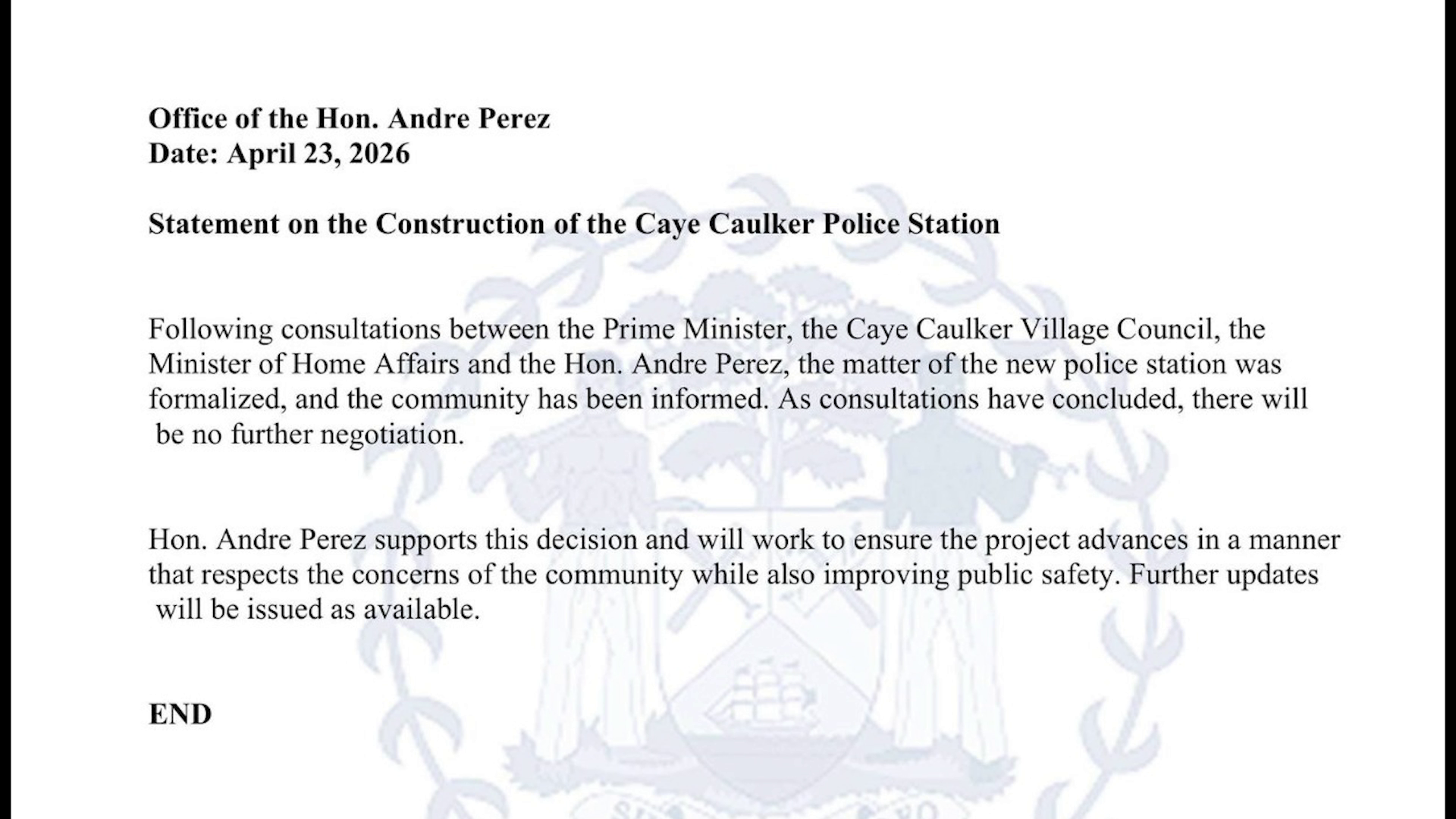
    For weeks, Caye Caulker residents organized to oppose the proposal, staging public protests, gathering signatures for a formal petition led by the local Village Council, and escalating demands for the government to honor its original commitment to build the police station on the designated site. Following the sustained public backlash, Belize Rural South Area Representative Andre Perez announced on April 23, 2026 that the government would reject the unsolicited private offer and immediately restart construction on Parcel 815.

    Perez clarified that the proposal to redevelop the parcel was never a finalized deal, emphasizing that the offer had only been under preliminary review when the Easter contractor break created a natural pause in the project. “We are listening to the concerns of the Caye Caulker community, and they have made clear they want the police station built on Parcel 815, where it was originally planned,” Perez stated in an interview. “As a result, we have agreed to move forward as planned, and contractor mobilization will get underway next week. I respect the will of the people of Caye Caulker, and there was never any confirmed sale, signed paperwork, or finalized negotiation for the property. It was just an unsolicited offer, and we have chosen to set it aside.”

    But while the government’s reversal has been hailed as a win for community organizing, the controversy has exposed deep-rooted concerns over transparency in public land decision-making on the island. Caye Caulker Village Council Chairlady Seleny Villanueva-Pott, who led the community’s pushback, said residents remain cautious, noting that the government’s public announcement lacks clarity and the core issue of land ownership remains unresolved.

    The parcel was originally donated to the Caye Caulker community by a private owner, and the Village Council is now moving forward with formal efforts to secure full legal ownership of Parcel 815 for the local government. “The community has shown incredible unity over the past two weeks, and we have made it clear we will accept nothing less than full control of Parcel 815 for the people of Caye Caulker,” Villanueva-Pott explained. “We have launched a formal petition and are still gathering signatures, and we are already in consultation with two legal teams to explore our options. If we need to pursue legal action to secure ownership, the full community stands behind this effort. We are hopeful that this announcement means Parcel 815 will be returned to the community, but we will continue our fight until that is formally finalized.”