作者: admin

  • Choiseul SPL leg delivers fireworks

    Choiseul SPL leg delivers fireworks

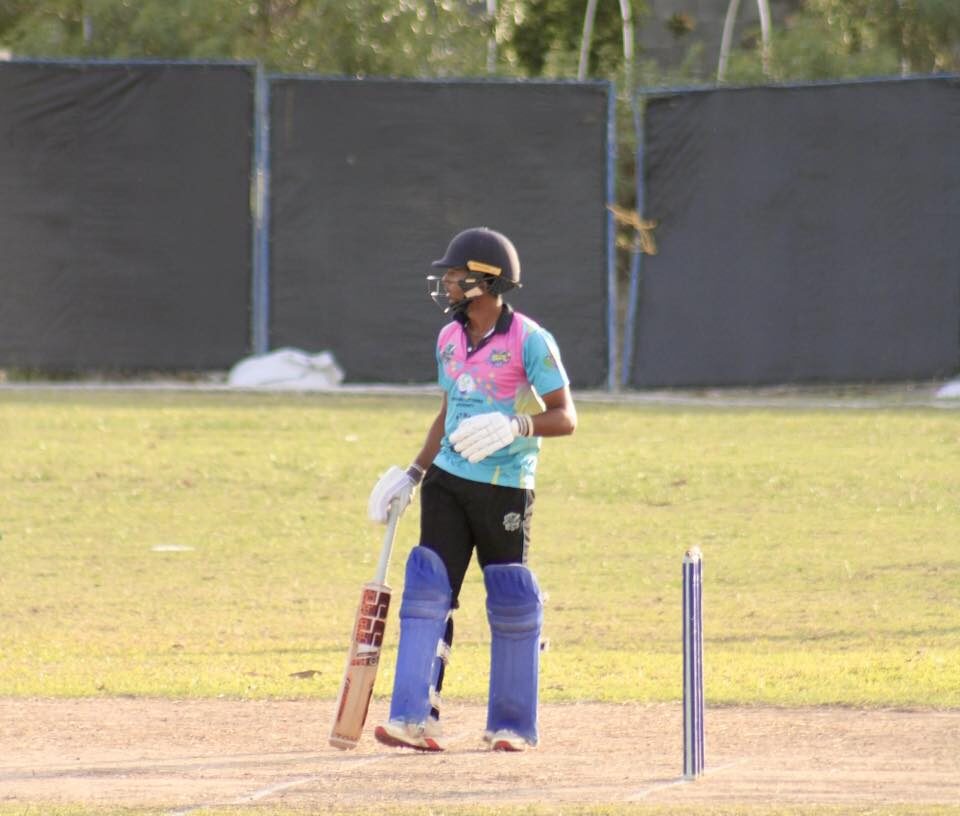
    The Saint Lucia Premier League T20 delivered another action-packed weekend of cricketing drama as the tournament entered its highly anticipated Choiseul leg, with four enthralling fixtures played across Saturday and Sunday at the La Fargue Playing Field — a venue that hosted both day matches and floodlit evening contests.

    The weekend’s opening clash on Saturday delivered instant tension, as the Soufriere Titans secured a last-over thriller against the Micoud Eagles by the narrowest of margins. Micoud won the toss and opted to bat first, posting a competitive total of 177 runs for the loss of seven wickets. Captain Mervin Wells laid a solid foundation for the innings, scoring a steady 48 runs from 40 deliveries, while Keygan Arnold stole the show with a blistering knock of 76 runs off just 45 balls, which included eight fours and four towering sixes to finish as the match’s top run-scorer. For the Titans, Djourn Charles delivered the most impactful bowling performance, claiming two wickets for 44 runs, while overseas recruit Kevin Sinclair put on a tight display of line and length, restricting the Eagles to just 13 runs from his four overs, picking up one wicket in the process.

    In their chase, the Titans got off to a disastrous start, losing Sinclair for a first-ball duck before Dwight Thomas was trapped leg before wicket just a few overs later. Middle-order batter Mateo Boulogne stepped up to steady the innings, hitting a quickfire 48 from 34 balls to keep the Titans in the hunt. While multiple batters got starts, consistent wickets from the Eagles bowlers meant the result would go down to the final over. The Soufriere-based side, nicknamed the men from Sulphur City, crossed the winning line with one wicket remaining and four balls left to spare, securing a hard-fought two-wicket victory.

    The second fixture of Saturday saw the Mon Repos Pioneers claim a 16-run win over the South Castries Lions. Batting first, the Pioneers were bowled out for 168 runs — a modest total that proved challenging enough for the Lions to chase. The total was almost single-handedly built by opener Sabinus Emmanuel, who smashed an explosive 76 runs off just 30 deliveries, hitting seven fours and seven sixes in a devastating display of power hitting. Apart from Emmanuel’s opening partner Gian Benjamin, who contributed 27 runs, the rest of the Pioneers batting line-up failed to make significant contributions, leaving the side with a smaller total than Emmanuel’s knock promised.

    The South Castries Lions’ key batters never got going in their chase. Star batter Johnson Charles fell for a first-ball duck, while Andre Fletcher, batting at four, managed only five runs. Bolton Sayers produced the standout performance for the Lions, scoring a well-crafted 51 off 27 deliveries with seven fours and two sixes, and Ephron Charles added a useful 38 runs lower down the order. Their late contributions were not enough to turn the tide, however, as the Lions were bowled out for 152, handing the Pioneers a comfortable victory in the end.

    Sunday afternoon’s contest between the Babonneau Leatherbacks and the City Blasters was dominated from start to finish by the central Castries-based side. Batting first, the Blasters piled up a mammoth total of 247 runs for the loss of four wickets, taking advantage of good batting conditions to hit at over 12 runs per over. Amari Goodridge led the charge with a brutal knock of 74 runs from just 23 deliveries, including 10 maximums and two fours. Kensley Paul (64) and Ryshon Williams (51) both contributed well-compiled half-centuries to build the huge total. For the Leatherbacks, Nyeem Rosemond’s one wicket for 28 runs was a standout effort on a day batters dominated, while Khan Elcock finished as the side’s most successful bowler with two wickets for 20 runs.

    The massive total proved far too much for the Leatherbacks, who were all out for 178 in reply. Joshua Mann produced a defiant fightback, scoring 72 runs off 37 deliveries, and captain Shervon Joseph chipped in with 35 runs. Beyond those two contributions, the batting line-up struggled to gain momentum, and the side fell to a 69-run defeat. Pacer McKenny Clarke was the star of the Blasters bowling attack, claiming four wickets for just 22 runs, including the key wicket of Mann, who he dismissed via a caught-and-bowled effort.

    The weekend’s final fixture saw Choiseul Craft Middle batter Junior Henry produce the performance of the tournament so far, as his record-breaking knock guided his side to a 28-run victory over the Soufriere Titans in a hotly contested local derby between neighbouring communities. Henry hit an astonishing 143 runs off just 61 balls, smashing 13 fours and 12 sixes to post the highest individual score of the 2026 tournament to date. With supporting contributions from his teammates, Henry’s knock powered the Craft Masters to a total of 236 runs from their 20 overs.

    Choiseul’s bowlers made early inroads into the Titans batting line-up, striking at regular intervals and putting the side firmly on track for a comfortable win. However, number 10 batter Shanii Mesmain produced a late counter-attack, blasting 64 runs from 28 deliveries to pull the Titans back into contention and launch a late surge. Despite his spectacular knock, the Titans fell short of the required target, handing the hosts a well-earned victory.

    Following the weekend’s action, City Blasters retain their position at the top of the tournament standings with 16 points. Soufriere Titans sit in second place with nine points, while Babonneau Leatherbacks and South Castries Lions are tied on seven points, with the Leatherbacks holding the higher position courtesy of a superior net run rate.


  • United Arab Emirates to quit oil cartel Opec

    United Arab Emirates to quit oil cartel Opec

    After nearly six decades as a core member of the Organization of the Petroleum Exporting Countries (OPEC) and its expanded OPEC+ alliance, the United Arab Emirates (UAE) has announced its formal withdrawal from both groups, a move that industry analysts warn could trigger far-reaching shifts in global energy markets and redefine geopolitical power dynamics across the Middle East.

    In an official statement, the UAE framed the departure as a deliberate alignment with its long-term strategic and economic priorities, noting that the decision reflects the rapid evolution of the country’s energy portfolio as it pursues diversification and expanded global market influence. UAE’s energy minister emphasized that exiting the production quota agreements bound to OPEC membership will unlock greater operational flexibility for the country’s energy sector, allowing it to adapt more nimbly to shifting global demand and its own development goals.

    The UAE first joined OPEC in 1967, just seven years after the cartel was founded in 1960 by five original members: Iran, Iraq, Kuwait, Saudi Arabia, and Venezuela. Its exit reduces OPEC’s current membership to 11 remaining nations, stripping the group of roughly 15% of its total oil production capacity. Current data from OPEC places the UAE’s annual output at 2.9 million barrels of crude oil, making it the cartel’s second-largest producer behind de facto OPEC leader Saudi Arabia, which pumps roughly nine million barrels annually. Industry observers also note the UAE has long been one of the alliance’s most compliant members, consistently adhering to agreed production cuts to stabilize global prices.

    Saul Kavonic, head of energy research at Australia-based MST Financial, called the exit “the beginning of the end of OPEC.” He argued that Saudi Arabia will now face an unprecedented challenge holding the remaining alliance together, as the kingdom will be forced to shoulder nearly all the responsibility for enforcing internal production compliance and managing global oil market dynamics on its own. Kavonic added that the departure could open the door for other dissatisfied OPEC members to follow the UAE’s lead in exiting the group.

    Beyond energy markets, Kavonic emphasized that the withdrawal marks the start of a fundamental geopolitical reshaping of both the Middle East and the global oil ecosystem. OPEC was established to coordinate national oil production policies among member states, with the core mission of delivering stable, predictable revenue for producing nations while balancing global supply and demand. Over the decades, the cartel’s membership has fluctuated, with nations joining and exiting at various points; today, beyond the five founding nations, remaining members include Algeria, Equatorial Guinea, Gabon, Libya, Nigeria, and the Republic of the Congo.

  • VAE stapt uit OPEC en OPEC+ in zware klap voor oliegroep en mondiale energiemarkt

    VAE stapt uit OPEC en OPEC+ in zware klap voor oliegroep en mondiale energiemarkt

    On Tuesday, one of the longest-standing members of the Organization of the Petroleum Exporting Countries (OPEC), the United Arab Emirates (UAE), announced an immediate withdrawal from both OPEC and the broader OPEC+ alliance, delivering a severe blow to the oil cartel and its de facto leader Saudi Arabia. The landmark decision comes at an already volatile moment, as the ongoing conflict between Iran and the United States has triggered a historic global energy crisis that has disrupted core supply chains and thrown the already fragile world economy into further disarray.\n\nFor decades, OPEC has worked to present a unified front to global markets, coordinating production quotas to stabilize global oil prices even as internal disagreements over geopolitical alignment and output targets have simmered beneath the surface. The exit of the UAE, a major Gulf oil producer, puts this carefully cultivated unity under unprecedented strain, with analysts warning it could trigger broader fragmentation and erode the cartel’s collective influence over global energy markets.\n\nGulf OPEC members already face persistent critical challenges to their core export infrastructure: around 20% of the world’s total crude oil and liquefied natural gas supplies pass through the Strait of Hormuz, the narrow waterway separating Iran and Oman. Ongoing threats and targeted attacks on commercial shipping from Iran have severely disrupted this key energy chokepoint, already raising insurance and transit costs for global energy shipments.\n\nThe UAE’s departure is widely viewed as a major diplomatic victory for former U.S. President Donald Trump, who has repeatedly attacked OPEC for artificially inflating global oil prices, accusing the cartel of “cheating the rest of the world.” Trump has long tied U.S. military security guarantees for Gulf states to oil pricing policy, publicly criticizing Arab producers for benefiting from American military protection while maintaining high prices that burden global consumers.\n\nAs a key regional business hub and one of Washington’s closest Arab allies, the UAE has openly criticized fellow Arab and Gulf states for what it calls inadequate responses to repeated Iranian attacks amid the ongoing regional conflict. Anwar Gargash, diplomatic advisor to the UAE president, slammed the response of the Arab League and the Gulf Cooperation Council (GCC) to Iranian aggression as “historically weak, both politically and militarily” during a recent appearance at the Gulf Influencers Forum.\n\”While GCC member states have offered each other logistical support, their political and military posture has remained consistently weak,\” Gargash stated. \”I expected this weak stance from the Arab League, but I did not expect it from the GCC. That is what has come as a real surprise.\”\n\nLooking ahead, the UAE’s exit is expected to accelerate fragmentation within both OPEC and OPEC+, making it far more difficult for the bloc to reach binding collective production agreements and maintain stability in global oil markets. This increased disunity will almost certainly amplify volatility in global energy exchanges and add further upward pressure to already soaring global inflation, which has been pushed higher by persistent energy price shocks over the past months.\n\nBeyond energy markets, the move is likely to escalate existing geopolitical tensions across the Middle East. The UAE has signaled it will pursue closer bilateral energy and security ties with Western nations outside of OPEC’s collective framework, leaving Saudi Arabia facing its most significant challenge in decades: preserving the cohesion and relevance of the oil cartel it has led for more than half a century.\n\nAs the global economy continues to grapple with widespread energy shortages and the cascading economic fallout from the Middle East conflict, governments and market participants around the world are now waiting with high anticipation to see how OPEC, Saudi Arabia, and the broader international community will respond to this unprecedented shift in global energy governance.

  • Dominican Writing Festival closes with new distribution agreements and calls for stronger Caribbean literary ties

    Dominican Writing Festival closes with new distribution agreements and calls for stronger Caribbean literary ties

    The fourth edition of the Dominican Writing Festival drew to a close on Sunday in Santo Domingo, wrapping up two days of dynamic dialogue, professional networking, and collaborative progress that solidified its growing role as a central hub for Caribbean literary communities. Held on April 25 and 26 at Santo Domingo’s Galería 360, the 2026 gathering brought together over 50 cross-sector literary stakeholders—including writers, independent publishers, academics, booksellers, and literary agents—from across the Caribbean: the Dominican Republic, Haiti, Cuba, Puerto Rico, and Venezuela. Over the course of the event, participants took part in panel discussions, author readings, live performances, and industry exchange sessions that addressed both the creative cultural work and practical business challenges shaping regional literature today.

    This year’s programming centered on a persistent, pressing question that echoed through every session: How can Caribbean literary markets, fractured for decades by geographic distance, language divides, and underdeveloped distribution infrastructure, build stronger interconnected networks? In his opening remarks, Rafael José Rodríguez Pérez, president of Río de Oro Editores and co-founder of CuentaRD, called for intentional, cross-border cooperation among publishers and expanded access to Caribbean literary works across the region. Festival founder Roxanna Marte framed the gathering as a core component of a larger movement to nurture a robust, self-sustaining regional literary ecosystem—and this year, that collaborative vision moved beyond words to tangible action.

    Organizers announced new book distribution partnerships with Puerto Rico’s Editorial Pulpo, and organized structured business matching sessions that connected independent publishers, regional distributors, and working authors directly. These practical industry-focused initiatives have become an increasingly central pillar of the festival’s mission, distinguishing it from traditional literary gatherings.

    The roster of featured participants reflected the region’s diverse literary landscape: Puerto Rican publisher Carlos A. Colón, Haitian writer Jacques Alix Louis, and Dominican authors Miguel Yarull, Manuel Chapuseaux, Ingrid Luciano, Clara Morel, Jhak Valcourt, Bismar Galán, Celestino Esquerré, and Siddharta Mata were among the creative voices in attendance. Academic contributors including Keturah Nichols, Rosa Calosso, Meaghan Coogan, María Carla Picón, and Ibeth Guzmán led conversations that tied literary production to broader regional conversations around history, identity, and cultural politics.

    Unlike earlier iterations that followed a more conventional literary festival format, the 2026 edition deliberately expanded its scope to act as a platform for critical debate and intentional industry-building. Panels delved into timely, cross-cutting themes including transnational migration, Afro-diasporic identity, colonial legacy, and digital humanities. The special dialogue *Haiti in Words: Identity, Resistance and Hope in Literature* centered the urgent need for deeper cultural exchange between Haiti and the Dominican Republic, a historically divided neighboring nation.

    Adding Venezuela as an official participating country extended the festival’s regional reach, with dedicated sessions exploring diaspora writing and displacement, such as the panel *Reading a New Country* featuring authors Siddharta Mata and Aída Magallanes. A standout session titled *From Paper to Screen* explored the expanding opportunities to adapt Caribbean literary works for film and stage, highlighting growing global demand for Caribbean stories outside of the publishing sector. A roundtable focused on cross-sector alliances between publishers, distributors, and local bookstores—bringing together stakeholders including Mary Claudia Pérez, Víctor Vidal, Francis Santos, and Luis Reynaldo Pérez—returned to the festival’s core theme, brainstorming solutions for independent Caribbean publishers to build stronger collective markets through collaboration, rather than competition.

    Beyond industry-focused work, the festival also featured inclusive programming for audiences of all ages, including dedicated children’s literature sessions, public poetry readings, theatrical performances, and live music, showcasing the event’s broader cultural impact across the Dominican Republic. During the closing ceremony, organizers awarded honors to María Carla Picón, Ibeth Guzmán, and Claudio Pérez for their decades-long contributions to Caribbean literary and editorial work. The ceremony also included a tribute to foundational Caribbean literary figures Julia de Burgos, Aída Cartagena Portalatín, and Teresa de la Parra.

    Four editions in, the Dominican Writing Festival has evolved far beyond a simple showcase for new literary work. This year’s gathering made clear that the event is now a driving force shaping the future of Caribbean publishing, as much as a space to celebrate the region’s rich existing literary legacy.

  • Applications open: 2027 MEXT Scholarship Programme

    Applications open: 2027 MEXT Scholarship Programme

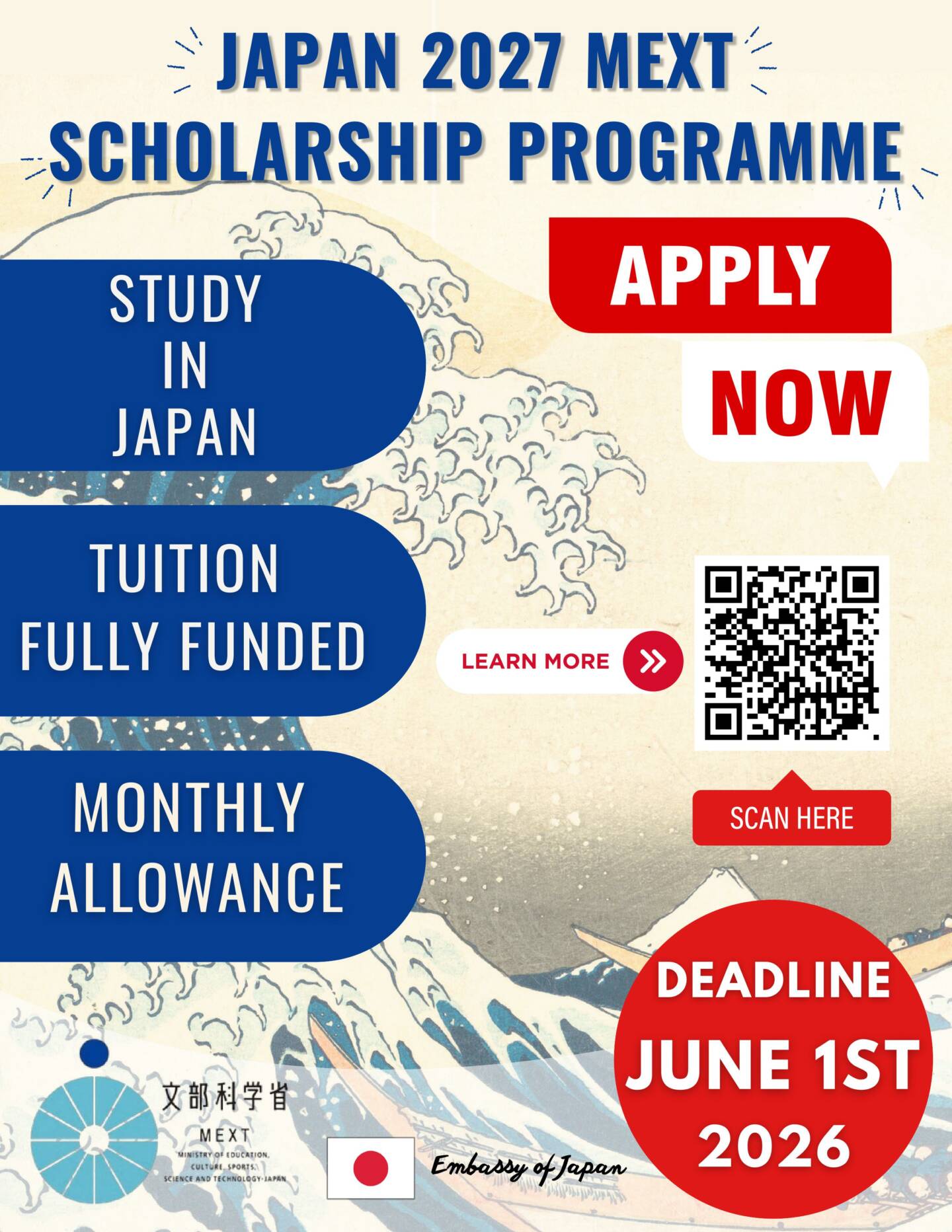
    Opportunities for international students aiming to pursue advanced academic study in Japan have arrived, as the Embassy of Japan has officially launched the application window for the 2027 Ministry of Education, Culture, Sports, Science and Technology (MEXT) Scholarship Programme, fully funded by the Japanese government.

    Designed to connect exceptional global talent with world-class Japanese higher education institutions, the program serves a dual purpose: it opens doors for transformative academic growth for outstanding overseas students, while advancing cross-border people-to-people exchange and nurturing the next generation of globally minded leaders.

    Per the official announcement from the Embassy of Japan, applications are only open to candidates who plan to enroll in a Master’s degree or higher-level doctoral or professional research program at a Japanese university. Successful awardees will receive comprehensive financial support that removes key barriers to studying abroad: the scholarship covers all academic-related costs including entrance examination fees, university admission fees, and full tuition fees. Beyond academic costs, recipients also get a monthly living stipend to cover daily expenses during their studies, plus a complimentary round-trip air ticket between Japan and their home country.

    All applications must be submitted no later than 1 June 2026, and the embassy has confirmed that no deadline extensions will be granted under any circumstances.

    To showcase the program’s long-running impact and the diversity of its past recipients, the embassy shared portraits of recent MEXT scholars from across the Caribbean region: 2022 awardee Darey Ann-Louisville from Suriname, who studies at the University of Tokyo; 2023 recipient Melanie Griffith-Quintyne of St. Lucia, enrolled at Akita University; 2024 scholar Brandon Tulsie from Guyana, attending the Shibaura Institute of Technology; and 2025 awardee Bridget Francis of Trinidad and Tobago, pursuing study at Kyoto University. All photographs included in the announcement are provided by the Embassy of Japan.

    Prospective applicants are advised to review full eligibility criteria and step-by-step application guidance by accessing the Embassy of Japan’s official website, or by scanning the QR code included on the program’s informational flyer.

    Highlighting the value of the opportunity, the embassy emphasized that the program is an ideal fit for driven, ambitious individuals seeking advanced academic experience in Japan, while also creating pathways to contribute to stronger bilateral and global cultural and educational exchange. For students ready to begin their academic journey in one of the world’s leading higher education systems, the application window is open now.

  • PM urges Barbadians to ‘be a hero to somebody’ in Heroes Day message

    PM urges Barbadians to ‘be a hero to somebody’ in Heroes Day message

    Barbados came together on April 28 to observe its annual National Heroes Day, a occasion dedicated to honoring the iconic figures who shaped the nation’s trajectory, with Prime Minister Mia Mottley delivering a stirring address that redefined heroism for modern citizens. In her message delivered to both domestic residents and the sprawling Bajan diaspora across the globe, Mottley rejected the common misconception that courage and heroism are reserved only for celebrated public figures, pushing instead for a vision of heroism rooted in daily action and service to others. The commemoration carries a special significance this year, as it marks the birthday of The Right Excellent Sir Grantley Herbert Adams, Barbados’ first Premier, a founding father of both the nation and the Barbados Labour Party. For current public servants, Mottley emphasized that Adams’ enduring legacy serves as a constant reminder that politics’ core purpose must be lifting up marginalized communities, upholding human dignity, expanding access to opportunity, and ensuring every Barbadian sees a place for themselves in the country’s future. Mottley opened her address by extending warm wishes to all Barbadians, at home and abroad, urging the nation to reflect on the sacrifices of the heroes who fought to build the independent, resilient country Barbados is today. During the ceremony, the Prime Minister paid special tribute to the nation’s two living National Heroes, highlighting their unique contributions to elevating Barbados’ global profile. The first, The Right Excellent Sir Garfield Sobers, showcased to the world that Barbadian talent combines grace, discipline, and unmatched skill that sets a global benchmark. The second, Her Excellency The Right Excellent Robyn Rihanna Fenty, has become a beacon for young generations across the island and the globe, proving that creativity, boldness, relentless hard work, and unwavering patriotism can carry a Bajan voice to every corner of the world. Drawing on the examples set by both historical and living national heroes, Mottley reiterated her core thesis: heroism is not measured by fame, formal ceremonies, or public applause. Instead, it lives in the values that guide daily life, the quiet examples people set for others, the burdens that individuals choose to carry on behalf of neighbors and community members, and the hope that is instilled in people who will never have the chance to repay that kindness. Against this backdrop, Mottley issued a straightforward but profound challenge to all Barbadians in 2026: step forward and be a hero to someone. She broke down what that everyday heroism looks like across age groups and communities. For a child, that means being a person they can look up to, modeling how to speak with integrity, work diligently, treat others with respect, and bounce back from failure. For a young person navigating an uncertain world, everyday heroism means proving that decency remains a strength, honesty still matters, discipline still yields meaningful rewards, and kindness is never a sign of weakness. For an elderly neighbor, heroism can be as simple as a phone call, an in-person visit, a warm meal, a helping hand, or just the quiet comfort of knowing they have not been abandoned or forgotten by their community. Mottley framed the concept of a hero simply: a hero is anyone who acts as a positive role model for at least one other person. It is a person whose core values, consistent virtues, and intentional choices give others a blueprint for how to live well. A hero inspires those around them to stand taller, work harder, live more purposefully, dream bigger, and deepen their love for their home country of Barbados. Echoing the words of the Barbadian National Anthem, which calls on citizens to be “Firm craftsmen of our fate,” Mottley noted that this is not just a lyric to be sung on ceremonial occasions—it is a binding duty that all citizens must live out every day. She closed her address by urging every Barbadian to commit to one small act of service: lift up one person whose life can be strengthened, encourage one young person who needs support, right one wrong that has been overlooked, and complete one act of service that leaves their home, school, workplace, house of worship, or community better than they found it. The national heroes honored today built the foundation of the modern Barbados that current citizens enjoy. Mottley left the nation with a closing question: what kind of Barbados will today’s citizens leave for the generations that come after them? Closing out the address, the Prime Minister wished all Barbados a happy National Heroes Day, repeating her core call to action: “Let each of us be a hero to someone.” (Issued by the Prime Minister’s Office)

  • Pierre: 1,000-dollar grant was ‘never meant to be enough’

    Pierre: 1,000-dollar grant was ‘never meant to be enough’

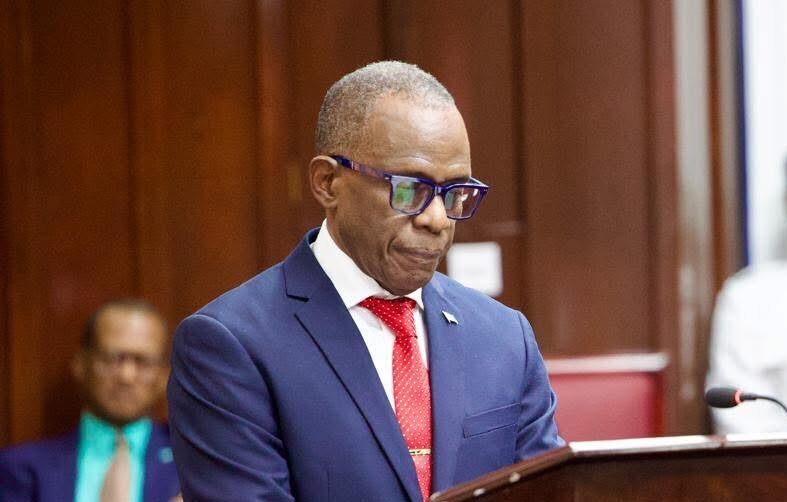
    St. Lucian Prime Minister Philip J. Pierre has pushed back against widespread public and social media criticism of a new family-focused policy unveiled during his recent annual Budget address, pushing to correct misinformation that has overshadowed the full scope of the government’s planned support package.

    During the three-hour Budget policy speech last week, Pierre announced a core policy measure: a one-time EC$1,000 grant that will be disbursed to eligible first-time mothers with registered newborn children, set to take effect on August 1, 2026. In the days following the address, the single grant announcement dominated public discourse, drawing critical commentary on social media and in local community discussions that framed the policy as a misguided attempt to incentivize higher birth rates.

    Speaking at a pre-Cabinet press briefing held on Monday, Pierre addressed the swirling controversy head-on, noting that critics had fixated on the grant while entirely overlooking a suite of complementary, far-reaching family support policies included in the Budget plan. “It’s one of the policy proposals for mothers of registered newborn babies who will receive a one-time grant of one thousand dollars… but there are some below it that everybody seems not to have seen,” he told reporters.

    Beyond the one-time grant, the Prime Minister outlined, the government’s full plan begins with a comprehensive review of national parental leave regulations following childbirth, designed to update existing provisions to better meet the needs of modern families. That policy overhual will be followed by a review of the island’s Affiliation Maintenance Act, alongside an expansion of the national school feeding programme that will deliver enhanced nutritional support to students across the country. Pierre argued that these context-setting measures had been erased from public conversation, replaced by superficial, politically motivated criticism.

    The Prime Minister also pushed back against claims that the grant program is intended to encourage higher birth rates to address the island’s well-documented low fertility rate and stagnating population growth. He emphasized that while population growth is a widely acknowledged concern for the small island nation, the government is seeking a thoughtful, responsible public conversation about the issue rather than pushing hasty, poorly targeted policies.

    “Whether we like it or not, there are concerns about population growth in this island, that’s a fact and what we ask for is a mature conversation by the country, a responsible discussion,” Pierre said. He dismissed claims that the grant amounts to a government payout to incentivize having children as political mischief, stressing that the policy’s core purpose is far more targeted.

    “People like to make political mischief when they talk about the government will give you a thousand dollars to make children, that is really not true, it was never true, and the buildup to it shows that it is not true,” he added.

    The Prime Minister clarified that the EC$1,000 grant is only intended to cover the initial costs associated with welcoming a new child, a burden that disproportionately impacts low-income and unemployed first-time mothers. Raising a child carries significant financial costs from birth, he noted, and the grant is a limited initial support measure — not a comprehensive solution, nor a reward for having children.

    “Babies are expensive, so the thousand-dollar grant is just an incentive to help people with their initial expenses; it is not a reward, nor is it a payment, nor is it something we give you, because the government wants you to make children. It is far from enough, it was never meant to be enough, nor was it meant to be any situation where the government is giving you an incentive to make babies, what it is, it is support for mothers, especially low-income or unemployed mothers,” Pierre explained.

    To round out the government’s broader family policy push, Pierre added that the grant will be paired with two additional support measures: expanded government assistance for parents with children enrolled in early childhood education facilities, and new financial incentives for private sector businesses that offer on-site or subsidized child care facilities for their employees.

  • Guyana minister raps CARICOM nations for accommodating Venezuela’s President with Essequibo brooch

    Guyana minister raps CARICOM nations for accommodating Venezuela’s President with Essequibo brooch

    A simmering territorial dispute between Guyana and Venezuela has erupted into a full-blown diplomatic controversy across the Caribbean Community (CARICOM), after Venezuelan President Delcy Rodriguez appeared in official meetings with multiple Caribbean leaders wearing a brooch that displays Venezuela’s map claiming Guyana’s resource-rich Essequibo Region as Venezuelan territory. The incident has sparked sharp criticism from a senior Guyanese official, internal political pushback within Guyana, and calls for regional accountability just weeks before the International Court of Justice (ICJ) hears formal arguments on the decades-long dispute.

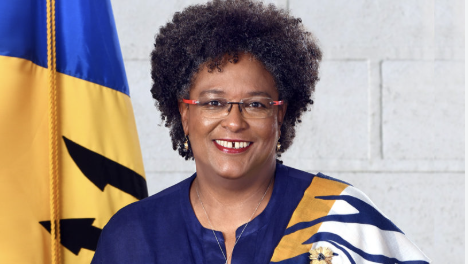
    In a blunt, public statement shared via Facebook late Monday, Guyana’s Minister of Local Government Priya Manickchand slammed CARICOM leaders who hosted Rodriguez and allowed the provocative display to go unchallenged during official engagements. Just hours before Manickchand’s post, Rodriguez had appeared alongside Barbados Prime Minister Mia Mottley at official events in Bridgetown while wearing the map brooch, which explicitly lays claim to the 159,000-square-kilometer Essequibo Region that makes up roughly two-thirds of Guyana’s total territory. This was not an isolated incident: earlier in April 2026, Rodriguez wore an identical brooch during meetings with Grenada Prime Minister Dickon Mitchell.

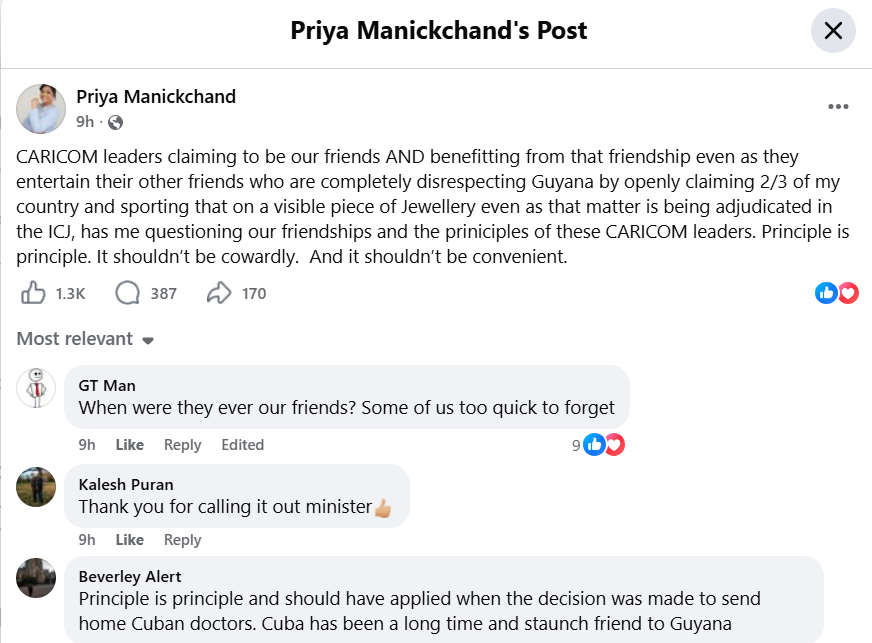
    Manickchand questioned the integrity of alliances between Guyana and other CARICOM members, noting that the territorial dispute is currently under active adjudication at the ICJ. “CARICOM leaders claiming to be our friends and benefitting from that friendship even as they entertain their other friends who are completely disrespecting Guyana by openly claiming two-thirds of my country and sporting that claim on a visible piece of jewellery has me questioning our friendships and the principles of these CARICOM leaders,” she wrote. The long-serving cabinet minister emphasized that commitments to sovereignty and territorial integrity should not be set aside for political convenience, adding “Principle is principle. It shouldn’t be cowardly. And it shouldn’t be convenient.”

    The criticism quickly sparked a domestic political backlash within Guyana. Beverly Alert, an executive member of the opposition Alliance For Change (AFC) and a former parliamentarian, hit back at Manickchand, accusing the Guyanese government of applying a double standard to questions of principle. Alert argued that the government itself abandoned principle when it terminated the country’s Cuban Medical Brigade programme, a move that came after the United States threatened to revoke visas for Guyanese officials and their immediate families over unsubstantiated claims that Cuban medical workers were exploited by the Cuban government. “Principle is principle and should have applied when the decision was made to send home Cuban doctors. Cuba has been a long time and staunch friend to Guyana,” Alert noted. Guyana was one of several CARICOM nations that ended the popular medical programme under U.S. pressure.

    To date, the Guyanese government has not released an official public statement on the controversy, which has been labeled “brooch gate” by regional political commentators. However, key private sector groups with close ties to the Guyanese administration have publicly condemned Rodriguez’s action and called for regional pushback. The Private Sector Commission (PSC), Guyana’s leading private sector umbrella organization, did not name Grenada in its statement but explicitly called on Barbados, CARICOM, and the broader international community to denounce the provocative move.

    “We call on the Government of Barbados, a valued CARICOM partner and long-standing friend of Guyana to stand firmly in defence of Guyana’s sovereignty and territorial integrity. Further, we call on CARICOM and all regional and international partners to remain vigilant and unequivocal in their support for the rule of law. Silence or inaction in the face of such deliberate provocation risks emboldening further escalation,” the PSC said.

    The controversy comes at a critical juncture for the territorial dispute. Next month, the ICJ will hold multiple days of public hearings where both Guyana and Venezuela will present the full merits of their arguments over the validity of the 1899 Arbitral Tribunal Award, which originally granted Essequibo to Guyana. The ICJ is expected to issue a final ruling on the case, which was brought to the court by Guyana, in the first quarter of 2027.

    While CARICOM as a bloc has repeatedly formally affirmed Guyana’s sovereignty over the Essequibo Region, many small CARICOM island states have maintained close bilateral ties with successive Venezuelan governments led by Hugo Chávez and Nicolás Maduro. These relations have been supported by decades of concessionary oil pricing and other forms of economic assistance from Caracas, creating a split in regional commitments that has been laid bare by the brooch controversy.

  • CXC calls on Caribbean to rally behind May–June 2026 Examination Candidates

    CXC calls on Caribbean to rally behind May–June 2026 Examination Candidates

    As the 2026 May-June regional examination cycle approaches, the Caribbean Examinations Council (CXC) has released a heartfelt, personal appeal to thousands of test-takers across the Caribbean, encouraging candidates to enter their exams with confidence while prioritizing self-care, and reaffirming the institution’s unwavering support for every learner sitting its assessments.

    The message, delivered via a public video address to candidates, parents, teachers and regional education stakeholders, comes from CXC Registrar and Chief Executive Officer Dr. Wayne Wesley, who framed his communication as a personal note from a lifelong Caribbean educator to students in their final preparation phases. This appeal also lands at a meaningful milestone for the 54-year-old regional assessment body, which has anchored Caribbean education systems for more than half a century.

    Founded in 1972, CXC was created to build and operate a locally rooted assessment system that centers the lived realities, collective aspirations, and sovereign cultural identity of Caribbean people. The first CXC examinations were held seven years after its founding, in 1979, and today, decades later, Dr. Wesley confirmed that the organization’s core founding commitments remain unchanged. “While much has shifted across education and the region over the decades, there are values that have stood the test of time: the cultural relevance of our syllabuses, the global recognition of our qualifications, the dedication of our team, and our absolute commitment to the success of every single candidate that takes a CXC exam,” he stated in his address.

    The upcoming 2026 May-June session will include the full range of credentials offered by CXC, spanning the Caribbean Advanced Proficiency Examination (CAPE), Caribbean Secondary Education Certificate (CSEC), Caribbean Vocational Qualification (CVQ), Caribbean Certificate of Secondary Level Competence (CCSLC), and the Caribbean Primary Exit Assessment™ (CPEA™).

    A highlight of the 2026 cycle is the official pilot launch of the Caribbean Targeted Education Certificate (CTEC) Mathematics Module 1, a development Dr. Wesley framed as proof of CXC’s ongoing work to expand accessible learning pathways for regional learners. More than 2,400 candidates from 13 CXC member states have already registered to participate in this first pilot. Participants in the pilot will earn a CTEC micro-credential as they work toward completing their full CSEC certification, marking a new flexible direction for assessment across the Caribbean.

    The CTEC initiative was first introduced as a key flexible education pathway proposal during CXC’s inaugural Regional Education Conference and Ministerial Forum, co-hosted with Jamaica’s Ministry of Education, Skills, Youth and Information in Kingston this past March. Education observers have described the four-day gathering as a watershed moment for Caribbean education; the event brought together more than 400 education leaders, policymakers, and practitioners from 27 nations to address the pressing challenges of teaching, learning, and assessment in an increasingly digital era. During the conference, Dr. Wesley emphasized that the region’s assessment systems must adapt to match how digital-native learners engage with and process knowledge, adding that educational equity is not a compromise on excellence, but rather its most authentic form.

    Closing his address to upcoming exam candidates, Dr. Wesley framed current innovations like CTEC as the tangible future of Caribbean education already taking shape across the region. “As you wrap up your final preparations, use your study time wisely. Look after yourself and your mental wellbeing. Eat well, and rest when you need to. Be confident, show up for all of your examinations — you’ve got this,” he urged.

    This report carries a disclaimer from NOW Grenada, which notes that the outlet is not responsible for the views, statements, or third-party media content shared by contributors, and provides a channel for users to report abusive content.

  • Police Arrest 22-Year-Old Male In Connection With Bomb Threat

    Police Arrest 22-Year-Old Male In Connection With Bomb Threat

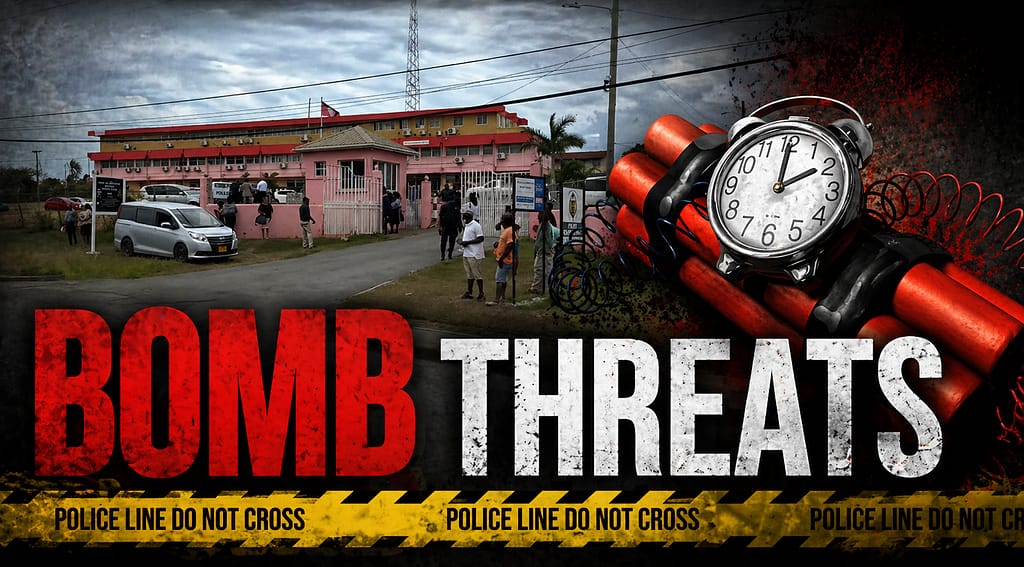
    The Royal Police Force of Antigua and Barbuda has confirmed the arrest of a 22-year-old male resident of Old Parham Road in connection with a bomb threat targeting the agency’s central headquarters. The threat was first reported on Monday, triggering an immediate response from law enforcement units across the island nation.

    Officers from the Criminal Investigations Department (CID) Task Force took the suspect into custody during a targeted operation launched shortly after 6:00 a.m. local time on Tuesday, April 28. As of the latest official update, the detained individual is cooperating with investigators as they work to unpack the details of the incident, including motive and any potential broader connections to other activities.

    In an official media statement released by the police force’s Office of Strategic Communications (STRATCOM), department leadership emphasized that all threats to public security are treated with the highest level of urgency. The administration reaffirmed its ongoing commitment to protecting the welfare and safety of every citizen and permanent resident across Antigua and Barbuda.

    Authorities note that the investigation is still active and evolving, and additional information will be released to the public once new developments are confirmed in the case.