作者: admin

  • NIA Breaks Ground on Transformative Multi-Million-Dollar Airport Expansion Project

    NIA Breaks Ground on Transformative Multi-Million-Dollar Airport Expansion Project

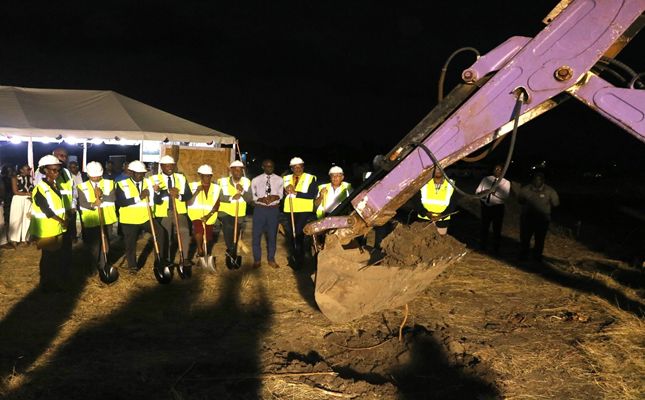
    On July 1, 2026, senior officials from the Nevis Island Administration (NIA) and key project stakeholders gathered in Newcastle, St. James, for a ceremonial sod-turning event, marking the official launch of a transformative multi-million-dollar expansion project for the Vance W. Amory International Airport (VAIA). The long-awaited infrastructure initiative, more than a decade in development, is poised to redefine Nevis’ regional connectivity, catalyze tourism growth, and strengthen the island’s long-term economic trajectory for current and future generations.

    Speaking to attendees at the groundbreaking ceremony, Nevis Premier Mark Brantley—who also holds portfolios for Tourism, Finance, and Economic Planning—framed the milestone as a landmark moment in the island’s developmental history. Brantley, whose administration is led by the Concerned Citizens Movement (CCM), emphasized that the initiative represents a deliberate, forward-thinking investment in Nevis’ next chapter.

    “We are gathered here today to make history, breaking ground for an investment that will propel Nevis forward for the next generation,” Brantley said. “This government is committed to lifting this island to new heights, and we are building this not just for today, but for the generations that will come after us. A modern, expanded Vance W. Amory International Airport is not just good for Nevis—it strengthens the entire Federation of St. Kitts and Nevis.”

    Brantley detailed the 10-plus years of persistent work that brought the project from concept to construction, noting that the path to groundbreaking required navigating complex technical challenges, iterative redesigns, and extensive negotiations to secure the necessary financing. “Major infrastructure projects take time, and this has been a relentless, ongoing effort,” he explained. “We designed and redesigned, went back to the drawing board time and again, and once we had a solid plan, we still had to secure the financing. There were long days and difficult nights navigating financial hurdles, political coordination, and planning for how Nevis would sustain a project of this scale. This was never an easy task, but we stayed the course to deliver a project that benefits all Nevisians.”

    The expansion project is expected to deliver widespread economic benefits at every stage, from construction through long-term operation. During the 18-month construction phase, the initiative will create substantial employment opportunities for local contractors, skilled tradespeople, general laborers, and local service providers, while boosting demand for locally sourced goods and materials. Once completed, the upgraded airport will support dozens of new permanent positions across operations, security, customs and immigration, ground handling, maintenance, and other core airport services. Beyond direct airport employment, increased air access and higher visitor volumes are projected to spur new growth and opportunity for local businesses and entrepreneurs across tourism-adjacent sectors, including hospitality, transportation, tour operations, restaurants, retail, and more.

    Brantley publicly thanked the three key funding partners that made the project possible: the Federal Government of St. Kitts and Nevis, which guaranteed a EC$20 million loan from the St. Kitts-Nevis-Anguilla National Bank (SKNANB); the Government of the Republic of China (Taiwan), which provided a US$20 million concessional loan; and private investor Patrick Drahi, who contributed US$25 million in direct investment capital to the initiative.

    His Excellency Edward Ling-Wen Tao, Ambassador of the Republic of China (Taiwan) to the Federation of St. Kitts and Nevis, reaffirmed Taiwan’s longstanding commitment to partnership with Nevis and shared confidence in the project’s ability to drive shared prosperity. “On behalf of the Embassy of the Republic of China (Taiwan), I extend my sincerest congratulations to the government and people of Nevis on this historic milestone,” Ambassador Tao said. “I am confident that we will continue to collaborate productively on the airport expansion project and other meaningful development initiatives, further strengthening the unbreakable bond between our two sides. I wish this project a smooth construction process, successful completion, and lasting prosperity and opportunity for the wonderful people of Nevis.”

    The ceremony also featured remarks from a broad cross-section of project stakeholders, including Alexis Jeffers, Project Coordinator and Advisor to the Premier on Investments; Michael Perkins, Project Manager; Oral Brandy, General Manager of the Nevis Air and Sea Ports Authority (NASPA); Seamus Kelly, representing lead contractor Kelly Construction; Leonardo Perez, Lead Engineer with Perez Engineering Construction and Consulting Services Ltd.; Anthony Galloway, Chief Executive Officer of SKNANB; John Hanley, Permanent Secretary in the Ministry of Tourism; and Janesha Daniel, local community representative.

    According to the project contractor, the entire expansion is scheduled for completion within 18 months. Key infrastructure upgrades include a 2,000-foot extension of the existing runway, which will bring the total runway length to 6,000 feet. Additional components of the project include construction of a dedicated on-site fuel farm, a new state-of-the-art fire hall, a fully expanded and modernized main terminal building, a purpose-built new Customs Hall, and an enlarged parking apron designed to accommodate up to 50 executive jets simultaneously.

  • Oproep aan president om zich in te zetten voor gezinshereniging oudere Surinamers

    Oproep aan president om zich in te zetten voor gezinshereniging oudere Surinamers

    A Surinamese lobbyist is calling on the country’s president to intervene on behalf of hundreds of elderly Surinamese citizens separated from their family members in the Netherlands, pushing for the revival of a defunct immigration scheme that allowed older parents to settle permanently near their children and grandchildren.

    Ram Rambaratsingh, the lobbyist leading the campaign, says that thousands of single elderly Surinamese have been trapped in hopeless circumstances since the Netherlands scrapped the expanded family reunification arrangement back in 2012. Most of the people affected by the policy change have all of their children and grandchildren already living and working in the Netherlands, Rambaratsingh explained in an open letter addressed to Surinamese President Jennifer Simons.

    Cut off from close family support, these elderly people frequently face crippling loneliness, unaddressed chronic health issues, and a lack of consistent daily care, the letter notes. Under current rules, they are forced to remain in Suriname, as their family members already based in the Netherlands cannot meet the strict requirements for permanent family reunification under standard immigration regulations. Currently, the only path for these seniors to visit their loved ones is through a short-term tourist visa that allows a maximum stay of 90 days. After their visa expires, they must return to Suriname to restart the entire application process, a cycle that generates significant unexpected costs and places enormous physical and emotional strain on aging travelers with underlying health conditions.

    What makes the situation particularly unfair, Rambaratsingh argues, is that many of these elderly residents held Dutch nationality before Suriname gained independence, yet they are now treated as ordinary foreign nationals when they seek to join their family in the country. He points out that this treatment stands in sharp contrast to policies adopted by other former colonial powers, which maintain more flexible migration arrangements for residents of their former overseas territories.

    In his letter, Rambaratsingh formally requests that President Simons raise the urgent issue with the Dutch government, specifically with the country’s Minister of Asylum and Migration. He is calling for either the full reintroduction of the original 2012 scheme, or a formal review of a new targeted program to address the unique needs of this vulnerable group of elderly Surinamese. To address potential concerns about public costs, Rambaratsingh emphasized that all adult children and grandchildren of the affected seniors have agreed to cover 100 percent of any related expenses, including health insurance, housing, and daily living costs, removing any financial burden from Dutch public services.

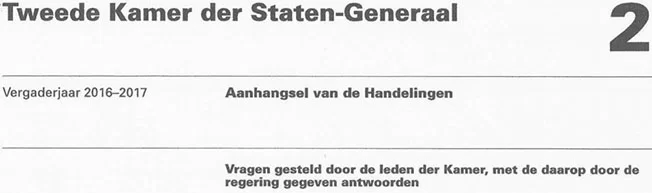
    As evidence of the long-standing push for policy change, Rambaratsingh referenced parliamentary questions raised in the Dutch parliament back in 2017. In response to those questions, the sitting Dutch government at the time confirmed that the expanded family reunification scheme had been terminated in October 2012. While the state secretary noted that elderly foreign nationals could still submit standard residence applications under Article 8 of the European Convention on Human Rights, the government rejected calls to reinstate the original special scheme. Official responses from that time also showed that just 20 applications for permanent residence were submitted by Surinamese residents aged 65 and older seeking to join their family in 2015, a low number that reflects the difficulty of accessing the standard pathway.

  • DHL Nevis Earns Caribbean Hero League Agent Service Point of the Month Award for May 2026

    DHL Nevis Earns Caribbean Hero League Agent Service Point of the Month Award for May 2026

    In a press release published by the TDC Group on July 3, 2026, DHL Nevis has earned one of the Caribbean region’s top honors for logistics service delivery: the Caribbean Hero League Agent Service Point of the Month Award for May 2026.

    Launched to celebrate standout DHL service locations across the Caribbean, the Caribbean Hero League program assesses nominees on four core criteria: operational excellence, sustained customer satisfaction, collaborative teamwork, and strict adherence to DHL’s globally recognized service standards. Claiming the monthly award cements DHL Nevis’s position among the highest-performing DHL outlets in the entire Caribbean region. The award-winning team, led by supervisor Lavern Liburd and including courier Kevin Franklyn, has already been celebrated internally for the milestone achievement.

    Laughton Herbert, Manager of DHL Nevis, emphasized that the regional honor is a direct reflection of the entire team’s consistent commitment to service quality. “This recognition is a testament to the dedication, professionalism, and passion of our entire team,” Herbert noted. “Every day, we strive to provide our customers with reliable, efficient, and friendly service. Receiving this award motivates us to continue raising the bar and reinforces our commitment to excellence.”

    Ernie France, Head of Nevis Operations, extended official congratulations to the local team, noting that the accomplishment brings well-deserved regional attention not only to DHL Nevis but also to its parent organization, the TDC Group. “We are extremely proud of the DHL Nevis team for earning this regional recognition,” France said. “Their dedication to delivering outstanding customer service and representing the DHL brand with professionalism has brought well-deserved recognition to Nevis and by extension the TDC Group.”

    France added that the honor underscores the team’s track record of not just meeting but exceeding the service expectations of domestic customers across Nevis, while upholding the rigorous global standards that define the DHL brand. Beyond recognizing internal performance, the award also highlights the critical economic role DHL Nevis plays in the local economy: connecting small-scale sellers, large businesses and individual customers to global supply chains and international markets through consistent, dependable logistics and courier services. By prioritizing timely, efficient delivery solutions, the team has built and strengthened long-term customer trust in the DHL brand across the island of Nevis.

    This press release was originally distributed via SKNVibes.com, which published the release in the form it was received.

  • Column: De rekening die niemand wil betalen

    Column: De rekening die niemand wil betalen

    As the parliamentary debate on Suriname’s 2026 national budget drew to a close, President Jennifer Simons delivered what may prove to be the most consequential message of the entire legislative session: there will be no expansion of the national budget, as the country simply does not have the funds to spare. This hard announcement comes as Suriname’s budget deficit has swollen to more than 5% of gross domestic product, with an additional 13 billion Surinamese dollars required to cover existing funding gaps. Beyond the raw numbers, Simons’ statement confronts a reality the South American nation has pushed off for years: Suriname has long been living beyond its financial means.

    The president warned that the next three years will bring significant economic hardship for the country, with new fiscal space only opening up once projected oil and gas revenues begin to actually flow into state coffers. Until that turning point, Simons emphasized, national leaders will be forced to make deliberate choices, prioritize core public needs, and accept the hard limits of the government’s implementation capacity. Not every policy initiative can move forward at once, she made clear.

    But the core question that remains unanswered is whether the country as a whole is willing to accept the consequences of this necessary fiscal reset. Across Suriname, austerity has become an almost taboo topic. As soon as cuts to public spending are mentioned, the public immediately assumes outcomes such as higher consumer prices, eroded purchasing power, reduced social services, and increased tax burdens. Most residents assume austerity will only force ordinary citizens to make further sacrifices – but that does not have to be the case, the commentary argues. In fact, the most logical place to begin reducing unnecessary spending is within the government itself.

    Long-running systemic waste in Suriname’s public sector is well-documented, from unproductive subsidies to groups and industries that do not actually need public support, to persistent public funding for state-linked institutions and parastatal enterprises that contribute little to national development while remaining permanently dependent on taxpayer dollars. Questions have for years been raised about bloated public payrolls, including the persistent issue of so-called ghost workers – individuals registered to receive public salaries who contribute little to no productive work, or who do not actually hold positions at all. No structural solution to this problem has ever been advanced.

    Widespread everyday inefficiency adds to the cumulative waste: inflated overtime claims with no corresponding increase in productivity, meetings that start hours behind schedule, and parliamentary sessions that are canceled for lack of a quorum even after full costs for security, driver services, catering, cleaning, technical support and other logistics have already been paid. These hidden costs do not always jump out from line items in the national budget, but ordinary taxpayers are ultimately the ones footing the bill for all unnecessary spending.

    The same logic applies to official overseas travel. While international engagement is undeniably necessary for Suriname – from negotiating with global financial institutions, courting foreign investment, participating in regional blocs, and carrying out core diplomatic work – and not all meetings can be conducted virtually, the public has a right to question whether every scheduled trip is truly essential. Even when airfare and hotel costs are covered by a hosting international organization, multiple related costs fall to the Surinamese state, including per diems, preparation expenses, protocol support, and costs to cover for the traveling employee back home. While these may seem like small individual costs, they add up to a significant sum that the country can ill afford in its current fiscal state. If the government is asking the public to prepare for three years of hardship, it must lead by example, cutting waste in its own operations first.

    This approach applies equally to other areas of unnecessary spending: luxury imports that do not meet basic public needs, which drain the country’s scarce foreign currency reserves; capital projects that can easily be delayed for a year with no negative impact; and public institutions whose actual social value has never been independently audited and verified. Every single Surinamese dollar spent by the government deserves scrutiny to confirm it serves a necessary public purpose.

    But spending cuts alone will not pull Suriname out of its ongoing fiscal crisis, the analysis notes. Leaders must also turn their attention to the revenue side of the national budget. For years, policymakers have discussed the need to increase fair royalty and tax contributions from the country’s gold and timber sectors. Suriname’s natural resources should benefit all of society, not just private actors. Every additional Surinamese dollar the state rightfully collects from these key extractive industries is one less dollar the government needs to borrow, or divert from core priorities like public education, healthcare, and social welfare. Responsible fiscal policy means not just cutting unnecessary spending, but also collecting all revenue that is owed to the public.

    Beyond numbers, the national budget is ultimately a test of national political discipline. Almost every stakeholder in the country agrees that austerity is needed – but almost everyone wants cuts to fall on someone else. Cabinet ministers push for larger budget allocations for their departments; members of parliament push for more local development projects; labor unions demand higher wages; private businesses push for tax breaks; public institutions demand more subsidies; and ordinary voters want lower consumer prices. All of these demands draw from the same nearly empty national treasury.

    This moment may be the critical opportunity for Suriname to learn that austerity does not have to equal greater poverty. When a household faces a temporary drop in income, it does not purchase a new car, even if it may be affordable in three years’ time. Instead, it first cuts out unnecessary spending, sets clear priorities, delays non-essential purchases, and protects core needs that support the family’s well-being. There is no reason a national government should operate by a different standard.

    Future oil and gas revenues will almost certainly open new economic opportunities for Suriname, but they will not solve one deep-rooted problem: the long-standing culture that treats unrestricted public spending as an unspoken right. That may be the biggest challenge facing the current administration: not just balancing the national budget, but modeling and instilling a new culture of responsible stewardship of scarce public resources – a habit that may prove more valuable long-term than the natural resource wealth the country hopes to extract in the coming years.

  • Leisure : Did you know ? #38

    Leisure : Did you know ? #38

    Haiti’s popular independent news and media platform HaitiLibre has announced a major expansion of its popular educational quiz initiative, Quiz.HaitiLibre, bringing the total number of interactive general knowledge games available on the platform to 180 following a July 1, 2026 monthly content update. As part of the platform’s signature twice-weekly “Did You Know?” knowledge segment – the 38th installment of which was published on March 7, 2026 – the feature this week explores the little-discussed historical mechanics of transatlantic triangular trade, a system that shaped the colonial history of Hispaniola, the island that includes present-day Haiti.

    The educational entry explains that the triangular trade was a structured global commercial system that integrated the colony of Santo Domingo, the precursor to modern Haiti, directly into European imperial economic networks. This sprawling maritime trading operation operated in three distinct, brutal phases. The circuit began when trading ships departed Western European ports – most notably major French harbors – loaded with standardized manufactured goods, firearms, textiles, and distilled spirits.

    These cargoes were then traded on the western coast of Africa to local slave trading intermediaries in exchange for captured African men, women, and children. The enslaved people were then packed tightly into ships for the horrific transatlantic crossing known infamously as the Middle Passage, where vast numbers died from disease, starvation, abuse, or neglect before reaching the Americas.

    Upon arrival in the Caribbean, the surviving enslaved people were sold at auction to white colonial plantation owners. The final leg of the triangle closed when ships returned to Europe with holds full of high-value, labor-intensive tropical export crops including sugar, coffee, and indigo. This closed commercial cycle generated unprecedented wealth for European colonial powers, built entirely on the exploitation and premature death of millions of enslaved African people.

    Quiz.HaitiLibre positions itself as an accessible, inclusive educational resource for curious learners of all ages. All games on the platform are 100% free to access, require no account registration, and are offered in both French and English to serve Haiti’s diverse linguistic communities and international audiences. Every quiz is structured with three graduated difficulty levels – easy, intermediate, and hard – to accommodate both casual learners and seasoned history enthusiasts looking for a challenge. The platform adds 31 new games each month as part of its regular content update cycle, covering topics ranging from local Haitian history and culture to global current events and general knowledge.

    Readers and learners are invited to visit the official Quiz.HaitiLibre website to explore the full collection of games, test their knowledge, share the platform with friends and family, and submit feedback through a contact form available at the end of each quiz to help the team improve the offering over time.

  • Regering moet SRD 13 miljard financieren om begroting 2026 uit te voeren

    Regering moet SRD 13 miljard financieren om begroting 2026 uit te voeren

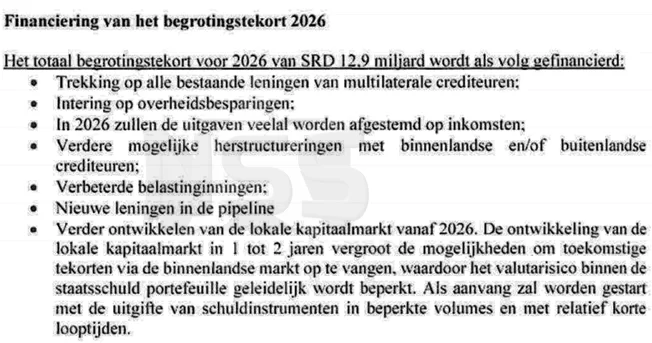
    Suriname’s national government will need to secure nearly 13 billion Surinamese dollars (SRD) in fresh funding this year to implement its adjusted 2026 national budget, according to the revised 2026 State Debt Plan approved by the National Assembly alongside the amended budget.

    The document outlines that the nation’s projected financing shortfall stands at 12.861 billion SRD, a figure rounded to 12.9 billion SRD. This deficit emerges when total government expenditure exceeds projected public revenue for the fiscal year. To close this budget gap, administration officials have outlined a mixed strategy combining new borrowing, active debt management, and targeted fiscal adjustments. Per the plan’s projections, the 2026 financing deficit equals approximately 5.1% of Suriname’s gross domestic product (GDP), with an additional primary deficit projected at nearly 4 billion SRD for the year.

    To cover the shortfall, the government plans to draw down from existing credit facilities provided by multilateral development banks, issue new domestic and foreign loans, and continue expanding the country’s local capital market. It will also proceed with ongoing sovereign debt restructuring efforts and implement controlled growth in public spending to keep fiscal pressures in check.

    Additional data from the debt plan shows that total debt service obligations for 2026 are projected to reach roughly 15.5 billion SRD. For foreign debt alone, the government is scheduled to pay approximately 405.5 million U.S. dollars in interest payments and principal amortizations this year, a sum that places significant strain on the country’s public finances.

    Looking ahead, the Surinamese government projects that fiscal pressure will ease gradually in coming years. This outlook is rooted in expectations of continued improvement in public finance management, the near-completion of national debt restructuring, and projected revenue streams from offshore oil production set to launch in 2028. Projections included in the debt plan indicate these factors will drive a significant decline in the country’s debt-to-GDP ratio in subsequent years.

  • Zapping Haiti of July 4th, 2026

    Zapping Haiti of July 4th, 2026

    As of July 3, 2026, Haiti is navigating overlapping political, security, and social developments, with key decisions from the national Council of Ministers and steady progress on counter-gang security operations.

    In the security domain, the Gangs Suppression Force (GSF) has established a sustained presence in the Tabarre neighborhood following offensive operations launched last week to dislodge gang control. GSF members are continuing regular patrols and clearing blocked transport routes to restore safe passage for local residents, with command emphasizing that recapturing gang-held territory is only the initial phase of the mission — securing the area long-term to prevent gang reoccupation remains the core ongoing objective.

    On the political front, the Council of Ministers adopted the long-awaited third version of a national electoral decree on July 2, 2026, wrapping up weeks of negotiations between the Provisional Electoral Council (CEP), the national government, and government-aligned political parties. The finalized decree has been forwarded to the National Press for official publication in the government’s official journal *Le Moniteur*. In addition to the electoral framework, the council approved a series of senior administrative and leadership changes: Gerald Rampliais stepped down from his role as Director General of Customs, and Walter Gabellus was appointed as his replacement. Hans L. Joseph, the former Director General of the Anti-Corruption Unit (ULCC), was removed from his post with no public explanation of the dismissal, and replaced by Goethie Varnelle Morency. Job Pierre was confirmed as Deputy Director General of the National Old-Age Insurance Office (ONA), and a reshuffle of multiple interim municipal councils was also approved, though full details of these local changes have not been released to the public.

    In diplomatic appointments, the Haitian government named two new ambassadors: Guy Lamothe will serve as Haiti’s top representative to Chile, while Antonio Rodrigue has been appointed ambassador to Canada. On July 2, Prime Minister Alix Didier Fils-Aimé personally attended a commemoration of the 250th anniversary of United States independence, held at the official residence of U.S. Chargé d’Affaires Henry T. Wooster. The prime minister praised the U.S. founding milestone as a defining embodiment of the values of liberty and national sovereignty, and reaffirmed the longstanding friendly bilateral ties between Haiti and the United States, extending the Haitian government’s official wishes for continued prosperity to the American people. Separately, Fils-Aimé issued formal congratulations, on behalf of the Haitian government and in a personal capacity, to Keiko Fujimori, daughter of former Peruvian president Alberto Fujimori, following her election as the next president of Peru. He commended the Peruvian people’s exercise of sovereign democratic will, and expressed hopes for Fujimori’s success in advancing national stability, inclusive development, shared prosperity, and stronger democratic institutions during her term.

    In judicial news, former Arnel Bélizaire, who previously represented the Delmas and Tabarre district as a member of parliament, was released from custody on July 2, 2026, by order of investigating judge Loubens Élysée. Bélizaire had been held for more than three months following his March 14 arrest, on charges including terrorism financing, conspiracy against state internal security, and criminal association. The judge ordered his release after concluding a formal hearing into the case.

    In the education sector, national end-of-cycle exams for 9th-grade students, learners at Family Education Centers (CEF), and students at Teacher Training Colleges (ENIJE) concluded successfully on July 2, 2026. Haiti’s Ministry of Education announced preliminary outcomes during a press briefing, expressing overall satisfaction with the orderly conduct of exams across all test centers. Turnout for the exams was high, with between 94% and 97% of all registered candidates attending their scheduled assessments.

  • Herbeoordeling Wiskunde-vakken leidt tot uitstel examenuitslagen HAVO en VWO

    Herbeoordeling Wiskunde-vakken leidt tot uitstel examenuitslagen HAVO en VWO

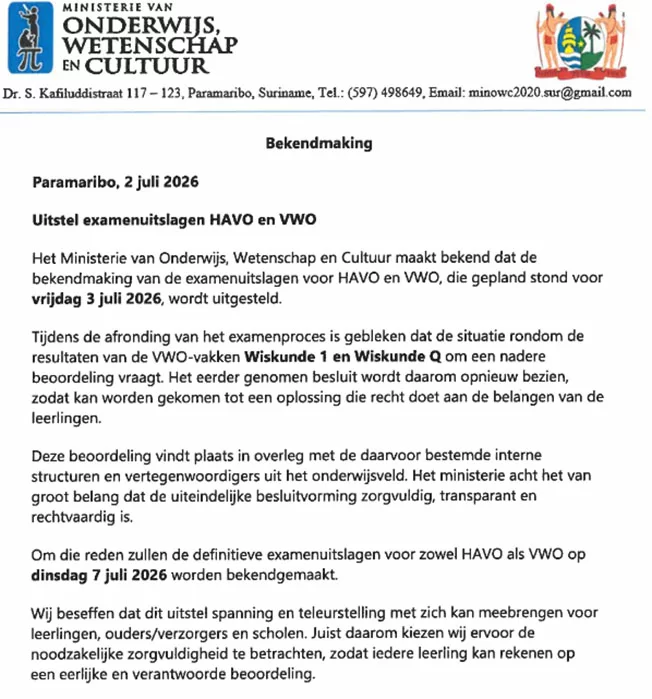
    After a full day of widespread uncertainty among exam candidates, their families, and school administrators across the Netherlands, the country’s Ministry of Education, Science and Culture (minOWC) has officially announced a four-day delay to the release of final HAVO and VWO exam results. What was originally scheduled for public release on Friday, July 3, will now be published on Tuesday, July 7, the ministry confirmed in an official statement issued Thursday evening.

    Rumors of a potential delay had circulated among educational communities for days before the official confirmation, leaving tens of thousands of students in limbo as they waited for word on their graduation and higher education placement status. The delay comes after ministry officials identified an issue in the final stages of the exam grading process that requires a re-evaluation of results for two VWO-level mathematics courses: Wiskunde 1 and Wiskunde Q.

    In response to the identified discrepancy, the ministry confirmed it would revisit a prior decision related to the grading of these two exams, with the explicit goal of reaching a final outcome that fully protects the academic interests of all participating students. The re-assessment process is being carried out in close consultation with dedicated internal review bodies and elected representatives from the national education sector. The ministry emphasized that its top priority is ensuring the final decision-making process is conducted thoroughly, transparently, and fairly for every candidate.

    Officials acknowledged that the last-minute delay will likely cause increased stress, anxiety, and disappointment for waiting students, their parents, and school staff who have already planned for the original release date. Despite these concerns, ministry leaders defended the choice to take extra time for the review, noting that the adjustment is necessary to guarantee every student receives a fair and accountable final result that accurately reflects their work.

  • Derde helft WK 2026: Emotionele rollercoaster: Portugal klopt Kroatië, Modric neemt afscheid

    Derde helft WK 2026: Emotionele rollercoaster: Portugal klopt Kroatië, Modric neemt afscheid

    The 2026 FIFA World Cup knockout stage delivered one of its most dramatic and emotionally charged matches to date on July 2, as Portugal secured a last-gasp 2-1 victory over Croatia at Toronto Stadium, bookending a historic night that saw Croatian legend Luka Modric bring an end to his glittering career on the game’s biggest international stage. What unfolded over 90+ minutes was a rollercoaster of tension, dramatic twists, and raw emotion that will long be remembered by football fans across the globe, as two European powerhouses battled tooth and nail for a place in the tournament’s last 16. From the opening kickoff, Portugal asserted their dominance on the contest, controlling roughly 70% of possession and carving out repeated dangerous chances against a defensively rigid Croatian side. The pace and trickery of winger Rafael Leao stretched the Croatian backline constantly from the left flank, forcing multiple hard challenges, set-piece opportunities, and putting experienced Croatian defenders under consistent pressure. Portugal’s creative hub Bruno Fernandes pulled the strings in midfield, but solid organization and defensive resilience from Croatia kept the game goalless through the opening 45 minutes. Key Croatian figures stood tall to block Portugal’s advances: defender Josip Stanisic led the defensive line’s aerial dominance, 35-year-old veteran Ivan Perisic used his decades of experience to snuff out attacking threats, and goalkeeper Dominik Livakovic pulled off a string of critical saves to keep his sheet clean. The closest Portugal came to an opening goal in the first half was an Alex Baena free kick that rattled the crossbar, but poor finishing and a lack of clinical edge in the final third left the sides level at the break, after an increasingly physical opening period that saw Portugal’s Ruben Dias pick up one of several first-half yellow cards. The second half brought an immediate shift in momentum, as Croatia came out of the locker room firing on all cylinders. It was that veteran experience that put them ahead, as Perisic coolly slot home a placed finish in the 53rd minute to put Croatia ahead and stun the heavily favored Portuguese side. Portugal responded aggressively, and their pressure paid off 14 minutes later when a VAR review awarded them a penalty. Cristiano Ronaldo stepped up to the spot and converted with his trademark composure, before unleashing his iconic “Siuuu” celebration that sent the packed Toronto Stadium into a frenzy. The drama only intensified from there. Ronaldo thought he had put Portugal ahead moments later, tapping home a second goal, only for VAR to rule the effort out for offside in a crushing blow for the Portuguese talisman. As the clock ticked down toward full time, it looked like the tie would be heading to extra time – until a perfect cross from Leao in the fourth minute of stoppage time found Goncalo Ramos, who directed a stunning header past Livakovic to put Portugal 2-1 up. The dramatic late winner sparked chaos among devastated Croatian fans, who threw bottles onto the pitch in frustration, forcing officials to temporarily pause the match to restore order. Moments later, Croatia thought they had salvaged a late equalizer through defender Josko Gvardiol, but for the second time in five minutes, VAR chalked off a goal for offside, amplifying the heartbreak for the Croatian camp. Beyond the scoreline, the night was defined by raw emotion as Modric played his final match in a World Cup, bringing an end to one of the most storied international careers in modern football. After the final whistle blew, the Croatian captain stood on the pitch visibly overcome with emotion, before sharing a poignant moment with his former Real Madrid teammate Ronaldo: the two legends, who shared years of success at club level, exchanged a heartfelt embrace and words of respect in a scene that captured the best of football’s camaraderie. Ronaldo himself was brought to tears during the post-match moment, paying tribute to injured teammate Diogo Jota by wearing the winger’s number 21 shirt and pointing to the sky in a touching gesture. In the end, Portugal crawled over the line to book their place in the round of 16, escaping a major upset against a determined Croatian side that fell just short of extending their tournament run. For Croatia, the defeat marked not just an early exit from the 2026 World Cup, but the end of an era with the departure of Modric, one of the greatest midfielders to ever play the game. This knockout thriller will stand as one of the most memorable matches of this World Cup, a contest that embodied both the beauty and cruelty of football, where legendary careers crossed, dramatic late twists unfolded, and lifelong memories were made on the global stage.

  • Grand’Anse (Haiti), Inauguration of the Women’s Center

    Grand’Anse (Haiti), Inauguration of the Women’s Center

    On July 1, 2026, Haitian officials and international stakeholders gathered in the coastal Grand’Anse department to mark a landmark step forward for women’s rights in the country: the official inauguration of a purpose-built Women’s Center focused on supporting survivors of gender-based violence and advancing women’s economic and social independence.

    Led by Pedrica Saint Jean, Haiti’s Minister for the Status of Women and Women’s Rights (MCFDF), the inauguration ceremony opened with a blessing service officiated by Reverend Father Edner Mars, followed by a traditional ribbon-cutting that formalized the opening of the new facility. The event drew a broad cross-section of governmental, civil society, and international partners, including Jérémie Mayor Onel Jacinthe, Jérémie First Instance Court Government Commissioner Jean Marie Alexandre Geatjens, UN Women Haiti Deputy Representative Sophie Havyarimana, Jérémie Vice-Delegate Wilbert Chéry, and Kerling Gaspard Saint Juste, the MCFDF’s departmental director for Grand’Anse.

    In his remarks at the ceremony, Mayor Onel Jacinthe reinforced the municipal government’s unwavering commitment to backing all initiatives that lift up women and girls who have survived violence. He called for broad grassroots civic participation, urging local residents to collaborate closely with the ministry and supporting institutions to strengthen the national fight against gender-based violence, which he described as a persistent societal scourge.

    Commissioner Jean Marie Alexandre Gaetjens brought sharp attention to a growing crisis facing the region: he reported a concerning upward trend in gender-based violence cases logged by the Jérémie Public Prosecutor’s Office. He stressed that sexual violence must not be dismissed as isolated, private incidents, but treated as the serious criminal offense it is, requiring strict, uncompromising judicial action. “There is no room for impunity. Every complaint brought before the courts will be examined with all the rigor required by law,” Gaetjens said, adding that no social, family, or political pressure would be allowed to interfere with the equal application of the law. He urged survivors, their families, and all community members to break long-standing cultures of silence by reporting all acts of violence to authorities.

    Sophie Havyarimana, deputy representative for UN Women in Haiti, welcomed the Haitian government’s investment in the Grand’Anse center, noting it is the first facility of its kind in the department. She called the inauguration a major milestone in building out robust national protection and support systems for violence survivors. Havyarimana emphasized that violence against women and girls remains an unacceptable violation of fundamental human rights, one that can only be defeated through coordinated collective action from government, community groups, and international partners. “We have a duty to break the silence. It is unacceptable to tolerate violence against women and girls. Together, we must put an end to this phenomenon so that every woman and girl can live in a safe, dignified environment free from all forms of violence,” she said.

    Jérémie Vice-Delegate Wilbert Chéry framed the fight against gender-based violence as a core priority for upholding social cohesion and driving Haiti’s long-term sustainable development. No country can achieve meaningful progress when half its population is blocked from accessing their fundamental rights, he noted, and reaffirmed the need for ongoing, coordinated action from public authorities and all sectors of Haitian society to guarantee women and girls effective protection, full exercise of their rights, and equal opportunities to contribute to national development.

    In her keynote address, Minister Pedrica Saint Jean explained that the new Grand’Anse Women’s Center is part of a broader national strategy to build a Haitian state that is proactive, protective, and responsive to women’s rights. “The establishment of the Women’s Center in Grand’Anse is part of a clear national vision: that of a state that protects, listens, and acts. It is based on fundamental principles: equality, social justice, security, solidarity, and the empowerment of women,” Saint Jean said. She outlined the dual symbolic and practical value of the new facility, describing it as “a space of dignity, listening, and rebuilding” where every survivor of violence will receive respectful, non-judgmental support at every stage of their recovery. The center will deliver integrated, multidisciplinary services spanning medical care, mental health support, social assistance, and legal aid, to remove barriers to justice for survivors. Beyond direct support, it will also serve as a hub for prevention education and community-wide cultural change to reduce rates of gender-based violence.

    Closing the ceremony, Saint Jean emphasized that the new center is not a final achievement, but the start of a renewed commitment from the Haitian state to the women of Haiti. “The Women’s Center of Grand’Anse is not an end. It is the beginning of a new pact between the State and the women of Haiti: a pact of protection, justice, and dignity,” she said.