
作者: admin

  • PM moving ahead with dev’t bank despite IMF objection

    PM moving ahead with dev’t bank despite IMF objection

    Prime Minister Godwin Friday of St. Vincent and the Grenadines (SVG) is holding firm to his administration’s flagship plan to launch a national development bank (NDB), pushing forward despite explicit warnings and opposition from the Washington-based International Monetary Fund (IMF). The proposal, a core campaign promise of Friday’s New Democratic Party (NDP) that won a landslide 14 out of 15 parliamentary seats in the November 2025 general election, is framed by the prime minister as a critical intervention to reverse years of economic stagnation and address the country’s soaring public debt crisis.

    Speaking on NBC Radio this Thursday, Friday — who also holds portfolios for finance, legal affairs and justice, economic planning, and private sector development — explained that the NDB is designed to solve long-standing structural barriers that block small and non-traditional businesses from accessing affordable credit. SVG currently carries a public debt load equivalent to 113% of its gross domestic product, and Friday warned that without bold policy changes, that figure could climb to 145% or higher within five years, a trajectory he calls completely unacceptable.

    While the prime minister acknowledges that the country’s debt profile is severe and requires careful management, he argues that accelerating inclusive economic growth is the fastest route out of the current crisis. He noted that even in discussions with IMF officials, the fund has agreed that growth is the most effective way to reduce debt burdens over time. The IMF has projected that SVG’s economic growth will moderate to 3.7% in 2025 as post-pandemic tourism and construction rebounds fade, and decelerate further to a medium-term average of 2.7% between 2026 and 2027 amid high global oil prices and a weaker global economic outlook. For Friday, this slow growth forecast makes the NDB a more urgent priority, not a less necessary one.

    “This is the way we get out of the difficult situation that we are in, and we have to transform our economy,” Friday said. “We have to unleash the creative and business potential in our economy and make it available to ordinary people to start doing things to grow our economy.”

    The IMF’s opposition, outlined by mission chief for SVG Sergei Antoshin in an April 28 statement, centers on three key concerns: risks to debt sustainability from adding a new quasi-fiscal institution to an already heavily indebted economy, the potential for contingent liabilities that could force the government to inject emergency public funds down the line, and the risk of political interference in lending decisions that has plagued regional development banks in the past, leading to high rates of non-performing loans. Antoshin also referenced a history of underperformance among similar institutions across the Caribbean.

    Critics have also framed the new NDB as a revival of a failed 1970s-era development bank launched by a previous administration, which was eventually absorbed into the National Commercial Bank after being deemed a stillborn, unsuccessful experiment. Friday rejected these claims, emphasizing that the project is not rooted in ideology or a bid to redeem old failed political initiatives. Instead, he argued that continuing with the status quo of fragmented lending support has not worked, and the NDB is a pragmatic solution to the proven problem of limited credit access.

    “Everybody identifies the problem, and we come back to the same thing — is to try to deal with what we have as if that is the perfection that we’re seeking. It doesn’t work. That’s what we have seen,” Friday said. “What we’re saying is what is the best way in which to achieve this, and that is why we are pursuing this objective, because we believe that, properly managed, properly established, that it can meet that need.”

    Friday confirmed that his administration will take the IMF’s concerns into account during the institutional design phase to avoid the pitfalls that derailed past projects. He noted that well-governed development banks across the Caribbean have delivered tangible economic benefits, proving that successful operations are not an impossibility. When asked about the risk of political lending — where loans are approved based on party affiliation rather than viable business plans — Friday said the bank’s long-term survival depends on strict, consistently applied lending standards.

    “For it to survive, for it to achieve its objective, it has to function on set principles that everybody understands,” he said. “You want to be generous and supportive of small investors and so forth… but the only way you can sustain that is if you’re also rigorous in terms of the standards that are applied to the lending of the money and the ways in which they are monitored and required to pay back. If you’re going to do it on a political basis, then you are not serious about the development of the country.”

    Unlike commercial banks, Friday said the NDB’s success will not be measured by profit maximization, but by the growth and performance of its borrowers. Currently, scattered government lending and support schemes for underserved groups operate across multiple separate entities, including the Farmer Support Company and the National Student Loan Company, which serve borrowers that commercial banks routinely reject. Friday framed the NDB as a way to consolidate these fragmented functions, introduce professional management, cut overhead costs, and improve overall efficiency. Beyond lending, the new bank will also provide ongoing business support services to help borrowers succeed, rather than just disbursing funds and leaving borrowers to sink or swim.

    On the topic of capitalization, Friday said the government has already identified initial seed funding in the national budget and has received positive feedback from external partners approached for support. The administration has reallocated approximately EC$1.5 million in seed funding to the project, and plans to grow the bank’s capital base over time without relying on expensive high-interest borrowing. Proceeds from the government’s upcoming citizenship by investment programme, which is set to launch soon, will also contribute to the bank’s capital, as these funds come with no interest obligations. The government targets raising at least EC$10 million in capital by the end of the year, a goal Friday calls entirely feasible.

    “What we can’t do is borrow money at 5, 6 and 7% and then put in the bank and you have to lend [at] 12%. That is not going to work,” he added.

  • Price of electricity with geothermal: expected medium term price drop but short term fluctuation

    Price of electricity with geothermal: expected medium term price drop but short term fluctuation

    Dominica Electricity Services (DOMLEC) board member Samuel Raphael has announced upcoming tiered electricity price reductions for all customer groups, a policy shift driven by the recent launch of the island’s new geothermal power facility. Speaking at a public press conference on Wednesday, Raphael laid out a clear breakdown of savings tailored to different consumption levels: residential and small-scale users will see their bills drop by up to 17%, small business owners will enjoy a 12% reduction, and larger commercial operations will benefit from a 10% cut. To illustrate the tangible impact for average households, Raphael offered a simple example: a customer currently paying $100 monthly for electricity would see their monthly payment fall to $83, translating to $17 in monthly savings.

    While the long-term trajectory for energy costs is downward, Raphael cautioned that short-to-medium term prices will likely see fluctuations driven by ongoing volatility in global crude oil markets. This instability, he noted, stems from escalating geopolitical tensions between the United States and Iran, which have pushed international oil prices upward in recent weeks. Currently, DOMLEC’s energy mix still relies on diesel for 25% of its total generation, leaving the grid exposed to swings in global fossil fuel pricing. As the market stabilizes over time, Raphael emphasized, the full cost benefits of geothermal power will take full effect, bringing consistent, lower prices.

    The new 10-megawatt geothermal plant has now been fully operational for approximately one month, injecting clean, renewable energy into DOMLEC’s supply grid. When combined with the island’s existing hydroelectric power infrastructure, renewable energy now accounts for 75% of DOMLEC’s total generation capacity. Raphael, who is also a private business owner and a stakeholder in Dominica’s key eco-tourism sector, expressed particular enthusiasm for this milestone. The shift to majority renewable energy not only brings down long-term consumer costs, he added, but also aligns with the island’s sustainability goals that underpin its eco-tourism brand.

    Even with the progress achieved, Raphael acknowledged that the remaining 25% dependence on fossil fuels means the utility will continue to face external price pressures until renewable capacity can be further expanded. No exact timeline for the full rollout of the permanent price cuts was shared during the press briefing, but Raphael confirmed that the utility is working toward implementing the reductions as soon as market conditions allow.

  • Antigua and Barbuda Ranked Among CARICOM States With Lowest Maternal Mortality Rate

    Antigua and Barbuda Ranked Among CARICOM States With Lowest Maternal Mortality Rate

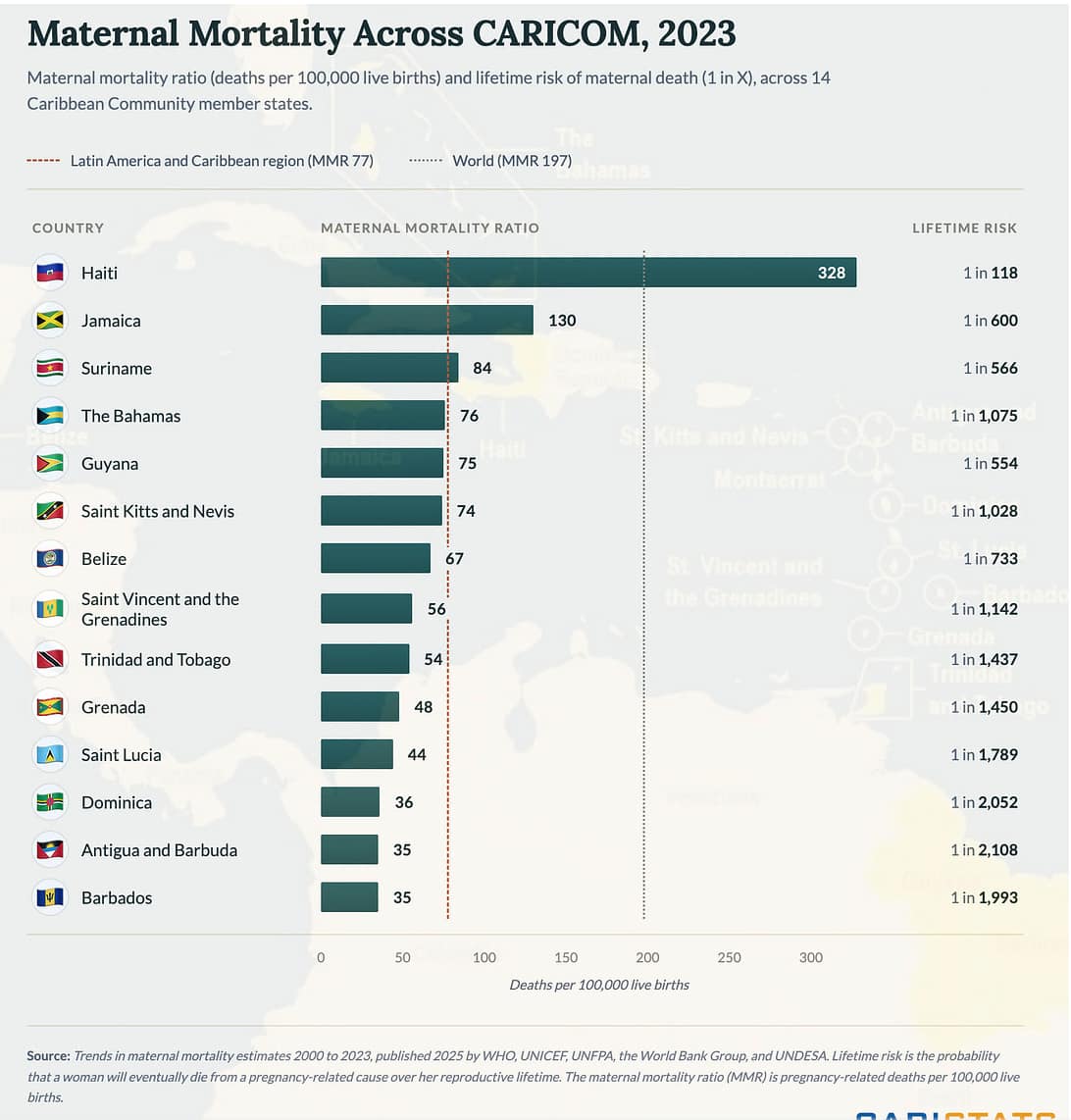
    The latest 2025 joint report from the United Nations, compiled by the World Health Organization, UNICEF, UNFPA, the World Bank Group and UN Department of Economic and Social Affairs, has painted a mixed picture of maternal mortality progress across the 14 CARICOM member states, documenting decades of broad gains but a concerning slowdown in improvements over the last eight years.

    The 2023 estimates included in the report highlight dramatic disparities in lifetime risk of pregnancy-related death across the bloc, which brings together Caribbean nations to foster regional integration and cooperation. At the highest end of risk, Haiti faces a grim lifetime maternal mortality risk of 1 in 118, while Antigua and Barbuda boasts one of the lowest risks in the region at 1 in 2,108. Most CARICOM nations fall between these two extremes, with lifetime risks ranging from 1 in 500 to 1 in 2,100 – a better outcome than the global average lifetime risk of 1 in 272, and on par with the broader Latin America and Caribbean regional average of 1 in 789.

    When tracking change across the 23-year period from 2000 to 2023, progress has been far from uniform across the bloc. Five nations – Suriname, Guyana, Saint Kitts and Nevis, Saint Lucia, and Dominica – have achieved remarkable gains, cutting their maternal mortality rates by 40% or more since 2000. Haiti and several other CARICOM nations have also recorded net reductions over the full 23-year timeline. However, the report identifies three notable outliers: Jamaica, The Bahamas, and Grenada, all of which saw higher maternal mortality levels in 2023 than they recorded in 2000.

    Beyond the uneven national results, the data confirms a clear slowdown in maternal mortality reduction across the region over the most recent eight-year period, mirroring a broader trend across Latin America and the Caribbean as a whole. Between 2000 and 2023, Latin America and the Caribbean recorded the smallest overall reduction in maternal mortality of any world region, at just 16.8%.

    Even amid these challenges, the report notes a key bright spot: eight out of the 14 measured CARICOM countries have already hit the United Nations Sustainable Development Goal target for maternal mortality, which calls for fewer than 70 maternal deaths per 100,000 live births by 2030.

  • IShowSpeed livestream in Jamaica amasses over 2.8 million views

    IShowSpeed livestream in Jamaica amasses over 2.8 million views

    A high-profile livestream shot by popular American content creator IShowSpeed from Jamaica’s capital Kingston on Friday has delivered staggering viewership numbers, cementing the broadcast as one of the creator’s most successful on-location productions to date. The stream pulled in more than 2.8 million total views, with a concurrent peak audience of 194,805 live viewers tuning in to watch the creator’s exploration of the island nation. Beyond raw view counts, the interactive stream generated 696,349 live chat messages from engaged audiences around the globe, and earned IShowSpeed more than 34,000 new subscribers in the process. Minutes after the stream wrapped, the creator’s cameraman shared the milestone metrics on the social platform X with a simple, triumphant caption: “Good stream.”

    The Kingston stop is the latest leg of IShowSpeed’s ongoing Caribbean tour, which has focused on highlighting local culture, landmarks and creative communities across the region. During his time in Kingston, the streamer visited a lineup of the city’s most iconic cultural and historical sites, including Emancipation Park, the world-famous Bob Marley Museum, the historic Devon House estate, and Jamaica’s National Stadium.

    The day’s tour opened at Emancipation Park, where former Miss Jamaica Universe Yendi Phillipps led a personalized educational session on Jamaican history. Phillipps walked IShowSpeed through the legacies of the country’s most revered national heroes, giving the creator and his global audience a foundational introduction to Jamaican heritage. The opening event also included a chance for IShowSpeed to join local students in a traditional Kumina dance, an immersive cultural experience that was shared live with his viewers.

    Later in the day, the streamer met with Jamaica’s Culture Minister Olivia Grange, and connected with a roster of the island’s most prominent musical artists, including Jesse Royal, Sean Paul, Beanie Man, Shenseea, Ding Dong, Naomi Cowan and Gyptian. The meetings and casual collaborations gave IShowSpeed’s global audience a front-row look at Jamaica’s world-renowned, vibrant music scene, deepening the creator’s engagement with local cultural stakeholders during his visit. The on-location stream also included special experiences for the creator, including a drone show and a meeting with the viral “Jamaican Spider-Man,” a local personality that gained viral attention online in recent months.

  • WATCH: Two alleged gunmen fatally shot by police in Mandeville

    WATCH: Two alleged gunmen fatally shot by police in Mandeville

    MANDEVILLE, JAMAICA – A fatal police operation in central Jamaica left two men dead and a handgun recovered Friday evening, following an alleged armed exchange between law enforcement and the individuals in the Mandeville neighborhood of Willowgate.

    According to initial official accounts, the incident unfolded shortly after 8 p.m. local time, when a team of officers began tracking a silver Toyota Axio traveling along Manchester Road. When police moved to intercept the vehicle, a shootout broke out between the occupants of the car and the law enforcement team.

    The sound of repeated gunfire sent dozens of area residents and bystanders fleeing for safety, with many scrambling to take cover behind nearby structures and parked vehicles to avoid stray rounds. Multiple law enforcement units responded to the scene, including operatives from the Area Three Fugitive Apprehension Team, a specialized unit tasked with capturing wanted suspects across the region.

    In the aftermath of the exchange, the two men inside the intercepted vehicle were pronounced dead at the scene, and a single illegal firearm was recovered by investigators. The entire stretch of Manchester Road near the Willowgate intersection was cordoned off by police immediately after the shooting to allow crime scene technicians to process evidence, with a photo of the closed-off area captured by photojournalist Kasey Williams.

    Local authorities have not yet released the identities of the two deceased men, nor have they confirmed whether the pair were wanted on outstanding criminal charges ahead of the Friday operation. Investigations into the incident are ongoing, per standard protocol for police-involved shootings in Jamaica.

  • Spirit exit likely to lead to higher US airfares, experts say

    Spirit exit likely to lead to higher US airfares, experts say

    When Spirit Airlines, the pioneering ultra-low-cost carrier that reshaped U.S. air travel for 32 years, ceased all operations on May 2, it left behind more than thousands of rebooked passengers and empty route slots: industry analysts and economists broadly agree that its exit will add significant new upward pressure on already climbing U.S. airfares.

    Founded in 1992, Spirit built its legacy on the so-called “Spirit Effect”, a market phenomenon that turned affordable air travel from a luxury into an accessible option for millions of consumers who had previously been priced out of flying. Its stripped-down business model — which eliminated free checked bags, complimentary in-flight meals, and other non-essential extras to keep base fares as low as possible — earned it a reputation as the industry’s most disruptive competitive force. This impact was so significant that the U.S. Department of Justice (DOJ) highlighted it in 2023, when regulators moved to block Spirit’s proposed merger with JetBlue, arguing that losing Spirit’s independent presence would harm consumer competition.

    Official DOJ data underscores just how much Spirit shaped market pricing: when the carrier entered a new route, average fares across all competing airlines on that route dropped by an immediate 17%, and when it exits a market, fares jump by an average of 30%. That historical trend has left experts bracing for broad fare increases as the aviation industry absorbs Spirit’s exit.

    The timing of Spirit’s collapse could not be worse for consumers, who are already facing rising ticket costs driven by skyrocketing jet fuel prices tied to ongoing conflict in the Middle East. New data from the U.S. Department of Transportation released this week confirms that U.S. airline jet fuel costs surged 56% in March compared to February, and are up 30% from the same period one year ago.

    While many carriers have moved quickly to fill the gap left by Spirit, with low-cost peers including Frontier, Breeze and Avelo adding capacity and new routes to capture Spirit’s former customer base, all of these existing competitors already price their tickets slightly higher than Spirit did. Frontier, the largest of Spirit’s ultra-low-cost rivals, has announced plans to add nine new routes this summer and 15 extra daily departures across 18 former Spirit routes, a move the airline projects will boost its key revenue metric by 3 to 5% and grow its total capacity by 6 to 8%.

    Even as existing carriers maintain the basic economy fare tiers that major airlines originally launched specifically to compete with Spirit and other budget carriers, experts say those low-cost options will likely become less attractive for consumers. Jan Brueckner, emeritus economics professor at the University of California, Irvine, noted that while basic economy tickets are not expected to disappear entirely, airlines will almost certainly raise their prices. “They might be less attractive” to budget-focused travelers, Brueckner explained.

    Aviation analysts broadly echo this assessment. “There’s no question in some markets fares will probably increase,” said Richard Aboulafia, an aviation expert at consultancy AeroDynamic. Richard Masler, head of analysis for the Centre for Aviation, pointed out that for more than a decade, Spirit’s disruptive presence forced legacy major airlines to cut their own fares and adopt more granular pricing models to stay competitive.

    Bradley Akubuiro, a partner at advisory firm Bully Pulpit International, noted that Spirit’s exit will not make air travel entirely unavailable to consumers, but it will eliminate the industry’s most powerful check on excessive pricing. “The likely consequence for passengers is not that air travel suddenly becomes unavailable,” he said. “It’s that the cheapest version of air travel becomes immediately harder to find in some markets.” Over time, he added, fares will continue to creep upward because “a meaningful check on the system is now gone.”

  • Nintendo to hike Switch 2 price, warns on profits

    Nintendo to hike Switch 2 price, warns on profits

    In a major update on the Japanese gaming industry’s financial health released Friday, gaming giant Nintendo has announced it will raise prices for its newly launched Switch 2 console, as skyrocketing memory chip costs driven by the global AI boom create unprecedented margin pressure. The company also warned that its full-year net profit will drop sharply by 27% in the current fiscal year ending March 2026. Rival Sony, by contrast, has delivered a far more optimistic forecast, projecting a 13% rise in gaming division income even as sales of its mature PlayStation 5 console continue to decline.

    Nintendo’s price adjustments will roll out in phases across key global markets. Starting May 25, Japanese consumers will see a 20% jump in Switch 2 retail prices. From September 1, the console will cost $499.99 in the United States, an 11% increase, and 499.99 euros in the European Union, representing a 6% price hike.

    For the 12-month period ending next March, Nintendo projects net profit will fall to 310 billion Japanese yen, equal to roughly $1.98 billion, on total annual sales of 2.05 trillion yen. That marks an 11.4% drop in revenue from the prior fiscal year. Operating profit is forecast to hit 370 billion yen, a figure that falls well below the average analyst consensus estimate of 480 billion yen, according to data compiled by Bloomberg News.

    The prior fiscal year delivered strong results for Nintendo, however. The company reported that net profit surged 52% year-over-year to 424 billion yen, while annual revenue climbed to 2.31 trillion yen, nearly double the prior year’s total. The Switch 2, launched last June, got off to a strong commercial start, with global sales growing steadily after its release. By the end of March, Nintendo had sold 19.86 million units of the new console, boosted by popular first-party titles including *Pokemon Pokopia*, *Mario Kart World*, and *Donkey Kong Bananza*.

    The core headwind facing console manufacturers right now is the rapid rise in memory chip prices. The global AI boom has spurred massive demand for high-capacity memory chips from data centers and AI developers, pushing up costs for consumer electronics makers including game console and smartphone producers. Supply chain disruptions linked to ongoing conflict in Iran have further tightened available supplies, worsening the cost pressure for manufacturers.

    For Sony, the past fiscal year saw PlayStation 5 sales fall to 16 million units, down from 18.5 million units in the prior 12-month period. Since the PS5 launched in 2020, Sony has sold 92 million units of the console overall, putting the company in a strong position to capitalize on the upcoming November launch of the highly anticipated blockbuster title *Grand Theft Auto VI*. Industry analysts note the franchise is expected to drive a massive wave of new console sales in the coming year.

    “If there is any game that can move millions of additional PlayStation units, it is this one,” Serkan Toto, a leading gaming industry consultant, told AFP.
    Sony projects that even with lower console sales, its gaming division will see higher profits in the fiscal year ending March 2027. Industry analysts explain that Sony’s more mature position in the PS5 product cycle leaves it better insulated from rising memory chip costs than Nintendo’s newly launched Switch 2.

    “Sony’s more mature PS5 console cycle leaves it better placed to weather higher memory costs,” said Amir Anvarzadeh, a strategist at Asymmetric Advisors. “Having already moved past the heavy hardware penetration costs typical of earlier product cycle years, Sony’s bottom line stands to benefit significantly from the high-margin software sales and ecosystem engagement that the *Grand Theft Auto VI* launch should trigger.”

    Nintendo, however, faces a more challenging operating environment, Toto noted. Switch 2 consumers are especially price sensitive, he said, and the console’s first-year game lineup is far weaker than that of the original Switch at launch. Even so, Toto added that Nintendo has room to improve its performance by ramping up software releases in the coming months: “But now it’s time for them to really step on the gas on the software side.”

  • US says two dead, one survivor in latest boat strike

    US says two dead, one survivor in latest boat strike

    In a latest development of the United States’ escalating anti-narcotics operation in the eastern Pacific Ocean, the US military confirmed Friday that it has targeted and struck another vessel accused of involvement in drug trafficking. The attack left two people dead and one person still alive, with an ongoing search and rescue mission organized by the US Coast Guard.

  • Pork Store & More celebrates educators with special Teachers’ Day giveback

    Pork Store & More celebrates educators with special Teachers’ Day giveback

    KINGSTON, Jamaica — On Jamaica’s Teachers’ Day, educators at Jamaica House Basic School were met with an unexpected, heartfelt surprise, as local food brand Pork Store & More by CB Foods launched a targeted community appreciation initiative to celebrate the critical, often underrecognized work educators do in building the nation’s future.

    The event centered on elevating the foundational role that early childhood teachers play in nurturing the next generation of Jamaican leaders, industry professionals and entrepreneurs. During the on-site pop-up activation, every educator at the school received a curated Caribbean Passion smoked meat bundle, loaded with local favorites including corned pork chub, streaky bacon, chorizo and jerk chicken sausages, paired with a gift voucher for future purchases at Pork Store & More.

    Brand representatives explained that the initiative was crafted not only as a public tribute to the daily dedication, patience and care that teachers pour into their students, but also as a practical support gesture. The meal bundles are designed to cut down on planning time for busy educators balancing packed professional schedules with personal responsibilities, simplifying everyday home cooking.

    For many teachers at the school, the unanticipated recognition left a lasting, uplifting impression. Marsha-Lee Crawford, a K2 educator who has served at Jamaica House Basic School since 2019, noted that this was the first large-scale community gesture of its kind she had experienced during her tenure. While small tokens of appreciation from parents are common, Crawford said the brand’s outreach felt uniquely meaningful.

    “Teachers are the backbone of every other profession — we make all other career paths possible,” Crawford shared in a company press release. “As an early childhood educator, I see it as a blessing to help shape and mold young minds that will go on to lead our country. This gesture made all that hard work feel seen.”

    Samantha Fisher, assistant brand manager at CB Foods, emphasized that the Teachers’ Day giveback is part of the company’s longstanding corporate commitment to honoring the vital contributions of local educators. “Teachers do work that shapes the entire future of Jamaica, laying the foundation for every child’s growth and development. It’s a demanding job that far too rarely gets the public recognition it deserves,” Fisher explained. “For our team, this was about finding a simple but meaningful way to give back to people who give so much of themselves to our communities every single day.”

    Fisher added that Jamaica House Basic School was selected for the initiative due to CB Foods’ years-long community partnership with the campus, which has included joint participation in national Labour Day service projects and ongoing product donation initiatives. The school’s location, just steps from CB Foods’ head office and the flagship Pork Store & More retail location, also made it a natural fit for the brand’s focus on supporting the neighborhoods where it operates.

    Moiya Chin-Lyn, channel manager of retail experience at CB Foods, shared that the brand’s core goal was to ensure every teacher felt seen and valued, beyond the symbolic nature of a traditional Teachers’ Day celebration. “We wanted to highlight the lasting impact that teachers have not just on students, but on entire families and communities. Gifting these practical, locally made products and vouchers was a way to create a genuine moment of encouragement and gratitude,” Chin-Lyn said.

    She noted that the warm, enthusiastic response from the Jamaica House Basic School team reinforced the value of community-centered outreach that honors local unsung heroes. “The teachers didn’t just appreciate the gifts — they appreciated that someone had taken the time to recognize their work. That reaction really speaks to how much these gestures mean,” Chin-Lyn added.

    The event was captured with a photo of CB Foods representatives Moiya Chin-Lyn and Alexandra McNamee alongside Jamaica House Basic School principal Veronica Burnett, as Burnett accepted the school’s collective gift on behalf of the faculty. The Teachers’ Day initiative is part of a series of ongoing community engagement efforts by Pork Store & More by CB Foods, which aims to deepen ties with local neighborhoods and celebrate residents whose consistent dedication builds stronger Jamaican communities every day.

  • Colombia reporter found dead in violence-wracked zone

    Colombia reporter found dead in violence-wracked zone

    In a tragic development that has shaken Colombia’s journalistic community, a 25-year-old local reporter was discovered dead Friday in the country’s violence-plagued northwest, an area where multiple armed groups battle for control of illegal economies, President Gustavo Petro has confirmed.

    Mateo Perez, who ran the independent online news platform El Confidente de Yarumal, had been missing since Tuesday. He was conducting reporting work in a rural district of Antioquia department, roughly five hours by car north of Colombia’s second-largest city Medellín, just weeks ahead of the country’s May 31 presidential election.

    Perez’s remains were recovered in a territory long contested by two of Colombia’s most powerful illegal armed factions: dissident fighters who split from the now-demobilized FARC guerrilla movement, and drug traffickers aligned with the Gulf Clan, the nation’s largest criminal cartel.

    Speaking via a post on the social platform X, President Petro directly attributed Perez’s killing to Jhon Edison Chala Torrejano, a top dissident guerrilla commander. According to Petro, Chala Torrejano is currently fighting to expand his control over the region’s lucrative illegal gold mining trade.

    The Foundation for Press Freedom, widely known by its Spanish acronym FLIP, issued a forceful condemnation of the murder, praising Perez as an indispensable voice for residents of the local area. The journalist’s work centered on high-stakes beats: organized crime, regional security, local politics, and public corruption, reporting that repeatedly put him in danger. FLIP confirmed that Perez had already faced sustained legal pressure stemming from his investigations into illegal economic activities controlled by armed groups.

    The area where Perez’s body was found is classified as an active disputed zone, with FARC dissidents and Gulf Clan fighters regularly clashing to secure territory and revenue streams, per FLIP’s on-the-ground research.

    Attacks on journalists are a persistent crisis in Colombia, where armed factions hold sway over large swathes of the national territory, funding their operations through cocaine trafficking, unregulated gold mining, and systematic extortion of local communities and businesses. In the lead-up to this month’s presidential election, the country has recorded a sharp uptick in guerrilla attacks across multiple regions.

    Since 1977, at least 170 journalists have been killed in Colombia, according to FLIP’s long-running tracking data. The killing comes amid shifting peace negotiations in the country: President Petro’s administration suspended peace talks with FARC dissident factions on April 21, but negotiations remain ongoing with the Gulf Clan, an organization labeled a terrorist group by the United States government.