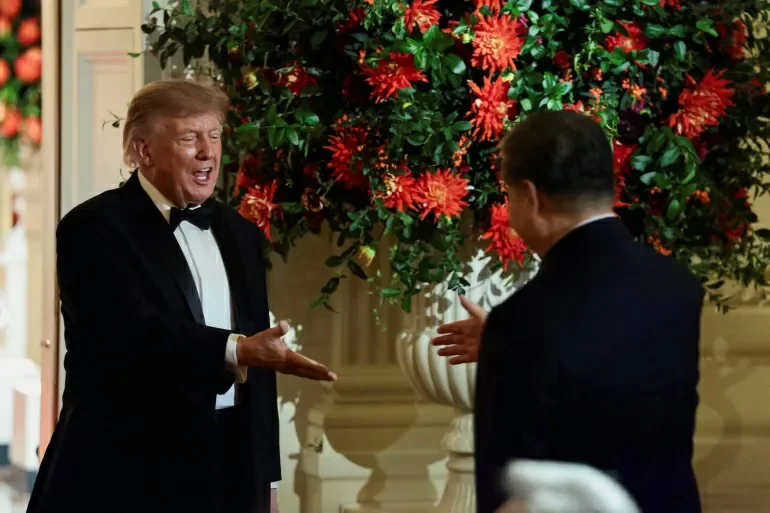
More than a decade has passed since Donald Trump first laid out his harsh views on China, and a stark contrast separates those early comments from the language he used during Chinese President Xi Jinping’s recent state visit to Washington. Where Trump once framed China as a power that robbed, deceived, and economically exploited the United States, this week he spoke of a “truly great friendship” between the two leaders and emphasized shared mutual respect.
This notable shift in tone does not mean the long-standing strategic and economic rivalry between the world’s two largest economies has come to an end. On the contrary, deep disagreements and competition persist across trade, artificial intelligence, advanced technology, the Taiwan issue, and global security. Yet the change in rhetoric reveals a clear evolution in how the Trump administration now approaches its relationship with Beijing.
To understand the scale of this shift, it is necessary to look back at Trump’s long history of commentary on China. Long before he won his first presidential term, Trump warned against China’s growing economic influence. In 2012, he took to Twitter to accuse China of cheating at the Olympic Games, linking that accusation to what he claimed was a broader pattern of deception, cheating and theft in Chinese business practices. During his first presidential campaign in 2015, he doubled down on these attacks, framing China as an enemy that had destroyed American jobs and gutted U.S. manufacturing industries. At a 2016 campaign rally, he went so far as to claim China had “raped” the United States through what he called unprecedented economic theft. Even after taking office, Trump maintained his aggressive stance, stating in 2020 that no other country had taken advantage of the United States as much as China.
These harsh remarks aligned with the political agenda Trump pursued in his first term: shrinking the U.S. trade deficit with China and taking a harder line on Beijing’s trade practices. But during Xi’s 2026 state visit to the White House, his tone was unrecognizable. He called Xi a “great gentleman”, highlighted the two nations’ “very good trading relationship”, and repeatedly emphasized the “truly great friendship” the two leaders had built. At the state dinner honoring Xi, Trump noted that despite their differing political systems, cooperation between the two sides had never been closer, and their relationship had been rooted in mutual respect and shared interest for both peoples since his 2016 election.
What drove this dramatic turnaround in rhetoric? There is no single simple explanation, but one key factor is the lesson Trump has learned through experience: shaping the U.S.-China relationship exclusively through pressure and tariffs is far more difficult than early rhetoric suggested. During his second term, the administration sharply raised tariffs on hundreds of billions of dollars worth of Chinese goods. Beijing responded in kind with its own tariffs on U.S. imports, and additionally restricted exports of critical rare earth elements – minerals that are essential to manufacturing everything from consumer electronics and electric vehicles to semiconductors and advanced military systems.
The trade war escalated rapidly before the two sides agreed to a temporary trade truce, which was extended during Xi’s recent visit. This extension has bought both governments time to work toward a broader comprehensive agreement, even as core disputes over tariffs, technology access and market entry remain unresolved.
A major reason for this shift to negotiation alongside pressure is the fact that China holds key economic and strategic cards that cannot be quickly or easily replaced by the United States. Beyond its dominant position in rare earth processing – a leverage Beijing demonstrated during the trade conflict through export restrictions – the sheer scale of China’s industrial manufacturing base makes full economic decoupling impractical for both nations. This explains why Trump continues to campaign for U.S. economic independence while also prioritizing a functional working relationship with Beijing.
A second core factor shaping the new tone is the personal diplomacy between Trump and Xi. Trump has long placed clear value on building personal connections with foreign leaders, and he repeatedly highlighted his longstanding personal relationship with Xi dating back to his first presidential campaign during the state visit. In an unusual break from standard protocol for sitting U.S. presidents, Trump personally traveled to Joint Base Andrews to greet Xi and his wife Peng Liyuan, and continued to emphasize their personal bond during all official events and the state dinner.
Xi has reciprocated this outreach, repeatedly emphasizing mutual respect between the two leaders and framing cooperation as a shared priority. He noted that the U.S. ambition to “Make America Great Again” and China’s goal of national rejuvenation can coexist, avoiding framing the two nations’ core national projects as inherently opposing, even as both leaders acknowledge their competing interests.
Despite the warm public rhetoric, it would be a mistake to interpret this shift as the end of U.S.-China strategic rivalry. Both nations continue to compete for global leadership in artificial intelligence, with Washington restricting advanced technology exports to China while Beijing accelerates the development of its own domestic technology industry. The Taiwan issue remains a fundamental point of disagreement: China claims the island as an inalienable part of its territory, while the U.S. does not recognize Taiwanese independence but continues to provide defensive military support to Taipei. Global issues such as Iran also remain points of divergence: Washington has pushed Beijing to use its influence in Tehran to advance U.S. goals, while China prioritizes its own economic and strategic interests in the Middle East.
No major breakthroughs were reached on any of these core issues during the state visit. The summit primarily produced two outcomes: a commitment to continued dialogue and the extension of the existing trade truce.
The most significant change, then, is not a fundamental shift in how Trump views China, but rather how he now manages the bilateral relationship. During his first campaign, he centered his messaging on blaming China for all of America’s economic struggles. In his second term, his approach has become far more pragmatic: negotiate where possible, apply pressure where necessary, and work to prevent competition from spiraling into open conflict. Xi has adopted a matching framing of stability, noting that the two nations can be competitors, but competition must be kept within clear boundaries to avoid escalating into military confrontation.
This has opened a new phase in U.S.-China relations: it is not traditional friendship, but managed rivalry with clear agreements on the limits of competition. The harsh rhetoric of the past has not disappeared entirely. Trump continues to accuse China of unfair trade practices, keeps tariffs and technology restrictions in place as leverage, and his administration continues working to reduce U.S. dependence on Chinese raw materials and technology. But in direct engagements with Xi, he has chosen a far softer tone. This is not a contradiction: great power diplomacy often combines hard-nosed negotiating behind closed doors with public gestures of personal outreach and goodwill.
This dynamic was on full display during the state visit: while American and Chinese negotiators haggled behind closed doors over tariffs, rare earths, AI and Taiwan, Trump gave Xi a personal tour of the White House and spoke of friendship during the state dinner.
One state visit cannot erase decades of growing rivalry between Washington and Beijing, nor can it build a new global order overnight. The warm words exchanged by Trump and Xi have not resolved the core structural competition between the two nations, but they have made clear that neither side is interested in further escalation in the near term. The extended trade truce buys more time for negotiations, while new dialogue mechanisms on AI and security keep lines of communication open.
For Trump, this marks a notable rhetorical shift: from framing China as an economic adversary that exploited America to recognizing it as a competitor with whom personal ties and working trade agreements are possible. For Xi, the trip delivered the ceremonial welcome he sought in Washington, even as Beijing remains under no illusion that the U.S. has abandoned its strategic competition with China.
The stark contrast between Trump’s rhetoric of a decade ago and his comments this week is ultimately a reflection of changing circumstances on the ground. Trump has not shifted from seeing China as an adversary to viewing it as an ally; he has shifted from raw confrontational rhetoric to a far more personal brand of pragmatic rivalry. Whether this new approach will deliver long-term results will not be determined by warm words spoken at a state dinner, but by the concrete agreements Washington and Beijing reach in the months ahead.