作者: admin

  • Minister Reid: No plans yet to restrict children’s access to social media

    Minister Reid: No plans yet to restrict children’s access to social media

    While a growing international movement advocates for prohibiting minors from accessing social media platforms, Barbados has declared it is not presently contemplating similar restrictive measures. This position emerges despite Australia’s recent enactment of groundbreaking legislation that bans children aged 16 and under from platforms including Instagram, Facebook, Snapchat, TikTok, YouTube, and X (formerly Twitter), utilizing age verification technologies to enforce compliance.

    The global landscape reveals increasing regulatory scrutiny, with nations including France, Spain, Italy, Norway, Denmark, Malaysia, Pakistan, and South Korea exploring comparable protective measures. These governments are responding to mounting concerns about the psychological impact and potential dangers digital environments pose to young users.

    Barbados Minister of Industry, Innovation, Science and Technology, Senator Jonathan Reid, confirmed the nation’s watchful stance. “We haven’t considered implementing such bans,” Reid stated, “however, we maintain strong interest in international developments. We anticipate evaluating the impacts of these decisions abroad to potentially integrate valuable lessons for our population.”

    Minister Reid presented a balanced perspective, acknowledging both the substantial benefits and inherent risks associated with social media engagement. He highlighted platforms’ capacity for positive connection and information sharing while simultaneously recognizing serious concerns including misinformation proliferation, cyberbullying, and hate speech dissemination.

    Central to Barbados’ deliberation is the preservation of free speech, which Reid described as fundamental to national identity. The government emphasizes developing strategies that maximize technological benefits while implementing safeguards against harmful content, particularly protecting vulnerable youth from documented psychological harms associated with excessive social media consumption.

    This cautious governmental approach coincides with rising domestic concerns regarding digital safety. The National Organisation of Women (NOW) has highlighted escalating cyber abuse incidents, with Head Melissa Savoury-Gittens noting that digital violence remains significantly misunderstood and underaddressed in current legal frameworks. Simultaneously, Director of the Criminal Justice Research and Planning Unit Cheryl Willoughby has advocated for comprehensive research into social media’s influence on youth behavior, emphasizing the necessity for collaborative societal response to emerging digital challenges.

  • Five Arrested After Nut Grove Search Yields Ammunition, Suspected Stolen Property

    Five Arrested After Nut Grove Search Yields Ammunition, Suspected Stolen Property

    A significant law enforcement operation in Nut Grove culminated in the arrest of five individuals and the seizure of a cache of illicit items, including ammunition and suspected stolen assets. The operation, which unfolded on the afternoon of December 23, 2025, began with the execution of a search warrant at a local residence. Authorities discovered a vehicle key, multiple currencies (Eastern Caribbean and U.S. dollars), a cellphone, and a set of license plates during the initial sweep. The scope of the investigation expanded to an adjacent plot of land, where officers uncovered a concealed black plastic container. This container held a firearm magazine, numerous rounds of ammunition, two snap caps, and gun oil. Additional evidence collected included clothing items and a black laptop. During personal searches, two units of gun oil were allegedly found on one of the suspects. Further compounding the findings, a blue automobile located on the premises was identified as likely stolen property. A subsequent inspection of a vehicle driven by one of the apprehended men yielded a magazine holster. The five suspects, all residents of Nut Grove, were taken into custody on allegations of robbery. All seized evidence, including the two vehicles, was transported to the St. John’s Police Station as authorities continue their investigative proceedings.

  • LETTER TO THE EDITOR – Why CARICOM has failed: A call to action

    LETTER TO THE EDITOR – Why CARICOM has failed: A call to action

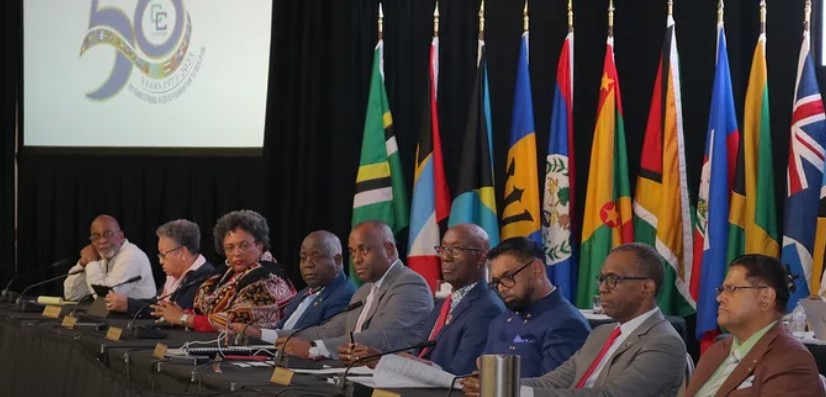
    A deepening diplomatic rift among Caribbean Community (CARICOM) leaders reveals alarming fractures within the regional bloc, exposing fundamental weaknesses in its governance structure. The current tensions—stemming from divergent positions on Venezuela relations, responses to US military presence in Caribbean waters, and recent US visa restrictions affecting Antigua and Barbuda and Dominica—highlight a critical juncture for the organization.

    The public exchange between Antigua and Barbuda’s Prime Minister Gaston Browne and Trinidad and Tobago’s Prime Minister Kamla Persad-Bissessar transcends mere diplomatic sparring. It reflects broader systemic failures that have plagued CARICOM since its 1973 establishment through the Treaty of Chaguaramas. Originally conceived to foster economic integration, coordinate foreign policy, and promote functional cooperation among newly independent states, the community now grapples with inconsistent implementation, poor coordination, and perceptions of political interference in domestic affairs.

    Historical context reveals this crisis has been decades in the making. The 1989 Grand Anse Declaration that launched the CARICOM Single Market and Economy (CSME) has yielded uneven results, with persistent barriers to labor mobility and divergent national regulations. The seminal 1992 West Indian Commission report ‘A Time for Action’ identified these structural weaknesses, yet most challenges remain unresolved today.

    Subsequent reviews, including a 2012 examination of the CARICOM Secretariat and Jamaica’s Golding Report, documented identical problems: weak compliance mechanisms, implementation failures, and an intergovernmental model lacking enforcement authority. These reports recommended stronger institutional processes and decision-making efficiency but were never formally adopted.

    Current tensions reflect growing perceptions of imbalance within the community. Many observe disproportionate benefits flowing to Trinidad and Tobago compared to Organization of Eastern Caribbean States (OECS) members, while development gaps widen between resource-rich Guyana and less developed CARICOM nations. These disparities, compounded by resource limitations at the Secretariat and policy coordination gaps, have eroded mutual trust.

    The situation mirrors challenges faced by other integration projects. The European Union’s experience with internal divisions during the financial crisis and Ukraine conflict led to comprehensive structural assessments. CARICOM now requires a similarly candid independent evaluation addressing competitiveness, governance, and equity concerns while reaffirming commitments to mutual respect and non-interference.

    As CARICOM approaches its 50th anniversary, the organization must confront its structural limitations or risk the fate of the failed West Indies Federation. The warning of Dr. Eric Williams—’one from ten leaves nought’—serves as a poignant reminder that without genuine unity, regional integration remains an unfulfilled promise.

  • COMMENTARY: The role of the remnant in Dominican society – a message for Christmas and the New Year

    COMMENTARY: The role of the remnant in Dominican society – a message for Christmas and the New Year

    The Caribbean nation of Dominica stands at a critical juncture where its very survival hinges not on military power or political rhetoric, but on moral fortitude, historical consciousness, and civic courage. This profound moment demands the awakening of what local intellectual Gabriel Christian describes as ‘the remnant’—those individuals forged in the principled postwar era following universal adult suffrage in 1951.

    Following the landmark achievement of self-governance, Dominica experienced a transformative period that cultivated exceptional character and civic virtue. This epoch produced visionary leadership including pragmatic businessman-statesmen and agricultural reformers who revolutionized education and rural development. The foundational philosophy of ‘koudmen’ (cooperative effort) created a society built on mutual accountability, discipline, and honesty that enabled effective governance despite limited resources.

    During this golden age, Dominica maintained thriving citrus and banana industries alongside local manufacturing of consumer goods ranging from fruit jellies to soft drinks. Trust-based financial cooperatives and credit unions flourished alongside genuine social cohesion, where traditional greetings symbolized deeper mutual respect rather than mere politeness.

    The remnant remembers institutional guardians like Truancy Officer Mr. Frank ensuring children’s education, Sanitary Officer Mr. Solomon maintaining public health standards, and forest guards protecting natural resources for future generations. This system represented not authoritarianism but ‘civic love’—a disciplined collective care preventing social fragmentation.

    Contemporary Dominica presents a stark contrast: educational institutions grappling with drug infiltration, communities besieged by criminal gangs, and environmental degradation threatening the ‘Nature Island’s’ ecological heritage. Trust in institutions has eroded while lawlessness proliferates, exacerbated by compromised leadership and foreign exploitation.

    Most alarmingly, some within the remnant class have acquiesced to systemic corruption, exchanging courage for complacency. This silent complicity threatens the nation’s foundational values as Dominica faces potential moral collapse under external influences and internal apathy.

    Drawing from Christian theological concepts, the remnant represents the moral minority preserving truth amidst societal compromise. Their power resides not in numerical superiority but in unwavering authenticity, perseverance, and obedience to conscience. This group must serve as Dominica’s moral compass—defending rule of law, environmental stewardship, and institutional integrity through concrete action rather than rhetoric alone.

    The urgent call to action demands the remnant reclaim their historical responsibility: mentoring youth, rebuilding cooperative institutions, and speaking truth to power without fear. Their mobilization represents the final barrier against complete moral dissolution and the last hope for national renewal through courageous civic engagement anchored in truth, justice, and genuine patriotism.

  • Hon. E. P. Chet Greene Extends Christmas Greetings to St. Paul Constituents

    Hon. E. P. Chet Greene Extends Christmas Greetings to St. Paul Constituents

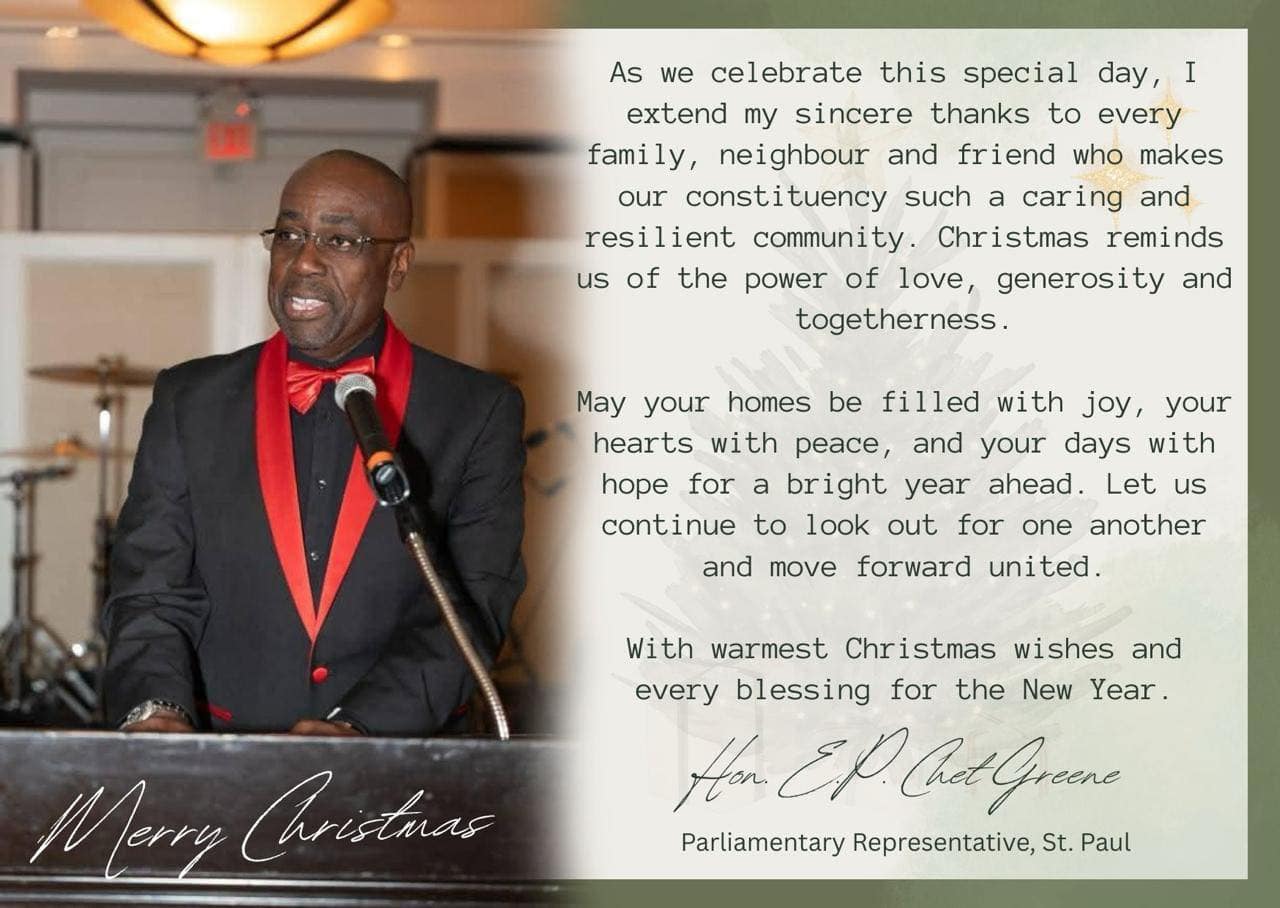
    The Honorable E. P. Chet Greene, Parliamentary Representative for St. Paul, has delivered a heartfelt Christmas message celebrating the communal bonds and resilience within his constituency. In his official holiday address, Greene expressed profound gratitude toward families, neighbors, and friends who contribute to making the community both compassionate and strong.

    Emphasizing the symbolic significance of the Christmas season, the representative highlighted themes of love, generosity, and unity. He noted that this time of year serves as an important reminder of the value of mutual support and collective strength.

    Greene extended warm wishes for joy, peace, and optimism in the coming year, encouraging constituents to continue caring for one another. His message concluded with a call for continued solidarity and a shared commitment to progress as the community moves into the new year.

    The communication stands as an official seasonal greeting from an elected official to the public, reinforcing social cohesion and shared values during the holiday period.

  • Eerste kersttoespraak: Paus Leo XIV herinnert aan lijden in Gaza

    Eerste kersttoespraak: Paus Leo XIV herinnert aan lijden in Gaza

    In his inaugural Christmas homily delivered on Thursday, Pope Leo XIV delivered a powerful address that centered on the humanitarian crisis in Gaza while issuing a universal plea for peace through dialogue. Speaking beneath the ornate balustrade of St. Peter’s Basilica—adorned with festive floral arrangements and red poinsettias—the pontiff drew poignant parallels between the Nativity story and contemporary global suffering.

    The Pope’s message specifically highlighted the plight of Gazans who have endured ‘weeks exposed to rain, wind, and cold,’ extending his concern to refugees and displaced populations across continents. He described Christ’s birth in Bethlehem’s humble manger as analogous to ‘a fragile tent among us,’ creating a theological framework for addressing modern homelessness and displacement.

    Beyond immediate humanitarian concerns, the pontiff addressed structural violence, referencing ‘defenseless populations tested by countless wars’ and youth ‘forced to take up arms who sense the futility of what they are asked to do.’ He criticized what he termed ‘the pompous speeches of those who send them to death,’ marking one of his strongest condemnations of military rhetoric to date.

    The core of his theological-political message emphasized that peace can only emerge through genuine dialogue: ‘There will be peace when our monologues are interrupted and we, enriched by listening, kneel before the humanity of the other.’ This formulation presented spiritual humility as a prerequisite for geopolitical resolution.

    The ceremony attracted thousands to the basiliek, with many documenting the solemn procession on smartphones. Despite persistent rainfall, faithful gathered in St. Peter’s Square awaiting the traditional Christmas message and ‘Urbi et Orbi’ blessing from the central loggia. This Christmas also marks the conclusion of the Holy Year celebrations, scheduled to officially close on January 6th—the Feast of the Epiphany commemorating the Magi’s visit to the infant Jesus.

  • PM Browne Sends Christmas Greetings, Urges Unity and Positivity for 2026

    PM Browne Sends Christmas Greetings, Urges Unity and Positivity for 2026

    In a heartfelt holiday proclamation, Antiguan Prime Minister Gaston Browne delivered an inspirational Christmas message to the nation this Wednesday, emphasizing themes of communal harmony and hopeful anticipation for the future. The Prime Minister’s address served as both a seasonal greeting and a motivational appeal to citizens, highlighting the importance of collective strength and optimism as the country approaches the new year. Browne articulated his wishes for widespread peace, abundant joy, and sustained prosperity throughout the holiday period and continuing into the coming years. His brief but impactful communication specifically encouraged national solidarity and a forward-looking perspective among residents. As the nation stands on the threshold of 2026, the leader urged populations to maintain resilience and positive momentum. The ministerial message concluded with formal benedictions and expressions of sincere goodwill extended to all members of the Caribbean nation.

  • Rotary Club of Antigua Extends Season’s Greetings to the Nation

    Rotary Club of Antigua Extends Season’s Greetings to the Nation

    The Rotary Club of Antigua has issued a heartfelt seasonal message extending Christmas greetings to all citizens of Antigua and Barbuda and residents throughout the nation. Club President Elisa Graham emphasized the holiday period as a poignant reminder of fundamental community values including compassion, generosity, and collective goodwill.

    In her official statement, Graham highlighted how the season provides an opportunity for reflection on societal blessings while simultaneously encouraging outreach to vulnerable community members. The message specifically called attention to those experiencing loneliness, hardship, or financial difficulties during the festive period.

    The communication detailed the organization’s ongoing commitment to its ‘Service Above Self’ philosophy, acknowledging the sustained support from corporate partners and the ‘Friends of Rotary’ network. Throughout the 2025-2026 term, the club has maintained its dedication to transformative community initiatives designed to create positive social impact.

    Graham’s message underscored the profound significance of minor charitable acts, noting how simple gestures of kindness can provide substantial comfort and joy to recipients. The statement concluded with aspirations for national unity and mutual support, wishing citizens a celebratory Christmas season and a New Year characterized by peace, health, and prosperity.

    The Rotary Club expressed hope that the holiday spirit would inspire renewed commitment to community service throughout the coming year, reinforcing the social bonds that define the Antiguan and Barbudan national identity.

  • Mansoors Spread Christmas Cheer at Paediatric Unit

    Mansoors Spread Christmas Cheer at Paediatric Unit

    In a touching display of seasonal generosity, Dr. Raymond Mansoor and his spouse reaffirmed their dedication to community welfare through their annual Christmas visit to the hospital’s Paediatric Unit. The couple personally delivered carefully selected gifts to young patients confined to medical care during the holiday period, creating pockets of joy for children separated from their families.

    Medical professionals at the facility expressed profound appreciation for the initiative, highlighting how these compassionate visits significantly elevate morale among both patients and staff. The tradition has evolved into an anticipated event that temporarily displaces clinical environments with festive warmth, providing psychological relief to children undergoing treatment.

    Beyond mere gift-giving, the Mansoors’ longstanding commitment represents a deeper investment in supporting vulnerable youth during challenging times. Family members observing the interactions noted measurable improvements in their children’s emotional states, describing how the surprise deliveries transformed the hospital atmosphere from sterile to celebratory.

    The continuity of this humanitarian practice demonstrates how individual acts of kindness can systematically combat holiday loneliness in healthcare settings. Hospital administrators confirmed such community engagements substantially contribute to holistic treatment approaches, merging clinical excellence with emotional support during emotionally vulnerable periods.

  • COMMENTARY: Caribbean black cake-  a sweet chronicle of memory, migration, and meaning

    COMMENTARY: Caribbean black cake- a sweet chronicle of memory, migration, and meaning

    Throughout the Caribbean archipelago—from Jamaica and Trinidad to Guyana and Dominica—the approach of significant celebrations is heralded by a distinctive aromatic signature: the rich, spiced fragrance of Caribbean Black Cake. This dense, molasses-dark dessert, profoundly infused with rum, transcends mere culinary delight to embody a cultural artifact meticulously preserved across generations and geographies.

    Historical evolution transformed the British plum pudding and fruitcake traditions, introduced by 18th-century colonists, into something uniquely Caribbean. Enslaved Africans and subsequent free communities radically reimagined these recipes utilizing local resources. Rum—distilled from the region’s economically dominant sugarcane—supplanted brandy as both preservative and flavoring agent. Burnt sugar, meticulously caramelized into ‘browning,’ imparted the cake’s characteristic deep hue, while tropical dried fruits underwent months-long rum maceration.

    The meticulous preparation underscores the cake’s significance. Families frequently initiate fruit soaking months—sometimes a full year—in advance, allowing flavors to mature into complex harmony. The batter, infused with nutmeg, cinnamon, allspice, and clove, is blended with creamed butter, eggs, flour, and caramelized sugar. Post-baking, cakes are traditionally ‘fed’ additional rum to enhance moisture and longevity, creating a dessert that improves with age without refrigeration.

    Regional variations abound while maintaining core cultural meaning. Trinidadian versions often exhibit a smooth, pudding-like texture, whereas Jamaican iterations are notably robust in spicing. In Guyana, the cake assumes near-sacred wedding symbolism representing prosperity and continuity, while Dominican recipes remain fiercely guarded family secrets transmitted through practice rather than written instruction.

    As Caribbean diaspora communities established roots in the United Kingdom, Canada, and the United States, black cake became an edible tether to ancestral homelands. Although commercial rum cakes gained popularity from the 1970s onward, homemade versions prepared by elder family members remain the unquestioned standard of authenticity.

    Beyond gastronomy, black cake encapsulates broader historical narratives: the fusion of colonial influences with African ingenuity, the alchemical transformation of hardship into richness, and preservation through adaptation. Typically served with coffee, sorrel, or rum, its consumption becomes a deliberate act of cultural remembrance—each slice containing centuries of adaptation, migration, and celebration.

    This culinary tradition functions as a living historical archive, where empire, resistance, memory, and family converge. The cake’s profound darkness contains multitudes of meaning, serving as both sweet sustenance and powerful symbol that declares: this moment matters.