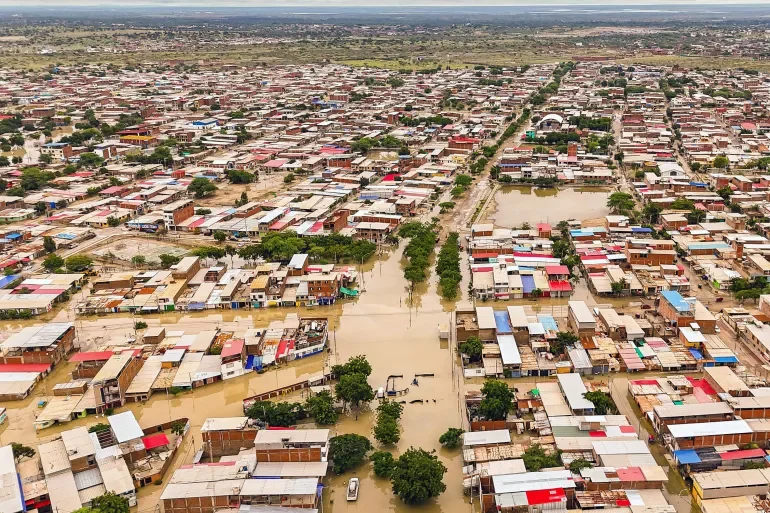
On November 27, 2026, submerged streets in Piura’s Santa Margarita neighborhood, northern Peru, captured in an AFP photo, marked the latest escalation of catastrophic weather events linked to an exceptionally powerful ongoing El Niño climate pattern that has wreaked widespread havoc across Peru and neighboring Ecuador.
In Peru’s Piura region, 12 consecutive hours of torrential rainfall on November 26 pushed water levels as high as 1.5 meters in populated areas, inundating residential homes, local businesses, public infrastructure, and major roadways. Official preliminary data from Peru’s National Institute of Civil Protection (Indeci) estimates roughly 2,000 families have seen their properties damaged by standing floodwater, with 700 households in the Ignacio Merino neighborhood among the hardest hit. Even local medical facilities faced severe disruptions: the José Cayetano Heredia hospital was forced to relocate respiratory infection patients to its main auditorium and move critically ill intensive care unit patients to safer, elevated areas to avoid water damage. The Peruvian military deployed response personnel and water pumping equipment to clear flooded residential zones, but local residents reported significant operational delays, with several pumps shutting down unexpectedly due to fuel shortages. Data from Peru’s national meteorological service Senamhi confirmed the unprecedented scale of the downpour, recording 117.6 millimeters of rain in Piura city between Thursday evening and Friday morning, while multiple other regional weather stations logged over 100 millimeters of precipitation in the same window. The Chira River’s La Ardilla monitoring station recorded a water discharge rate of over 2,076 cubic meters per second, blowing past the maximum high-alert threshold for flooding, with regional authorities warning that moderate to heavy rain events are forecast to continue across parts of Piura in the coming days.
Across the border in Ecuador, cumulative extreme weather events dating back to August 29 have had even more devastating human costs. The latest situational update from Ecuador’s National Secretariat for Risk Management documents 2,227 separate weather-related incidents including floods, landslides, intense rainfall, and soil erosion, affecting a total of 126,935 people nationwide. Of those impacted, 80,016 face direct property damage, while 46,919 have been formally classified as displaced or homeless. Official confirmed fatalities stand at 34, with an additional 23 people reported injured. The crisis has spread across 24 of Ecuador’s provinces, with Guayas, Esmeraldas, El Oro, Los Ríos, Galápagos, Santa Elena, and Manabí identified as the most severely affected zones. As of November 27, 36 rivers and waterways had breached their banks, while 16 additional watercourses were recorded with rapidly rising water levels that threatened new flood events. Coastal cities including Manta saw new rounds of neighborhood submersion after local rivers overflowed, prompting mass voluntary evacuations of residential areas. Ecuador’s national emergency response operations remain fully activated, with authorities having distributed more than 40,000 humanitarian aid packages to impacted households to date.
All these unfolding disasters are being fueled by an unusually intense El Niño event, a climate phenomenon triggered by abnormal warming of surface waters in the central and eastern equatorial Pacific Ocean that disrupts global atmospheric circulation and shifts traditional rainfall and temperature patterns worldwide. Peru’s national El Niño research commission ENFEN issued a warning on November 13 that the local coastal El Niño Costero warming event off Peru’s shores is projected to persist well into 2027, maintaining extreme intensity through February of that year, while the broader central Pacific El Niño system is also forecast to remain at very strong levels through the same timeframe. For Peru’s northern coastal regions, above-average rainfall and repeated heavy downpour events are expected to continue through January 2027.
The cascading impacts of the prolonged strong El Niño extend far beyond immediate flood and landslide damage. A joint new report from the Food and Agriculture Organization (FAO) and the World Food Programme (WFP) released on November 28 warns that global food insecurity could rise sharply across 16 identified high-risk hotspots over the next six months, with El Niño a major contributing factor to worsening conditions in southern Africa, Central America’s Dry Corridor, and northeast Uganda. In the Central American Dry Corridor, the 2026 first annual harvest season was the driest recorded in 40 years, with over 75% of total crop yields lost across large swathes of the region. In Guatemala alone, an estimated 3.2 million people are projected to face severe food insecurity between October 2026 and February 2027. The two UN agencies have emphasized that proactive, pre-emptive intervention is critical to prevent further losses of agricultural crops, livestock, and livelihoods for vulnerable low-income families, and have launched a coordinated action plan designed to deliver targeted support to 9 million at-risk people across 22 countries.
El Niño veroorzaakt zware overstromingen in Peru en Ecuador