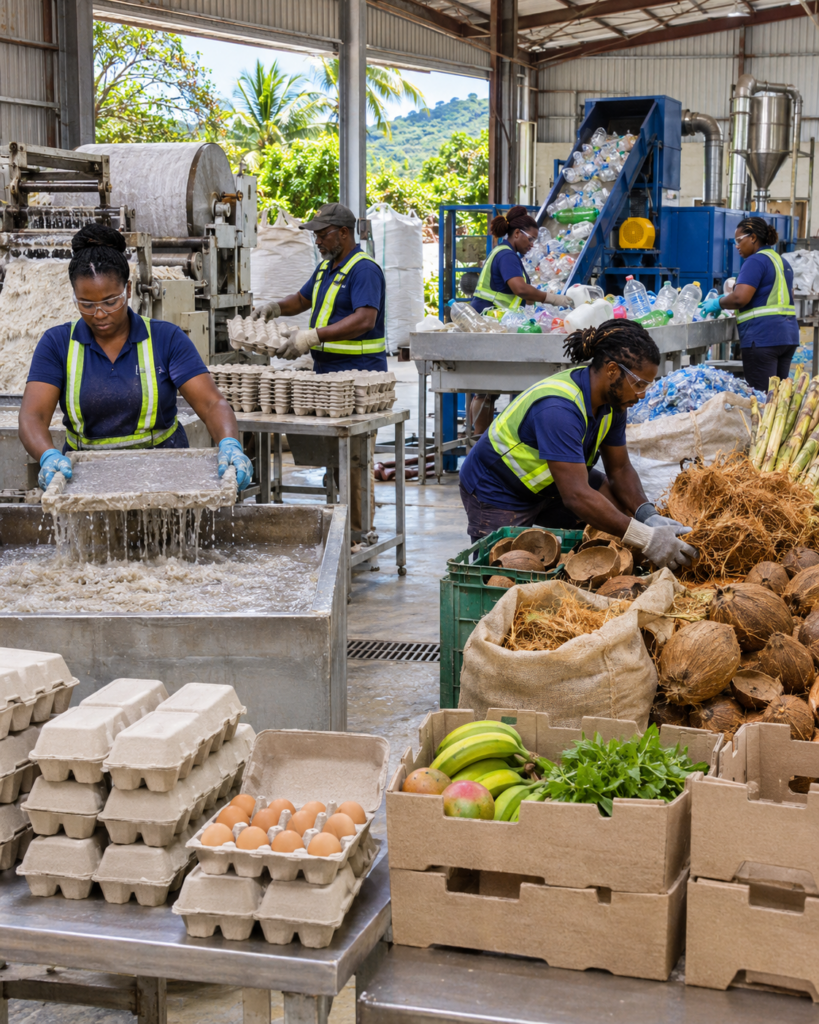
During a recent guest appearance on Pointe FM’s popular *Taking Stock* business programme, Antigua and Barbuda’s Information Technology Minister Melford Nicholas laid out a forward-looking economic strategy that would convert the nation’s underutilized waste streams into high-value domestic industries, rather than continuing the costly practice of shipping raw discarded materials overseas for third-party processing.
Nicholas outlined a diverse pipeline of actionable, low-barrier projects that leverage existing local resources to reduce national waste burdens while creating new revenue streams. For paper waste, he noted that discarded office and consumer paper products can be repulped domestically to produce custom packaging cartons for the country’s thriving agricultural export and domestic poultry sectors, eliminating the need to import pre-fabricated packaging supplies that currently add overhead costs for local farmers and egg producers. He highlighted the existing small-scale plastic recycling facility operating in the Powells area as a proven, successful proof of concept that can be scaled up to handle far more of the island’s post-consumer plastic waste, cutting down on plastic pollution while producing reusable raw materials for local construction and consumer goods.
The minister also emphasized untapped value in underused agricultural byproducts, pointing to abundant, often discarded coconut shells and other farm residues that can be processed into high-demand consumer and industrial goods, rather than being sent to local landfills. A further high-potential opportunity, he noted, lies in end-of-life vehicles: instead of crushing decommissioned cars into low-value metal cubes for export, local processing facilities can refine scrap metal into standardized, higher-purity stock that commands a far higher price on global export markets, while creating local jobs in material sorting and processing.
According to Nicholas, this coordinated suite of waste-to-value operations would create hundreds of direct and indirect entry-level roles, with a particular focus on opening sustainable employment pathways for young Antiguans and Barbudans, while catalyzing long-stalled growth in the country’s light manufacturing sector.
The minister acknowledged that the viability of these new processing ventures hinges on access to affordable, reliable energy, a longstanding pain point for small industrial operators on the island. He noted that the government’s ongoing multi-phase expansion of national solar and wind renewable energy infrastructure is on track to deliver significantly reduced utility costs for manufacturing and recycling operators in the coming years, removing one of the largest barriers to competitive operations.
To move the proposals from concept to execution, Nicholas outlined a collaborative implementation roadmap: relevant government agencies will work with industry stakeholders to formalize each proposed recycling and processing project into bankable, fully vetted business models that can be presented to local entrepreneurs, regional investors, and international development financing partners. The government also plans to partner with the University of the West Indies and other academic and civil society stakeholders to conduct feasibility assessments, identify the most commercially viable projects, and connect qualifying ventures to available grant and low-interest loan funding.
At this stage, no formal implementation timetable, projected total investment value, or targeted job creation figures have been released, as the government moves to gather additional stakeholder input and complete preliminary market assessments before rolling out formal policy and support frameworks.
Government sees new industries in recycling paper, plastics and agricultural waste