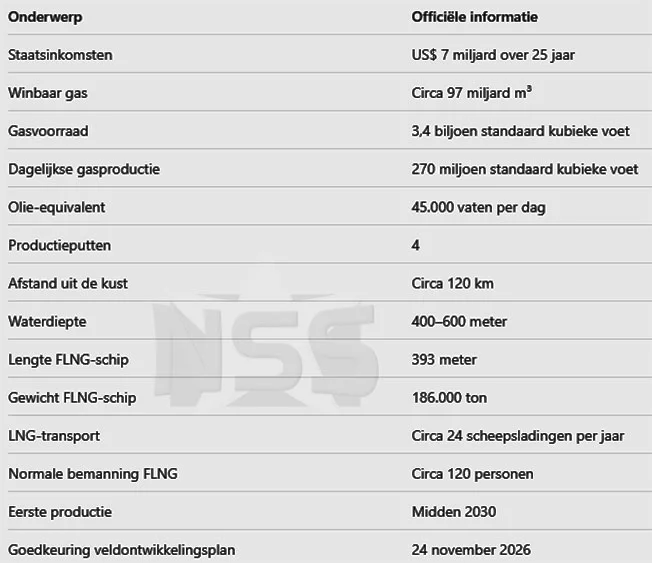
On November 27, state-owned Surinamese energy firm Staatsolie released full official details of the KrakaWi gas development in Block 52, following the formalization of its final investment decision, outlining a landmark 25-year offshore gas initiative that is projected to deliver an estimated $7 billion in total revenue to the Surinamese national government.
The core Sloanea gas field at the heart of the project holds roughly 97 billion cubic meters of recoverable natural gas, with commercial production scheduled to kick off at mid-2030 at a baseline daily output of 270 million standard cubic feet of natural gas. At full operational capacity, the project will export approximately 24 liquefied natural gas (LNG) cargoes per year from Suriname’s offshore sites, establishing the country as a new entrant in the global LNG supply market. The projected $7 billion in public revenue translates to an average of $280 million annually, though actual yearly returns will fluctuate based on prevailing international gas market prices, real production volumes, and pre-negotiated fiscal terms outlined in the project agreements.
Total upfront capital expenditure for the development stands at $1.6 billion, split between joint venture partners Malaysian energy giant PETRONAS and Staatsolie. PETRONAS holds an 80% operating stake, contributing $1.28 billion in funding, while Staatsolie retains a 20% share with a $320 million investment, which Staatsolie CEO Annand Jagesar confirmed is fully financed and secured as of the announcement date.
The Sloanea gas field is located 120 kilometers off Suriname’s coastline, in water depths ranging from 400 to 600 meters. Development plans include the construction of four dedicated production wells, connected via subsea seabed pipelines to a purpose-built Floating LNG (FLNG) facility. Staatsolie formally signed off on the full field development plan on November 24, two days prior to the public announcement of the final investment decision, a document that codifies all technical specifications, environmental mitigation protocols, and step-by-step execution timelines for the entire project.
The 270 million cubic feet daily gas output carries an energy equivalent of roughly 45,000 barrels of oil per day, and unlike Suriname’s existing offshore oil projects that see steep production decline after peak output, the KrakaWi development is engineered to maintain a nearly flat, stable production rate across its full 25-year operational lifespan. The FLNG unit has an annual liquefaction capacity of 1.5 million tons of LNG, which over the 25-year project timeline adds up to a maximum total output of 37.5 million tons of LNG when running at full utilization.
The custom-built FLNG vessel, which will sail to Suriname from Malaysian shipyards in 2030, measures 393 meters in length – 93 meters longer than the production vessel deployed for Suriname’s existing GranMorgu offshore oil project – with a 64-meter beam, a total displacement of 186,000 tons, and a height of roughly 80 meters above the waterline. It will be the first ever FLNG facility operating within the CARICOM regional bloc. Onboard storage capacity reaches 177,000 cubic meters of liquefied natural gas plus an additional 20,000 cubic meters of natural gas condensate. The vessel is designed to accommodate a core crew of 120 personnel during regular operations, with maximum residential capacity for up to 158 staff. The onboard liquefaction process shrinks the volume of extracted natural gas by a significant factor, enabling cost-effective, long-distance transport via specialized LNG carriers.
For PETRONAS, the KrakaWi project represents a key strategic expansion of its global LNG portfolio, adding a new production hub in South America that diversifies its global supply base and strengthens long-term delivery security for its international customer network. The announcement builds on PETRONAS’ rapid expansion in Suriname’s energy sector over recent years: in June 2025, the firm signed a production sharing agreement for deepwater Block 66, with a mandatory commitment to drill two exploration wells, and in November 2025 it acquired stakes in shallow-water Blocks 9 and 10, taking on operator status for Block 9 and partnering with Paradise Oil Company, Chevron, and QatarEnergy for Block 10 operations.
Beyond direct state revenue, the KrakaWi project lays critical foundational infrastructure to unlock further untapped gas reserves across Suriname’s offshore blocks, and enables commercial development of oil reservoirs with high associated gas content that were previously not economically viable. The daily energy output of the project is equivalent to roughly 1,200 megawatts of theoretical electrical generation capacity, accounting for standard energy conversion losses – a figure that signals massive potential for downstream industrial development powered by domestic natural gas, though Staatsolie notes that additional onshore pipeline and processing infrastructure would be required to redirect a portion of KrakaWi’s output for local domestic power use, as current project design is fully oriented toward LNG export. Staatsolie and PETRONAS have maintained a collaborative partnership in Block 52 since 2013, and six years after the initial 2019 Sloanea gas discovery, the project is now shifting from exploration and appraisal phases to full-scale construction, commissioning, and eventual commercial operations, establishing Suriname as a dual oil and gas exporting nation with multi-decade revenue streams from its offshore energy sector.
Staatsolie raamt inkomsten uit KrakaWi voor de Staat op US$ 7 miljard