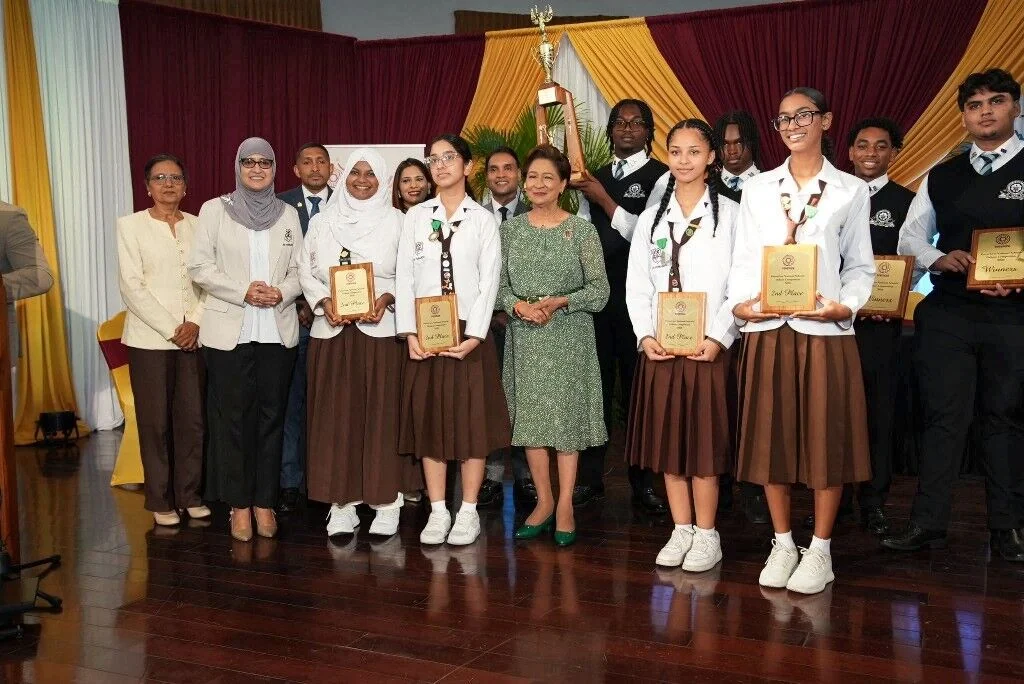
At the 2026 PowerGen National Schools’ Debate Competition finals and awards ceremony held yesterday, Trinidad and Tobago Prime Minister Kamla Persad-Bissessar delivered a pointed address centered on the ethical boundaries of artificial intelligence in educational settings, issuing a clear call for student learners to prioritize independent reasoning rather than ceding their cognitive work entirely to generative AI tools. The high-profile student competition centered its core debate on the provocative motion: “The use of Artificial Intelligence to create responses for a debate competition is unethical”, a framing that set the stage for Persad-Bissessar’s targeted challenge to all participating youth to rigorously interrogate the acceptable parameters of AI integration in their academic journeys. The prime minister acknowledged that AI has already reshaped core sectors from formal education to global commerce and daily interpersonal communication, emphasizing that the technology can serve as a valuable supplementary tool for brainstorming new concepts, identifying logical gaps in a pre-existing line of reasoning, and accelerating preliminary research. Crucially, however, she stressed that the onus of critical judgment remains fully on the student: they must independently verify all supporting evidence, curate arguments that align with their own authentic perspectives, and articulate all claims in their unique voice rather than relying on AI-generated text as a finished product. To illustrate the tangible risks of unthinking AI dependence, Persad-Bissessar posed a series of probing hypothetical scenarios for the student audience: if a competitor cites a polished, AI-generated argument complete with seemingly credible statistics and attributed sources, what would they respond if an opposing debater asked whether they had actually reviewed the cited source material themselves? She pushed attendees to grapple with fundamental unresolved questions: where does permissible research assistance end and genuine intellectual authorship begin, and what ethical obligations do speakers owe to their audience when presenting an argument as their original work? Persad-Bissessar further noted that the skill of independently evaluating information and exercising autonomous, well-reasoned decision-making is not a narrow requirement for passing school exams, but a foundational life competency that delivers lifelong value long after students graduate from formal education. These critical thinking habits, she explained, empower young people to identify unaddressed gaps in their school communities, advocate for necessary local changes, and step forward as leaders when other people remain silent. Reaffirming her administration’s policy commitments, the prime minister stated that her government is dedicated to expanding structured opportunities for young citizens to contribute directly to policy decisions that impact their daily lives, adding that when state institutions extend an invitation for youth to share their perspectives, officials bear a formal responsibility to listen to and act on that feedback. She closed her remarks by encouraging all competition finalists to carry the public speaking, research, and critical thinking confidence they built during the tournament back to their respective school campuses and local communities, noting that the nation actively relies on their fresh, original ideas to drive grassroots progress. After a series of tightly contested rounds, the two finalist teams — ASJA Girls’ College of San Fernando and Queen’s Royal College (QRC) — delivered standout performances, with Queen’s Royal College ultimately taking home the 2026 championship title.