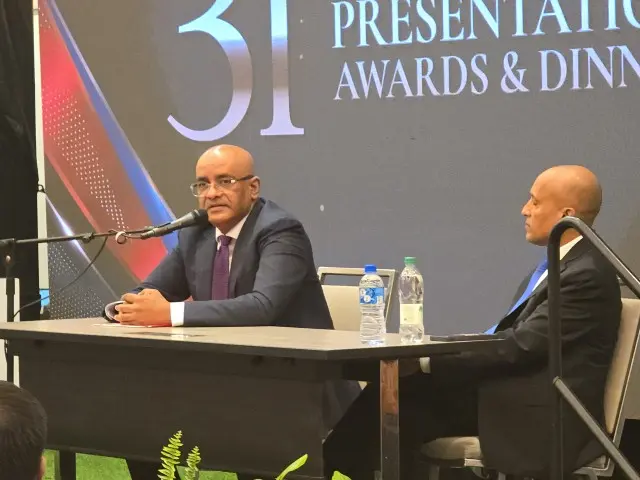
Delivering remarks at the 2026 Guyana Manufacturing and Services Association (GMSA) annual awards gala hosted at Georgetown’s Marriott Hotel on the evening of November 26, Vice President Bharrat Jagdeo publicly dispelled widespread public misconceptions that the United States had been pressuring Guyana to enter unstructured bilateral negotiations with Venezuela over the long-running Essequibo land boundary dispute. Jagdeo, a former head of state of Guyana, made the clarification directly as U.S. Ambassador to Guyana Nicole Theriot sat on the event stage, who nodded in unambiguous agreement as the vice president corrected the public narrative. Jagdeo went on to affirm that the U.S. government’s official framing of two legitimate pathways to resolve the decades-old territorial dispute – either via a binding ruling from the International Court of Justice, or mutually agreed formal bilateral talks – was entirely accurate. He also specifically thanked Ambassador Theriot for her recent public restatement of Washington’s full, unwavering support for the 1899 Arbitral Tribunal Award, the historic international legal ruling that formally demarcated the border between Guyana and Venezuela, and which Caracas has repeatedly rejected in recent decades. Jagdeo noted that Guyana’s legal team has built a robust case before the ICJ, and the nation anticipates a favorable ruling from the global judicial body when the verdict is released in January 2027. The vice president’s comments came on the heels of public statements last week from People’s National Congress Reform (PNCR) leader Aubrey Norton, who laid out his party’s unified commitment to upholding Guyana’s territorial sovereignty and the validity of the 1899 award. Norton acknowledged that in the highly unlikely scenario that the ICJ rules the 1899 award invalid, structured bilateral talks between Guyana and Venezuela would become a necessary next step, but emphasized that he remained fully confident the court would side with Guyana. The opposition leader further called on the current administration to convene formal, cross-party consultations to lock in a unified, long-term national strategy for defending Guyana’s territorial integrity, to ensure no shifts in domestic political leadership could weaken the country’s negotiating or legal position on the border issue for decades to come.