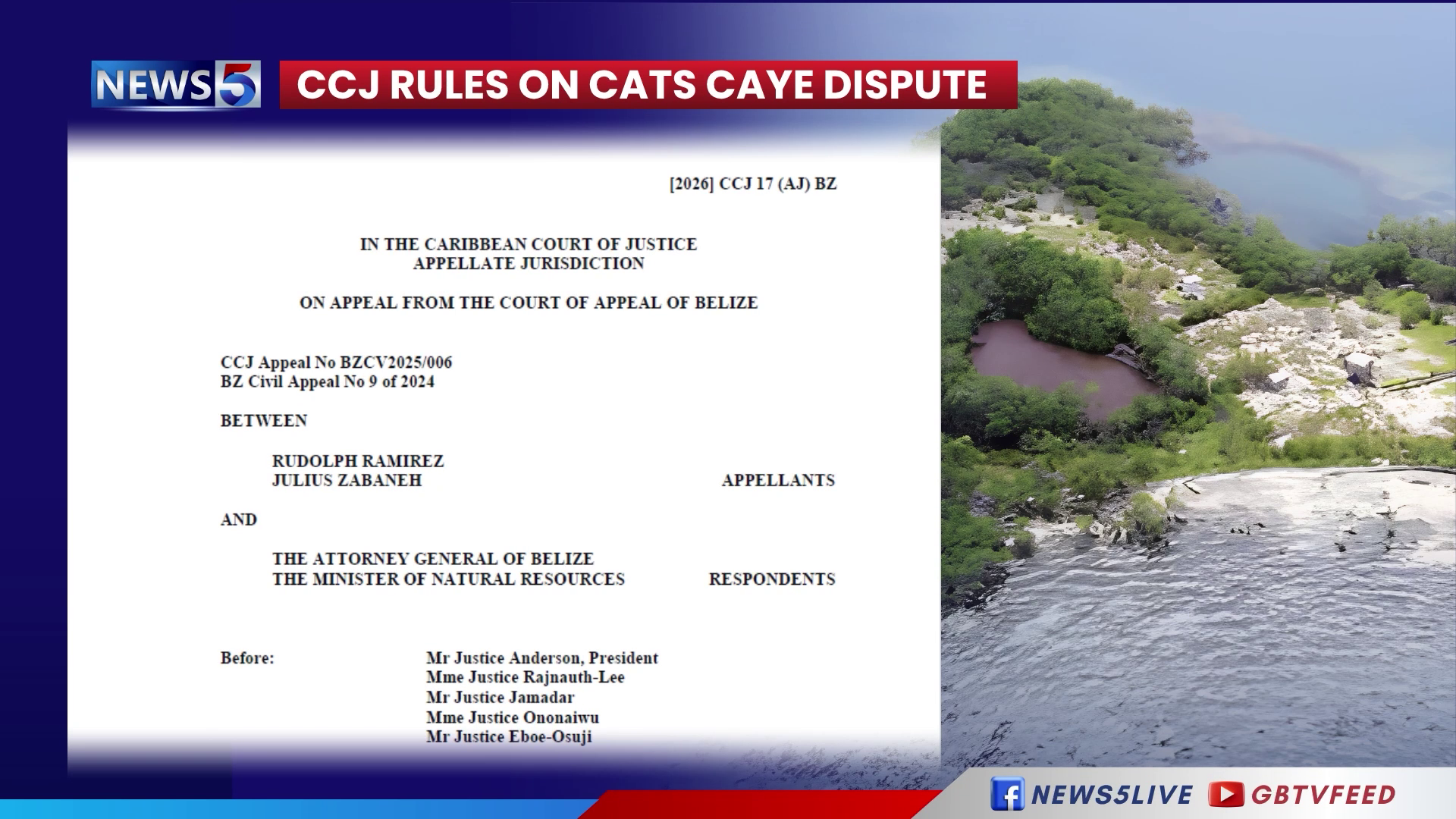
On November 26, 2026, the Caribbean Court of Justice (CCJ) delivered a landmark, precedent-setting judgment that effectively closes the door on long-running, multimillion-dollar legal claims stemming from unlawfully issued duplicate government land grants across Belize.
The core of the court’s ruling establishes an unambiguous legal standard: once a parcel of state-owned land has been formally granted to a title holder, it ceases to be classified as public national land, and no government authority holds the legal power to issue a second, competing grant for that exact same property. The justices formally declared a 2019 Minister’s Fiat Grant issued to appellants Rudolph Ramirez and his co-litigant Zabaneh for a 14-acre parcel located at Cats Caye completely null and void, with no legal standing whatsoever. This decision explicitly overturns the long-criticized Andre Vega legal precedent, a ruling that had previously exposed the Government of Belize to tens of millions of dollars in costly, unjustified compensation claims from bad actors exploiting the duplicate title loophole.
Representing the government in the proceedings was Senior Counsel Eamon Courtenay, who emphasized the transformative impact of the verdict for Belize’s long-troubled land administration framework. The court dismissed the appellants’ appeal in its entirety, ordering Ramirez and Zabaneh to surrender the $2,878.20 sum they had paid for the invalid grant, confirming their purported title was never legally valid, and mandating the pair to cover all legal costs the government incurred during the multi-year litigation.
Courtenay noted that for years, corrupt bad actors had exploited gaps in the previous legal framework: after identifying parcels that had already been formally titled, these parties would collude with complicit former government ministers to secure second duplicate grants, then file lawsuits demanding full market-value compensation for their “invalid” titles, forcing the state to pay out millions in public funds to settle these abusive claims. The CCJ’s ruling explicitly classifies this practice as an abuse of governmental authority, eliminating this predatory revenue stream entirely.
While affirming the government’s victory, the CCJ also issued a pointed, critical warning regarding the severely disorganized state of land recordkeeping at Belize’s Ministry of Natural Resources. The justices stressed that reliable, fully accurate public land registers are a non-negotiable foundation for a functional property system, as individuals and businesses routinely make high-value real estate investments, secure bank loans using land as collateral, and conduct property transactions based entirely on the credibility of official government records. Courtenay echoed this warning, noting that accidental administrative errors in land records could create unfair outcomes for innocent, unknowing property buyers, and called for a complete overhaul of recordkeeping protocols to eliminate all political interference from the Lands Department’s operations, ensuring public officials maintain full, unaltered, accurate land documentation for every parcel in the country.
CCJ Slams Door on Duplicate Land Grant Claims: “You Cannot Have Two Titles to the Same Piece of Land”