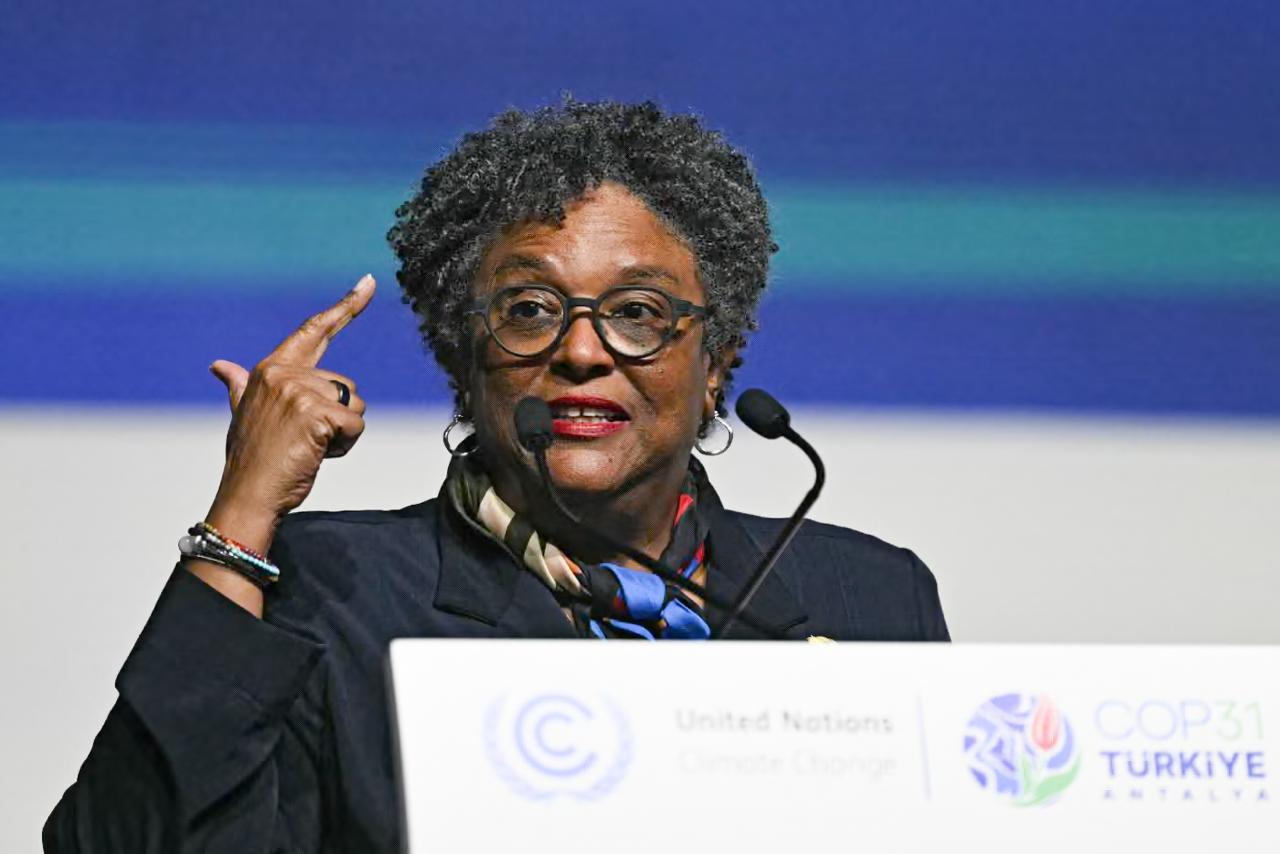
Barbados’ Prime Minister Mia Mottley has escalated a global grassroots campaign to rally public support for sweeping, immediate climate action, launching a widespread call for residents across every nation to add their names to the “1.5 billion voices for 1.5 degrees” petition, as newly verified temperature data confirms the planet is veering perilously close to breaching critical warming thresholds. The petition, first unveiled by Mottley during the recently concluded COP31 UN Climate Change Conference hosted in Antalya, Türkiye, is designed to build overwhelming public pressure on global policymakers, corporate leaders and multilateral bodies to implement far more aggressive emissions cuts, with a specific focus on slashing methane pollution, to preserve the Paris Agreement’s core target of capping global average temperature rise at 1.5°C above pre-industrial levels. Mottley’s renewed push comes in response to damning new scientific data, first documented in a UK Guardian investigation, which confirmed that for the first time in recorded human history, the planet logged six straight days where average temperatures sat more than 2°C above pre-industrial baselines. For Small Island Developing States (SIDS) like Barbados, which have spent decades leading the global “1.5 to stay alive” advocacy movement to highlight that even incremental warming threatens their very territorial and cultural survival, this milestone is not an abstract data point: it is a tangible, life-threatening warning sign. “What does this unprecedented temperature trend mean for billions of people around the world, especially the communities that have done the least to cause the climate crisis but bear its harshest blows?” Mottley posed in her latest public address. She laid out the cascading, already visible toll of uncurbed warming: spiraling death tolls from extreme weather, mass job losses across agriculture and coastal industries, cross-border displacement, rising social unrest, shrinking national economies, catastrophic flood events, raging wildfires, multi-year droughts, widespread food insecurity, total crop failures, mass livestock die-offs, accelerating biodiversity collapse and a new generation of once-unthinkable extreme weather events that are now becoming annual occurrences. “We do not need to speculate on these impacts, because 2026 has forced us to watch this dystopian climate narrative unfold in every single region of the planet, from the Arctic to small Pacific atolls to major European and North American cities,” Mottley noted, labeling 2026 a historically unprecedented year for all the worst possible reasons. The Barbadian prime minister also voiced sharp public disappointment with the final outcomes of COP31, noting that the two-week summit closed without a binding, overarching collective agreement on accelerated climate action, sending a deeply worrying signal that multilateral cooperation is crumbling at the exact moment the planet needs coordinated, large-scale intervention more than ever. Mottley took specific aim at wealthy developed nations, pointing out that many have allocated massive new pools of public funding to address security risks stemming from unnecessary, ongoing armed conflicts, while chronically underfunding climate adaptation and mitigation efforts even as the data confirms the climate crisis is the single largest root cause of long-term social, economic and conflict-related instability across the globe. She went on to condemn repeated, unfulfilled climate pledges from high-emitting nations, noting that a growing number of governments have rolled back, weakened or outright abandoned their formal Paris Agreement obligations, with some even moving to withdraw from the 2015 landmark global climate pact entirely. “We have also seen deliberate moves to loosen regulatory controls on methane emissions, a short-lived but super-potent greenhouse gas that drives more than 30% of current near-term warming,” Mottley emphasized. “This pattern of inaction and regression reveals a staggering level of indifference to the fate of our planet and every living species that calls it home, a catastrophic failure of global leadership that is placing the future of every child born today in existential danger.” For Mottley, the climate crisis has remained the central priority of her domestic policy agenda in Barbados and her international diplomatic advocacy precisely because it is no longer a distant future risk: it is an immediate, life-or-death threat to human communities, national economies, and entire planetary ecosystems. “Humanity and the natural world exist in a fully symbiotic relationship, and Mother Earth is crying out for the global human family to end this cycle of destruction before we become the authors of our own collapse,” she stated. Even amid the deepening gloom of broken pledges, stalled multilateral talks and record-shattering temperature data, Mottley stressed that a narrow but actionable window for meaningful, course-correcting action still remains – and the 1.5 billion signature petition is designed to unlock that potential. “I launched this petition at COP31 in the explicit hope that ordinary people across every corner of the globe would use this collective platform to demand that their elected officials, corporate leaders and international governing bodies implement the urgent policies and targeted financial commitments required to pull the planet back from the climate cliff,” she explained. Mottley issued a targeted call to action for two distinct groups: residents of wealthy developed nations who are now experiencing first-hand the impacts of climate-fueled disasters that were once considered rare in their regions, to stand in solidarity with climate-vulnerable communities in the Global South, and frontline communities that face daily climate risks to keep amplifying their demands for change. “Every single person who adds their signature sends an unambiguous message to heads of government, corporate executives, leaders of international bodies, and civil society groups that no more delays are acceptable, and every leader must act right now,” Mottley urged. “When we hit 1.5 billion signatures, we will generate an unstoppable wave of public momentum and public pressure that no institution can afford to ignore. Every single one of us has a voice, and we can turn that individual voice into collective power through the “1.5 billion voices for 1.5 degrees” appeal. Make no mistake: our lives, and the lives of future generations, literally depend on it. Members of the public can access and sign the petition via the official Voices for 1.5 Degrees online platform.