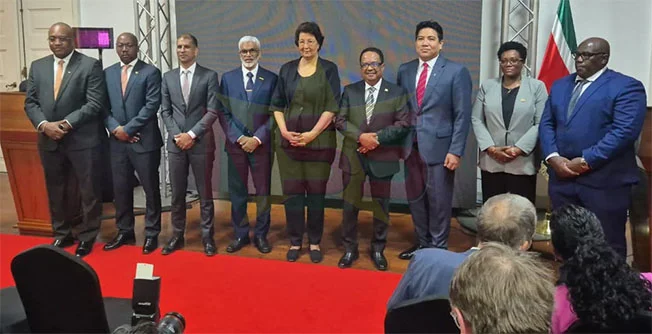
On November 26, officials from Malaysia’s state-owned energy conglomerate PETRONAS and Suriname’s national oil company Staatsolie gathered at the Presidential Palace in Paramaribo for a formal signing ceremony marking the final investment decision (FID) for the landmark KrakaWi offshore gas project, with a commemorative group photo taken post-signing courtesy of photographer René Gompers. Far from being a standalone initiative, the KrakaWi project is only the first step of a far larger, multi-phase energy expansion plan across Suriname’s offshore basins, as revealed by PETRONAS President and Group CEO Tengku Muhammad Taufik during the event.
Taufik outlined that the consortium is already advancing planning for a second gas development projected to be at least twice the scale of KrakaWi, alongside pre-development work for a separate offshore oil project. Adding further momentum to the country’s energy sector growth, new exploration drilling operations kicked off earlier this month in Block 66, targeting the Senna and Picolet prospects. PETRONAS currently holds operating stakes in eight offshore blocks across Suriname, building on 13 years of steadily deepened collaboration with Staatsolie. The ongoing drilling campaign in Block 66 extends the successful exploration track record previously established in adjacent Block 52, part of the geologically prolific “Golden Lane” corridor that Taufik noted holds massive untapped oil and gas reserves that will position Suriname as a major regional energy hub.
Staatsolie Managing Director Annand Jagesar emphasized that the KrakaWi project lays a foundational infrastructure framework that will drive down costs for all future energy developments in the country. For the first time, Suriname is moving beyond theoretical potential to launch formal commercial offshore gas production, with the pipelines, processing facilities, local technical expertise and supply chain networks built for KrakaWi set to make subsequent projects far more economically viable.
Jagesar also pulled back the curtain on the years-long, high-stakes negotiation process that preceded the FID. The KrakaWi development was initially deemed commercially unfeasible, requiring cross-functional teams of geoscientists, commercial negotiators, legal advisors and financial analysts from both firms to design innovative solutions to unlock project viability. Talks were marked by occasional friction as Staatsolie worked to safeguard Suriname’s national public interests while PETRONAS balanced its own corporate mandates and Malaysian stakeholder priorities, with the final outstanding sticking point only resolved 48 hours ahead of the official public announcement.
Looking to the long term, Jagesar framed PETRONAS as a critical strategic benchmark for Staatsolie’s own growth trajectory, with the Surinamese state firm targeting substantial expansion over the next 10 to 20 years powered by the offshore energy boom. The partnership with PETRONAS brings not only billions in capital investment, but also decades of specialized global expertise in gas processing and liquefied natural gas (LNG) technology that would otherwise take Suriname generations to build independently. Jagesar also floated plans to extend bilateral cooperation between Suriname and Malaysia beyond the energy sector to mutually beneficial areas including sustainable agriculture and ecotourism.
Local workforce development has been written into the core terms of the partnership, with 16 Surinamese nationals already employed directly by PETRONAS, and 12+ Surinamese university students participating in targeted training programs in Malaysia through a formal exchange partnership with the Anton de Kom University of Suriname. Suriname President Jennifer Simons stressed during the ceremony that knowledge transfer, vocational training and local capacity building are non-negotiable pillars of the national agreement, ensuring that Surinamese workers and domestic small businesses are not sidelined as the energy industry scales. Government authorities are now prioritizing aligned vocational curricula and local enterprise certification programs to ensure domestic stakeholders can fully participate in the global energy value chain, as the pipeline of upcoming oil and gas projects makes this local preparation work increasingly time-sensitive. Officials clarified that the FID announced at the November 26 ceremony applies exclusively to the KrakaWi project, with subsequent developments moving through their own independent regulatory and approval processes.
Na KrakaWi: PETRONAS heeft groter gasproject en olieontwikkeling in het vizier