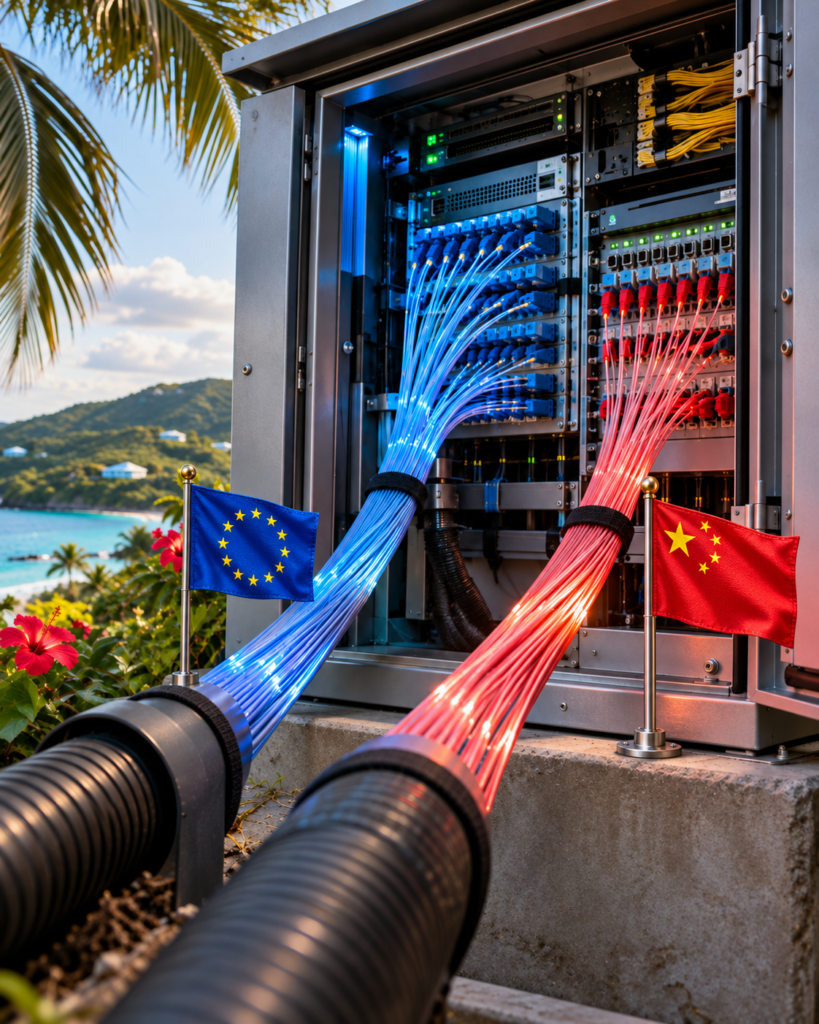
During a recent appearance on Pointe FM’s widely listened-to “Taking Stock” public affairs program on Tuesday, Antigua and Barbuda’s Minister of Information Technology Melford Nicholas publicly revealed a previously undisclosed detail of the country’s national fibre-to-the-home (FTTH) rollout: the government intentionally passed up a lower-cost bid from a Chinese telecommunications provider to select a European vendor’s proposal, a decision explicitly motivated by a desire to prevent diplomatic friction with the United States.
Nicholas made the revelation while unpacking the ongoing high-stakes tech and trade rivalry between Washington and Beijing, a dynamic that has pressured small Caribbean nations to navigate competing interests between the two global powers. He confirmed that the government evaluated two formal competing bids during the procurement phase for the residential fibre network: one submitted by an unnamed European firm, and a separate submission from a Chinese entity that carried a notably lower price tag. No identifying details for either bidding company, nor the final contracted cost for the project, were shared during the broadcast.
The minister framed the U.S. campaign to dissuade allied and partner nations from adopting hardware manufactured by major Chinese telecom giants including Huawei and ZTE as fundamentally rooted in commercial and technological competition, rather than the frequently cited public U.S. concerns over potential Chinese state surveillance. Nicholas noted that while surveillance-related claims have been deployed as a rhetorical tool to steer countries away from Chinese tech procurement, the underlying rift between the two superpowers is at its core a sprawling trade dispute. He went on to acknowledge China’s unprecedented industrial and technological progress in recent decades, highlighting that the country has built a comprehensive, highly optimized domestic manufacturing ecosystem that creates significant competitive challenges for Western industry peers.
State-owned utility APUA ultimately completed the full island-wide FTTH deployment in 2022, with prior public estimates putting the total project investment at approximately $21 million. No public disclosures prior to Nicholas’ radio comments had named the unsuccessful Chinese bidder or published a side-by-side cost comparison of the two competing proposals. The minister’s explicit confirmation that cost competitiveness was set aside to preserve positive diplomatic ties with Washington offers a rare unvarnished look at the difficult balancing acts facing small developing nations caught in the crossfire of great power tech competition.