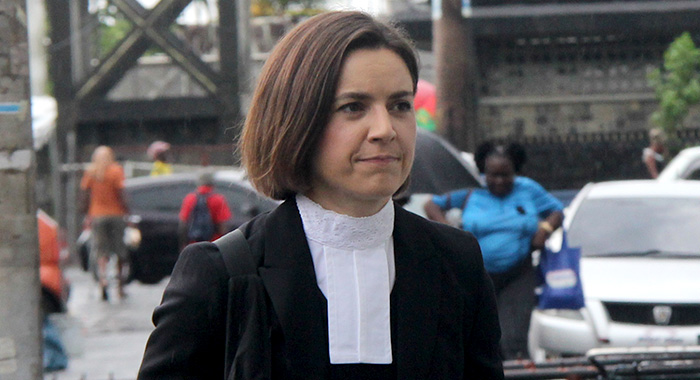
The high-stakes legal battle stemming from St. Vincent and the Grenadines’ November 2025 general election entered a critical phase recently, as defence counsel Kate Temple-Mabe, representing two senior New Democratic Party (NDP) officials, mounted a rigorous challenge to the legitimacy of two post-election petitions filed by defeated opposition candidates. The 2025 poll delivered a landslide victory for the ruling NDP, which secured 14 out of 15 available House of Assembly seats, ousting candidates from the opposition Unity Labour Party (ULP) across nearly all constituencies. The two defeated ULP hopefuls, Augustus Carlos Williams (who contested the Northern Grenadines seat) and Luke Browne (running in East Kingstown), filed separate election petitions seeking to void the results in their respective constituencies, targeting sitting Prime Minister Godwin Friday (winner of the Northern Grenadines seat) and Foreign Affairs Minister Dwight Fitzgerald Bramble (East Kingstown victor). The petitioners base their challenge on Section 26(1)(a) of the national Constitution, arguing that both incumbents hold Canadian citizenship and are thus automatically disqualified from holding legislative office. In her sweeping submissions to the court, Temple-Mabe first cast serious doubt on the petitioners’ claim that their legal action was rooted in public interest. She highlighted the stark discrepancy in electoral performance between Williams and Friday, noting that Williams garnered a mere 339 votes compared to Friday’s decisive 2,185-vote haul at the polls. Pointing out that the petitioners are not merely requesting a by-election to fill the vacant seats, but are demanding the court directly declare them the duly elected representatives, Temple-Mabe questioned the sincerity of their public interest framing. “If this really was about public interest … Why ask for those remedies?” she posed to the court, asserting that the petitions’ true unstated goal was to install the defeated candidates into office without a fresh popular mandate. The defence counsel further argued that the extraordinary remedy of directly installing the petitioners as winners is both legally unavailable under existing constitutional frameworks and fundamentally unconstitutional, warning that such a ruling would severely undermine core democratic principles by overriding the will of the electorate. Temple-Mabe walked the court through the precise wording of Section 25(1)(a) of St. Vincent and the Grenadines’ Constitution, which explicitly permits non-Vincentian Commonwealth citizens to stand for legislative election and serve in the House of Assembly. She noted this provision aligns the country’s electoral rules with Jamaica’s framework, but differs from stricter regimes such as that of St. Kitts and Nevis, which restricts candidacy exclusively to full local citizens. She urged Justice Gertel Thom to disregard unrelated legal precedents from other jurisdictions, emphasizing that the dual citizenship case involving former St. Kitts and Nevis Prime Minister Denzil Douglas, and the centuries-old British treason ruling against William Joyce, rest on distinct factual contexts and divergent constitutional provisions that have no bearing on the current Vincentian proceedings. Temple-Mabe also pushed back against the petitioners’ claim that ballots cast for Friday and Bramble constituted “wasted votes”, noting there is no verifiable evidence that a meaningful share of the electorate ever saw, read, or understood pre-election notices the petitioners circulated claiming the two NDP candidates were ineligible. In their subsequent reply submissions, lead counsel for the petitioners, Senior Counsel Stuart Young, countered that the right to stand for election under Section 25 of the Constitution is a qualified, not absolute, entitlement. Young argued that even if a candidate appears to meet the baseline eligibility criteria on paper, they are immediately disqualified once a separate constitutional disqualification provision comes into effect, noting that both Friday and Bramble voluntarily swore an oath of allegiance to Canada during their naturalisation process. He presented a side-by-side textual comparison of the Canadian citizenship oath and St. Vincent and the Grenadines’ official Oath of Allegiance, arguing the two documents are nearly identical in wording. Rejecting the defence’s deep dive into Commonwealth legal history, Young urged the court to adopt a strict literal interpretation of the Constitution, framing the voluntary acquisition of foreign citizenship as a self-imposed disqualification that no external party can force on a candidate. “The only person disqualifying you is yourself,” he emphasized, adding that candidates can easily avoid this conflict by formally renouncing any foreign citizenship before their nomination as election candidates. Senior Counsel Anand Ramlogan later provided supplementary clarifying submissions on behalf of the petitioners before the close of proceedings. At the conclusion of the multi-day hearing, Justice Gertel Thom commended all legal teams for their thorough, well-researched presentations, noting that members of the public following the proceedings benefited greatly from the detailed legal arguments. She formally reserved her judgement, announcing that the final ruling on the high-profile dual citizenship election petitions will be delivered when the court reconvenes for its next scheduled term.
Petitioners’ request to be placed in office unavailable, unconstitutional, defence lawyer tells court