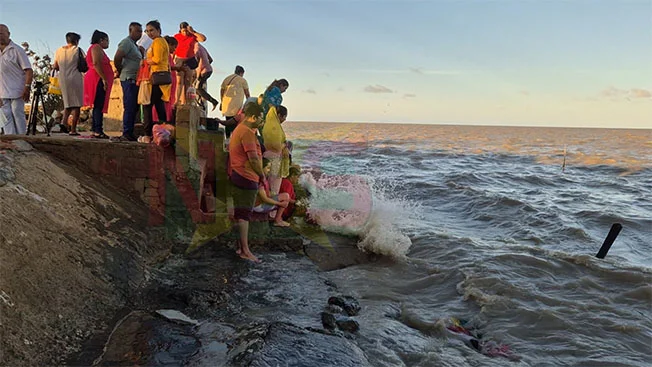
On a breezy Tuesday, thousands of Hindu faithful traveled to the Tieraatstan Rameshwaran pilgrimage site at Weg naar Zee, a coastal settlement on Suriname’s Atlantic shore, to take part in the sacred Ganga Nahan ritual, a local iteration of the mass spiritual bathing ceremony that draws millions of participants to India’s Ganges River each year.
Led by Doemandnath “Moenna” Bajnath, chair of the foundation that stewards the site, the community has fought for decades to preserve the sacred grounds, which have been steadily encroached upon by aggressive Atlantic surf that has claimed vast swathes of surrounding coastal land over the years. “This is a blessed site,” Bajnath noted. “For 40 years, people have come here to make offerings, cleanse their inner selves, and pray for everything from physical healing to collective well-being. The fact that this spot still stands, when almost all the land around it has been washed away, is nothing short of remarkable.”
In local spiritual tradition, the Atlantic Ocean at Weg naar Zee is revered as Saritpati, the mythic confluence where all the world’s rivers – including the Ganges – are believed to flow together, making it a fully sacred substitute for the Indian river for Suriname’s large Indo-Surinamese community. The site now features a purpose-built concrete stairway descending from a protective seawall directly into the surf, where crowds of whole families wade into the churning waves to complete their ritual bathing, while others wait patiently on the elevated dyke, buffeted by crisp, stiff coastal winds. A small number of devotees are knocked off balance by the powerful, unpredictable swells as they perform their rites.
Bajnath explained that the community has poured years of unpaid labor and donated funds into constructing the sturdy dyke that now protects the pilgrimage grounds, a nearby stretch of public road, and adjacent private residential plots from being swallowed by the ocean. “The waves had almost erased this entire site,” he said. “We now stand nearly a kilometer further out into the sea than the original shoreline from decades ago. This structure only exists because of community donations, thousands of hours of volunteer work from our foundation members, and divine blessing.”
Despite their progress, Bajnath emphasized that the community cannot afford to become complacent. Maintenance work on the dyke continues nonstop, and repeated appeals to successive Surinamese national governments for long-term, large-scale coastal protection support have yet to yield a permanent, robust solution. During extreme high spring tides, ocean water still regularly spills over the top of the dyke, flooding parts of the sacred grounds.
After completing their ritual baths, attendees can use on-site changing facilities before gathering for a collective free vegetarian feast, entirely funded by community contributions. Volunteers work tirelessly behind the scenes to bake fresh roti, cook large vats of spiced rice, prepare tangy homemade chutney, and peel mountains of potatoes to feed the thousands of attendees. Bajnath noted that donation volumes have fallen in recent years, and issued a public appeal for continued community support to expand the site’s facilities, noting that international tourists have already begun to visit the unique spiritual landmark. “We want people all across the world to learn about this place, to come here not just to pray for their own well-being, but for the future of Suriname as a whole,” he said. “So much of this coast has been taken by the sea, but this special, sacred spot has endured. It is far more than just a stretch of beach.”
Ganga nahan: Bidden voor zichzelf én voor Suriname