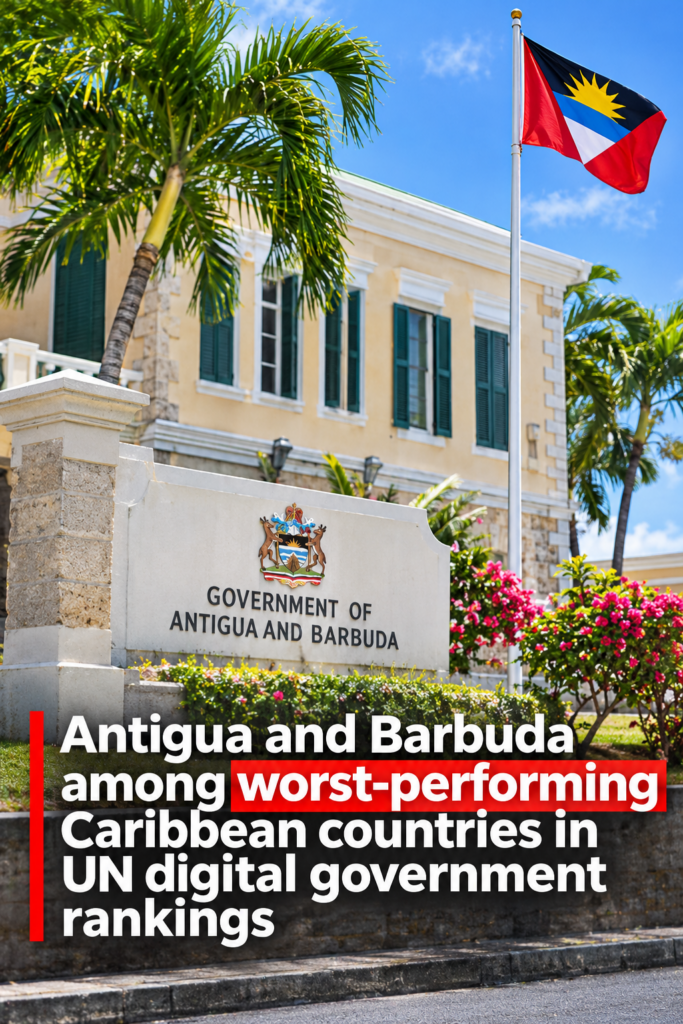
Released on November 19 by the United Nations Department of Economic and Social Affairs, the widely cited 2026 UN E-Government Survey has unveiled that Antigua and Barbuda claims the 129th spot in global digital government development rankings, trailing nine other sovereign nations across the Caribbean region. The country posted an overall E-Government Development Index (EGDI) score of 0.5837, landing it formally within the UN’s designated high EGDI tier, yet exposing notable structural lags in its digital public service rollout relative to neighboring states.
The EGDI framework, a globally standardized benchmark for cross-national digital governance performance, calculates final scores on a 0 to 1 scale by aggregating three weighted core metrics: the Online Service Index measuring the scope, accessibility and transactional functionality of government digital platforms, the Telecommunications Infrastructure Index tracking national broadband and connectivity coverage, and the Human Capital Index evaluating population digital literacy and relevant technical skill levels.
Regional rankings show Trinidad and Tobago leading the Caribbean cohort at 70th globally with a score of 0.7784, followed by the Dominican Republic at 79th, and St. Kitts and Nevis at 81st – the top performer among all Organisation of Eastern Caribbean States members. Jamaica ranks 98th, the Bahamas 100th, Saint Lucia 106th, Grenada 113th, Barbados 114th, and St. Vincent and the Grenadines 116th, all positioning well ahead of Antigua and Barbuda’s 129th place.
A granular breakdown of Antigua and Barbuda’s component scores reveals a stark unevenness in its digital transformation trajectory: the country earns a 0.6384 score for telecommunications infrastructure and a 0.7189 score for human capital, indicating its foundational connectivity and population skill bases are relatively robust. However, its Online Service Index lags dramatically at just 0.3938, marking digital government service delivery as its most critical bottleneck. This gap is further underscored by the subnational local government assessment, which placed the capital city of St. John’s 131st out of 194 evaluated global urban centers, with a Local Online Service Index score of 0.3564, exposing parallel shortcomings at the municipal service level.
The survey findings do not indicate a total absence of digital government offerings in Antigua and Barbuda, but rather highlight that its rollout of transactional public services – including permit applications, tax payments, business licensing, civil registry submissions and public information access portals – has failed to keep pace with regional peers. For local policymakers, the results serve as an actionable baseline to prioritize targeted upgrades to online public service ecosystems, to reduce bureaucratic friction, improve accessibility for residents and small businesses, and narrow the digital governance divide across the Caribbean.