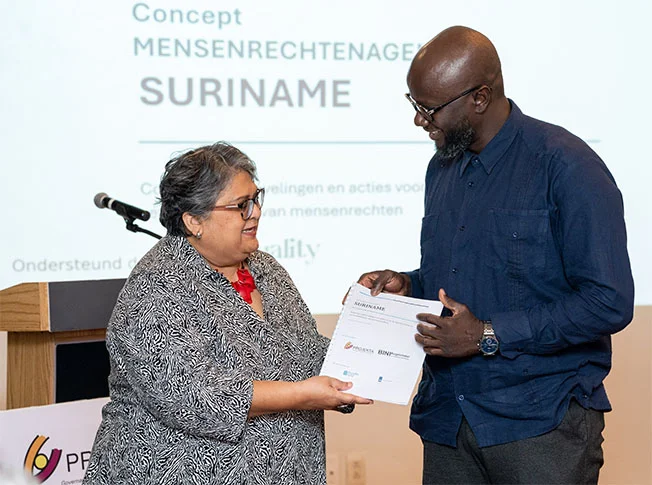
On November 20, representatives from Suriname’s civil society network formally unveiled a landmark draft National Human Rights Agenda, a collaborative policy document developed to embed core democratic principles, rule of law safeguards, and human rights protections into every stage of the country’s development, rather than delaying those priorities until projected oil and gas revenues begin flowing into state coffers. The initiative is jointly led by local non-profit Stichting Projekta and the Citizen Initiative for Participation and Good Governance (BINI), with input from nearly 30 civil society groups, independent subject-matter experts, and grassroots community activists across the nation. Sharda Ganga, director of Projekta, presented the first printed copy of the agenda to National Assembly member Ebu Jones during the official launch event, warning that sidelining human rights protections in favor of prioritizing rapid economic expansion from upcoming fossil fuel projects risks entrenching existing systemic inequality, social exclusion, and dangerous concentrations of state power that could become irreversible long before energy sector profits are realized. The 12-pillar framework of the draft agenda is rooted in existing international and regional human rights obligations that Suriname has already committed to uphold, covering a full spectrum of priority areas: democratic governance and fundamental civil liberties, rule of law and equitable access to justice, anti-discrimination and equal treatment, women’s rights, child welfare, Indigenous and tribal community land and self-determination rights, accessibility for persons with disabilities, public health, inclusive education, climate and environmental stewardship, labor rights, poverty alleviation, anti-human trafficking measures, and fair migration and statelessness policies. Stakeholders developed the specific policy recommendations through a nationwide public survey and targeted collaborative workshops, where participating organizations ranked community-identified needs to ensure the agenda reflects on-the-ground realities rather than top-down bureaucratic priorities. During the launch ceremony, Deputy Ambassador of the Netherlands to Suriname Michiel Bierkens noted that the structured agenda would serve as a shared roadmap to clarify collective priorities and strengthen collaborative partnerships between civil society, the executive branch of government, and the national parliament. Representatives from marginalized community groups also shared specific unmet needs during the event: Aniel Koendjbiharie of disability advocacy group Wan Okasi called for full accessibility to legal protections, public services, and state decision-making processes for people living with disabilities; Carla Bakboord of the Women’s Rights Centre emphasized the urgent need for expanded gender-based violence prevention services, safe shelter facilities for survivors, and sustained public funding for women’s protection programs; Loreen Jubitana of the Association of Indigenous Village Heads of Suriname pushed for formal legal recognition of Indigenous collective land rights, protection of traditional ancestral territories from extractive industry encroachment, and mandatory, meaningful community consultation for all state projects that impact Indigenous livelihoods; Rachel Wittenberg of LGBTQ+ advocacy group PAREA advocated for full anti-discrimination legal safeguards and formal legal recognition of transgender people’s gender identities and same-sex partnerships; and Seran Naarden of legal advisory firm Dynamic Legal Advice highlighted gaps in timely child protection services, calling for better inter-agency coordination and formal mechanisms to include children’s voices in all policy decisions that affect their lives. Projekta’s leadership also criticized the current standard of governance in Suriname, noting that civil society groups are almost always consulted too late in the policy drafting process, after high-stakes decisions have already been finalized, leaving community input with little tangible impact. The draft agenda is designed to function as a practical, actionable accountability tool that sets clear timelines for priority measures, assigns explicit implementation responsibilities to relevant government bodies, and establishes standardized metrics to track progress over time. The coalition of participating civil society organizations has stated it will hold ongoing structured discussions with policymakers to refine the final agenda, collaborate on implementation rollout, and conduct regular public oversight to ensure the government delivers on its human rights commitments. The full public text of the draft Concept Human Rights Agenda for Suriname is available for public review via the official Projekta online portal.