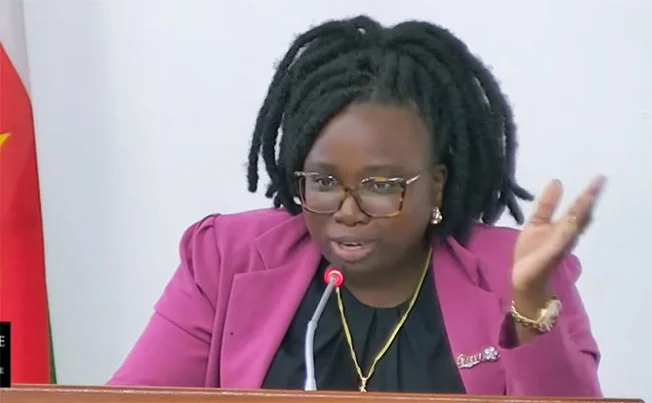
On November 20, Surinamese National Assembly representative Dinotha Vorswijk of the ABOP party laid out a series of urgent, detailed objections during parliamentary deliberations over draft legislation that would formalize a bilateral airspace agreement signed between Suriname and the United States on October 15, 2024. The deal is framed as a collaborative tool to support interceptions of civilian aircraft suspected of participating in transnational illicit drug trafficking, but Vorswijk warned that its vague and far-reaching terms pose tangible risks to Suriname’s national sovereignty, domestic aviation safety, and public fiscal liability.
Vorswijk opened her intervention by noting that Suriname already has a long track record of U.S.-backed security cooperation, including participation in the Caribbean Basin Security Initiative and joint maritime patrol operations. However, she argued this new air-focused agreement cuts far deeper into sovereign national authority, as it establishes binding procedures for operating within Suriname’s controlled national airspace. She first pressed the national government to disclose verifiable outcomes of all prior U.S. security partnerships, including documented numbers of intercepted drug shipments, and long-overdue public evaluation reports covering joint defense, law enforcement, and intelligence sharing activities.
One of Vorswijk’s most pressing critiques centered on clauses governing intelligence sharing and operational autonomy. Under the current draft, she noted, Surinamese intelligence agencies would be required to obtain explicit pre-approval from the U.S. Embassy in Paramaribo before sharing any relevant third-party information, a stipulation she said would severely erode the independent decision-making capacity of Suriname’s domestic security apparatus. She also flagged that the agreement grants the United States unilateral authority to suspend or terminate all support at its own discretion if it determines Suriname has violated pact terms, with no publicly defined, transparent criteria for triggering such a suspension — a loophole she warned could easily be weaponized as a tool of coercive diplomatic pressure. She further questioned whether finalized operational implementation protocols for the interception program have been drafted at all, and which governing body will hold ultimate operational command over active interception missions: Surinamese domestic authorities, or embedded U.S. advisory personnel.
The parliamentarian also laid out concrete, life-threatening risks to Suriname’s thriving domestic civilian aviation sector, which serves remote rainforest communities where air travel is often the only reliable link to medical care, commercial services, and regional transport. Vorswijk explained that domestic pilots regularly operate in extremely challenging conditions, with sudden, unforecast tropical weather patterns, vast stretches of dense uninhabited rainforest, and patchy, limited radio communication infrastructure that often causes pilots to deviate from pre-filed flight plans or lose radio contact temporarily. She pointed directly to Article 2, Section 4 of the agreement, which explicitly lists deviations from flight plans, lost radio contact, and low-altitude flight as formal indicators of potential drug trafficking activity — criteria that would regularly flag legitimate flights carrying medical emergency patients, tourists, and local civilian passengers as high-priority interception targets. Vorswijk pressed the government to outline concrete safeguards to prevent wrongful interceptions of these non-suspect domestic flights, and to clarify rules governing responses when an aircraft refuses landing orders during an interception operation.
Vorswijk further criticized the complete absence of the Civil Aviation Safety Authority Suriname (CASAS) from the agreement’s accompanying explanatory memorandum, despite the fact that CASAS holds statutory responsibility for all core civilian aviation oversight functions, including pilot licensing, aircraft airworthiness certification, and national aviation safety data management. She demanded confirmation that CASAS leadership was ever consulted during the agreement’s drafting process, and questioned whether the understaffed, resource-strapped agency — which already struggles to maintain oversight over dozens of small, unimproved rural airstrips across Suriname’s interior — has the personnel, technical equipment, and operational capacity to execute its required roles under the new pact.
Finally, Vorswijk raised explosive, unaddressed questions around legal and financial liability in the event of a botched interception. She outlined a plausible worst-case scenario: a fully legitimate domestic civilian aircraft loses radio contact due to an unforeseen mechanical fault, is misidentified as a drug smuggling plane, intercepted, and forced to make an emergency landing or even crash, resulting in property damage, injuries, or fatalities. Under the current terms of the agreement, she noted, the United States only provides intelligence and radar data, while all active interception operations are carried out by Surinamese personnel. This structure, she warned, would almost certainly leave the Surinamese state fully liable for all resulting damages, while U.S. authorities face zero legal or financial accountability for wrongful actions caused by flawed U.S.-provided intelligence. Vorswijk closed her remarks by affirming that cross-border cooperation to fight transnational drug trafficking is a necessary priority, but insisted that Suriname must operate as an equal, sovereign partner in all such arrangements. She formally called on the government to provide full, public clarity on all outstanding questions related to aviation safety, sovereign authority, intelligence protocols, and liability rules before the National Assembly holds any final ratification vote on the agreement.
Vorswijk vreest risico’s voor Surinaamse piloten bij luchtvaartverdrag met VS